NDOW releases 2 bears into the wild

Nevada Department of Wildlife officials this weekend released two nuisance bears back into the wild.

Employees from Wind River Bear Institute of Florence, Mont., helped NDOW, including on of the agency’s Karelian bear dogs.

An 8-year-old female bear captured in Zephyr Cove on Saturday was released Sunday morning in the mountains above her capture site. The bear had never been captured before.

A bear captured on the west side of Carson City on Friday was released by NDOW on Saturday south of Gardnerville in the Carson Range. The male bear had been captured once before, in Washoe Valley, about three weeks ago.

— Lake Tahoe News staff report


·


No reason to pay full price for lift tickets

By Janet Fullwood, San Jose Mercury News

Skiers and snowboarders are perpetual optimists who like to believe the coming season will bring more powder than ever before. While that’s up to Mother Nature, one hard, cold fact is for sure: Peak-season rates at prominent resorts now top $100 a day at the ticket window.

Snow-sports enthusiasts can just say “ouch” — or go online to save.

Taking their cues from airlines and hotels, mountain resorts are selling discounted lift tickets online and through smartphone apps, and pricing them according to anticipated demand. Many are also enlisting third-party resellers whose sophisticated platforms allow them to release a limited number of tickets at a given rate or otherwise change prices on the fly.

“Because resorts can control dates and volume, they can put out deals up to 80 percent off the walk-up rate,” says Ron Schneidermann, co-founder and CEO of Liftopia, a San Francisco-based site that is to snow-sports enthusiasts what Expedia is to air travelers.

“The airline industry did a good job of conditioning people to book in advance,” he adds, “and that’s what the ski industry is doing now. The focus is on advance-purchase, online bookings, whether through the individual resort websites or us.”

Season passes bought early in the year (the best deals dry up after Labor Day) offer the best value for those who plan to spend a lot of time on the slopes. But for those who can’t justify the cost or just want to try someplace new, advance purchase of a date-specific lift pass can bring significant savings of 10 to 60 percent.

And it’s not just infrequent skiers who bite. According to Schneidermann, about one in five Liftopia customers holds a season pass to a resort other than the one for which they’re buying tickets online.

Read the whole story


Round Hill Pines Beach under new management

By Kathryn Reed

Round Hill Pines Beach will have new operators for the first time since 1968.

While Frank and Susan Forvilly wanted to keep operating the Nevada beach, the U.S. Forest Service said no. Instead, it was revealed Nov. 15 that Bob and Tammy Hassett will take over the operations starting with the 2014 season.

Four bids from potential concessionaires were submitted to the Forest Service. Per federal law the Forest Service does not have to disclose who the bidders were.
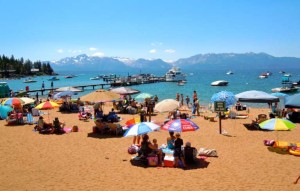
Round Hill Pines beach will have a new concessionaire for the first time in 46 years. Photo/LTN file

Round Hill Pines beach will have a new concessionaire for the first time in 46 years. Photo/LTN file

Douglas County had long been after the Forest Service to make changes to the popular beach area. Bid documents were finally released last December. Deadline extensions and the government shutdown delayed the process.

Steve Mokrohisky, Douglas County manager, was not available for comment.

Bob Hassett, per his MO, did not return phone calls. Hassett also operates the marinas at Camp Richardson, Timber Cove and Lakeside, as well as owns the Beacon Restaurant. (Earlier this year he sold the Fresh Ketch restaurant.)

Since 1984 the Forest Service has owned this half-mile of beach that includes a food area, pool and marina.

“Improvements could occur within 12-18 months, dependent on the completion of the (National Environmental Policy Act) process. The NEPA process will include public involvement. We want the community to have a voice in the redevelopment of the property, with the goal of ensuring that Round Hill Pines remains a family-oriented resort,” Cheva Heck, USFS spokeswoman, told Lake Tahoe News.

In the past this area had overnight accommodations. The Hassetts want to bring that back. New cabins will likely be built where the boarded up cabins sit at the top of the road before people descend to the beach. Yurt-like structures, which are all the rage, may also be built. Expect tent camping, too.

The current facilities are run down. The Hassetts want to change all of that. Rehabbing the historic lodge and adding food service are possible. Restrooms and showers are coming. The Forest Service said the Hassetts want to build a new day lodge to replace the restaurants that exist now. This would include room for special events and a camp store. The pool will also get a face-lift.

They also want to improve the entrance off the highway. Coming from the west the left turn to the beach area is a bit precarious because of how fast traffic is going in both directions.

Improved parking for vehicles and bikes are in the plans. More cyclists are expected to access the beach now that a trail goes to it from Stateline.

The beach is idyllic, with Mount Tallac a distinct fixture across the lake. This is a popular place for weddings because of the natural environment. A special event pavilion has been proposed.

The Hassetts have a 30-year lease to operate the facility. Financial details have not been released. But what the Hassetts pay the Forest Service will fluctuate based on the investment they make into the property.

It is not yet known if the entrance fee will increase. The Hassetts will propose a rate to the Forest Service, and the feds have ultimate say over that fee.



1 bear killed, 1 to be relocated

On Thursday, one bear was put down and another caught with the goal to release it on Friday.

Nevada Department of Wildlife officials said because of the extent of the injuries to the Incline Village bear it had to be euthanized. The animal could not use its back legs, which may have been the result of being hit by a vehicle.

In Reno on Nov. 14 a 3-year-old bear was trapped near the Truckee River on Livermore Drive. It will be released Nov. 15 near Spooner Summit with the full aversive conditioning treatment which consists of rubber buck shot fired at the bear and the use of Karelian bear dogs chasing and usually treeing the bears.

“We give the bears a bad experience in the hope that they do not come back,” NDOW biologist Carl Lackey said in a press release.

— Lake Tahoe News staff report


·


Muir’s 130-year-old giant sequoia cloned

By Louis Sahagun, Los Angeles Times

Horticulturists recently announced that they had successfully cloned a genetic replica of an ailing 130-year-old giant sequoia planted by conservationist John Muir in the 1880s on his ranch in Martinez.

And many more are apparently on the way, they say.

If all goes according to plan, the first clone nurtured in a Michigan laboratory will be shipped within a year to California for planting at Muir’s homestead in the East Bay, said David Milarch, co-founder of the nonprofit Archangel Ancient Tree Archive.

Muir, regarded as the father of the modern conservation movement, returned from a Sierra Nevada trip with the original seedling wrapped in a damp handkerchief.

Read the whole story


Time to count birds in South Lake Tahoe

The Christmas Bird Count in South Lake Tahoe is Dec. 14.

Each year tens of thousands of volunteers throughout the country count birds for a day.

Meet at Alpina Coffee Cafe on Emerald Bay Road at 8am.

More info is online.


Official: Resorts need to offer more than skiing

By Kathryn Reed

TRUCKEE – If ski resorts don’t become year-round playgrounds, they are going to be out of business. In large part, this is because climate change is bringing less snow to the slopes.

This was the message delivered Nov. 12 by Bob Roberts, president of the California Ski Industry Association. The Truckee-Donner Chamber of Commerce breakfast meeting was filled with industry representatives.

Winters are warming and that means less snow falling in the Sierra. While snowmaking will help save the industry, it won’t be enough. And this is especially true when the drive-up market heads to the slopes when Mother Nature dumps, not when the man-made stuff is blown.

Roberts points to how dramatically things have changed in his lifetime. Five significant glaciers were on Mount Shasta when he worked at that resort. Now, he said, they are slivers.

“We need to stop thinking of them as ski resorts and see them as mountain resorts,” Roberts said. “We’re seeing it here in Tahoe.”

Resorts in Tahoe have been trying to stay ahead of the game as they invest in the on-mountain product. Rope courses, ziplines and other play structures are for the most part year-round activities and not limited to just when there is no snow.

Bob Roberts, president of the California Ski Industry Association, talks Nov. 12 in Truckee. Photo/Kathryn Reed

Bob Roberts, president of the California Ski Industry Association, talks Nov. 12 in Truckee. Photo/Kathryn Reed

Roberts pointed out how this summer $100 million was invested in Tahoe area resorts. He noted even a small resort like Sierra-at-Tahoe spent $4.5 million. Then there are the bigger players like KSL (owner of Alpine and Squaw Valley) and Vail Resorts (parent company of Heavenly, Kirkwood and Northstar) that are spending even more. In the last three years KSL will have spent $46 million on its two resorts.

A four-season resort is what ski resorts need to evolve into, Roberts said.

The Tahoe area is responsible for 53 percent of the California skier visits, though 57 percent of the spending occurs here. This equates to $58 million a year in local taxes, Roberts said. Resorts account for 1,700 full-time employees and 7,200 seasonal.

Another concern for ski resorts is fewer people are skiing and snowboarding. Roberts said K2 snowboard sales are down 50 percent. The average number of newbies to skiing-snowboarding across the country has been 1 million. That figure dropped to 850,000 last season.

“We have to get this thing jacked back up. We need to make sure they are hooked and want to continue on,” Roberts said of new skiers and riders.

Between 8.5 million and 10.5 million people from the U.S. ski or snowboard each year. Weather is usually the factor that makes the number fluctuate. The British market is still strong, while the Chinese sector is increasing.

The Asian and family markets are growing in California, while seniors has leveled off.

The demographic that is changing is singles and those younger than 18. They aren’t hitting the slopes. That, Roberts said, is something the industry needs to keep its eye on.


USFS to sell Christmas tree permits

The U.S. Forest Service Lake Tahoe Basin Management Unit will begin selling Christmas tree permits Nov. 18.

Permits cost $10 each (cash or check only) with a limit of two permits per family. Permit holders may choose from a variety of pine, fir or cedar in designated cutting areas.

This year, the LTBMU will issue 2,500 permits available on a first-come, first-served basis. Provided permits are not sold out, the last day to purchase a permit is Dec. 20.

The last day to cut a tree is Dec. 24.

Permits will be at:

· Forest Supervisor’s office, 35 College Drive, South Lake Tahoe, beginning Nov. 18. This office is open Monday through Friday from 8am-4:30pm.

· Incline Village Forest Service office, 855 Alder Ave., Incline Village, beginning Nov. 20. This office is open Wednesday through Friday from 8am-4:30pm.

Maps to designated cutting areas are provided at the time of purchase.


Controlled burns at Meeks Bay, Taylor Creek

U.S. Forest Service fuels management crews will begin prescribed fire operations on South and West shores Nov. 12.

Weather and conditions permitting, operations will take place near Glenridge Parkway at Meeks Bay and near Taylor Creek on Highway 89 across from the sno-park. The Meeks Bay unit total is 42 acres and crews may burn as much of the unit as possible. At the Taylor Creek unit, crews will burn 10 acres. Both operations are likely to continue through the end of the week and possibly through the weekend.

Because of the project size at Meeks Bay, a significant amount of smoke may be seen rising from the project area and smoke will be visible on Highway 89. Smoke can also be expected in the Taylor Creek area. Smoke from prescribed fire may continue for several days after the initial ignition.

Forest Service staff will post road signs around the areas affected by the prescribed fire, send email notifications, and update the local fire information line at (530) 543.2600, ext. 6.


Calif. to help Ma Nature with cloud seeding

By Matt Weiser, Sacramento Bee

As California concludes a second drought year and water managers hope eagerly to avoid a third, utilities across the state are poised for that first mass of pillowy gray clouds to drift ashore from the Pacific Ocean.

When it arrives, if conditions are right, they’ll be ready with cloud-seeding tools to squeeze out every extra snowflake, with the goal of boosting the snowpack that ultimately feeds the state’s water-storage reservoirs.

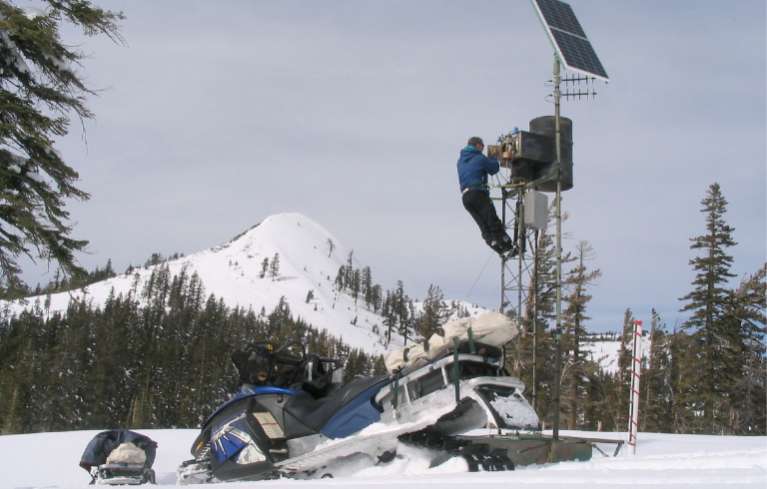
Cloud seeding in the Sierra Nevada. Photo/DRI

Cloud seeding in the Sierra Nevada. Photo/DRI

Once viewed by some as a fringe science, cloud seeding has entered the mainstream as a tool to pad the state’s crucial mountain snowpack. New technology to manage the practice, and research that points to reliable results, have cemented cloud seeding as a dependable and affordable water-supply practice.

“The message is starting to sink in that this is a cost-effective tool,” said Jeff Tilley, director of weather modification at the Desert Research Institute in Reno, which practices cloud seeding in the Lake Tahoe Basin and Eastern Sierra Nevada. “The technology is better; we understand how to do cloud seeding much better. And because we know how to do it more effectively, it’s definitely taken more seriously.”

Cloud seeding is often misunderstood as a kind of magic that conjures rain from thin air. In reality, it is simple chemistry combined with careful weather monitoring.

As practiced in California and elsewhere in the West, cloud seeding involves spraying fine particles of silver iodide into a cloud system to increase snowfall that is already underway or about to begin. Silver iodide causes water droplets within the clouds to form ice crystals. As the crystals grow larger, they become snowflakes, which fall out to create more snow than the storm would have generated on its own.

Read the whole story