Study: Skiers happier than snowboarders

By Stephen Wayne Kasica, Outside

Researchers from South Korea inadvertently supplied skiers with more ammunition in the ideological war between which is better: skiing or snowboarding.

According to the study published in the journal Applied Research in Quality of Life, skiers find more pleasure from a day on the slopes than snowboarders. Among the 279 participant study, skiers showed higher levels of pleasure and involvement in their sport than snowboarders did.

Read the whole story


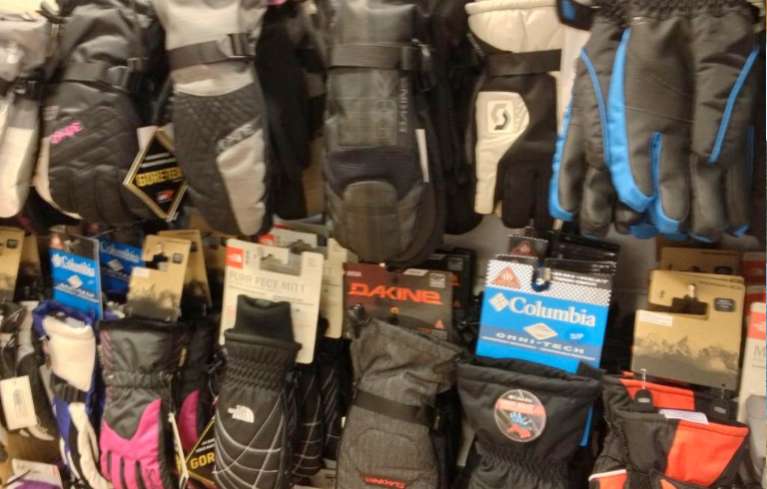
Gloves are not an accessory to overlook

By Kathryn Reed

Every element of outdoor wear is important. Hours can be spent researching the best skis and boots. But seldom is the same amount of time and effort given to finding the best accessories.

Gloves often fall into the category – they fit, I’ll buy them. And while fit is a huge component, there are more things to consider when choosing the fabric to protect your digits.

“When a glove fits you are going to want to be able to pinch in front of the fingers. You don’t want it so tight because blood flow won’t reach the end of the finger,” Lindsay Thayer, marketing manager at Tahoe Dave’s in Kings Beach, said.

Gloves are an important accessory for skiers.

Gloves are an important accessory for skiers.

Then there is the question whether gloves or mittens are better. Mittens were the overwhelming response for kids. It’s easier to get them on and often they are warmer.

The warmth factor is also why adults like mittens. They are recommended for people with poor circulation or those who always are complaining about cold hands.

“All the fingers get to snuggle together,” is how Thayer explained it to Lake Tahoe News.

A hybrid of a glove and mitten is the lobster claw. The index finger and thumb are separate from the other three fingers. This allows for more dexterity.

“What you want is balance between warmth, dexterity and water-proofness,” explained Matt Gibely, glove guru at Alpenglow Sports in Tahoe City.

He said it’s important to have gloves for each sport – downhill, Nordic and backcountry.

Dexterity is not critical for most people skiing the slopes of Lake Tahoe. A glove with waterproofing material, along the lines of Gore-Tex, is recommended. The waterproof layer is usually not the outer shell, but instead goes in between the shell and the warming layer.

Synthetic insulation will not be affected by moisture as much as down.

“Nordic gloves are a whole different animal. Those tend to breath very well because Nordic skiers are exerting energy the whole time,” Gibely told Lake Tahoe News.

As with most gear, the price for a pair of gloves is all over the board. Ski magazine in September came out with its top six picks. They ranged in price from $40 to $375.

Dave Salazar, salesman at Sports Ltd. in South Lake Tahoe, said heated gloves are the most expensive – topping out at about $400. A battery makes the gloves warm; then there are settings to adjust the amount of heat.

Salazar and Thayer are proponents of the one-time use hand warmers. But don’t put them in your palm because the blood does not circulate there. Use the compartment on top of your glove – that’s what it’s there for – not your money or a key. The top of your hand is where the blood is circulating and what you want heated so the warmth reaches your fingertips.


Ski resort tries to curtail evaporation from snowmaking reservoir

By Sandra Emerson, Inland Valley Daily Bulletin

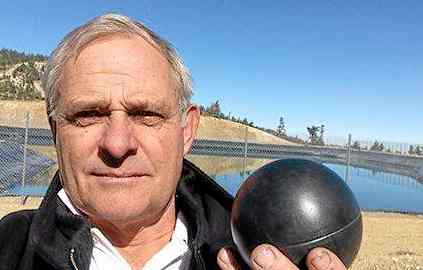
Ron Ellingson will be watching the Mt. Baldy reservoir closely this ski season. The 10-million-gallon reservoir is used to make snow during the ski season and like any body of water, succumbs to evaporation, but for Ellingson, president of Mt. Baldy Ski Lifts Inc., the evaporation means higher costs and less snow for skiers.

Ron Ellingson, president of Mt. Baldy Ski Lifts Inc., holds one of the hollow plastic conservation balls produced by Glendora-based manufacturer XavierC LLC.

Ron Ellingson, president of Mt. Baldy, is using hollow plastic conservation balls on his snowmaking reservoir. Photo/Provided

So, to keep costs down and provide more snow to visitors, Ellingson contracted with Glendora-based manufacturer XavierC LLC, to install hollow plastic conservation balls to reduce the evaporation.

The balls are 4 inches in diameter and float along the top of the reservoir to reduce evaporation by up to 90 percent.

As the water level rises and lowers, the balls adjust by piling on top of each other or by spreading out across the surface.

Read the whole story


Eldorado closes forest roads

Dirt roads in Eldorado National Forest will be closed for the season starting Jan. 1.

They will remain closed until at least April 1.

Roads subject to the seasonal closure are identified on a free-of-charge map that is available at all Eldorado National Forest offices or online.

The seasonal closure is designed to protect roadbeds and watersheds from damage and to safeguard water quality.

The seasonal closure does not affect routes in the Rock Creek Area of the Eldorado National Forest near Georgetown, which has its own route closure process.


Vonn may not race before Olympics

By Nick Zaccardi, NBC

No date has been set for Lindsey Vonn‘s return to competition after her surgically repaired right knee swelled up after skiing out of a downhill race in Val d’Isere, France, on Dec. 21.

Vonn is working with her own team and medical staff to get the swelling under control, U.S. Ski Team coach Alex Hoedlmoser told The Associated Press.

“There is no decision yet if, or where she is going to race ahead of the Olympics,” Hoedlmoser told the Associated Press.

Read the whole story


Schumacher injury brings off-piste skiing dangers to light

By Tom de Castella, BBC

Former F1 champion Michael Schumacher is fighting for his life in a French hospital after suffering a head injury in an off-piste skiing accident.

How dangerous is off-piste skiing?

Schumacher was wearing a helmet, which experts say may have prevented him dying in the immediate aftermath.

Skiing itself is far safer than cycling or swimming, per million participants, says Dr. Mike Langran, a GP who founded the website ski-injury.com. The risk is “in the order of two to four injuries per 1,000 days spent on the slopes,” he says.

But is venturing off-piste more dangerous? There are no comprehensive statistics as it’s impossible to know how many people are skiing off-piste at any one time, experts say. Off-piste refers to any area not marked out and maintained for use by skiers.

Off-piste slopes are not groomed by snowplows, so rocks, precipices and cliffs may not be easy to spot, especially in poor visibility. But the biggest risk is avalanches.

In the past two days alone, seven people have died in the Alps from avalanches.

Read the whole story


Olympic celebration at Sugar Pine Point

Ed Z’berg Sugar Pine Point State Park will host an Olympic Heritage Celebration Jan. 11-19 to honor the 1960 Games at Squaw Valley.

Opening ceremonies are set for 11:30am Jan. 11.

There will be a guided ski/snowshoe tour of Olympic trails.

On Jan. 18 from 10:30am-2pm there will be a ski-and-shoot biathlon on the same terrain Olympians competed on in 1960.

The events are free, but parking is $10.


Full moon snowshoe on West Shore

A ranger will lead a 90-minute full moon snowshoe tour at Sugar Pine Point State Park on Jan. 18.

It begins at 7pm. A beginners’ clinic will start at 6:30pm.

Wear warm, layered clothing, waterproof hiking boots and bring a flashlight. S

pace is limited and reservations are required by calling West Shore Sports at (530) 525.9920.

The $25 fee per adult includes parking, snowshoes and guided tour. Children 12 and under are free.

Proceeds benefit the Sierra State Parks Foundation.


Ganong closer to making U.S. Olympic team

By USSA

BORMIO, Italy — Travis Ganong (Squaw Valley) closed the 2013 calendar with another positive stride toward his first Olympic Winter Games with a tie for 10th in a rugged Bormio downhill to lead the U.S. Ski Team.

Starting second, Ganong powered though snow at the top of the notorious Stelvio and through rattling bumps in the middle section to post his best Audi FIS Alpine World Cup finish of the season.

Norwegian Aksel Lund Svindal, who skied in relatively clear conditions, skied a flawless line to win the race for the 25th World Cup victory of his career.

Marco Sullivan (Squaw Valley) also landed in the points for the U.S. Ski Team with 22nd.

Bode Miller (Franconia, N.H.) was rocked hard through the middle section and bounced low on the traverse to finish outside the top 30.

Austrian Hannes Reichelt was second with Canadian Erik Guay third for his second straight downhill podium.


Fire leaves raw beauty along snowshoe trek

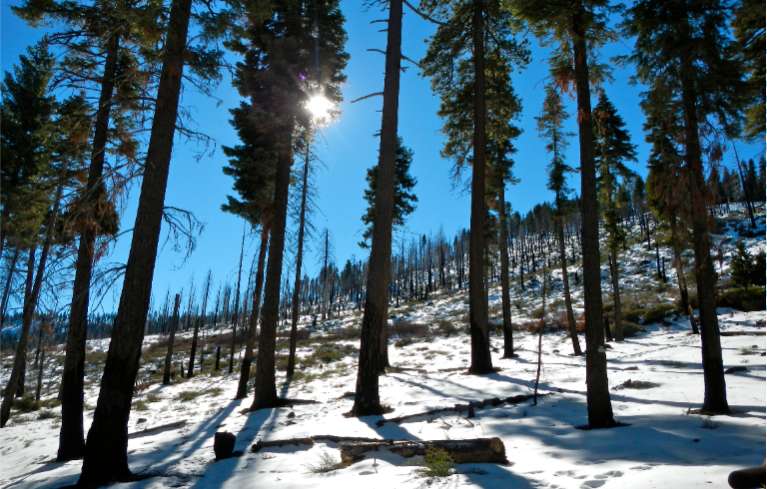
The Angora Fire forever changed the landscape of Gardner Mountain. Photos/Kathryn Reed

The Angora Fire forever changed the landscape of Gardner Mountain. Photos/Kathryn Reed

By Kathryn Reed

FALLEN LEAF LAKE – Traipsing through the woods it all looked so different – partly because it was covered in snow, partly because we were going the opposite the direction we are used to and mostly because we were on snowshoes instead of a bike.

Riding from South Tahoe High School to Fallen Leaf Lake is a standard summer-fall mountain bike ride. But last weekend we left a car on 13th Street by the school and started on Fallen Leaf Lake Road.

But before we headed back toward the first car, the three of us took off for Fallen Leaf Lake via the campground. A family of four from out of town, based on their accents, was taking photos near the glassy, picturesque lake with a snow-covered Mount Tallac in the background. We did the same.

While the shoreline is free of snow, we were happy to have our snowshoes for the remainder of the trek. Snow depth matters to some extent for snowshoeing, but fortunately going over a bare spot here or there doesn’t require taking your equipment into the shop.

We cross to the other side of Fallen Leaf Lake Road and head south through the closed U.S. Forest Service gate.

With so many offshoots in this area it would be easy to not end up where you intended. However, it would be hard to get lost. A hard left and you will eventually be on Highway 89, going straight will get you to the Gardner Mountain neighborhood.

At the start we see tracks from a large vehicle, like a tractor. We’re not sure what it was doing out there.

A small aspen grove with its white bark adds contrast to the dominant pines.

It doesn’t take long and we are where the Angora Fire of June 2007 ravaged the landscape. Beyond the obvious remaining charred trees it is also so open here. The start of the route is denser – like what this whole area once was like.

We veer to the right to stay high enough so we will come out at the far end of the STHS’ football field. Had we gone even higher we would have been able to see Lake Tahoe – something that wasn’t possible before the fire.

Looking uphill the remains of the fire are more evident. It’s hard to find a tree that is alive. A pile of logs is a reminder of how this area is still being restored.

We also pass the many markers for the pet cemetery.

Freel and Jobs peaks come into view directly in front of us.

At times the trail is wide enough so Sue, Brenda and I can walk together, while other times we are single-file.

It’s relatively flat, which is a good thing considering Brenda is dealing with a rather recently surgically repaired knee and I have a raw heel from a previous snowshoe.

But the bounty of beauty we are immersed in is what matters. It’s a good jaunt to get the snowshoe legs into shape for the season.

ngg_shortcode_0_placeholder (Click on photos to enlarge.)