Unemployed tend to exercise more

By Bill Bradley, Outside

I lost my job in December. The writing had been on the wall since the first round of layoffs in July. No one was surprised. The company treated the departed well and ushered us out the doors with severance papers in hand. I’d been employed since I was 14—thank you, Stan at the Cottage Café, for giving me my first shot—and had no clue what to do, so I just started running.

I’ve been a runner since I was in junior high, so it’s not like I lost my job and went full Forrest Gump. I ran my first marathon in October while still employed. (A complete disaster.) Without the constraints of a desk job and with new found free time on my hands, I ran whenever and for however long I wanted. Gone were the days of squeezing in five miles before work. I sure as hell didn’t have anywhere else to be.

A 2011 study from the National Bureau of Economic Research found that white-collar workers exercise more when they’re unemployed. “From an economical jargon, the time cost or opportunity cost is now lower,” said Dhaval Dave, co-author of the study and economics professor at Bentley University. “So you should see a lot more people exercising.”

Read the whole story


Full moon yurt dinners in Tahoe City

The Winter Discovery Center at Tahoe Cross Country is putting on two full moon yurt dinners.

The evening starts with a moonlit hike, ski or snowshoe from the Tahoe XC trailhead where there will be hot mulled wine and hot chocolate next to a roaring fire. The terrain is gentle. A three-course hot meal awaits in the dinner yurt.

Chef Douglas Dale of Wolfdale’s will providing the meal on Jan. 17 and Jan. 18, 6-9pm.

The dinners are fund raisers for the facility’s 30-foot Pacific yurt.

Call (530) 583.5475 or email valli@tahoexc.org to make a reservation. Tickets are $70 per person.


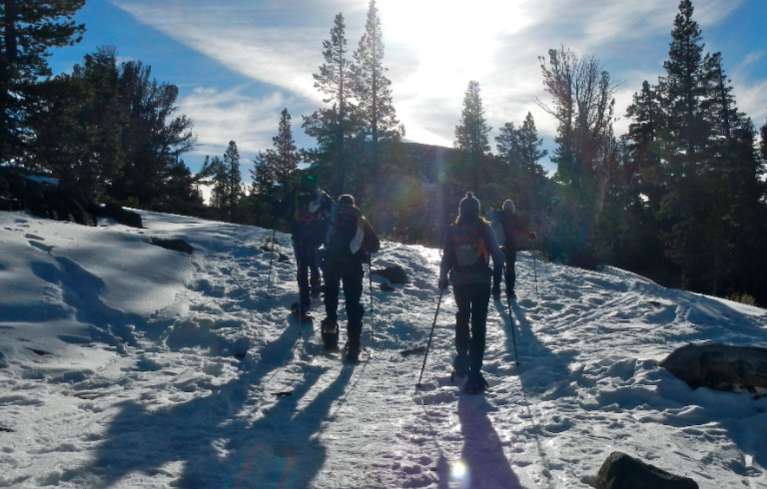
Celebrating 2014 atop Elephants Back

Elephants Back loom ahead of the snowshoers on Jan. 1. Photos/Kathryn Reed

Elephants Back looms ahead of the snowshoers. Photos/Kathryn Reed

By Kathryn Reed

Starting the New Year surrounded by the beauty of nature in the company of friends should become a tradition.

Craig and his six women – me, Sue, Donna, Suzy, Carolyn and Trish – started 2014 with a snowshoe to the top of Elephants Back in the Mokelumne Wilderness.

It was one of those incredibly perfect Lake Tahoe days: the sun beaming down, the sky a deep blue with streaks of white clouds, not even a wisp of wind at the top.

If only those moments could be bottled.

We took our time last Wednesday. Donna’s gadget recorded us being in the wilderness for about four hours, but only two of which actually involved walking. We did put in 4.61 miles, gained 1,168 feet in elevation and went to 9,584 feet.

Photo stops were a necessity, as was a leisurely lunch at the top.

One reason for choosing this excursion was thinking there would be more snow compared to lake level, which is rather barren. Plus, much of the trail is exposed so there was less likelihood of ice being an issue.

The trail starts off narrow, so we are in a line. The snow is hard in this section, so the claws on the snowshoes are welcome. So are the poles for a better sense of balance. Sun filters in between the tall pines.

It doesn’t take long for Elephants Back and Round Top Peak to show themselves.

Plenty of people have been here before us. While it’s nice to not be breaking trail, there are too many trails at times. We know the direction we should be headed and have plenty of daylight, so it’s no big deal. But I would imagine it would be a bit disconcerting for those who are unfamiliar with the area.

At one point Frog Lake was on our left and Woods Lake to our right in the distance. I never saw them. But in the summer I always see Frog Lake on my way to Winnemucca Lake. Part of this trail is also a segment of the Pacific Crest Trail. We never saw that trail indicator either.

Pausing we turn around and in the not too far distance is Caples Lake. From this perspective it looks large and completely covered in ice. I can only imagine the fishermen are out there enjoying their sport.

At the base of Elephants Back the snow is like sugar. While it’s ideal for our purposes, it will pose an avalanche danger once more snow arrives. This consistency does not make for a good base.

It’s not until we are part way up Elephants Back that we are able to see a frozen Winnemucca Lake at the base of Round Top. Earlier we had passed a couple who had spent the night there. That would have been one heck of a way to ring in the New Year.

On our way out we saw people headed to Round Top with the intention of skiing down. I shook my head thinking I hope those are rock skis they have on.

We took our snowshoes off to make it up the loose volcanic rock of Elephants Back. There was no way to snowshoe to the top. But that didn’t matter.

The views at the top of Elephants Back are some of the best to be had in such a short distance – especially since the expanse of beauty spills forth in every direction.

Getting there:

From South Lake Tahoe, go west on Highway 50. Turn left on Highway 89. At Pickett’s Junction, go right on Highway 88. At the top of Carson Pass, park on the left. The trailhead is by the building.

A sno-park permit is required between Nov. 1-May 30. The closest place to the trailhead to buy one is at Sorensen’s Resort. Or they may be purchased online. The cost is $25 for the season or $5 per day. It’s a $94.50 fine if caught parking without a permit.

ngg_shortcode_0_placeholder (Click on photos to enlarge.)


BLM offering free access on select days

The Bureau of Land Management will waive recreation-related fees for visitors Martin Luther King Jr. Day on Jan. 20, Presidents’ Day weekend Feb. 15-17, National Public Lands Day on Sept. 27 and Veterans Day on Nov. 11.

Much of Nevada is controlled by the BLM. The BLM manages and facilitates recreational activities across more than 245 million acres in the U.S.

Other fees, such as overnight camping, cabin rentals and group day use, will remain in effect.

More information is available online.


Everyday athletes may be able to train brains to perform like a pro

By Alex Hutchinson, Outside

It goes without saying that Olympic athletes need to be strong, fit, and tough. But none of that matters if they aren’t capable of adapting quickly to unexpected circumstances. Take former Slovenian swimmer Sara Isakovic. During the 2008 Beijing Olympics, with one length remaining in the 200-meter freestyle final, disaster struck. Isakovic misjudged her final flip turn, and as she uncoiled her legs to explode off the wall, she could feel her toes just barely graze it.

“I remember thinking, This is not happening! Why now?” Isakovic, 25, recalls. “Then, in a split second, I was able to refocus.” Riding on a surge of adrenaline, she tore down the last length to nab a silver medal, breaking the previous world record and missing gold by just 0.15 seconds.

Isakovic is now a research assistant in psychiatry at UC San Diego, where she works with Martin Paulus, a leading player in the search for brain — training techniques that will enable the rest of us to develop elite-level mental agility. Says Isakovic, “What we’re interested in is how you build resilience, how you train your brain to be as tough as your body.”

Read the whole story


Kashima 5th in moguls in Calgary

By USSA

CALGARY, Alberta -– World Cup Champion Hannah Kearney (Norwich, Vt.) earned a second-place finish on a steep and icy Calgary moguls course Saturday, while Patrick Deneen (Cle Elum, WA) took third, his first FIS World Cup podium of the Olympic season.

On Saturday Kearney also became the first U.S. athlete to achieve two top-three finishes required for Olympic qualification.

Athletes will be gunning for podium spots harder than ever at the Visa Freestyle International at Deer Valley Jan. 9-11.

Sho Kashima (Stateilne) earned a fifth-place finish, proving his mental strength after he injured his knee last season on the same run, while Heather McPhie (Bozeman, Mont.) placed sixth.

Canadians Mikael Kingsbury and Justine Dufour-Lapointe won the men’s and women’s events. Kearney and Dufour-Lapointe are tied in FIS points and will both wear the yellow bib at the Visa Freestyle International at Deer Valley.

Single-digit temperatures and course conditions were a factor for all the athletes, preventing most from skiing confidently on the slick, icy snow.


Winter softball tourney looking for teams

The 32nd annual March of Dimes Snoball Softball Tournament is Jan. 25-26 in South Lake Tahoe.

Players from more than 100 teams brave the elements and put their skills to the true test.

This is a double elimination tournament with two divisions, men’s and co-ed.

Proceeds fund research to develop new treatments for birth defects and infant health problems. In addition, it provides support for perinatal education and programs to educate families about lifestyle choices resulting in healthier babies.

For more info, call (775) 200.1949 or email dhyatt@marchofdimes.com.


USFS to pile burn on Luther Pass

U.S. Forest Service fuels management crews will resume prescribed fire operations at Luther Pass on Jan. 6. Operations will continue as conditions allow.

All prescribed fire projects are conducted in accordance with an approved prescribed fire burn plan. Burn plans describe specific conditions under which operations are conducted including the weather, number of personnel, and opportunities to minimize smoke impacts.

Smoke from prescribed fire may continue for several days after the initial ignition. Smoke that settles in low lying areas in the morning usually lifts out of the area during normal daytime heating. All prescribed fires are monitored regularly for burning and smoke dispersal and action is taken to mitigate concerns as they arise. The Forest Service makes every effort to conduct prescribed fire operations during weather patterns that carry smoke away from communities.

Forest Service staff will post road signs around the areas affected by the prescribed fire, send email notifications, and update the local fire information line at (530) 543.2600, No. 6.


Ski helmet use not reducing brain injuries

By Kelley McMillan, New York Times

The fact that Michael Schumacher was wearing a helmet when he sustained a life-threatening head injury while skiing in France on Sunday probably did not come as a surprise to experts who have charted the increasing presence of helmets on slopes and halfpipes in recent years. The fact that the helmet did not prevent Schumacher’s injury probably did not surprise them, either.

Those taking lessons at Heavenly must wear a helmet. Photo/LTN file

Those taking lessons at Heavenly must wear a helmet. Photo/LTN file

Schumacher, the most successful Formula One driver in history, sustained a traumatic brain injury when he fell and hit his head on a rock while navigating an off-piste, or ungroomed, area at a resort in Méribel, France. Although he was wearing a helmet, he sustained injuries that have left him fighting for his life in a hospital in Grenoble, France.

Schumacher’s injury also focused attention on an unsettling trend. Although skiers and snowboarders in the United States are wearing helmets more than ever — 70 percent of all participants, nearly triple the number from 2003 — there has been no reduction in the number of snow-sports-related fatalities or brain injuries in the country, according to the National Ski Areas Association.

Read the whole story


Volunteers needed to count bald eagles

Volunteers are needed for the Jan. 10 bald eagle count in Lake Tahoe.

No experience required.

Tahoe Institute for Natural Sciences is the lead agency for the count.

There are 30 observation spots around the lake.

To sign up call (775) 298.0066.