Study: Old trees keep growing — in girth

By Richard Harris, NPR

Like other animals and many living things, we humans grow when we’re young and then stop growing once we mature. But trees, it turns out, are an exception to this general rule. In fact, scientists have discovered that trees grow faster the older they get.

Once trees reach a certain height, they do stop getting taller. So many foresters figured that tree growth — and girth — also slowed with age.

“What we found was the exact opposite,” says Nate Stephenson, a forest ecologist with the U.S. Geological Survey, based in California’s Sequoia and Kings Canyon national parks. “Tree growth rate increases continuously as trees get bigger and bigger,” Stephenson says.

The General Sherman, a giant sequoia in California’s Sequoia National Park, is more than 2,000 years old, and is thought to be the largest tree (by volume) in the world.

Read the whole story


Kirkwood skier on podium in Freeride World Tour

Josh Daiek, who rides for and lives in Kirkwood, placed second Jan. 22 in the men’s ski competition of the SWATCH Freeride World Tour.

The event took place at Courmayeur Mont Blanc in Italy and was the first of six events on the FWT this season.

Daiek’s run began with two massive cliff drops that earned the appreciation of the event’s judges and spectators. He earned a score of 87.5, only 1 point of the day’s leader, Loïc Collomb-Patton of France.

Daiek will have home field advantage when the tour arrives at Kirkwood Mountain Resort on March 1.


Epic Mix creates competition on, off the slopes

By Kathryn Reed

Based on the amount of vertical feet being skied by people at Heavenly Mountain Resort, it would be hard to know the whole mountain hasn’t opened because of the lack of snowfall.

Those who are into keeping track of where they ski, vertical feet, number of days and other stats just have to sign up for Epic Mix. The social media component to skiing is Vail Resorts way of making it more than just a ski day. And while it’s offered at all their mountains, Heavenly has the most enthusiastic Tahoe participants.

Its nicknamed “Epic crack” because it is so addictive.

At the end of a ski day, Shirley Hackett goes over her Epic Mix account online. Photo/Kathryn Reed

At the end of a ski day, Shirley Hackett goes over her Epic Mix account online. Photo/Kathryn Reed

Shirley Hackett, 56, skis every day at Heavenly – except when she’s skiing someplace else. In summer 2011 she was diagnosed with a life-changing illness that almost kept her off the slopes for good. When she got back in January 2012 her goal was to ski 1 million vertical feet. She ended that season with 2.5 million vertical feet in 85 days.

In the 40-plus days she has skied this season she is at more than 1 million vertical feet. It’s a little easier to do this at Heavenly compared to the New York resort where she learned to ski. It had 250 vertical feet top to bottom.

Hackett’s goal last season was to ski 100 days. She got in 112 – but not all at Heavenly. For her 102 days at a Vail owned resort she skied 2,619,439 million vertical feet. She finished the season top among all women at all Vail Resorts.

“So, now all of this seems quite easy,” Hackett said as she went over the various components of her Epic Mix page.

And the prize at the end of the season?

“There is nothing except bragging rights,” Hackett tells Lake Tahoe News with a smile. “It’s good clean fun. You are outside in one of the most beautiful places, exercising. You can’t beat that.”

Anyone can go online to see how people are doing – assuming they’ve made their profile public. It’s optional to activate Epic Mix.

Dave Maderis, who also skis at Heavenly, decided after the first year he could beat the record of 4.3 million vertical feet. So in 2011-12 at age 69 he began his quest. In 136 days he skied 4.8 million feet – for those bragging rights.

He did so through a viral infection and cracked ribs.

Maderis decided after turning 70 he didn’t need to challenge himself in quite the same way.

In year three, Mark Emmerling, who’s home resort is Heavenly, decided he was going to beat the Colorado guys who often have an earlier start to the season, sometimes a later ending date and resorts with longer runs. He did so – skiing 7,036,536 million vertical feet in 2012-13.

Robert Martin collects his vertical feet on a ski bike.

Then there are the stories of those who have camped out at World Cup to swipe their pass to get the feet without ever getting on the lift, let alone skiing down. It was also an easy way to earn the Dark Knight pin, which is 10 lifts after 4pm.

“I don’t think we had any idea how really, truly competitive our guests are,” Stacey Pool, director of online experiences for Vail Resorts said. And they are competing against people they may not know, especially people at another resort.

But Epic Mix isn’t just about vertical feet. It’s also about pictures, pins, lessons and racing. Vertical feet and photos are the two most popular features of the application.

Photos can be uploaded to Facebook within a matter of hours. It’s there with the resort’s logo, so it’s practically free advertising. Guests can buy photos if they want.

People can be seen on chairlifts tracking their pins, vert feet and posting photos. It’s that addictive. They don’t even wait until the end of the day to know their stats or share their info with others.

“You don’t have to be the best skier in the world. It’s a game,” Maderis told Lake Tahoe News. “It’s good for people who come up 15 to 20 days to see how many points they can acquire.”

The points are based on pins, vertical feet and other criteria.

Vail Resorts started Epic Mix as a way to tap into the burgeoning social media platform.

“It was a way to capture special memories, experiences you were having on the mountain and then you could share with friends,” Pool told Lake Tahoe News. “At first we measured social impressions – how many eyeballs were on social posts. It was in the millions of social impressions in the first year.”

Each year Vail has tweaked Epic Mix or added something to it. New this year is with ski or snowboarding lessons the ability to track one’s progression. It also has the name of the instructor and other details not available if the person has not activated Epic Mix. (Epic Mix is free and is available on season passes and day passes.)

Pool said Epic Mix is not being used to track where individuals are. However, it has been used when someone has turned up missing to see where they have been skiing so ski patrol can start with that area to locate the person.

With the pins that can be collected – and they are all virtual – it’s possible to put them up in a route on the mountain at times that would disperse skiers from congested areas. People know where they are by using their smart phones.

Otherwise, Epic Mix is considered a passive app, and that’s how Vail Resorts intends to keep it. What will be new for 2014-15 – if anything – Pool isn’t saying. After all, this season isn’t even half over.



Teter third in halfpipe at Mammoth

By USSA

MAMMOTH MOUNTAIN -– Kaitlyn Farrington (Bellevue, Idaho) clinched her spot on the Olympic halfpipe snowboarding team Sunday with her bold victory at the final event of the Sprint U.S. Grand Prix series.

Arielle Gold (Steamboat Springs, Colo.) also secured her Sochi spot Sunday. Olympic champion Kelly Clark (West Dover, Vt) settled for second while Hannah Teter (South Lake Tahoe) finished third in the electrifying final.

“Everyone is claiming that this is the best pipe of the season, if not the best in years. It’s just so soft. I definitely felt the heat but sometimes that makes me get in the zone when I know I’ve got to do it, like it’s all or nothing. So, it pushed me to the be in the spotlight … and I like the spotlight,” Teter said.


White ready for 3rd Winter games in halfpipe

By USSA

MAMMOTH MOUNTAIN -– Defending Olympic champion Shaun White, who rides for Northstar, will get a chance to win three-in-a-row at the 2014 Winter Olympic Games after clinching a spot on the Olympic halfpipe snowboarding team Sunday with his victory at the Sprint U.S. Grand Prix series finale.

Local favorite Greg Bretz (Mammoth Lakes) also earned a spot on the team with his impressive performance throughout the Grand Prix tour. Style-conscious veteran Danny Davis (Truckee) took second on Sunday with rookie Ben Ferguson (Bend, Ore.) third.

“It was a long week for me, but I made the team. I’m pretty happy. My runs are definitely up to my expectations,” White said.


Donner Lake State Park captures its history

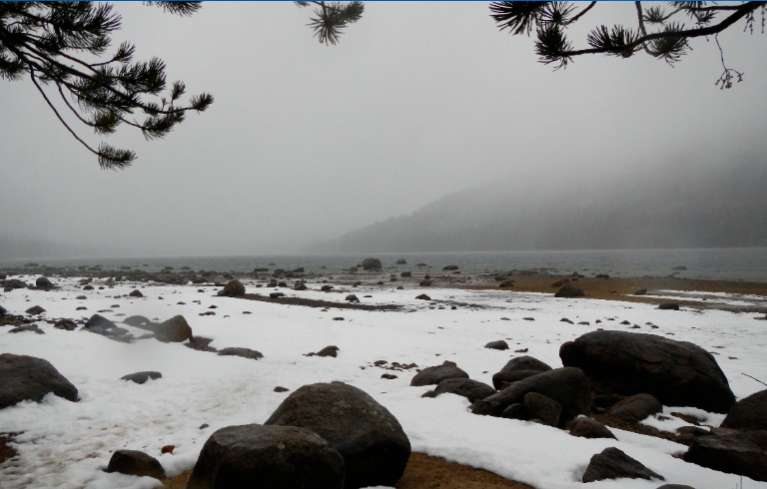
Donner Lake is uninviting on the lone stormy day of January. Photos/Kathryn Reed

Donner Lake is uninviting on the lone stormy day of January. Photos/Kathryn Reed

By Kathryn Reed

TRUCKEE – A park named after the Donner party should be visited in inclement weather. It’s the best way to get a feel for what the 81-member wagon train went through in the winter of 1846-47.

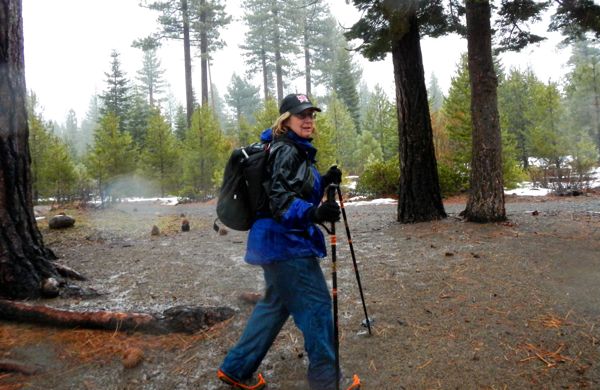
While such weather has been scarce this winter, we ventured out in some last Saturday. Wind was blowing. The temperature was dropping. A mix of rain and snow drenched us. We were not as unprepared as the Donner party, which lost 36 people on the trek across the Sierra, but we certainly weren’t ready for the elements.

For some reason we pushed on.

A soggy Sue treks through Donner Memorial State Park on Jan. 11.

A soggy Sue treks through Donner State Park on Jan. 11.

Being at the ocean on a stormy day is something I’ve always enjoyed. This was a bit like that. While the waves were nowhere near ocean-like, they were strong enough to appreciate the force of Mother Nature.

Donner Memorial State Park does not have many places to hike, but there is a 2½-mile roundtrip interpretive trail that is in large part along the lake.

We were happy to have our Yak Tracks on to contend with the ice on the trail.

With all the rocks, it appears Donner Lake is low like all the other lakes in the state. Interestingly, one of the interpretive signs talks about the seven-year drought that started in 1987. The frail lodgepole could not defend against the mountain pine beetle that thrived in the drought-weakened trees. Strong winds in winter 1994-95 blew many of the diseased trees to the ground.

While this area is known for the deadly, cannibalistic wagon train, it is also home to part of the original interstate system. Before Interstate 80 there was Highway 40. Signs are still in the area depicting Old Highway 40.

The railroad is on the obscured view of the wall of granite.

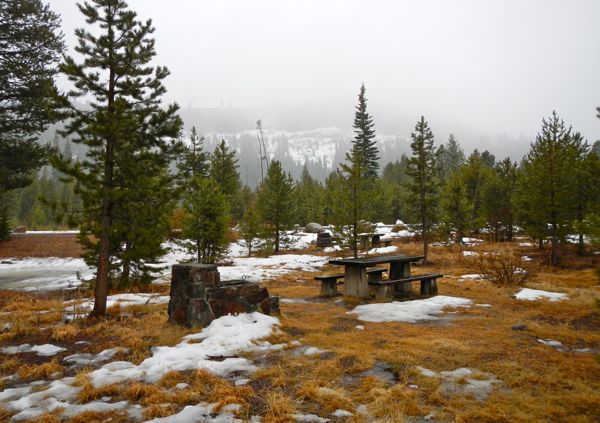
The day use area has great views, including to the towering (invisible on this day) granite wall where the railroad is.

But before that for a short time it was Highway 37. It was part of the 3,000-mile Lincoln Highway that went from coast-to-coast.

Before automobiles, though, there was the train. On this particular day it was too overcast to see up to the tracks. Those who ski Sugar Bowl know the name Judah. Theodore Judah was an engineer who surveyed the first transcontinental railroad.

It was Charles Crocker, Mark Hopkins, Leland Stanford and Collis P. Huntington who formed the Central Pacific Railroad Company. Mostly it was Chinese who in two years built the tracks through the Sierra for these barons of industry who capitalized off of what amounted to slave labor.

To this day Truckee has a train depot that takes travelers to points east and west.

The natural beauty and intriguing history make the lake and park a multi-dimensional visit – no matter the weather or season.

——

Notes:

• Getting there: From Lake Tahoe head west on Interstate 80. Take the Donner Pass Road exit. (There is a sign saying Donner State Park.) Go left at the stop sign. The park is on the left. It costs $8 to park or there is free parking on the road. If entering off the road, you’ll see a sign that says “East Beach access” – veer left for the trail, right for the beach.

• Dogs are allowed on leash.

• A new museum – High Sierra Crossing Museum – at the park is expected to open later this year.


White wins overall Sprint slopestyle tour

By USSA

MAMMOTH MOUNTAIN -– Sage Kotsenburg (Park City) took the victory in slopestyle at the final stop of the Sprint U.S. Grand Prix Tour at Mammoth Mountain on Saturday. His progressive first run scored a full three points ahead of the rest of the field, including Kyle Mack (West Bloomfield, Mich) in second and Ryan Stassel (Anchorage) in third.

Nominations for the first U.S. Olympic team for slopestyle snowboarding will be announced Sunday after the final halfpipe qualifier.

In addition to Olympic qualification, athletes have been competing for a total of $500,000 in cash prizes throughout the Sprint U.S. Grand Prix tour, including a $10,000 bonus for Shaun White, who rides for Northstar, the winner of the Sprint U.S. Grand Prix Tour overall.

White sat out Saturday’s competition in order to rest before an attempt to qualify for halfpipe on Sunday.


Men from Squaw earn points in downhill

By USSA

WENGEN, Switzerland — Olympic gold medalist Bode MIller (Franconia, N.H.) finished fifth, a mere 0.35 behind winner Patrick Kueng of Switzerland in a wind shortened running of the 84th Lauberhorn downhill on Saturday.

The race start was lowered as high winds ravaged the upper half of the fabled course, cutting over a full minute from the normal leg burning run time. Young gun Jared Goldberg (Holladay, Utah) took advantage of the rugged and technical bottom half to storm to 12th from the 40th start position.

Miller navigated the turny middle part of the sprint course flawlessly, then made a small mistake just above the finish to drop out of podium contention.

Marco Sullivan (Squaw Valley) also charged from the late start numbers to finish 16th from bib 29. Travis Ganong (Squaw Valley) was the only other American to finish inside the points with 28th.

Ted Ligety (Park City) opted to sit out the downhill in order to rest for Sunday’s slalom.


Anderson claims Sprint Grand Prix title

By USSA

MAMMOTH MOUNTAIN -– Jamie Anderson (South Lake Tahoe) took the Sprint U.S. Grand Prix overall slopestyle title and a $10,000 cash prize with her win Saturday at Mammoth Mountain.

Karly Shorr (Truckee) put down a progressive run to land second while Jessika Jenson (Rigby, Idaho) took third. Nominations for the first U.S. Olympic team for slopestyle snowboarding will be announced Sunday after the final halfpipe qualifier.

In addition to Olympic qualification, athletes have been competing for a total of $500,000 in cash prizes throughout the Sprint U.S. Grand Prix tour, including a $10,000 bonus for Jamie Anderson for winning the Sprint U.S. Grand Prix Tour overall.

Anderson’s winning run: 50-50 on down rail, gap to boardslide switch out, cab tail 270 out, switch backside 540, backside 540 and cab 720.

“I didn’t have to compete today but I chose to just because it’s really good practice going into X Games next week. More than anything it’s snowboarding and it’s so fun,” Anderson said. “It’s beautiful weather, the park is all time and I’m just having a good day. It’s not just the local Tahoe community; it’s the entire U.S. and even my friends throughout that world that are supporting me. It’s really special to come together for the Olympics because of how much love you get from your country and representing your nation. It’s like nothing I’ve ever done before.”


Snowmaking saving Lake Tahoe’s ski season

By Lisa M. Krieger, San Jose Mercury News

These are the unlikely saviors in the lofty peaks of the serene Sierra: high-tech snow machines, roaring like jets and spewing million-dollar crystals.

“If it wasn’t for snowmaking, we probably wouldn’t be open,” said Barrett Burghard, head snowmaker at Heavenly Mountain Resort, who is propping up the beleaguered mountain economy with his vast computer-driven complex of snow guns, pumps, compressors, pipes, hydrants, nozzles and miles of hoses.

Mother Nature, always fickle, has been especially cruel this drought year to the resorts and mountain communities that depend on snow for their economic survival. Instead of fluffy powder, there’s just granite, mud and manzanita.

Innovations in technology — such as the $40,000 Super PoleCat, with a built-in automated weather station that alters man-made snow characteristics — make it possible to produce an acre of thigh-deep snow in an hour. That’s enough to blanket a football field with snow 8 feet deep during a three-hour game.

In this dry and balmy winter, the small, historic and family-owned resorts without extensive snow making — such as Donner Ski Ranch or Dodge Ridge — haven’t opened, costing jobs and starving local businesses. The National Winter Trail Days event at Tahoe Donner Cross Country Ski and Snowshoe Center was canceled. But big corporations running Heavenly, Northstar, Kirkwood, Squaw Valley, Alpine Meadows and Mammoth Mountain have made major investments in snow-making tools. Squaw Valley alone has spent $5.2 million since 2012. This month virtually all of the snow at the resorts came out of machines.

Read the whole story