Mancuso top U.S. woman in super G at 10th

BY USSA

LENZERHEIDE, Switzerland -– Julia Mancuso (Squaw Valley) skied into the top 10 Thursday at the Audi FIS Alpine World Cup super G final, leading the U.S. women during the final speed event of the 2014 season.

All three U.S. women finished in the points during the sunny super G finale, with Stacey Cook (Mammoth Mountain) finishing 11 and Leanne Smith (North Conway, N.H.) 14 behind race winner and World Cup super G champion Lara Gut of Switzerland. The race is set to air on Universal Sports at 1:00 p.m. EST.

Thursday concluded the best-ever super G season for Cook, who tied with Mancuso for 15 in the super G standings. Smith finished 19 in super G for the season.

Lara Gut of Switzerland took the victory and secured the World Cup super G title, while Austrian Anna Fenninger locked the overall title with her second place finish. Slovenian superstar Tina Maze took third.

The blue skies and warm temperatures were ideal for racing Thursday, but the challenging course and bumpy snow got the best of four of the discipline’s top 20 athletes.

A nations team event is scheduled for Friday, when Bode Miller (Franconia, N.H.), Tim Jitloff (Reno), David Chodounsky (Crested Butte, Colo.), Mikaela Shiffrin (Eagle-Vail) and Mancuso will race in a bracket-style parallel giant slalom.

The women will return to the hill again on Saturday for the final World Cup slalom race of the season.


3 U.S. men in top 10 in super G

By USSA

LENZERHEIDE, Switzerland -– Bode Miller (Franconia, N.H.) rallied to an impressive third in the Audi FIS Alpine World Cup super G final Thursday, closing the men’s speed events for the 2014 season.

Crystal clear skies and hard snow enabled the athletes to lay down a final statement on the season, with Ted Ligety (Park City) gunning into fifth and Travis Ganong (Squaw Valley) ninth behind winner Alexis Pinturault of France.  Thomas Mermillod Blondin of France took the second spot.

The result put Ligety in fourth overall with 869 points, just 50 points behind Pinturault of France, with two races to go. Miller climbed to fifth in the overall super G standings.


Avi dogs — the difference between life and death

By Susan Wood

Ski trail maintenance worker Jeff Eckland can thank his lucky stars he had man’s best friend looking for him when he broke his back tumbling in a massive avalanche at Kirkwood Mountain Resort a decade ago.

Although the highly trained canine leaped across the rainbow bridge 14 years ago, the golden retriever named Doc will live on in the heart of Eckland. The Kirkwood staffer is only one of three people in 159-chronicled avalanches who was rescued alive by a dog in the United States since records were kept by the National Search and Rescue organization in 1969.

“It was 11:30,” Eckland recalled as if it were yesterday. “It had been snowing for days.”

The snow stopped, and the Kirkwood snow safety crew had already blasted the night before. But the wind loaded the slope above Button Bowl.

The three off-duty employees made a short hike up. Eckland took off first on his skis in front of his colleagues on snowboards when a soft slab avalanche wider than the length of a football field gained on him. Trees that appeared 300 yards away were suddenly in his face and scooped him up like a ragdoll.

“I went 80 mph in the blink of an eye,” he told Lake Tahoe News.

He was held against the tree debris for 20 seconds, then buried under 4 to 5 feet of snow just above the lifts along Buckboard flats.

“I thought ‘I’m going to die here’,” Eckland recalled.
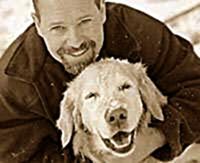
Jeff Eckland and Doc Photo/Provided

Jeff Eckland and Doc Photo/Provided

One friend rode down to Chair 3 to call in the destructive slide. The other went to the ski patrol station at Chair 2, where longtime ski patroller and Doc’s handler Dave Paradysz was digging a pit. He quickly took Doc on the snowmobile as far as he could go along the slide path while another dog looked at the end of the slide. Doc immediately headed for the trees debris.

Eckland was motionless and hypothermic, folded upside down in half with his ski boots next to his head. A piercing pain came from his back, prompting him to think a tree impaled him.

“I didn’t know which way was up. I was losing air and going black, when a paw broke the snow. I knew what it was, then all the oxygen rushed in,” he said, adding how his body corrected like a spring when the very excited dog dug him out.

Eckland estimated he was buried for about 15 minutes, the golden quarter hour for avalanche victims to survive.

It took three months of mainly rest for Eckland to recover from a broken back.

It broke his heart when Doc died in 2000. He immortalized the dog with a tattoo on his chest.

Eckland certainly is a believer in the avalanche dog program and tells his story whenever he can.

“If not for the dog, I’d be dead. This was the only tool we had that would’ve found me,” he said. “Their sense of smell is so incredible.”

In the land where skiers and riders may boast some of the deepest snow – at times on the planet, snow safety is serious business. Kirkwood maintains a program with seven dogs: Logan, 8; Stella, 8; Boji, 6; Pearl, 3; Huckleberry, 3, MoMo, 10 months; and Chewy, 7.

Fred Newberry, a Kirkwood ski patroller since 1999, handles Chewy, a golden retriever. He admits snow safety work can be unpredictable and “not an exact science.”

What he does count on is the dedication, training and drive of his dog, who primarily works inside the ski resort boundaries, but ventures out to assist Alpine and Amador counties in this rugged Sierra Nevada mountain country. The dogs are there to protect in-bounds skiers and boarders, along with the patrollers.

“The dog saved his life,” Newberry said of Eckland. “It’s why we not only have the dog program, but we support it.”

Many of the Lake Tahoe area ski resorts have dog avalanche rescue programs. Golden retrievers like Doc and Chewy are commonplace.

“They’re very obedient, trainable and have a good fetch drive,” Newberry said.

A godsend to Heavenly

With seven dogs of its own, sister ski area Heavenly Mountain Resort would add “good victim loyalty,” “high energy” and “good physical condition” as characteristics that make for an ideal avalanche rescue dog. Some of the dogs are related to others at fellow ski resorts.
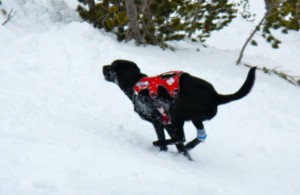
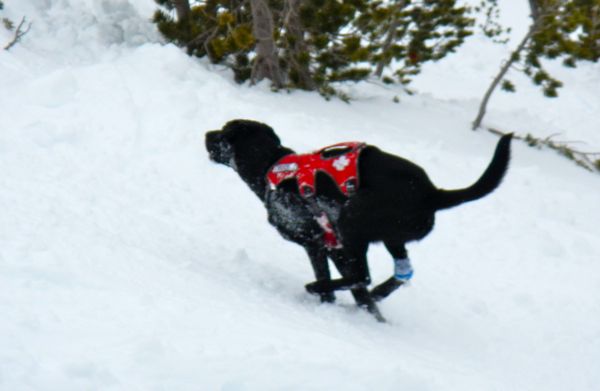
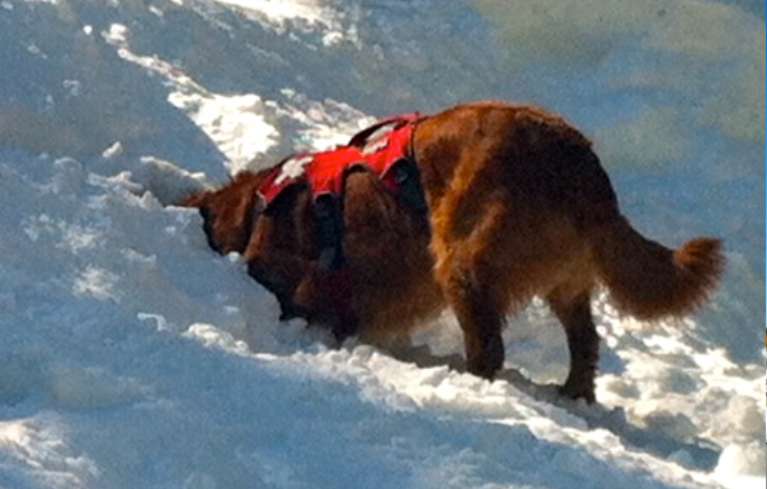
Truckee bounds up the slope at Heavenly. Photo/Kathryn Reed

Truckee bounds up the slope at Heavenly Mountain Resort. Photo/Kathryn Reed

Heavenly patrollers got to prove the traits firsthand on a recent demonstration drill with 3-year-old black Lab Truckee. According to his playing card that Heavenly hands out, Truckee is Heavenly’s first Lab on its rescue dog team.

Truckee came down Milky Way Bowl on handler Chris Child’s shoulders, ready and eager to work. Some ski resorts have leaned toward delivering smaller dogs that way.

Child met up with fellow handler Colton Terry, who acted as a witness to the mock scene. The two discussed clues, then the collar came off and that was Truckee’s clue to go to work searching for a buried Heavenly employee.

“The idea is to get him downwind (to pick up the scent),” Terry said.

With a few quick, shallow digs at the snow, Child kept Truckee focused. His nose covered what appeared to be a mock slide path in a grid pattern. In a matter of a few minutes, the canine started digging feverishly where the staffer was buried more than 3 feet.

Truckee slid on his belly down the hill afterward to celebrate his find.

“The dogs always find their person,” Terry said.

The patrollers bring in a few tricks of the trade to try such as using squares of wool against a sweaty body to simulate the human smell.

Terry has assisted Douglas County sheriff’s deputies with his golden, Summit, who’s in his ninth season.

Apparently, Summit’s work ethic is even better than Terry’s. The patroller admits when he wants to relax on his day off, Summit acts like he’s ready to work every day. And this could mean appearances at schools and events and serving as ambassadors of the resort. Guests can’t help but surround the canines and pet them like one recent day at the top of the Sky Express chairlift when a few people had their pictures taken with Summit and Madeline, another golden retriever.

But one thing is clear. These dogs are working machines, and they must go through a rigid certification program to do what they do. Terry mentioned the dogs having to locate two people in 15 minutes in a 200-foot square area.

Sierra’s new pup to follow in proven path

“Search,” the stern call came from Sierra-at-Tahoe ski patroller Tim Owen to his 2-year-old golden retriever, Kopa, in the trees alongside Castle where a resort employee was buried on another recent drill.
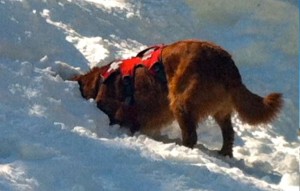
Kopa furiously digs for the buried person at Sierra in a training exercise. Photo/Susan Wood

Kopa furiously digs for the buried person at Sierra in a training exercise. Photo/Susan Wood

In his second season at Sierra, Kopa comes from a long line of patrol dogs. Boomer Murphy from Squaw Valley is his father. Kopa, who has been in training since he was 6 months old, is thought to be “extremely playful, but disciplined.”

After a few minutes passing and a few nudges from Owen “to go to work,” Kopa went right to the hole. Sierra patrollers have a few holes they dig on Castle, but move them often to test the dogs.

Kopa has not been on a mission yet, but “we do train for the worst and hope for the best,” Owen explained. The dogs use the Swiss standards for avalanche dog rescue training, which involve phases of progress.

Kopa and 5-year-old Khuno, the senior dog in the group, assist in backing up the patrollers, especially when they sweep Huckleberry Canyon. The gates leading to the El Dorado County backcountry are increasingly enticing for riders seeking powder.

With more skiers and boarders each year going into the backcountry to make fresh tracks, the dogs become more of an asset. Varying layers of snow from soft to hard contribute to the chance of more avalanches.

“I think the combination of more backcountry users in general and having weather patterns we’re not used to out here make it more of a factor. People in the backcountry take it for granted that the conditions could be the same (all the time),” fellow Sierra ski patroller Shannon Maguire, who handles the newest addition to the resort’s pack of dogs, told Lake Tahoe News.

Nine-month-old Hunter, another golden, has been “killing it” in his training Owen praised, as Hunter and Kopa played outside the Grandview Lodge.

Maguire said it’s been a learning experience for both handler and dog. Each handler of the 22 patrollers at Sierra becomes an alternate handler before making the grade. Each dog goes to school for up to two years.

“It’s definitely a learning curve. He’s a puppy. It’s a lot of work because he’s surrounded by people and smells. It can be a challenge,” she said, smiling.

Maguire played hide-and-seek last summer to get Hunter in the mode of finding people.

Then after training switches to snow, the idea is to have the dogs ready in two seasons.

The avalanche rescue dog program was initiated in the 1997-98 ski season with patroller Bob Schults and his dog Sirius, who was tragically killed when he was struck by a vehicle on Highway 50 about a decade ago. The program was diligently maintained through the efforts of Keebah, Rush-To and later Cruiser in 2005.

“They’re a valuable asset when you consider most people in the ski area aren’t wearing beacons,” said Sierra Avalanche Center forecaster Brandon Schwartz, who works for the U.S. Forest Service in Truckee.

Avalanche conditions have been all over the map this season with varying layers of snow when it does appear.

A small avalanche recently occurred in Eagle Bowl at Kirkwood and someone had to be dug out.

Devastating avalanches have happened this year in the West from Colorado to Oregon, with some resulting in fatalities and living up to its name “the white death.” A book under that name highlights the large avalanche at Alpine Meadows north of Lake Tahoe in 1982.
House to debate USFS, ski resort water rights

By Jason Blevins, Denver Post

The Water Rights Protection Act — which would prohibit the federal government from seizing privately-acquired water rights used on federal lands — arrives for debate on the House floor Thursday.

HR3189 — sponsored by Rep. Scott Tipton, R-Colo., and co-sponsored by 15 Western members of Congress — stems from the ski industry’s now 3-year-old fight with the agency, which sought in 2011 to revise permit regulations to require ski areas to transfer water rights used on public lands over to the Forest Service.

The ski industry — which sued to stop implementation of the new water-rights clause — argues the permit change amounts to illegal takings of private property. The Forest Service says the water regulation is a return to original policy outlined by the 1986 National Forest Service Ski Area Permit Act and keeps water resources connected to public land.

A U.S. District Court judge in December 2012 overturned the water clause and required the Forest Service to gather public input on the change to federal permitting.

Read the whole story


Prescribed fires planned for Tunnel Creek

The Nevada Division of Forestry will be conducting prescribed burns at Tunnel Creek in the Lake Tahoe Nevada State Park backcountry in March, April and May, weather permitting.

The Tunnel Creek road from Highway 28 to Tunnel Creek Station may be closed in order to conduct the burns. Signs will be posted throughout the area when burns are being conducted.

Fifty acres will be burned in eight treatment units.

The burns are part of ongoing fuels treatment and forest restoration efforts being conducted by the Nevada Tahoe Resource Team in the Lake Tahoe area. The goal of the project is to create a healthier forest and to make the area more resistant to catastrophic wildfire.

For more information, contact the Nevada Division of Forestry at 775.684.2500.


Ganong 6th in World Cup downhill

By USSA

LENZERHEIDE, Switzerland — Two-time Olympic champion Ted Ligety (Park City) became only the second American man in history to podium in all five events, tying for second in the Audi FIS Alpine World Cup Finals downhill in Lenzerheide.

Ligety, who started fourth to set the early pace, was just 0.11 off the winning time of Austrian Matthias Mayer, tying with Italian Christof Innerhofer. The finish bumped Ligety up to third in the World Cup overall chase with three races remaining.

Travis Ganong (Squaw Valley) was sixth and Bode Miller (Franconia, N.H.) eighth.

Ligety joined an elite group of only eight men – including Miller – who have scored podium finishes in all five World Cup disciplines.

Norway’s Aksel Lund Svindal was fifth to move ahead of Marcel Hirscher for the World Cup overall lead. Ligety overtook Alexis Pinturault of France to jump into third.

Svindal hoisted the World Cup downhill crystal globe for the second consecutive season, after clinching the title a week ago in Kvitfjell.

Miller led the U.S. Ski Team in the final downhill standings with seventh, Ganong was ninth and Ligety pulled into the top 30 with 26th.


Mancuso finishes downhill season ranked 15

By USSA

LENZERHEIDE, Switzerland — Julia Mancuso (Squaw Valley) was 10th to lead the U.S. Ski Team in the final downhill of the Audi FIS Alpine World Cup season Wednesday.

“Last downhill of the season and you just really have to go for it. It’s a really tough course. It’s a fun hill,” Mancuso said. “There’s definitely room for improvement (in my downhill season), so I’m just going to keep working to improve and hopefully next year will be going better. I just had a lot of things going on with equipment, and that always gets into your head, especially when it’s an important year to be in top form.”

Swiss Lara Gut picked up the win, while Germany’s Maria Hoefl-Riesch took the crystal globe, despite not finishing the race. Hoefl-Riesch was helicoptered off the slope.

Austria’s Anna Fenninger had a chance to catch Hoefl-Riesch, but was sixth, however she did leap into overall points lead surpassing Hoefl-Riesch by 11 points with three races remaining.

Lindsey Vonn (Vail) had won the women’s downhill title the past six consecutive seasons.

Stacey Cook (Mammoth Mountain) was 18th.

Mancuso finished the downhill season ranked 15th and Cook 18th. Leanne Smith (N. Conway, N.H.) also finished in the top 30 at 30.


Google building off-road map for hikers

By Jame Sturz, Outside

Last summer, Google launched a unique program in which it loans out backpack versions of its car-mounted Street View cameras, called Trekkers, to intrepid explorers. It’s an ingenious idea: put these devices in the hands of the people who know a trail, river, or stretch of wilderness best, and let them map it out.

Last August, the first loaner was taken to Hawaii’s Big Island, where Rob Pacheco, cofounder of outfitter Hawaiian Forest and Trail, was charged with mapping the island’s most important and accessible trails. Street View product manager Evan Rapoport says he chose Hawaii from “tens of thousands” of applications because of its ecological diversity, visual lushness, focus on preservation, and accessibility. “It’s a place where people go, but it’s also a place they dream of going,” he says.

On Nov. 25, 2013, I joined Pacheco for his final day of mapping the 116,000-acre Kahuku section of Hawaii Volcanoes National Park. We hiked past koa and ohia lehua trees, lava flows, and a 400-foot-deep pit crater. (Rangers were still talking about how a mouflon had recently tumbled into it.) The unit, which came with a 32-ounce Nalgene that dangled from one side at hip-level, was wired to a Galaxy Nexus, housed in a near-indestructible case that dangled from the other. The phone served as the pack’s controller, letting users tap in their manner of travel, with options including everything from canoe, to dogsled, to horseback. It also streamed a checkerboard of images across its screen as we hiked. Then the GPS-stamped, 360-degree pictures were saved to an ejectable, 480-gigabyte SSD disk.

Read the whole story


Heavenly to host slopestyle competition

Heavenly Mountain Resort has been added as a stop for the North Face Park and Pipe Open Series.

The slopestyle competition will be in the Ante Up Park on March 13-15.

For info about registering to compete, contact Julia Jimmerson at jjimmerson@mtsports.com or 801.349.4616.


Getting schooled in science by snowshoeing

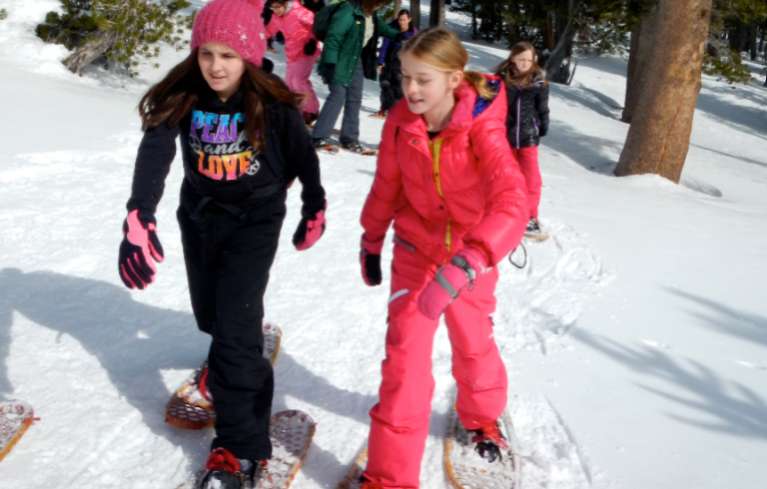
McKenna Villa, left and Braya Weaks from Zephyr Cove Elementary trek at Heavenly. Photos/Kathryn Reed

McKenna Villa, left and Braya Weaks from Zephyr Cove Elementary trek at Heavenly. Photos/Kathryn Reed

By Kathryn Reed

Students at Zephyr Cove Elementary School spent a day learning via a different kind of white board – snow.

Thirty-two students in Damon Kixmiller’s fifth-grade class spent a recent Thursday snowshoeing at Heavenly Mountain Resort as part of the U.S. Forest Service’s Winter Trek Conservation Education program.

Kixmiller believes place-based education – like this field trip – helps cement science concepts into the children’s brain. Plus, some of the kids had never been up the gondola before.

Braya Weaks liked the gondola the best.

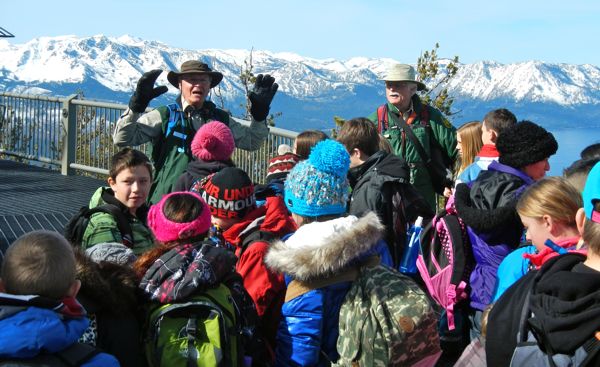
Volunteer Ranger Bob Sweatt talks about what can be seen from the mid-station.

Volunteer Ranger Bob Sweatt talks about what can be seen from the mid-station.

“It was cool to see all the tracks beneath us. I saw some bear tracks,” she said.

The entire experience is rooted in education. It starts at Explore Tahoe where the kids learn about the old style snowshoes they would be wearing. They were once handwoven by the Washoe Indians.

While Kaleb Villa was having fun, he said, “It’s pretty tiring” using the long bamboo snowshoes.

On the ride up the gondola the students learned about the history of Van Sickle Ranch, which they pass over. They see the remnants of the 2002 Gondola Fire, point to where the Upper Truckee River flows into Lake Tahoe, and see Mount Rose in the distance.

Stopping at the mid-station they get out to see the sights and learn some more – like how Mount Rose, Mount Pluto and Mount Watson are old volcanoes.

They are able to answer volunteer Ranger Bob Sweatt’s question about how the area was formed – by glaciers, volcanoes and faults.

Youngsters know the trees were harvested for the silver mines in Nevada.

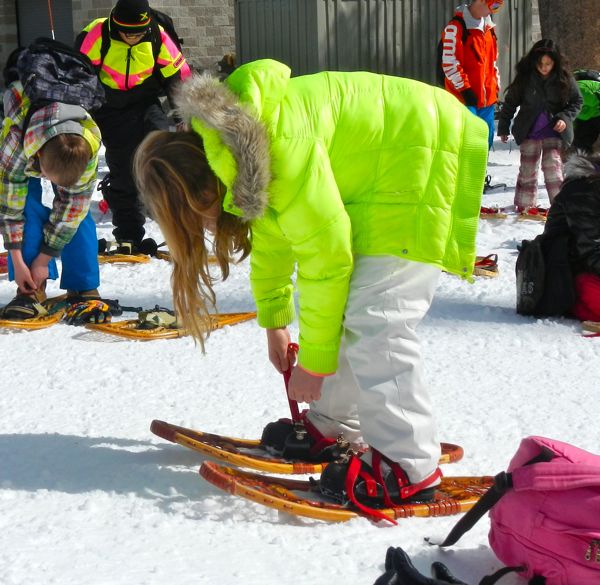
Emma Snipes tightens her snowshoe binding.

Emma Snipes tightens her snowshoe binding.

The learning started in the classroom before they got to the mountain and continues after. Kixmiller’s class creates a webpage and students do writing assignments related to the experience.

Volunteers help the Forest Service run the program. This has saved the agency money so it can keep offering the program to schools in the area. Some schools have had to skip the program because of financial reasons, like ones in Nevada City and Fallon.

Volunteer Ranger Tim Kosier has the kids sitting in an open space looking a their surroundings and asks them questions.

They know that the tree stump could be habitat for animals. And many of the prints they are likely to see in this area not far from the terminus of the gondola are bounders like rabbits, squirrels and the American pine marten.

“The American pine marten is an indicator species,” Kosier tells the students as they rest in the snow. “They indicate the health of the forest. By putting up cameras and collecting fur from pine martens we see if they are healthy. We are finding that they are healthy.”