Finding a solution for weeds

By Melinda Myers

Don’t let lawn weeds get the best of you. These opportunistic plants find a weak spot in the lawn, infiltrate and begin the take over your grass. Take back the lawn with proper care. Your lawn will not only be greener and healthier, but good for the environment.

The grass and thatch layer act as a natural filter, helping to keep pollutants out of our groundwater and dust out of our atmosphere. They also reduce erosion, decrease noise and help keep our homes and landscapes cooler in summer. And a healthy lawn is the best defense against weeds.

Start by identifying the unwanted lawn invaders. Use them as a guide to improve your lawn’s health and beauty. Weeds appear and spread when the growing conditions are better for them than the grass. Correct the problem to reduce the weeds and improve the health of your lawn. Killing the weeds without fixing the underlying cause is only a temporary solution. Unless the cause is eliminated the weed problem will return.

Here are a few of the more common weeds, the cause and possible solutions for managing them out of the lawn.

High populations and a variety of weeds mean you need to adjust your overall lawn care practices. Mow high and often, removing no more than one-third the total height of the grass at one time. Leave the clippings on the lawn in order to return water, nutrients and organic matter to the soil. This along with proper fertilization using an organic nitrogen slow release fertilizer with non leaching phosphorous can greatly reduce weeds.

Knotweed and plantains often found growing next to walks and drives or other high traffic areas can also be found in lawns growing on heavy poorly prepared soils. These weeds thrive in compacted soil where lawn grasses fail. Reduce soil compaction and improve your lawn’s health with core aeration. Aerate lawns when actively growing in spring or fall. Or replace grass in high traffic areas with permeable pavers or stepping stones to eliminate the cause.

Nut sedge is a common weed in wet or poorly drained soils. Improve the drainage to manage this weed. It may mean core aerating the lawn and topdressing with compost, regrading or the installation of a rain garden to capture, filter and drain excess water back into the ground.

Clover and black medic mean it’s time to get the soil tested and adjust fertilization. Both thrive when the lawn is starving. Clover was once included in lawn mixes because of its ability to capture nitrogen from the atmosphere and add it to the soil. If these weeds are present, boost the lawn’s diet starting this spring with a low nitrogen slow release fertilizer. It feeds slowly throughout the season, promoting slow steady growth that is more drought tolerant, disease resistant and better able to outcompete the weeds.

Creeping Charley, also known as ground ivy, violets, and plantains usually get their foothold in the shade and then infiltrate the rest of the lawn. Take back those shady spots by growing a more shade tolerant grass like the cool season grass fescue or warm season St. Augustine grass. Mow high and fertilize less, only 1 to 2 pounds of nitrogen per growing season, than the sunny areas of your lawn. Or replace the lawn with shade tolerant groundcovers. Adjust your overall care to reclaim and maintain the rest of the lawn.

Crabgrass and Goosegrass are common weeds that follow a hot dry summer. Mow high to shade the soil and prevent many of these annual grass weeds from sprouting. Corn gluten meal is an organic pre-emergent weed killer that can help reduce these and other weeds from sprouting. Apply in spring and fall applications to reduce weeds by as much as 80 percent in three years.

And, when mowing this year, consider an electric or push mower to manage your lawn in an even more eco-friendly manner.

Melinda Myers has more than 30 years of horticulture experience and has written more than 20 gardening books.
Becker Peak — short trek for big views

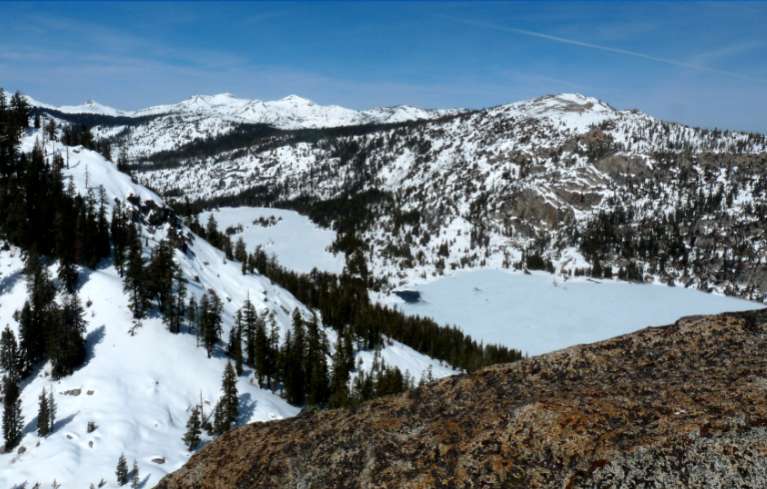
Frozen Echo Lakes from Becker Peak. Photo/Richard Matera

Frozen Echo Lakes from Becker Peak. Photo/Richard Matera

By Kathryn Reed

Crevasses and the refraction of light have Echo Lake looking like it is mirroring a sky filled with puffy cumulus clouds. It’s as though a pale blue marker has been used to draw circles on the white sheet of ice.

From our vantage point atop Becker Peak and then walking along the ridge, Echo Lake is mesmerizing.

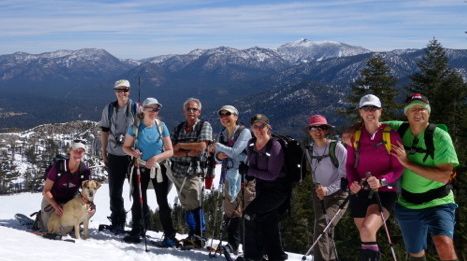
Kae, AJ the dog, Richard, Carol, Stan, Sandy, Sue, Corine, Donna and Craig almost to the top.

Kae, AJ the dog, Richard, Carol, Stan, Sandy, Sue, Corine, Donna and Craig almost to the top.

Nine of us spent last Sunday snowshoeing to the top of Becker Peak – elevation 8,391 feet.

Snowshoeing this year has required seeking out higher elevations because it’s only dirt at lake level. And while some were in shorts and others in short sleeves, the snowshoes were definitely needed. Snow even covers the road leading into Echo Lake.

A late morning start was ideal so the snow had some give to it. Almost everyone used poles, which was good on the steeper sections – for the ascent and decline.

The worst part, at least in terms of exertion, is turning off the road and heading straight up to the ridge. We made the left directly across from the Berkeley Camp and by a few no parking signs.

Some in the group advised that it’s better to start a little farther up the road during hiking season to avoid what is bushy terrain without snow.

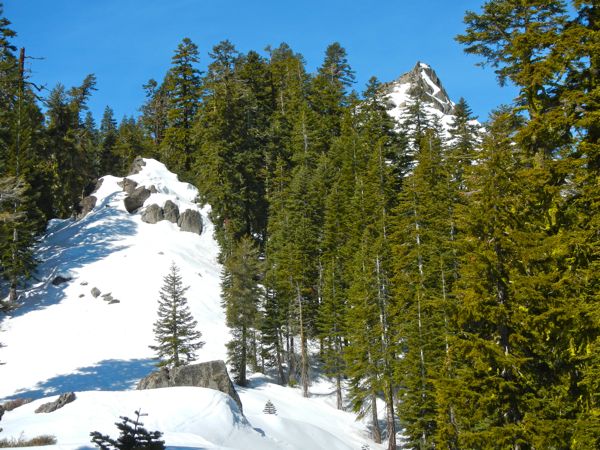
Becker Peak Photo/Kathryn Reed

Becker Peak
Photo/Kathryn Reed

There’s plenty of snow now so those bushes are not visible.

If the route up does not take your breath away, the views on top of the ridge are bound to. Flag Pole, Angora Peak, Dicks Peak, the back of Mount Tallac, Jakes Peak, the Angora burn area and Lake Tahoe all spill forth in an array of winter beauty.

And while it would be possible to call it a day at this point in terms of scenic beauty, the views only get better.

Even though Craig was correct to say the hard part was over, there is still some climbing to do.

I have to say I was glad to be with people who had done this trek before. Even though other snowshoers had laid down a trail before us, their route was a bit sketchy at times. Some said there was no way to get lost, but I’m also of the belief there is a first for everything.

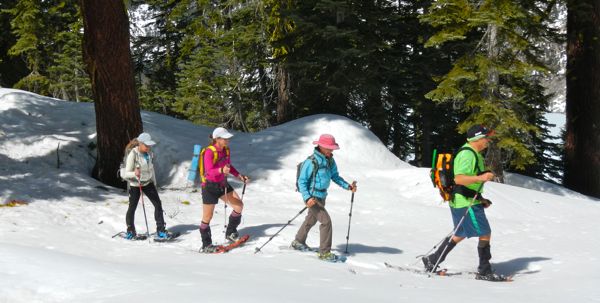
Carol, Donna, Corine and Craig snowshoeing through the wilderness. Photo/Kathryn Reed

Carol, Donna, Corine and Craig snowshoeing through the wilderness. Photo/Kathryn Reed

Not too much farther and we see the slopes of Sierra-at-Tahoe on our left and a frozen Echo Lake to our right.

We get to what could be another stopping point where there is an incredible expansive view of Echo Lake. We pause long enough for photos before making the final ascent up to Becker Peak.

The peak itself is a pile of large rocks. Off come the snowshoes so we can scramble to the top. Even AJ the dog is able to make it up to the top. We sit there a bit, having a bite to eat, taking in the views and putting layers back on to ward off the nippy wind.

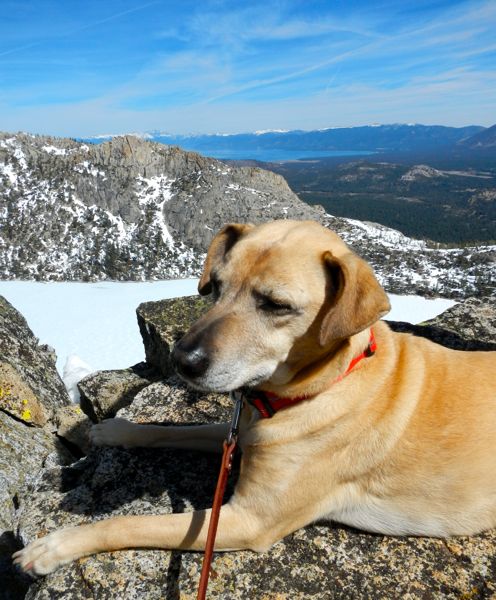
AJ with a frozen Echo Lake in the background and Lake Tahoe in the distance. Photo/Kathryn Reed

AJ with a frozen Echo Lake in the background and Lake Tahoe in the distance. Photo/Kathryn Reed

It’s 360-degrees of pure Sierra serenity.

Skiers are along the edge of Echo Lake. Talking Mountain from this vantage point looks like it would be easy to reach.

We climbed about 1,000 feet to get to this point. It’s about 4.5 miles round trip. We chose a lower route back that provided more views of Echo Lake and Lake Tahoe.

—-

Getting there:

From South Lake Tahoe, take Highway 50 west over Echo Summit. Turn right on Johnson Pass Road. Parking is to the right.

A sno-park pass is required from Nov. 1-May 30. They may be obtained online.


Pain McShlonkey Classic coming to Squaw

The Pain McShlonkey Classic returns to Squaw Valley March 29. Now in its fourth year, this action packed on- and off-mountain event serves as a hilarious tribute to legendary skier Shane McConkey.

Hosted by the Shane McConkey Foundation, the event is a fundraiser for local nonprofits, with this year’s event benefiting Make-A-Wish Foundation and the Tahoe Truckee Unified School District’s environmental education programs.

The festivities begin March 29 at 9am as athletes line up atop KT-22 for an all-out snowblade blitz. The pros will take on 30 amateurs in an anything-goes battle to the finish.

For event details, registration information, after party tickets or to make a donation to the Shane McConkey Foundation, go online.


Warm-up routine could save your knees

By Gretchen Reynolds, New York Times

Rupturing an anterior cruciate ligament in the knee is a nightmare. As the parent of a teenage son who is seven months out from ACL reconstruction surgery, I can attest to the physical and psychological toll it can take, not to mention the medical bills. But a practical new study suggests that changing how sports teams warm up before practices and games could substantially lower the risk that athletes will hurt a knee, at a cost of barely a dollar per player.

Injuries to the ACL, which connects the tibia and femur and stabilizes the knee joint, are soaring, with an estimated 150,000 cases a year. The ligament is prone to tearing if the knee shears sideways during hard, awkward landings or abrupt shifts in direction – the kind of movements that are especially common in sports like basketball, football, soccer, volleyball and skiing.

Motivated by the growing occurrence of these knee injuries, many researchers have been working in recent years to develop training programs to reduce their number. These programs, formally known as neuromuscular training, use a series of exercises to teach athletes how to land, cut, shift directions, plant their legs, and otherwise move during play so that they are less likely to injure themselves. Studies have found that the programs can reduce the number of ACL tears per season by 50 percent or more, particularly among girls, who tear their ACLs at a higher rate than boys do (although, numerically, far more boys are affected).

Read the whole story


Jitloff hangs on for win in GS at Squaw

By USSA

SQUAW VALLEY — Tim Jitloff (Reno) brought a crowd of thousands to a roaring crescendo Friday with another masterful performance in Squaw Valley to win his second consecutive Nature Valley U.S. Alpine Championships giant slalom title.

The Olympian, who grew up nearby and raced as a young athlete at the 1960 Olympic resort, captured his second victory in three days at Squaw with a 1.61 margin of victory over Brennan Rubie (Salt Lake City). Fellow Olympian Jared Goldberg (Holladay, Utah) was third, as Olympic gold medalist Ted Ligety (Park City) did not finish the final run.

“It was sketchy in there for a second, but I kept it solid, I kept it safe. When I got down at the bottom here I did charge to make sure I got in there,” Jitloff said. “I just put down two good ones today, two solid ones. I didn’t do anything over the top. Yeah, it was a good day.”


Nev. may regulate elk, deer antler collection

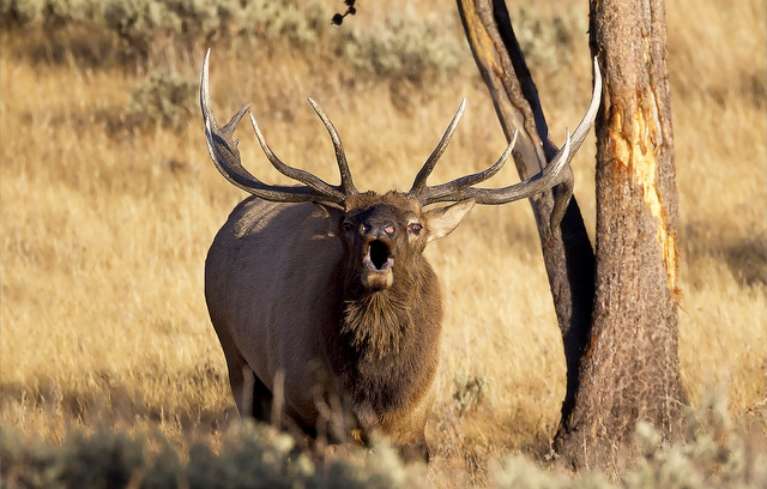
 Elk with trophy antlers. The Nevada Department of Wildlife is looking at regulating the growing practice of collecting the trophies to protect the state’s deer and elk populations. (Tim Torell/Nevada Department of Wildlife)

Nevada Department of Wildlife is looking to regulate collecting the trophies to protect deer and elk populations. Photo/Tim Torell/Nevada Department of Wildlife

By Sean Whaley, Las Vegas Review-Journal

CARSON CITY — There’s gold in them thar antlers, and as a result, the Nevada Department of Wildlife is looking at regulating the growing practice of “shed hunting” to protect the state’s deer and elk populations.

Deer and elk shed their antlers every winter and collecting them has become a lucrative pastime for some and an outdoor recreational activity for others.

The antlers are used in a variety of ways, including as chandeliers, furniture or other decorative items.

Read the whole story


Mancuso third in GS on home slope

By USSA

SQUAW VALLEY — Olympic slalom gold medalist and World Cup slalom champion Mikaela Shiffrin (Eagle-Vail) continued her storybook season Thursday with a victory in the Nature Valley U.S. Alpine Championships giant slalom.

To kick off the first day of spring, the 19-year-old technical phenom posted a 1.5-second first run lead before expanding it to a massive 1.88-second margin of victory.

It was the third U.S. title of her young career, adding to the slalom titles she locked in 2011 and 2012.

Julia Mancuso (Squaw Valley), who has won the giant slalom title for five straight seasons dating back to 2009, posted a blistering second run to jump from ninth to third.

Race conditions again proved to be perfect on the challenging Red Dog at Squaw Valley.


Utah plan would link 7 ski resorts

By Brady McCombs, AP

SALT LAKE CITY — More than three decades after the idea was first discussed, general managers at seven Utah ski resorts announced Wednesday they are committed to finally building a series of chairlifts that would link their ski areas and give the state a European-style experience.

But it won’t be available to skiers anytime soon.

Utah ski officials made clear during a news conference that it’s a concept, not a plan, with no hard timeline. Dozens of key decisions still need to be made, and the project will require permits and approvals from government officials. One general manager said he thinks it could take a decade to complete.

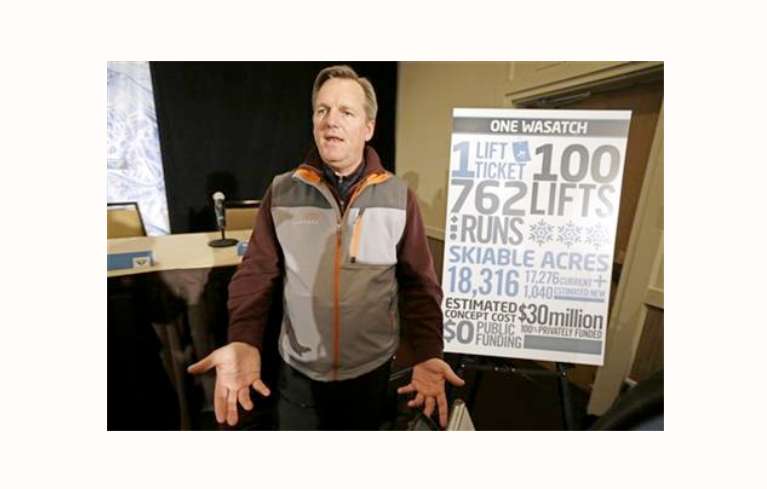
Mike Goar, from Canyons Resort, speaks with reporters following a news conference Wednesday, March 19, 2014, in Salt Lake City. A coalition of Utah ski resort managers from Alta Ski Area, Brighton Resort, Canyons Resort, Deer Valley Resort, Park City Mountain Resort, Snowbird Ski and Summer Resort and Solitude Mountain Resort are reviving their plans for a series of interconnected chairlifts that would link seven ski areas that would give the state a Euro-style experience. (AP Photo/Rick Bowmer)

Mike Goar of Canyons Resort speaks March 19 about reviving plans for a series of interconnected chairlifts that would link seven ski areas. Photo/Rick Bowmner/AP

The project is expected to cost up to $30 million, paid for entirely by the resorts, said Nathan Rafferty, president of Ski Utah, a trade organization representing the ski resorts.

It would link Alta Ski Area, Brighton Resort, Canyons Resort, Deer Valley Resort, Park City Mountain Resort, Snowbird Ski Resort and Solitude Mountain Resort. Skiers who buy one pass would have access to 100 lifts, 750 ski runs and more than 18,000 skiable acres.

By combining 25 square miles of terrain, the Utah resorts could offer North America’s largest skiing complex — three times the size of Vail, Colo., and twice as big as Whistler Blackcomb in British Columbia.

Rafferty said it would create an experience unique to North America. In Europe, lifts connecting ski areas are common. In the U.S., a daily pass to a ski resort usually confines you to that resort no matter how close a neighboring resort is.

If completed, the linking lifts would bring the spotlight to Utah’s ski community and put it in prime position to lure skiers from popular resorts in Colorado and California, ski officials said.

“You combine that with our accessibility and the airport, and there’s not a ski community in this country that can beat us,” said Jenni Smith, Park City Mountain Resort general manager.

The new proposal will reopen a debate that has long triggered strong opposition from backcountry skiers, wilderness advocates and municipal water officials.

Carl Fisher, executive director of Save Our Canyons, said the ski resorts already have a sufficient footprint on the Wasatch Range, and linking lifts would ruin pristine areas used by outdoor enthusiasts.

“It’s a gimmick, a marketing ploy,” he said. “They are trying to use to attract more tourists.”

Rafferty said the resorts are committed to maintaining the watershed, preserving backcountry ski terrain and going through all the necessary public permitting. They’ll continue talking with Fisher’s group and others with concerns, he said.

The latest proposal calls for the lifts to be built on private land. However, Fisher said he doesn’t think it’s possible for linking lifts to avoid affecting public land. Even if the lifts are on private property woven amid public parcels, the ski runs likely would be on forest land, he said.

And it’s not just about ski season. Hiking trails used in the summer would be affected as well, Fisher noted.

“You’re going to be hiking around lift towers instead of rocks and trees,” he said. “You’re going to be looking at cable and chairs instead of wildlife.”

Alta Ski Area general manager Onno Wieringa said he hopes the project can be accomplished in the next decade. But he said it will come down to each ski area crunching the numbers and seeing if it makes sense financially.

“Before we would invest $10 million or $5 million or whatever, we’ve got to feel that we’re going to get some return on that money,” Wieringa said.

Though completion of the concept may be years away, having all seven ski resorts agree on the parameters is a significant step, said Mike Goar, general manager at Canyons Resort. They’ve reached outlines for revenue sharing and identified three sites for connection points. The project now has a name, “One Wasatch,” and a website with maps and information.

“The idea was finally baked enough,” Goar said.

All seven said making it happen is long overdue. When Wieringa’s children, now in their early 20s, were tiny, he and his wife dreamed of their children being able to take an interconnected lift from the small town of Alta over the mountain ridge to Park City to go to school.

“It gets off the dime and makes us accountable to the process,” Wieringa said. “It is going to put a little heat on us.”


Changes coming to South Shore beaches

By Kathryn Reed

Expect some changes at the beaches this summer on the Nevada side of the South Shore.

Now that the Forvilly family does not have the concession at Round Hill Pines Beach it also means the Bleu Wave boat is not docked there. It is at Zephyr Cove.

Frank Forvilly, who with his wife Susan for decades operated the Round Hill Pines operation under the oversight of the U.S. Forest Service, told Lake Tahoe News their son, Ryan, is taking over the business.

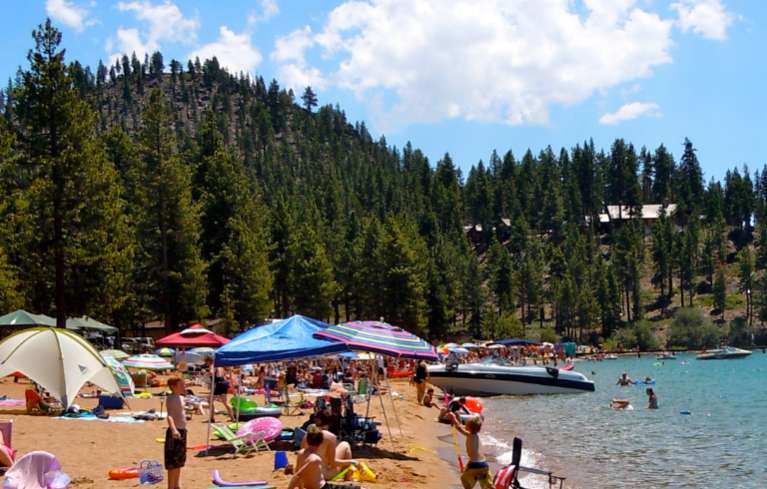
Round Hill Pines Beach will be under new operators this summer for the first time since 1968. Photo/LTN file

Round Hill Pines Beach will be under new operators this summer for the first time since 1968. Photo/LTN file

Aramark, which runs the operations on the USFS owned-Zephyr Cove site, and Forvilly solidified a contract this month. Neither returned phone calls.

The Bleu Wave is a luxury yacht. This compares to the M.S. Dixie II that Aramark runs which is an old-fashioned paddle-wheeler.

Aramark has a permit from the Tahoe Regional Planning Agency to run four boats out of Zephyr Cove.

“Regarding the operation at Aramark, TRPA is not monitoring how many boats they are running out of Zephyr Cove. They might have four, but if not, then theoretically they could bring the Bleu Wave in under their permit,” Jeff Cowen, TRPA spokesman, told Lake Tahoe News. “We would need to document it, but it may require a permit revision.”

Forvilly is also looking to conduct weddings at Nevada Beach this summer.

“Forest Service concessionaires do have the ability to sublease services, like kayak rentals, etc., but we don’t have any information about a new wedding concessionaire at the Nevada Beach pavilion,” Lisa Herron, USFS spokeswoman, told Lake Tahoe News.

Forvilly will be subleasing from Steve Lannoy, who owns Kayak Tahoe. Lannoy has the concession at Nevada Beach and other South Shore locations.

This will be the first season Bob and Tammy Hassett have operated Round Hill Pines Beach. Bob Hassett has run several marina operations on the California side for years, as well as being owner of Beacon restaurant at Camp Richardson.

Herron said potential improvements at Round Hill Pines are still in the permitting phase.

“Nothing has been submitted for the Round Hill Pines Beach location. It remains to be seen if they will need a TRPA permit. Minor modifications and maintaining the current uses are usually exempt from TRPA requirements,” Cowen said.


Jitloff wins GS at Squaw Valley

By USSA

SQUAW VALLEY — Olympian Tim Jitloff (Reno) sliced a wire-to-wire FIS giant slalom victory Wednesday to open five days of Nature Valley U.S. Alpine Championships competition in sun soaked Squaw Valley.

“It was actually just nice to get the feel on the hill. It’s a very nice hill and they could certainly run the World Cup on this if they wanted. That’s a tough hill, you have to bring a lot of intesity,” Jitloff said.

The race, a precursor to Friday’s U.S. Championship event, was on Red Dog with incredible snow conditions and a large crowd of fans, friends and families on hand to enjoy the annual alpine skiing end-of-the season celebration.

2014 NCAA giant slalom champion Mark Engel (Salt Lake City) of the University of Utah was second, followed by two-time Junior World Champion and current NorAm overall champ Ryan Cochran-Siegle (Starksboro, VT.).