Ski conditions decent despite scarcity of snow

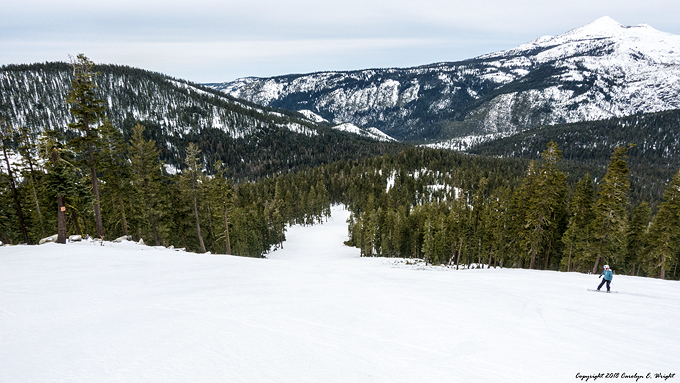
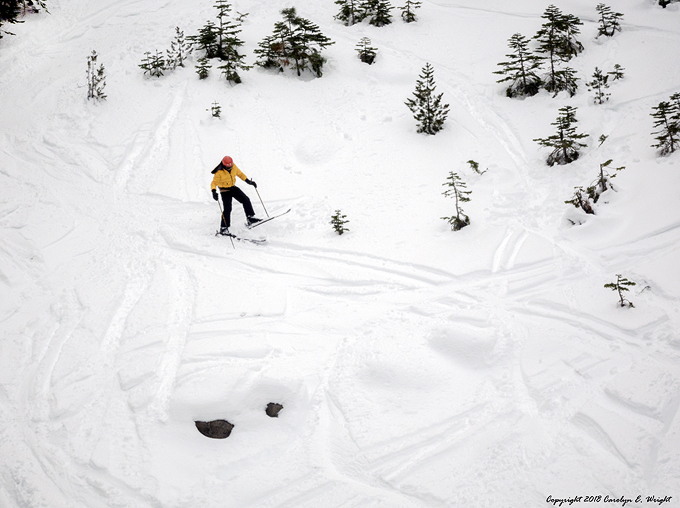
It’s as though the trail of snow leads to the top of Pyramid Peak. Photo Copyright 2018 Carolyn E. Wright

By Kathryn Reed

TWIN BRIDGES – Perfect corduroy. Slightly crusty powder. Hard pack. Soft, pillowy snow. Dirt and twigs.

Ski conditions are so variable right now in the greater Lake Tahoe area that it depends on the run, not just the ski resort.

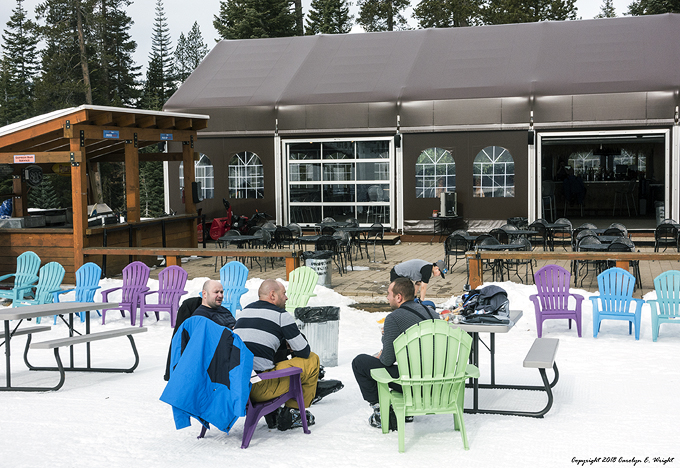
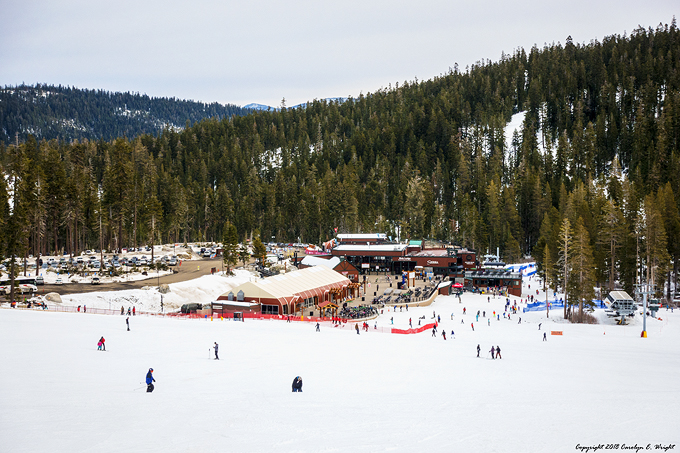
Sierra-at-Tahoe on Monday was a mixed bag, with mostly pleasurable moments. And considering the mountain was devoid of the masses that were here during the weekend, it meant wide-open runs, no lift lines, and no waiting for a cocktail.

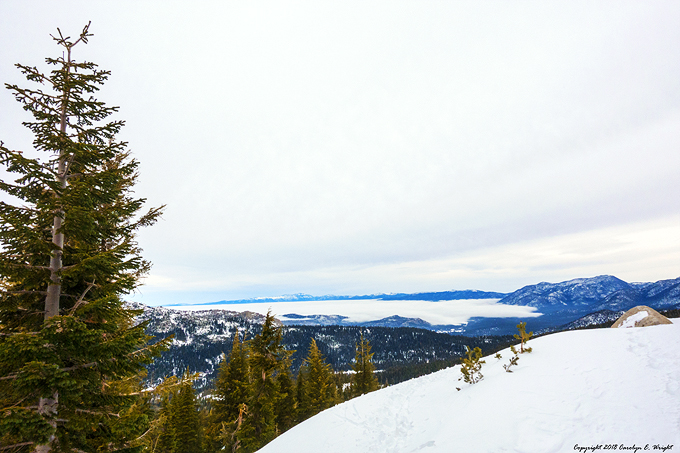
Fog covers Lake Tahoe on Jan. 29 as seen from the 360 Smokehouse at Sierra. Photo Copyright 2018 Carolyn E. Wright

Lower Main had been transformed into a race course for high school teams, with the public side a mogul lover’s dream.

As with most seasons when Mother Nature is remiss at providing ample white stuff, the groomers and snowmakers can save a season.

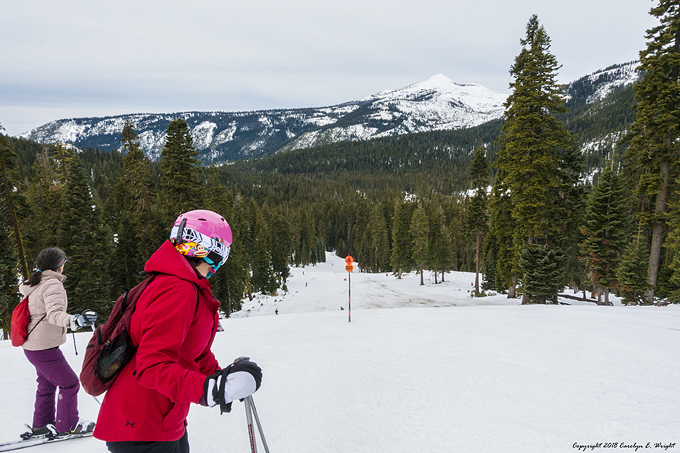
Skiers assess the terrain on Beaver where coverage is lacking a bit. Photo Copyright 2018 Carolyn E. Wright

The groomers are being put into overdrive right now while an inversion hangs over the area. It means temps at lake level are colder than they are on the slopes. Snowmaking requires a certain temperature; it hasn’t dropped low enough the past few nights for the guns to be fired up.

It wasn’t until last week that the West Bowl area of Sierra opened; the back side is also open. This is super late in the season for these areas to be accessible.

Time to shed layers at West Bowl in the warm temps. Photo Copyright 2018 Carolyn E. Wright

All resorts in the region were able to open more terrain after last week’s dump. The problem, though, is the forecast is dry through at least Valentine’s Day. The love from the snow god’s just hasn’t been here this season for the resorts, which are coming off a record snowfall a year ago.

Going down Dogwood off the West Bowl chair it was near perfect conditions. There is no indication there is a lack of snow. But then when the trail merges onto Beaver it’s another world. A lot of brown snow can be found here. Still, it’s manageable. No rocks could be seen.

Skiing in closed areas is never a good idea. Photo Copyright 2018 Carolyn E. Wright

Upper Powderhorn was super – plenty of snow (all white) – and nicely groomed.

Sierra does an excellent job of posting signs about conditions ahead. Pay attention.

One yahoo decided to duck under the roped off area of Clipper that said “closed.” Observing from the chairlift, he was in way over his head. These are the people that end up unnecessarily putting ski patrollers’ lives at risk.

Nearly the entire mountain at Sierra is open for skiing/snowboarding. Photo Copyright 2018 Carolyn E. Wright

Tree skiing is always risky; it’s even more so when there isn’t ample snow. And closed, means closed. Those powder stashes aren’t worth it.

Considering February and March are two of Tahoe’s better months for skiing, it’s possible plenty of powder days are still to be had this season.


Blue moon, supermoon, total lunar eclipse rolled into one

By Associated Press

The moon is providing a rare triple treat this week.

On Wednesday, much of the world will get to see not only a blue moon and a supermoon, but also a total lunar eclipse, all rolled into one. There hasn’t been a triple lineup like this since 1982 and the next won’t occur until 2037.

The eclipse will be visible best in the western half of the U.S. and Canada before the moon sets early Wednesday morning, and across the Pacific into Asia as the moon rises Wednesday night into Thursday.

Read the whole story


Douglas County recruiting search and rescue members

Douglas County sheriff’s search and rescue is having an academy in April for potential members.

Rescuers are essentially on call 24/7; working in the county and helping neighboring rescue teams.

DCSAR is accredited by the Mountain Rescue Association and responds to high/low angle rope rescue events, reports of lost or injured backcountry snowshoeing, skiing, snowmobiling and hiking incidents. The volunteers also handle fire evacuations, river or flood rescues and lost/overdue off road drivers. Any previous experience in any of this areas are useful, but not a requirement to attend the academy.

Anyone who enjoys the outdoors, is over 18 year of age and has a desire to serve their community in times of emergency may apply. Comprehensive training is provided to ensure all members are safe and capable. There is no testing for physical limitations, however members must be able to go out into the back country in any type of weather.

The academy begins April 6. Applications are available online. They are due March 1.

For more info, email dcsar@douglasnv.us.


Memorial snowshoe at Camp Rich in February

Fresh Tracks 5K Snowshoe Walk and Race — the Eric Nageotte Memorial – will be Feb. 25 at 10am at Camp Richardson.

Tahoe Mountain Milers Running Club is hosting the event. Beneficiaries are Girls  On The Run-Sierra and Metastatic Breast Cancer in honor of club member Renee Gorevin and local doctor Kelly Shanahan. 

Sign up by Feb. 10 to save $10. Reserve a pair of snowshoes if you need them or bring your own. Walkers welcome.

Preregistration is $25, which includes a winter beanie, snowshoe rental if needed, post-race refreshments, and continued day use of groomed Camp Richardson trails. Day of race registration is $35. Signup online.


Measure R’s ‘extra’ money for fields exhausted

By Kathryn Reed

The $500,000 that Measure R provided for South Lake Tahoe fields has been spent.

The recreation joint powers authority that oversees the bond was given an update about the status last week. That board is made up of representatives from South Lake Tahoe, El Dorado County and Tahoe Paradise Resort Improvement District.

Originally called Measure S when voters passed it in 2000, it was renamed Measure R in 2011. At that time voters agreed to restructure how the money was spent on fields and bike trails. The property tax assessment expires in 2030. (Voters could reauthorize it or it could be rewritten in some manner.)

Field improvements included the play area at Sierra House Elementary School, funds for South Tahoe High School’s softball field, and the new field and new T-ball field at Al Tahoe.

Until the measure expires in 12 years, $50,000 will continue to go toward field maintenance on an annual basis.

“It is designated to go for maintenance of the field and other facilities built with JPA money at LTCC,” John Upton told Lake Tahoe News. Upton is the lone paid staff member of the JPA. He has overseen Measure S since the get-go, and was instrumental in it evolving into Measure R.

“The money goes to the city, which then transfers it to the consortium, of which the city is a partner. The provision for the $50,000 going to the city for that maintenance is part of the original JPA Joint Facilities Agreement,” Upton explained.

The Community Play Consortium was created in the past couple of years, with the city and Lake Tahoe Community College the members. They control the artificial turf field where the college soccer team plays, which was the original community field paid for by Measure S. The two new fields built last year near that site and where SnowGlobe was held the last two years are the other fields under the purview of the consortium.

At this time the consortium is satisfied with the $50,000 it receives. Representatives can always ask for more, but there is no guarantee it would be forthcoming.

Lauren Thomaselli, who heads the city’s recreation department, told the JPA board that the long-awaited concession stand is finally going to be built. The $15,000 left over from the restroom facility will be used for the food venue. It will be an addition to the current structure.


Season pass war heats up between Vail, Alterra

By Jason Blevins, Denver Post

Skiers and snowboarders notched yet another victory Monday as Telluride ski area joined the Epic Pass for the 2018-19 season, the first limited-access partner to take up with Vail Resorts as it squares off with Alterra Mountain Co. in a season-pass brawl.

Last week, Denver-based Alterra announced its Ikon Pass, an alliance of 23 owned and partner resorts that would vie to unseat the decade-old Epic Pass’ 750,000 annual sales.

The two passes could soon account for up to a third of all North American skier visits, and the winners in the snowy skirmish will be skiers.

Read the whole story


Virtual reality helps U.S. Olympic ski team

By Rick Maese, Washington Post

There are mountains in the Alps, from Austria to France, that veteran alpine racers have skied dozens of times over the years, so often they know every curve and can anticipate every bump.

“There’s some guys on tour for 15 years who have 60 runs down these hills,” said American skier Travis Ganong. “At that point, it’s kind of ingrained — they know where to expend energy, where to save energy, where to push the line and where to hold back.”

And then there’s the downhill course for next month’s PyeongChang Games, located in the Taebaek mountains about 90 miles east of Seoul, far removed from the World Cup circuit and foreign to most ski racers. Most of the world’s top skiers have raced the Olympic course just a couple of times.

Read the whole story


Quadruple cork is the future of snowboarding

By Gordy Megroz, Outside

Snowboarders in South Korea will fly higher and perform more-complicated maneuvers than ever before, thanks in part to practice airbags. The cushy landings provided by the stuntman-style crash pads mitigate injury risk, allowing riders to master tricks they’d otherwise never dream of trying.

“The amount of progression that occurred during the 20 years when we didn’t have airbags has been matched during the four years since we started using them,” says Jack Mitrani, a former competitive rider.

Still, one of the hardest moves we’re likely to see at the 2018 Winter Games was developed the old-school way, by repeatedly bashing out attempt after attempt on cold, unforgiving snow.

Read the whole story


Oddsmakers cry foul over NBA’s proposed ‘integrity fee’

By Todd Dewey, Las Vegas Review-Journal

For years, the NBA and other major pro sports leagues claimed they wanted to stop the spread of legal sports betting in order to protect the integrity of their games.

Now, the NBA wants a piece of the action. To protect the integrity of the game.

If, as expected, a federal ban on sports betting is lifted in the coming months, the NBA wants sports books to pay the league 1 percent of the money wagered on its games as an “integrity fee.”

Read the whole story


Tahoe basin home to a variety of unusual species

By Adam Jensen

Think of them as your next-door neighbors — the hundreds of species of wildlife inhabiting the Lake Tahoe region. From boas to beavers to salamanders that roll down hill, the area boasts some unique inhabitants. Each is adapted to its own niche in the sometimes unforgiving Sierra Nevada. Some species you may know, others maybe not, but here’s a look at just a few of Lake Tahoe’s wildest locals.

Showshoe hares and white-tailed jackrabbits

As you’re out and about this winter, there are two types of rabbit species that may be donning new coats right alongside you. Both the snowshoe hare and the white-tailed jackrabbit make their homes at Lake Tahoe, and both turn white during the winter months to camouflage themselves from predators.

While some people assume all white rabbits seen during the winter at Lake Tahoe are snowshoe hares, white-tailed jackrabbits are widespread in open country above 8,000 feet, said Will Richardson, executive director and co-founder of the Tahoe Institute for Natural Science (TINS). Snowshoe hares, the smaller of the two species, can be found “just about anywhere on the West Shore,” he added.

Another common rabbit variety, cottontails, began their spread around the Lake Tahoe Basin in the early 2000s and closed the final gap in their east-to-west distribution in 2016, Richardson said. TINS is interested in speaking with people with first-hand knowledge of when the cottontails began appearing  in their neighborhoods to further its understanding of the species’ spread.

“I’ve been here 21 years, and I think the first time I saw a rabbit was five years ago,” said Kathy Strain, a South Shore resident and associate professor of biology and environmental science at Lake Tahoe Community College.

The spread of the cottontails may have helped the gray fox expand its range into the area as well.

Mountain beaver

People may be familiar with the distinctive dams built by the paddle-tailed variety of American beavers, which were pre-settlement inhabitants of the Lake Tahoe region before being trapped out of existence in the area and later reintroduced.

There’s another variety of beaver that also calls the area home. The mountain beaver is significantly smaller than the American beaver and lacks the distinctive tail. Richardson described the species as an “overgrown and very primitive vole.”

While they don’t build large dams like the American beaver, the burrowing species can still change hydrology, making perennial streams go underground through extensive tunnels it builds just under the soil surface.

“There’s not a lot known about them,” Richardson said. “We seem to think that they’re fairly rare.”

There are American beavers all around the Tahoe area, as well as muskrats, which could be confused with the mountain beaver. The muskrat has a long, flat tail, while the mountain beaver’s tail isn’t clearly visible.

Northern rubber boa

“Boa constrictor” and “Lake Tahoe” are not often found in the same sentence, but the area does host a species of snake that uses constriction to catch its food.

The northern rubber boa varies in color from brown to orange to pink and can be found in a variety of habitats around the lake. Desolation Wilderness, near the lake’s southwest corner, offers particularly inviting environs for the snake.

The boa can reach about 2 feet in length and is not dangerous to humans. Its head-like tail confuses both predators and prey, and it has a reputation among herpetologists as having one of the better personalities among its ilk.

“If there’s a sweetheart in the reptile world, it’s the rubber boa,” Richardson said.

One snake variety with a less stellar reputation among the public, the rattlesnake, may also be finding homes closer to the Lake Tahoe Basin.

It’s pretty clear that rattlesnakes are able to reach the Lake Tahoe Basin from the west, Richardson said, noting the number of the venomous snakes that can be found at places like nearby Lover’s Leap. It’s unclear if they are also able to make it up from the east, Richardson said.

There is evidence that climate change is driving species to higher elevations. Whether the movement of rattlesnakes toward Lake Tahoe is temporary or a long-term trend is unclear, Richardson said.

While rattlesnakes may not be people’s favorites, Richardson noted they do provide an important ecological role of controlling rodent populations that can spread disease.

The Western pearlshell mussel can be found in the Upper Truckee River. Photo/LTN file

Western pearlshell mussel

Mussels may be more associated with the California coast than the Sierra Nevada, but some South Shore streams host a long-lived native bivalve that is an indicator of environmental health.

The average life span of the western pearlshell mussel is 60 to 70 years, although some individuals are thought to have lived more than 100 years, according to the Xerces Society for Invertebrate Conservation.

“Because this species is sedentary, sensitive to environmental changes, and long-lived, it can be an excellent biological indicator of water quality,” according to the society.

The mussels depend on trout species as part of their life cycle, as the juvenile form of the western pearlshell attach to fish prior to dropping off and burrowing into soft substrate as adults.

The native mussels should not be confused with Asian clams, an aquatic invasive species that has established populations in the lake, or quagga or zebra mussels, potentially devastating aquatic invasive species that can be found in western waterbodies but have been kept out of Lake Tahoe through prevention efforts including mandatory boat inspections.

Mount Lyell salamander

The often dry slopes of the Sierra Nevada can be a harsh environment for amphibian species. Still, the Lake Tahoe area does support native populations of frogs, toads, and salamanders.

One of these salamander species, the Mount Lyell salamander, makes its home soaking up the water near snowfields and doesn’t have an aquatic phase in its life cycle.

Living below ground and staying inactive during extreme temperatures and conditions, the small gray-to-brown salamander blends in with its granite surroundings. It has also developed an unusual way of defending itself.

 “Because they live in steep, rocky, icy terrain, when they get threatened, they curl themselves into a wheel and actually roll downhill,” Richardson said.

Canyon live oak

Known for its expanses of pine trees, Lake Tahoe also supports satellite populations of canyon live oak trees, which are typically found at lower elevations in the foothills.

The trees, also known as golden cup oaks, attract specific species of animal communities.

The California sister butterfly, which features an orange spot near the tips of its wings, is among the species people can find living near canyon live oaks, Richardson said.

Once completed, the Incline Village to Sand Harbor Bike Path will be a great place to look at some of Tahoe’s oak trees. The hike down to Vikingsholm in Emerald Bay also provides glimpses of some huge individuals.

Spotted owl

When it comes to owls, people are most likely to hear great horned owls at Lake Tahoe, and they’re most likely to see northern pygmy owls, active during the day and given away by squawking birds signaling their arrival. People could also find spotted owls — but only if they’re extremely lucky.

There’s a handful of breeding pairs in the area, but the nocturnal species doesn’t make itself known to the casual observer, Richardson said.

As with a great deal of wildlife viewing, staying quiet, patient, and observant are keys to finding some of Lake Tahoe’s more unusual wildlife. It also never hurts to be in the right place at the right time.

Adam Jensen is the environmental education specialist with the Tahoe Regional Planning Agency. This article is republished from the winter 2017 edition of Tahoe In Depth.