Sierra river could win wild and scenic protections

By Don Thompson, AP

SACRAMENTO — Part of a river draining the central Sierra Nevada could win new protections from a wild-and-scenic designation under a bill approved by the state Senate on Thursday, despite complaints that the action could aggravate water shortages caused by California’s drought.

The state Senate voted 22-12 to apply the designation to nearly 37 miles of the Mokelumne River in Amador and Calaveras counties.

SB1199 by Sen. Loni Hancock, D-Berkeley, heads to the Assembly over the objections of Sen. Tom Berryhill, who represents the region affected by the proposal.

Berryhill, R-Twain Harte, said the designation would prohibit dams and diversions while restricting land use along the river just when the state needs the water most.

“I just can’t understand why we would ever start taking options off the table,” said Berryhill, noting that water districts and Amador County supervisors are opposed. “With California reeling from a drought, now is not the time to set aside another river district.”

He also objected to Hancock proposing a bill affecting his district.

“I don’t think the author would appreciate me going into Berkeley and doing a bill there,” he said.

Hancock said the 157-mile-long river provides water to 1.3 million residents in counties east of San Francisco. She said the bill protects existing and future water rights of four water districts in Amador and Calaveras counties.

“I am bringing this designation forward as a Californian,” Hancock said. “This is, in fact, all of our river.”

The bill would designate 20 miles of the river’s North Fork as wild, and nine miles as recreational. Three miles of the main stem of the river would be designated as scenic, and 4.6 miles as recreational. The designation would stop at the Pardee Reservoir, about 60 miles southeast of Sacramento.


Ropes course tests physical, mental strength

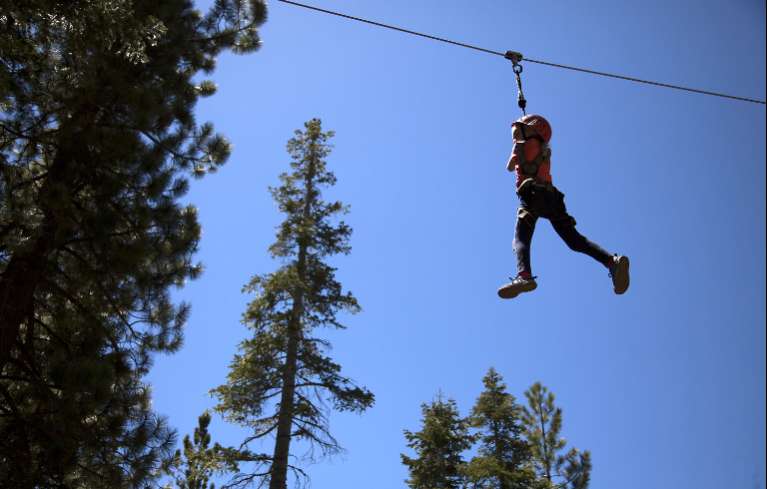
Gabriella Thompson, 6, flies through the air at the ropes course in Tahoe City. http://northtahoeadventures.com/

Gabriella Thompson, 6, flies through the air at the ropes course in Tahoe City. Photo Copyright 2014 Carolyn E. Wright

By Kathryn Reed

TAHOE CITY – A cable to walk on that is no bigger around than the diameter of an average finger, balance beams swinging a hundred feet off the ground, bridges swaying even without the wind, ropes that turn climbers into spiderpeople. These are just a few of the contraptions of the ropes course at Granlibakken.

“I’m like Indiana Jones,” 8-year-old Jace Smith of Vancouver, Wash., says as he scampers along a bridge. His parents are below with cameras and words of encouragement.

His friend, Gabriella Thompson, 6, of Corpus Christi, Texas, is all smiles as she whirs through the air on a zipline.

They are on the Flying Squirrel course, which is designed for kids as young as 5. Apparatuses are closer to the ground and the safety equipment is different than what it is used on the adult course. But big kids can go on this one, too.

Bridges is a loosely used word by designers. It’s really some contraption to get from Point A to Point B. And never is it a solid bridge in the traditional sense, where one feels secure and doesn’t think twice about crossing it.

These bridges are tricky. They all move. Sometimes the only thing to hang onto is your harness. Steps can be at angles or much farther apart than is comfortable. Ropes to grasp sometimes feel out of reach.

One “bridge” is really a snowboard suspended in air that requires hanging on like you’re water skiing.

And the ground, well, it’s always quite a ways down.

Some of the courses have ziplines going from one platform to another. These are brief opportunities to catch your breath, or take a look around at the incredible scenery. But that’s assuming ziplines don’t take your breath away.

All the stations are tucked into the woods.

The whole thing is like an adult jungle gym.

These ropes courses are not for people who like staying in control and in their comfort zone.

Ricki and Mark Viray came over from Marysville for the day to test their agility in the Monkey zone. There are five options – one beginner, three intermediate and one advanced. It’s possible to do all five in the time allotted.

Even though Mark Viray has a desk job, it’s in the military, so he has more practice doing things like this. His wife shows off her balancing skills by not holding onto ropes or her harness as she cautiously puts one foot in front of the other.

Carolyn Wright of Zephyr Cove is thanking her Pilate’s instructor for building up her core muscles.

Balance and a bit of upper body strength, along with the mindset that fear of heights is not going to cause paralysis, are helpful.

“Fear of heights is such a common fear. I don’t think you overcome it, but you learn to manage that fear,” Jesse Dessens, president and CEO of North Tahoe Adventures, told Lake Tahoe News.

Besides friends and couples who want to challenge themselves, the courses are often used by families and as team building excursions by companies.

Twenty people can go in a group, with groups starting every hour.

This will be the third summer North Tahoe Adventures has operated the ropes courses at the Tahoe City resort. Their Squaw Valley operation has existed for 16 years.

Notes:

• North Tahoe Adventures runs the ropes course at Granlibakken. More info is online.

• Phone – 530.581.7563

• Cost — $50 for 13 and older; $40 ages 5-12. Sessions are 2½ hours.

• Maximum weight – 260 pounds.

• Open year-round.

ngg_shortcode_0_placeholder (Click on photos to enlarge.)


USFS work on Upper Truckee River resuming

Work on restoring the Upper Truckee River will resume June 2. The U.S. Forest Service and California Tahoe Conservancy are working on what’s called Reach 5.

The first stage involves the reinstallation of a temporary bridge. During bridge installation and once the temporary bridge is in place, passage underneath the bridge will not be possible. Boaters will need to remove their vessels from the river and carry them around the bridge, which is located approximately 5,000 feet downstream from the Highway 50 crossing at Elk’s Club.

The next step will be the construction of a temporary access road and the installation of construction and boundary fencing. Then construction of the new channel begins.

Approximately 7,400 feet of new channel will be built in two phases, over four years that began in 2013.

The project will replace the existing stream channel with a new channel that is designed to be more stable. It is connected to the adjacent floodplain, which is expected to provide a better aquatic habitat, support a healthier meadow ecosystem, and reduce the amount of fine sediment that reaches Lake Tahoe.

For safety reasons, the area will be closed from June 15-Oct. 15. The closure area and more info is online.


Mountain festival returns to North Shore

The second summer Alpenglow Mountain Festival is June 21-29 on the North Shore.

The festival is a celebration of human-powered events, demos, presentations, film and more. Participants may hike, trail run, and enjoy natural history excursions and lake shore yoga.

Alpenglow Mountain Festival is geared toward beginner and intermediate summer recreation enthusiasts,

offering a range of activities for all interests and ability levels. The majority of events are free and space is limited. Participants are encouraged to register online in advance.


USFS finalizing plans for Tallac improvements

The U.S. Forest Service wants to make improvements to the Tallac Historic Site based on what the public believes should happen at the South Shore facility.

An alternative that was developed in response to public comment was chosen as the preferred alternative. People who previously commented have until mid-July to make more comments on the draft Historic Facilities Best Management Practices Retrofit project.

The project is designed to improve water quality and improve recreation opportunities at the site. Improvements would include infiltration basins, planted swales, and slope stabilization along the shoreline. Other work calls for the installation of barriers to prevent off-pavement parking, configuring better pedestrian routes, planting native plants, and repairing existing fences.

At Kiva Point informational signs would be installed, the pathway from the parking area to the beach would be upgraded to meet disability accessibility standards, and some user-created trails would be removed. A restroom would be built at the parking area, 20 additional parking spaces would be constructed, and a fence would be installed between the beach area and Taylor Creek Marsh.

The proposed project is designed to improve traffic by reconfiguring the three entrances along Highway 89 (Valhalla, Tallac, and Taylor Creek) into two entrances located at the existing Taylor Creek Visitor Center intersection and across from the Camp Richardson corral entrance. An internal road would connect the intersections.

The Tallac Site parking area would be expanded to include an additional 90 parking spaces. The Valhalla parking area would be expanded to include an additional 45 spaces. And the existing unimproved parking area near the Valhalla entrance would be paved.

The volunteer campground at the Baldwin Trailer Park site would be upgraded and reconfigured to include 15 additional campsites that meet accessibility guidelines.

If funding comes through, work on the 10-year project could begin next May.

For more information, go online.


Wild Tahoe Weekend all about native species

U.S. Forest Service Lake Tahoe Basin Management Unit will host the fourth Wild Tahoe Weekend on June 7-8 at Taylor Creek Visitor Center.

The weekend event consists of the Lake Tahoe Bird Festival on that Saturday and the Native Species Festival on Sunday.

Lake Tahoe Bird Festival, a family event, is free from 10am-3:30pm. The event includes guided bird walks along the Rainbow Trail every hour until 1:30pm, a bird art contest for all ages, information on migratory birds and spotting scope use, and a presentation by master falconer Marie Gaspari Crawford that includes live birds of prey.

Art submissions (photography, sculptures, drawing, paintings, etc.) for the bird art contest may be submitted to Rena Escobedo at rescobedo@fs.fed.us before June 4.

For a schedule of activities, go online.

Native Species Festival on that Sunday is from 10am-4pm.

Walks led by field professionals and local students will teach people about native Tahoe yellow cress, quaking aspen trees, and local wildlife. The event will also feature a nature walk for dog owners. Students will present a program called, “What is a Swale?” at the amphitheater in the afternoon.

For more information, contact Jean Norman at 530.543.2694.


Free 2-day tennis clinic for Tahoe kids

Douglas County is offering two days of free tennis instruction for children 8 and older.

Veteran instructors Rob Wheatley and Hersh Herschman will lead youngsters through a variety of drills that are designed to introduce them to the sport as well as refine skills of those who are more experienced.

There will be a limited number of rackets available for those who need one. Come dressed to play – which means athletic wear and non-marking shoes. Be sure to bring water and sunscreen.

The clinics are June 14-15 from 11:30am-1pm at the Zephyr Cove Tennis Club on Warrior Way. Children may participate one or both days. Arrive 15 minutes before the start time. This is open to all youth in the Lake Tahoe Basin.

Pizza will be delivered courtesy of Coyote Grill in Round Hill and the Northern California section of the U.S. Tennis Association will provide goodies for each participant.

Space is limited and preregistration is required. Call 775.586-7271 to register or for more information.


Expect road delays during Sunday’s bike ride

The 23rd annual America’s Most Beautiful Bike Ride is June 1 starting at MontBleu casino in Stateline.

Cyclists will be riding clockwise around the lake.

Highway 89 will have delays. Vehicles will be banned from going north between 6:30 and 8:30am. The southbound lane will remain open at all times.

For more info, go online.


Learn about wildflowers at Washoe Meadows

California Native Plant Society member Lisa Berry will lead a wildflower walk through Washoe Meadows State Park on June 1 from 10am-1pm.

Berry is a UNR graduate with interests in hiking, skiing, rock climbing and wildflowers. She teaches English and wildflower classes at Lake Tahoe Community College.

To join the hike, RSVP to Lynne at LCPaulson@comcast.net or Krissi at 530.577.4335. They will provide location and more details.


Squaw Valley at a distinct crossroads

By Julie Brown, Powder

I am the product of a Squaw Valley romance. In 1974, my dad moved there to join the ski patrol, a job he had been dreaming of since he was a high school misfit growing up in Sacramento. Six years later, he met my mom, a Chico State college student who spent her winter semester loading chairs. They fell in love over deep Sierra snow and lived happily as newlyweds in a shack on Squaw Valley Road that was so cold the water would freeze in the dog bowl every night. They taught me how to ski at Squaw, and as a result, I’ve pursued a life in the mountains. But the home I know is on the precipice of a radical change.

Ten miles north of Lake Tahoe, the second deepest lake in the U.S., Squaw Valley Ski Resort sits at the far end of a U-shaped valley. A vibrant meadow and a bitterly cold creek run up to the foot of a towering granite wall, the masthead to the five peaks that collectively make up the ski resort. Each mountain stacks up behind the other, higher and higher up the valley, a staircase that rises 3,000 vertical feet until the top of 9,050-foot Granite Chief. In the best of years, storms pound on Squaw’s mountains from November to May and can drop several feet of snow in a day. And after the storm retreats, the sky is the clearest of blues. Meanwhile, chairlifts climb to the tops of all the summits a skier can see, granting them the best access to the steepest terrain around. Gnarled rock is etched into the mountains’ embankments, forming features with names like the Fingers, the Chimney, and China Wall, cliffs that generations of skiers have approached to prove their worth.

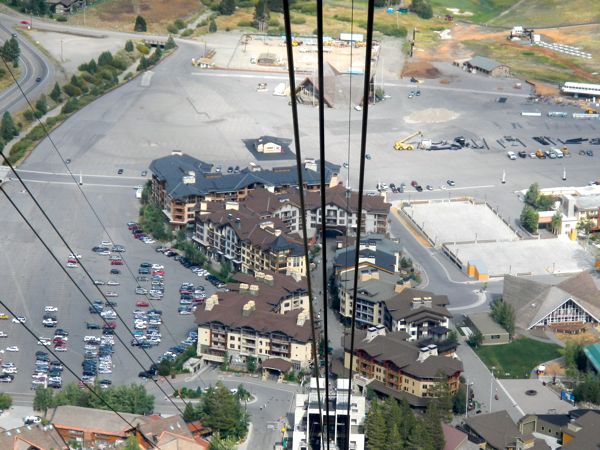
At the bottom of the mountain, vast parking lots stretch to the east and to the north. That’s where Squaw Valley’s development plan, now going through the approval process, would increase the size of the base area sevenfold. The proposal most recently submitted to Placer County outlines a completely revamped village with buildings that could reach seven stories, 1,757 additional bedrooms, and a 90,000-square-foot water-based recreation center that Squaw management said would attract 300,000 annual visitors. In short, Squaw Valley is on the verge of its biggest overhaul since the 1960 Winter Olympics came to town.
Resort owners want to completely transform Squaw Valley's village area. Photo/Kathryn Reed

Resort owners want to completely transform Squaw Valley’s village area. Photo/Kathryn Reed

On Dec. 6, 2010, Nancy Cushing, the widow of Squaw Valley founder Alex Cushing, sold Squaw Valley Ski Corp for an undisclosed amount to KSL Capital Partners, one of Denver’s largest private equity firms. Eric Resnick, KSL’s managing director and a former executive at Vail Resorts, told the Denver Post that his company had found a “crown jewel.” Along with the ski area’s iconic mountains, the company saw a blank canvas primed for building a resort destination.

“Squaw Valley is the birthplace of the modern mountain resort in the United States, with a heritage, history, amenities, and perhaps most of all, extraordinary terrain that can never be replicated,” Resnick said at the time.

The acquisition added Squaw Valley to a list of well-known hotels, spas, golf courses, and elite clubs that KSL has owned across the globe, including places like the Grand Wailea Resort Hotel & Spa in Maui, the historic Hotel del Coronado in San Diego, and ClubCorp, the largest owner of golf and country clubs in the country. KSL outlines its investment philosophy on its website—they acquire assets in the travel and leisure sector, assign an independent team to manage that asset, pour money into growing the business, and “generate attractive rates of return for its investors,” which include public state and corporate pension funds, private and university endowments, and wealthy individuals, among other sources. In the months leading up to the transaction, KSL named Andy Wirth as the new CEO. Wirth had previously led similar ventures for Intrawest at Steamboat Springs, Colo.

“This mountain, this organization needed new ownership,” says Wirth. “It’s an incredibly soulful mountain, a remarkable mountain. The company itself—the facilities were undercapitalized, poorly marketed, and not very effectively managed. And frankly, virtually everybody in the ski industry knew this.”

In three years, Wirth cleaned house at Squaw. Management focused on customer service and the lifties said hello more often. Starbucks moved in with a ski-in/ski-out coffee stand. Wirth said the resort reduced its environmental footprint by 15 percent. And in September 2011, KSL bought neighboring Alpine Meadows, unifying two of the best ski areas in Tahoe. But the biggest change didn’t roll out until the following December. In an effort to globally compete as a resort destination, Squaw Valley submitted an application to the Placer County Planning Department to build a new village.

The latest draft of their proposal calls for more condos, hotels, and cabins, plazas and courtyards, shops and restaurants. It includes pedestrian-friendly walkways and a world-class training facility called the Mountain Adventure Center, complete with pools, waterslides, zip lines, and a lazy river, according to the latest renderings. Attempting to be a good valley neighbor, Squaw is planning to mitigate its environmental impact. The development plans include restoration of Squaw Creek, which has been listed by the Environmental Protection Agency as an impaired waterway since 2002, and nearly all of the project is infill development, so the structures will be built on property that has already been disturbed, like parking lots. Additionally, Squaw would commit $1 million annually to fund environmental projects. According to the resort, the development would double the resort’s employment capacity, bring in some $20 million in additional tax revenue, and diversify the ski resort’s business so it can be successful year-round, with or without snow, an aspect of the business that’s become glaringly relevant as Tahoe goes through its third drought year in a row.

“We sure as hell have the mountains,” says Wirth. As he sees it, it’s not the skiing that’s holding Squaw Valley back. It’s the lack of places for people to stay. According to Wirth, Squaw Valley has the capacity to move 58,000 skiers an hour on the hill, which is slightly less than Whistler/Blackcomb, but the resort has just 15 percent as many hotel rooms.

“Aesthetically, the parking lots are acres of parking lots,” says Wirth. “I haven’t found a single person, opponent or proponent, to stand with me in the parking lot and do a 360 and tell me there’s a whole lot of soul in these parking lots. They’re parking lots and we think they could be something better.”

Inside Wirth’s office, a large black and white photo of the late Shane McConkey dominates the wall behind his desk. McConkey, a longtime Squaw local who became one of the most influential skiers in history, is skiing Eagle’s Nest, a short but sheer pitch next to the KT-22 chairlift. The photo captured an intense moment when McConkey paused to peer down the steep flutes, a shower of slough spilling out from under his skis. Wirth is no stranger to crucial moments of decision like the one portrayed in the photograph. The day I met with him was one of his first days back in the office after a skydiving accident almost ripped out his right arm and nearly killed him. His quick survival instincts saved his life. Ever the optimist, reflecting back on that incident, Wirth told me life has since been outstanding. “I look at it and say a whole bunch of great things came out of that day,” he says.

Wirth talks fast, but he still takes the time to choose his words. It’s easy to understand his vision: the economy needs stimulus, Squaw Valley is undercapitalized, change is needed. But as is the case in most ski towns, the ski area CEO is controversial. People trust Wirth or they don’t. When he moved to town, he immediately got involved with the community, supporting popular causes and nonprofits like Disabled Sports USA Far West and the High Fives Foundation, both of which recently recognized Wirth with awards for his community service and partnership. Despite that show of civic-mindedness, opponents of the Squaw Valley development tend to see him as the wolf in sheep’s clothing for a corporation that had a plan to execute.

“He seems like a puppet,” says Jamie Schectman, co-founder of the Mountain Riders Alliance, a group dedicated to “creating sustainable mountain playgrounds.” “These guys are so competitive and so driven, they’ll do anything.”

Wirth met the executives at KSL while he was at Steamboat Mountain Resort in Colorado, where he had been working for 20 years, starting as an unpaid intern and leaving as the resort’s top executive. While at Steamboat, Wirth helped bring in more nonstop flights from large metropolitan areas and played a role in building the Steamboat Grand, a large luxury hotel at the base of the ski area. But, as he likes to point out, he wasn’t always the ski resort executive. Wirth worked as a backcountry ranger in Rocky Mountain National Park and fought wildfires on a hotshot crew in northern New Mexico. Wirth now lives in one of Truckee’s wealthiest neighborhoods, but when he was working as an intern at Steamboat, he ate ramen and worked the nighttime audit shift at a local hotel.

“We’re mountain people at the core,” says Wirth. “We’re of that cloth. We think we can create opportunity for employment, to create jobs. We think it can be soulful and be appropriate to the Squaw Valley brand.”

Wirth admits the level of development, growth, and change he intends to bring to Squaw Valley is significant.

“This is not a little bit of change. Not a bucket of change,” he says. “This is a 50-gallon barrel of change. And I think people were caught off guard.”

Read the whole story