Water sports quickly burn calories

By Molly Hucklebridge

The warm summer air and refreshing water of Lake Tahoe beckon you to play. Did you know that you could burn calories faster and tone up quicker in the water than in an air-conditioned gym?

Consider these outdoor water activities for fun and healthy fitness adventures.

Water calisthenics: Burn more calories faster

Swimming and water aerobics are forms of resistance training. You don’t have to be an experienced swimmer to see fitness results. Water aerobics is ideal for any age or fitness ability. Water’s buoyancy helps protect your knees and joints. Another perk: The American Exercise Association (AEA) suggests exercise in water burns more calories than walking on land at a moderate pace.

For a great underwater workout, try scissor kicks, jogging in place, or hopping from side to side.

Standup paddleboarding

You may not know what it’s called, but you have definitely seen it in action. Standup paddleboarding is a new, popular water sport for calmer waters. It takes some balance and coordination, but you may surprise yourself how laid back it can be. On the South Shore, rentals are available at Kayak Tahoe, South Tahoe Standup Paddle, and SUP Tahoe. Once you’ve fine-tuned your skills, try standup paddle yoga with Lake Tahoe Yoga, or glide into the Wednesday Night SUP Races, which claim to be “America’s best standup paddleboard race.” Races launch every Wednesday in the summer from El Dorado Beach in South Lake Tahoe.

Kayak or canoe on the lake

One of the most exciting ways to experience the lake and test your fitness is simply to paddle. Kayaking and canoeing engage your core and, depending on your fitness level and exertion, can get your heart pumping. Boats can be launched on most public shorelines, and kayak rental options are abundant. Always wear a personal flotation device, and check ahead for inclement weather.

For the ambitious water chasers, Emerald Bay State Park’s boat-in campground, only accessible by boat or on foot, is an overnight option. Extreme adventure seekers should consider the 72-mile Lake Tahoe Water Trail – the lake’s answer to the Tahoe Rim Trail. Break it up into smaller trips or camp on public beaches and tackle the whole lake. Safety note: Conditions can be rough and trips should be planned with caution. For maps and information, visit laketahoewatertrail.org and make State Park reservations at reserveamerica.com.

A workout for the brain

While splashing around or engaging in a water fight is fun for the kids, it also plays an important role in their development. Water play is a sensory experience that can help children with motor skills, stimulate language skills, increase social skills, and can reinforce science and mathematical concepts.

Beyond the lake

In late spring, the snowmelt hits just the right flow on the East Fork of the Carson River. Rafters and kayakers jump on this opportunity to paddle down a designated Wild and Scenic River stretch through snow-covered mountains in the Carson-Iceberg Wilderness. Rafting outfitters offer one- or two-day trips, which include family friendly rapids, breathtaking scenery, and an option to soak in the area’s hot springs.

For a more leisurely float, paddle a 5-mile stretch down the Truckee River. Self-guided options start in Tahoe City.

Molly Hucklebridge is the communications specialist for Barton Health.
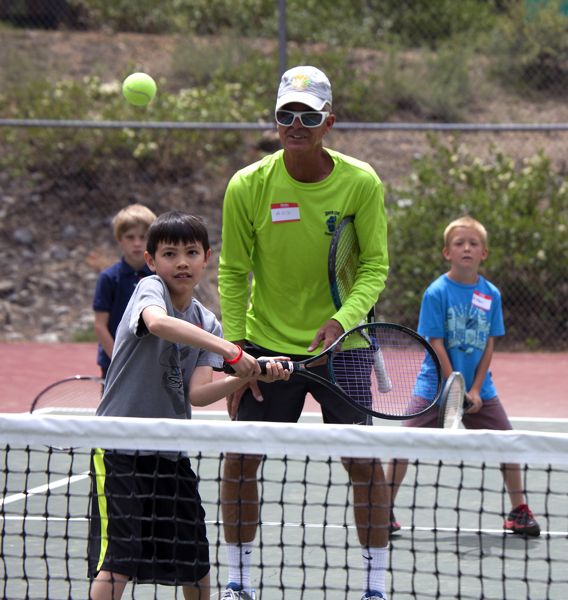


Youngsters take over the courts at Zephyr Cove

ob Wheatley watches Jordan Berry hit a volley as Drew Fehskens and Ryder Tannaci look on. Photo/Provided

Rob Wheatley watches Jordan Berry hit a volley, as Drew Fehskens and Ryder Tannaci look on. Photo/Provided

Zephyr Cove Tennis Club provided an opportunity for Tahoe youth to pick up a racket for the first time and to receive formal instruction.

The annual Kids Tennis Clinic on June 14-15 was led by Rob Wheatley, Bob Beutenmiller and Ross Rittiman, who were assisted by many volunteers from the club.

“We were amazed at the kids’ talent and enthusiasm, and encourage them to continue to play,” Wheatley, who is the teaching pro at the club, said in a press release.

Hannah Trew, one of the participants, especially “liked the volleying.” MaKenna Abel shared that “my favorite part was learning how to serve.” Many of the children agreed and added, “It was fun!”

The free event was a product of the Douglas County Parks and Recreation Department in conjunction with Zephyr Cove Tennis Club.


Remote Nev. trail has rugged political path

By Benjamin Spillman, AP

RENO — Hot, dry and dusty.

That’s how someone who buzzed across Nevada on Interstate 80 or Highway 50 might describe the scenery.

But crossing the state on foot via the American Discovery Trail is a completely different experience.

The national, coast-to-coast trail stretches 496 miles through Nevada from Baker to Incline Village, goes over 10,000 and 12,000 foot mountain summits, through thick stands of aspen, crosses paths of elk herds and mountain lions and along the shore of Lake Tahoe.

“It’s paradise, man,” said Brian Stark, who in 2011 ran the Nevada section of the trail in 11 days, seven hours and 28 minutes. “It was a world of difference between running the highway and running actual trail across the state of Nevada.”

Stark, 42, has run across 31 states and made the trip in part to highlight the significance of the American Discovery Trail, which goes between Cape Henlopen State Park in Delaware and Point Reyes National Seashore in California.

Although sections of the trail have been in existence before the United States was a country, the American Discovery Trail hasn’t yet been recognized by Congress. Recognition, according to Stark and others, would make it possible to post trail markers for runners, cyclists and equestrians and help elevate the visibility of the route.

For Nevada, it would mean exposing some of the nation’s best backcountry to a wider audience of potential visitors, extreme athletes and adventurers.

“When I got to those woods and bearing down on Lake Tahoe, the alpine forest, the pine needles, the blue lakes … it was just a really, really great thing to see,” Stark told the Reno Gazette-Journal, describing the experience. “The thought of Nevada from people who don’t live there is flat and brown but that is not the case.”

While the trail is an opportunity to see parts of Nevada, and the country, most people never see, the politics of getting the designation from Congress is all too familiar.

From about 1998, Congress has seen several proposals to designate the American Discovery Trail, but the job remains undone.

Backers say they have a difficult time identifying specific problems they could address because it’s not getting derailed out in the open. It’s merely languishing without action while supporters try to assuage vague concerns about the trail representing an increase in federal control of the land.

Peter Schoettle of the American Discovery Trail Society said westerners in particular have a tendency to view any sort of federal designation as an expansion of the federal government.

“Everybody east of the Mississippi laughs at that and thinks it is loony,” Schoettle said. “I think there is a real split in the country.”

Backers merely want Congress to add the American Discovery Trail to the National Trails System, which was created in 1968 as a system of scenic, historic and recreational trails. There are now eight National Scenic Trails, 15 National Historic Trails and more than 1,000 National Recreational Trails.

The American Discovery would be unique because of its length and fact it goes east-to-west, unlike the Pacific Crest, Appalachian and Continental Divide trails, which go north and south. It would also be a new category of trail that would link urban and rural communities in addition to backcountry.

The bill doesn’t call for any spending, nor would it include restrictions on building, energy development, mining or grazing.

“This is not a wilderness trail. We are not trying to protect any wilderness areas,” Schoettle said. “If somebody wants to build something right next to the trail that’s fine.”

The most recent effort is a Senate bill introduced in May by Sen. Chris Coons, D-Del., and Sen. Mark Kirk, R-Ill. There’s also a companion bill in the House.

Ted Oxborrow of Carson City, who, along with his son, Trevor, supported Stark’s run, has been trying to gain support from Nevada’s representatives. He said it’s been difficult even getting staff members to take the time to listen to the proposal, even though Nevada’s backcountry is a highlight of the entire trail.

Rep. Mark Amodei, R-Nev., whose district includes part of the trail, wouldn’t take a stance for or against the idea.

“Rep. Amodei is not opposed, but as is his practice, he will need to talk with local stakeholders before throwing his full support behind it,” spokesman Brian Baluta said.

Sen. Dean Heller, R-Nev., wouldn’t even go that far.

“Senator Heller is continuing to review this legislation,” spokeswoman Chandler Smith wrote in response to the proposal.

Rep. Steven Horsford, R-Nev., was also noncommittal.

“At this point, Congressman Horsford will further review the bill to determine what it means for Nevada,” spokesman Tim Hogan said.

Senate Majority Leader Harry Reid, D-Nev., is in favor of the bill, said spokeswoman Kristen Orthman.

Although the bill appears non-controversial, it doesn’t make it a slam dunk, according to Orthman.

“It has been tough to move any land bills, frankly,” she said.

Earlier this year a bill with bipartisan, Nevada support to create the Tule Springs Fossil Bed National Monument got derailed in the House after Rep. Rob Bishop, R-Utah, a leader on the Natural Resources Committee, sponsored a change that would have directed proceeds of public land auctions in Nevada back to Washington, D.C.

Oxborrow, 72, who has done the Nevada section of the trail about a dozen times, has no plans to back off lobbying in favor of the designation. He’s already got signs to post as soon as he can get approval from the Bureau of Land Management, which needs Congress to act first.

“People question why I do this,” Oxborrow said. “The answer is because I have a history here.”

His great-grandparents, Mary and Joseph Oxborrow, helped found the small town of Lund in the late 19th century. Oxborrow, of Carson City, acknowledges his style of persuasion could be grating to lawmakers and their representatives.

“I’m older and I tend to be less patient with bureaucracy,” he said. “I tend to say ‘let’s cut the crap and get to the heart of it’.”


Hwy. 28 rain gardens to be installed

Several rain gardens are going to be constructed along Highway 28 in Incline Village.

The stormwater treatment project is a collaboration between Nevada Tahoe Conservation District and Nevada Department of Transportation as part of the Incline Village Green Streets Project.

The goal of the project is to treat stormwater runoff using low-cost, roadside rain gardens. The project is expected to result in reduced stormwater volume and pollutant loading to Lake Tahoe.

It will be built in September through the state highway fund, a Nevada Division of State Lands License Plate grant and a Nevada Division of Environmental Protection grant. Incline Village Rotary Club is providing revegetation and maintenance assistance.

Rain gardens are shallow depressions that accept rainwater and snowmelt from the road. They allow runoff to soak into the ground, filtering out pollutants which otherwise could degrade Lake Tahoe’s clarity.

NTCD is asking adjacent homeowners to assist the project in the form of reimbursed irrigation water access.

For more info, call 775.586.1610, ext. 25.


Wooden boat show coming to Tahoe Keys Marina

The South Tahoe Wooden Boat Classic celebrates the history and stories behind the pre-war and post-war runabouts of the 1940s. World II brought among the most significant changes in runabout boats from material, color, design and construction techniques.

The show is July 25-26 at the Tahoe Keys Marina in South Lake Tahoe.

Tickets are available online.


High aspirations for Tahoe hockey players

By Jessie Marchesseau

Hockey isn’t about slamming people into walls, starting fights or broken teeth. It’s not even about scoring goals, blocking the puck or being able to move around on a 3mm wide slice of metal. For South Lake Tahoe’s junior hockey players, the sport is really about hard work, dedication, teamwork and friendship.

“It’s a commitment, and it makes you feel connected when you’re with other kids that do the same thing,” said 14-year-old Katie Sonntag, who met her best friend Leah Marino at hockey practice.

Tucker Cannon, center, maneuvers around defenders. Photo/Provided

Tucker Cannon, center, maneuvers around defenders. Photo/Provided

Being part of a team is one of Sonntag’s favorite things about the sport. As a hockey player, she spends a lot of time training, and consequently a lot of time with her teammates.

The season goes from August to April, and sometimes includes post-season tournaments and summer camps, making it a year-round activity for many of the players. Tahoe teams have practice twice per week, consisting mainly of passing drills, skating practice, conditioning and shooting. But players don’t necessarily stop there.

Tucker Cannon, 12, has been playing for five years and is a center for the Tahoe Grizzlies. In addition to twice-weekly practices and weekend games, he gets on the ice for some skate time two more days per week. Marino, 13, plays defense for the Grizzlies. She has been on the team since she was 6 and spends extra time off the ice working on her stick handling and shooting skills, plus doing basic core and leg workouts.

Sonntag has transitioned from the Grizzlies to playing center for the San Jose Junior Sharks girls’ team. As a member of this team, she has practice and/or games six days per week and still puts in workout time outside the rink. She practices in Tahoe during the week, then travels to either San Jose or another game location every weekend.

Without many nearby hockey communities, players and their families generally travel to the Bay Area or even farther for weekend games and tournaments. This requires a big commitment on the part of parents as well.

“The logistics can be challenging,” said Pete Sonntag, Katie’s father, “but I wouldn’t do anything but support them to the fullest extent possible.”

Even with so much time and energy dedicated to hockey, these players still find time to participate in other organized sports. Sonntag is on a track and field team, Marino plays soccer, and Cannon plays baseball and soccer but says hockey is the hardest.

“It’s one of those sports that makes them better athletes for every other sport,” Tyler Cannon, Tucker’s father, told Lake Tahoe News. He describes it as requiring the hand-eye coordination of baseball and the foot speed of soccer.

Katie Sonntag, who is about to score, wants to be on the U.S. hockey team one day. Photo/Provided

Katie Sonntag, who is about to score, wants to be on the U.S. hockey team one day. Photo/Provided

But athleticism isn’t the only aspect of playing hockey that carries over into other parts of their lives. All three players agree hockey has taught them even more important lessons such as the benefits of hard work and dedication, and it has also instilled a sense of self-confidence.

“The more confidence you have in yourself, the better you play,” Marino told Lake Tahoe News. “It’s the same in the world, too.”

As they move forward, these players are all looking forward to new experiences in hockey. Cannon had the opportunity to play AAA elite hockey with the Bay Area Blazers in the spring post-season which took him to tournaments as far away as Chicago, the heart of hockey country. Marino has been invited to try out for the San Jose Junior Sharks girls’ team. And Sonntag is considering the idea of a hockey prep school.

While Cannon seems content to just see where hockey takes him, the girls, on the other hand, have lined out some pretty specific hockey goals. Both have set their sights on the Olympics, along with stints playing Division I college hockey and on the U.S. Women’s National team. Not even in high school yet, they are already talking about what college teams they want to play for and the benefits of attending hockey prep schools for a better chance of getting recruited.

All of this may seem like a lot for the kids and their families, but Pete Sonntag said it is all worth it to see his daughter doing something she loves so much and living out her dreams.

He has already made a significant commitment to his daughter’s hockey aspirations and said he will continue to support her as much as possible. “If she has a dream she wants to pursue,” he said, “I can’t think of something better for a kid to go after.”


Star gazing event at Spooner Lake

There will be a laser-guided tour of starry wonders with professional stargazer and astronomy instructor Gigi Giles at Spooner Lake State Park on June 20.

People will have a chance to peer through high-powered telescopes and astronomical binoculars at an elevation of 7,000 feet and learn various aspects of astronomy and space science.

The event is from 8:30-10pm. Meet in the upper parking lot. Spooner Lake is located at the intersection of highways 28 and 50.

Wear comfortable shoes and bring a warm jacket and flashlight.

There is a per vehicle entry fee of $10; Nevada residents receive a $2 discount.

For more info, call 775.831.0494, ext. 224.


Class focuses on landscaping with native grasses

Learn how to landscape with native and adapted bunch grasses as a system instead of just ornamental highlights through the Beautiful Bunch Grasses class.

Lake Tahoe master gardeners will teach people how to understand the concept of meadows, prairies and succession. People will be taught how to develop beautiful landscapes with grasses that are multifunctional, resilient and well-defined, as well as how to let plant material build and stabilize your poor Tahoe soil over time, naturally.

The free class is July 7 from 5:30-6:30pm at Lake Tahoe Community College Demonstration Garden, 1 College Drive, South Lake Tahoe.


Foldable kayak demonstration at Kings Beach

The Oru kayak uses an origami-inspired design to transform from a compact box into a high-performance 12-foot boat.

The creative team behind the San Francisco-based startup will be putting on an on-the-water demo at Kings Beach on June 14 from 11am to 2pm. The event is open to the public and attendees will be able to test paddle the kayak.

While it was originally conceived as an easily storable kayak for urban apartment dwellers, the applications for a folding boat are practically endless. The Oru kayak can be packed in the coat closet of a small apartment, stowed below deck on a sailboat for quick trips to shore, or kept in a car trunk for spur of the moment paddles. Paddlers can hike it through backcountry to remote waters, or check it as luggage on a commercial flight. It weighs 26 pounds.


‘Red flag’ warning issued for Tahoe, western Nev.

A “red flag” warning has been issued for most of western Nevada, as well as South Lake Tahoe and Truckee for June 12 from 8am-11pm.

The National Weather Service in Reno says it will be windy and dry through Friday.

The strongest winds are expected Thursday afternoon and evening. Low humidity adds to fire danger. The conditions mean fires can grow rapidly in size and intensity.

Officials are asking people to avoid activities that may spark a fire, like yard work, target shooting or having a campfire.