Sierra-at-Tahoe being neighborly with free tickets

Sierra-at-Tahoe is offering free skiing to passholders of neighboring resorts with the “Have One On Us” program.

Passholders from Dodge Ridge Ski Area and China Peak Mountain Resort will be granted one day of free skiing at Sierra-at-Tahoe through the end of February.

Free skiing for eligible passholders is available Sunday through Friday, non-holiday until Feb. 28. Blackout dates include Feb. 17 and 18.


Sports books buried by Eagles, mystery bettor wins $10M

By Todd Dewey, Las Vegas Review-Journal

The house doesn’t always win, especially when the Patriots are in the Super Bowl and a mystery bettor riding an epic hot streak is on the other side.

Caesars Palace sports book reported a seven-figure win on the Eagles’ 41-33 upset of New England in Super Bowl LII and the Westgate sports book reported a small win. But William Hill sports book reported a multimillion-dollar loss, CG Technology sports books reported a mid six-figure loss and most other Las Vegas sports books also lost on Sunday’s game.

The mystery bettor — just call him Biff Tannen Jr. — who beat Las Vegas out of millions of dollars when he won all of his wagers on the World Series reportedly won more than $10 million on at least $7.4 million in money-line bets on Philadelphia, which closed at plus 170.

Read the whole story


Nev. could give away nearly 3,000 free-range horses

By Benjamin Spillman, Reno Gazette-Journal

Nearly 3,000 free-range horses in Nevada’s Virginia Range could be under new ownership by the end of May, according to state officials.

The Nevada Department of Agriculture on Tuesday published a request for proposals for people willing to take ownership of the iconic herd.

Opponents of the proposed giveaway say it “spells disaster” for the herd, which many consider symbolic of Nevada’s western culture.

Read the whole story


Big-air snowboarding to make Olympic debut

By John Jeremiah Sullivan, New York Times

The history of snowboarding dates to 1938 in Yosemite National Park. A slight young man named Robert Trumbull, a Honolulu newspaper editor who wrote a weather column under the byline Sol Pluvius (Rainy Sun), was on vacation. Chicago-born, Trumbull had seen plenty of snow, and he had been surfing. That was the all-important crossing of the wires. “Yesterday Sol showed the natives a new trick,” reported The Honolulu Advertiser, “snow-surfing, or as Sol called it, ‘snurfing.’ ” He coined the word.

That may all be sports trivia, but it’s about to become important trivia, because soon, in this very winter of 2018 — 80 years after Trumbull’s breakthrough — will occur the Olympic debut of a sport known as “big-air snowboarding,” which is the snurfing equivalent of big-wave surfing.

It is best described as the most beautiful, insane, stupid, dangerous, death-wishing, insane and beautiful sport ever perpetrated on innocent spectators.

Read the whole story


Lack of snow severely impacts Central Sierra resorts

By Marek Warszawski, Sacramento Bee

Tim Cohee

This winter marks the 60th anniversary of China Peak, the 1,300-acre ski area in the Sierra National Forest east of Fresno.

But instead of celebrating, owner/operator Tim Cohee is contemplating the ultimate bummer while struggling through what he describes as the worst season he’s experienced during more than 40 years in the business.

“We have reserves, but at some point they’re going to run out,” Cohee, the former chief executive at Kirkwood resort, said. “At that point you have to shut the resort down. There is a scenario – maybe it’s not this year – but there is a scenario that says the ski area no longer exists because of these droughts.”

Read the whole story


Ranger led snowshoe at Sugar Pine Point

A California State Park interpreter will lead snowshoers along a 90-minute walk on the West Shore on Feb. 10.

Participants will discover what attracted Tahoe’s earliest settlers and uncover secrets of the Hellman-Ehrman Estate in Sugar Pine Point State Park.

Meet near the restrooms in the day use side of Sugar Pine Point State Park (lake side entrance off Highway 89). Wear warm layered clothing, waterproof hiking boots, and bring snowshoes. If there is minimal snow, the hike will proceed without snowshoes.

While event is free, the $5 parking fee still applies. The event is from 11am-12:30pm.


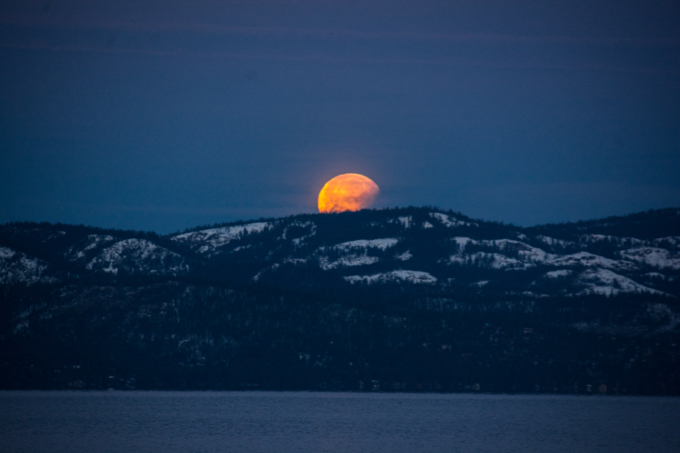
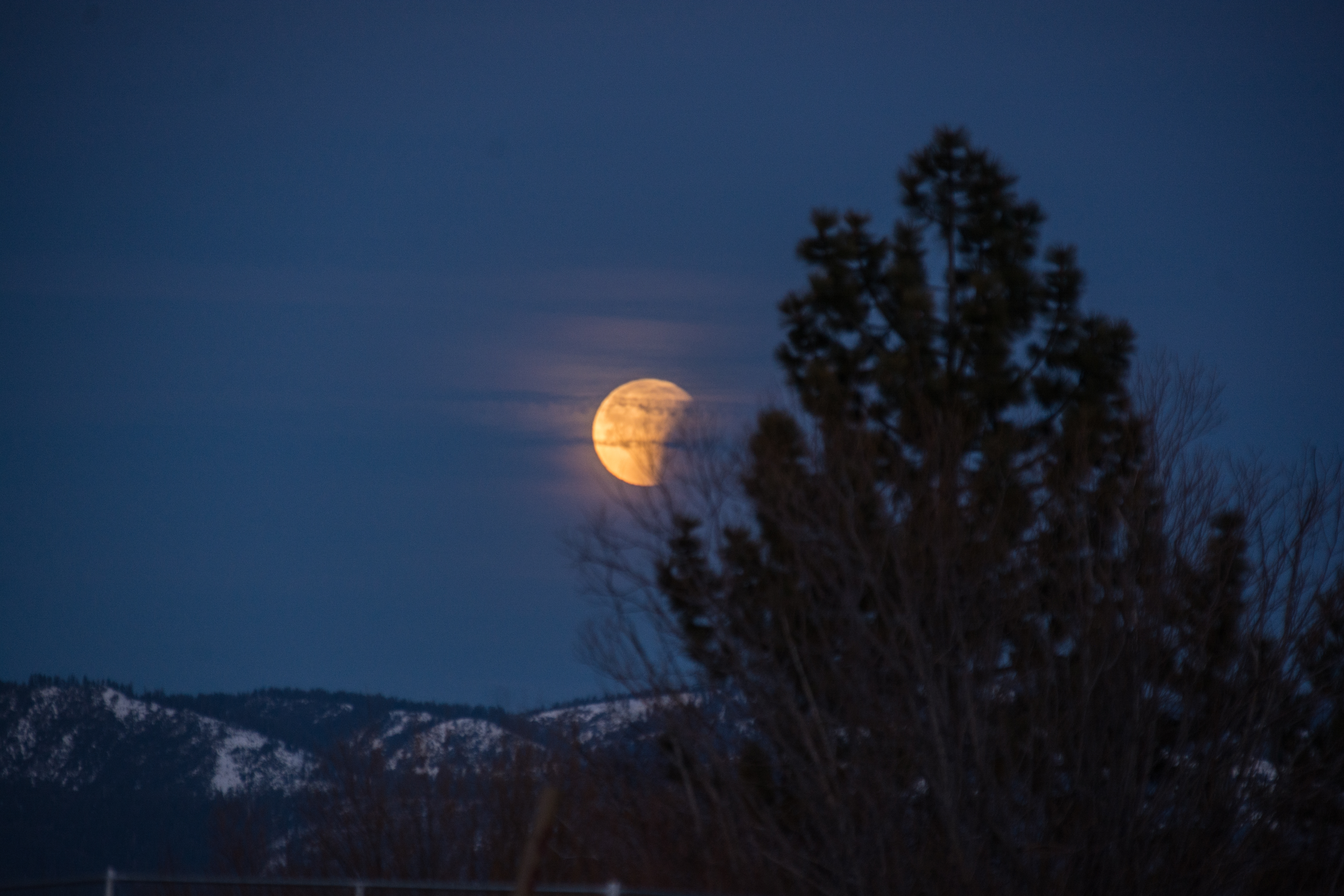
Trifecta moon event over Lake Tahoe

Photo/John Gomez

South Shore resident John Gomez captured the lunar trifecta this week in a series of photos.

Photo/John Gomez

He shot them from the top of Kingsbury Grade.

Photo/John Gomez

The Jan. 31 full moon was the second of the month, making it a blue moon. It was also a supermoon, meaning it was at its closest point to the Earth. Then there was a total lunar eclipse, known as a blood moon.

Photo/John Gomez

The next time all three will happen at once again will be in 2037. The previous occurrence was in 1982.

— Lake Tahoe News staff report


Nev. sports books win record $248.7M in 2017

By Todd Dewey, Las Vegas Review-Journal

Nevada sports books won a record $248.7 million in 2017, a hold of 5.1 percent from a record betting handle of $4.8 billion, according to a year-end report released Wednesday by the Gaming Control Board.

The win eclipsed the previous record set in 2015 by almost $17 million. The handle increased for the eighth consecutive year. It has climbed from $2.5 billion wagered in 2009 to $3.4 billion in 2012 to $4.2 billion in 2015 to almost $5 billion last year.

Read the whole story


Corporate sponsors of Olympians enter the #MeToo fray

By George B. Cunningham

Revelations brought to light during the trial of sports doctor Larry Nassar are reverberating.

High-level resignations are piling up at Michigan State University, the physician’s former employer. USA Gymnastics, the team’s governing body, has severed its ties with the Karolyi Ranch, the compound where many of the team’s gold medalists say the physician sexually abused them, and its entire board is resigning. The U.S. Olympic Committee is under severe pressure from advocates.

The gymnastics scandal’s shock waves also have financial implications. One day before Nassar’s sentencing, AT&T suspended its USA Gymnastics sponsorship. A month earlier, Procter & Gamble severed ties with the organization as well.

Sexual abuse is a chronic condition that afflicts many other sports besides gymnastics. With the #MeToo and #TimesUp movements gaining momentum and their influence growing, might they affect the 2018 Winter Olympic Games, an event that traditionally commands substantial sums from sponsors? As a sport management professor who focuses on diversity and inclusion, my analysis leads me to believe that’s quite likely.

Sponsorship at the Olympics

Since corporate sponsors and other outside sources are contributing about 35 percent of the U.S. Olympic Committee’s $34.47 million annual budget, their loss could prove financially devastating to U.S. Olympic teams and athletes.

Ever since the 1984 Los Angeles Summer Olympics, corporate sponsors have pitched in mightily with the nation’s Olympic funding efforts.

Official sponsorships for the International Olympic Committee now top $1 billion. That’s a tenfold increase since the lead-up to the 1988 Summer Olympics.

Winter Games sponsorship funding generated by the host country has also soared, rising from $163 million in 1998 to $1.2 billion in 2014.

Team USA, or the collective group of U.S. Olympians and teams, currently has 18 corporate sponsors – deals that usually generate $100 million over a four-year period. And the support does not stop there. Companies can support specific teams or individual athletes. Toyota, for example, is sponsoring the U.S. figure skating, speed skating and hockey teams.

Not exactly philanthropic

Though sponsors will frequently tout their support as helping Olympians achieve their goals, this largesse isn’t purely philanthropic. The fact is that corporations give athletes and teams money to enhance awareness of their brands and burnish their image with a lucrative marketing tool.

They achieve these goals by linking their name with successful athletes. Sponsors are placing a bet that consumers will feel good about Olympic contenders and winners, then they bank on some of that glow transferring to their brand. Sponsors strategically use marketing techniques to improve the odds of this happening.

The positive association set between the sport product and sponsor is key. What happens, though, when the sport product elicits negative feelings and attitudes? At that time, the association linkages turn negative, to the detriment of the sponsor. As a result, the sponsor is likely to suspend or terminate the relationship.

Companies tend to drop their endorsement packages when athletes generate negative press coverage. Examples include the uproar that followed Filipino boxer Manny Pacquiao‘s homophobic slurs and the fallout when Russian tennis star Maria Sharapova tried (and failed) to cover up her use of a banned performance-enhancing substance.

Failure to sever those ties can hurt the business bottom line. UC Davis Professor Victor Stango, for example, found that golfer Tiger Woods’ extramarital affairs have cost the shareholders of his endorsers, including Nike, Gatorade and others, as much as $12 billion.

The 2018 Olympics and #MeToo

Where, then, does this leave sponsors of the 2018 Olympics, Team USA and U.S. Olympic athletes?

On the one hand, some of the sponsorship packages have been in place for years, with sponsoring companies taking steps to leverage the relationships. Thus, the sunk costs are considerable.

On the other hand, it is hard to imagine a time in recent years when the brand association of the U.S. Olympic team, as a whole, has been poorer. In the past year, both USA Swimming and USA Gymnastics have been rocked by sexual abuse accusations regarding coaches and other staff like Nassar. The calls for the U.S. Olympic Committee’s leaders to resign grow louder by the day.

Over the past year, it has become clear that the nation no longer tolerates sexual abuse and harassment. Powerful men like movie mogul Harvey Weinstein, TV newsman Matt Lauer, and football coach Rich Rodriguez have had their prestige vanish and their careers collapse once their predations came to light.

American companies get this and can’t afford to be associated with anyone tainted by this kind of scandal.

Though similar cases of sexual abuse and sexual harassment have not yet surfaced among Winter Olympic teams or athletes, the Olympic rings themselves are already tarnished.

It may be only be a matter of time before other organizations follow AT&T and Procter & Gamble’s lead, and suspend or terminate their relationships with the Olympics until its leadership works harder to crack down on sexual abuse in the world of sports.

George B. Cunningham is a professor of sport management and faculty affiliate of the Women’s and Gender Studies Program, and director of the Laboratory for Diversity in Sport at Texas A&M University.



Can scientists learn to make nature forecasts?

By Michael Dietz, The Conversation

Imagine that spring has finally arrived and you’re planning your weekend. The weather forecast looks great. You could go to the beach – but what if it’s closed because of an algal bloom? Maybe you could go for a hike – will the leaves be out yet? What might be in flower? Will the migratory birds be back? Oh, and you heard last year was bad for ticks – will this spring be better or worse?

We all take weather forecasts for granted, so why isn’t there a “nature forecast” to answer these questions? Enter the new scientific field of ecological forecasting. Ecologists have long sought to understand the natural world, but only recently have they begun to think systematically about forecasting.

Much of the current research in ecological forecasting is focused on long-term projections. It considers questions that play out over decades to centuries, such as how species may shift their ranges in response to climate change, or whether forests will continue to take up carbon dioxide from the atmosphere.

However, in a new article that I co-authored with 18 other scientists from universities, private research institutes and the U.S. Geological Survey, we argue that focusing on near-term forecasts over spans of days, seasons and years will help us better understand, manage and conserve ecosystems. Developing this ability would be a win-win for both science and society.

The benefits of forecasting

Beyond helping people plan their weekends, ecological forecasts will improve decision-making in agriculture, forestry, fisheries and other industries. They will help private landowners, local governments and state and federal agencies better manage and conserve our land, water and coastlines, for example by warning of events such as pest outbreaks and harmful algal blooms. They will improve public health through better forecasts of infectious disease outbreaks and better planning in anticipation of famine, wildfire and other natural disasters.

Ecological forecasts will also deepen our understanding of the world around us, and of how human activities are altering it. Forecasting formalizes the cycle between prediction and testing that is at the heart of the scientific method, and repeats it on a much quicker cycle. It can accelerate the pace of discovery in the environmental sciences at this critical time of rapid environmental change.

New tools and technology

Big data is driving many of the advances in ecological forecasting. Today ecologists have orders of magnitude more data compared to just a decade ago, thanks to sustained public funding for basic science and environmental monitoring. This investment has given us better sensors, satellites and organizations such as the National Ecological Observatory Network, which collects high-quality data from 81 field sites across the United States and Puerto Rico. At the same time, cultural shifts across funding agencies, research networks and journals have made that data more open and available.

Digital technologies make it possible to access this information more quickly than in the past. Field notebooks have given way to tablets and cell networks that can stream new data into supercomputers in real time. Computing advances allow us to build better models and use more sophisticated statistical methods to produce forecasts.

Technical and social challenges

So far, though, ecological forecasting has not kept pace with advances in data and technology. In our article, we lay out a road map for accelerating the field by tackling the bottlenecks slowing us down.

Some of these bottlenecks are technical, such as better integrating the streams of data that are now available from many different sources, such as field studies, sensor networks and satellite observations.

Other challenges involve human choices. Ecologists need to spend more time engaged in two-way communication with stakeholders, rather than just pushing out the latest research to decision-makers. And we need better ways to transfer state-of-the-art research from universities to agencies and private industry.

Perhaps most limiting is that ecologists traditionally have not been taught forecasting concepts and methods. But as I have written, this situation is changing. There now are summer workshops and a growing number of university courses in ecological forecasting. Prediction is leading to new theories that aim to unify different parts of ecology.

Ecology’s choice

At the dawn of numerical weather prediction in the 1950s, scientists at the National Weather Service faced a choice. They could either wait to start forecasting until the underlying research, models and tools improved, or proceed immediately with making forecasts and learn by doing. They chose the second path. It proved harder than expected – but had they waited, they likely would have failed because they would have missed a critical window when experts and agencies were willing to make major investments in this effort.

Up to now, ecologists have generally adhered to the first, more conservative path. But in this time of rapid environmental change, the societal need and technological capacity for forecasting have never been greater. The forecasts won’t always be right, especially as the field develops, but failure is part of learning. The time for ecologists to start forecasting is now.

Michael Dietze is an associate professor of Earth and environment at Boston University.