Lake Tahoe patrols prepared for more boaters
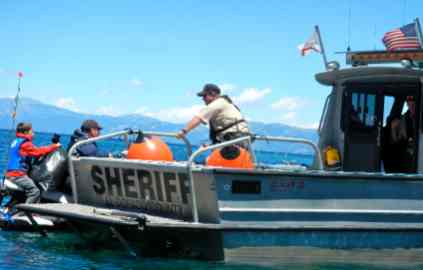
Les Lovell with El Dorado County Sheriff's Department cites personal watercraft riders who were allegedly speeding in Emerald Bay. Photos/Kathryn Reed

Les Lovell with El Dorado County Sheriff’s Department cites personal watercraft riders who were allegedly speeding in Emerald Bay. Photos/Kathryn Reed

By Kathryn Reed

CAMP RICHARDSON – The drought may be good and bad news for Lake Tahoe.

Many reservoirs in California and Nevada are well below normal levels. Folsom Lake slip owners have until today to remove their boats because of the rapidly declining water level. Lahontan and Rye Patch reservoirs’ boat launches in Nevada are closed.

All of those boaters and other could be headed for Lake Tahoe.

But Tahoe marinas are also affected by the lack of water. The runoff is at a trickle. Sand Harbor marina officials say launches could stop mid-summer. Meeks Bay recently dredged. Even so, they could only go to the bulkhead.
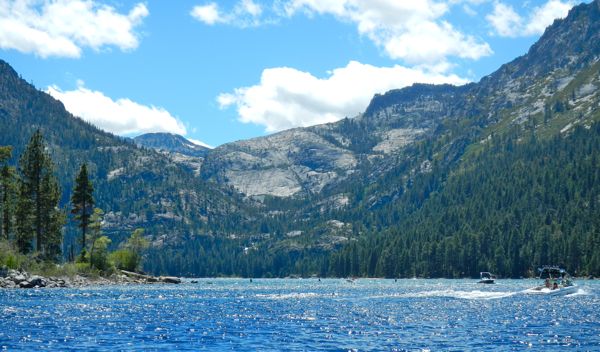
Emerald Bay presents the most problems for boat patrollers, especially on July 4 when hundreds of vessels are there.

Emerald Bay presents the most problems for boat patrollers, especially on July 4 when hundreds of vessels are there.

El Dorado County Sheriff’s Department’s marine vessel could not maneuver into that West Shore marina on June 27 without risking damaging the prop. The boat was kicking up sand before it reached the buoy near the entrance.

Getting gas at Camp Richardson was a bit precarious on Friday, too. Kahl Eidam had to carefully maneuver the 27-foot Almar to the dock. A dockhand said Bob Hassett, who operates the marina, is going to get a longer hose so it stretches farther down the dock where vessels are waiting in deeper water.

(Eidam, a former sergeant with the California Highway Patrol, is in his first year with the sheriff’s boat patrol.)

The sheriff’s boat is operating out of Camp Rich right now after being at Tahoe Keys Marina for 20 years. A long-term lease with Tahoe Keys is being negotiated.

Marinas throughout Tahoe could be affected by the declining water level.

“I don’t know how they are going to get some of the bigger boats out in the future,” Les Lovell said of vessels at Tahoe Keys because of the shallow water.
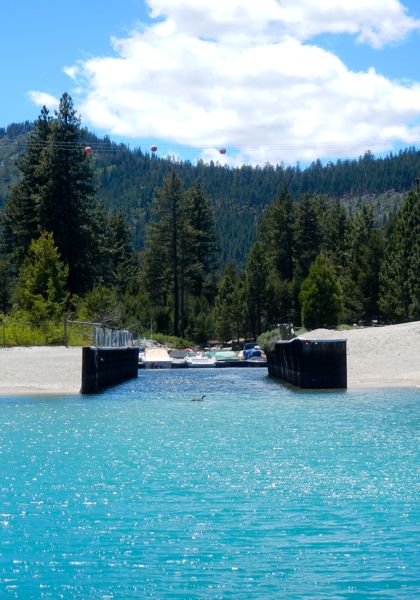
Meeks Bay Marina was dredged this season, but the approach was not.

Meeks Bay Marina was dredged this season, but the approach was not.

Lovell, a former lieutenant at the department who has been on boat patrol for three years, said he expects there to be more issues this season because of the lower water level and potential for more boaters at Tahoe because of the lack of water elsewhere.

“Because of the low water level this year there will be a lot of crashes into rocks. You can’t mark them all,” Lovell told Lake Tahoe News.

He is also fearful people will run into sandbars during Fourth of July. This is always a precarious evening for people returning to marinas. Many have been drinking and all are ready to be home by the time the fireworks are over.

Hitting a sandbar usually means instantly stopping and often people are thrown overboard.

Lovell said his biggest worry is near Cove East before the Tahoe Keys Marina where the water level is so shallow and the long sand bar is not marked.

South Lake Tahoe officials are also worried about the water level.

“A concern for this year is the shallowness of the water. There is a concern of boaters literally getting stuck in the shallow waters this year,” Tracy Franklin, spokeswoman for the city, told Lake Tahoe News.

She said off Regan Beach the depth is 2½ feet quite a ways from shore.

Emerald Bay is El Dorado County’s biggest spot to patrol. While there were about a dozen incidents last season, some including people being thrown from their vessel, there were no major injuries. Property damage was the big issue because of the rocks.

A rock garden of sorts is protruding on the right side of the entrance to Emerald Bay. This might be better than last year when the shallow rocks weren’t visible.

Not far from D.L. Bliss State Park is a tree that is about 50-feet down. About a foot of it is now above the surface. A buoy that looks like an old balloon is attached to it to warn boaters. Still, the boat guys predict boaters or those on personal water craft will run into it.

The dropping water level will keep exposing rocks and trees – thus becoming a hazard. Not all will be marked.

Jumping off rocks is also an issue.  There’s a group near Rooster Rock along the Rubicon hiking trail taking pictures. But this is where many opt to do bit a jumping off into Lake Tahoe. California State Parks, which owns the land, has made this a big no-no. The boat patrollers have the authority to cite them.
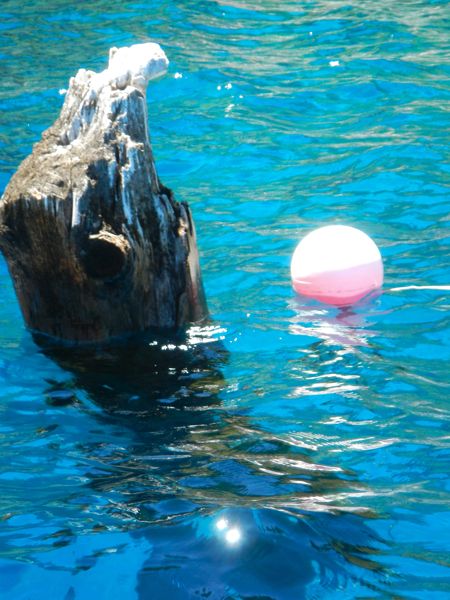
A tree stump is one of many obstacles in the way of boaters on Lake Tahoe.

A tree stump is one of many obstacles in the way of boaters on Lake Tahoe.

While it’s OK to operate a boat with alcohol in hand, it’s not OK to be inebriated. The same 0.08 blood alcohol level while driving a car applies to a boat.

Most of the agencies at Lake Tahoe with boat patrols are participating in Operation Dry Water, a three-day enhanced boating under the influence program that ends today. Besides getting drunken boaters off the lake, it is also an opportunity to educate people.

Education is a large part of what the boat patrolmen do.

On Friday, the boat guys were talking to people about their speed in Emerald Bay. It’s a 15 mph zone. Around a buoy field – like near the boat-in campground – it’s is a maximum of 5 mph within 200 feet.

On this day it’s tourists who are contacted. Some are in rental boats. A clue to a rental vessel is if the registration ends in LE.

Lovell is quick to spot boats with outdated registration. When they prove they have their paperwork, they are given a warning. But citations may be issued. And if they are drunk, they are going to jail.

But it’s not just the water these guys patrol. They also can and do patrol the beaches.

The U.S. Coast Guard, which operates out of the North Shore, may board any vessel. All other law enforcement on the lake must have probable cause to stop someone.

Registration is a biggie with motorboats, while lifejackets is an issue with others. Anyone using a paddle needs to have a lifejacket that fits him or her. If the person is 14 or older, it’s OK to have the jacket in or on the vessel.

But Lovell pointed out that a jacket attached to a standup paddleboard isn’t going to help the person if they hit their head on the board or are in deep water. After all, the surface temperature of Lake Tahoe has not hit 60 degrees and hypothermia can then become factor.




Volunteers needed for July 5 beach cleanup

The League to Save Lake Tahoe will host its annual Keep Tahoe Red, White & Blue Beach Cleanups at five locations throughout Lake Tahoe on July 5.

Volunteers of all ages and abilities are invited to join the effort from Tahoe City to Nevada Beach and South Shore.

Last year, the League’s July 5 beach cleanup volunteers removed 370 pounds of trash and 60 pounds of recyclables. The most common items were cigarette butts and beer bottles.

The League will provide reusable bags and buckets. Volunteers are invited to bring reusable water bottles and gloves.

The League is partnering this year with the U.S. Forest Service, Tahoe City Public Utility District, and South Lake Tahoe. Businesses sponsoring beach locations are: Ridge Resort, Lake of the Sky Outfitters, North Face, Grass Roots Natural Foods, SUP Tahoe, and Willard’s Sport Shop.

Locations: Commons Beach, Tahoe City; Taylor Creek, Kiva and Tallac Historic Site, South Shore; Regan Beach, El Dorado Beach and Timber Cove, South Lake Tahoe; Nevada Beach, Zephyr Shoals, East Shore.

RSVP to Cassie@keeptahoeblue.org.


Eldorado forest limits types of fires

Due to the severe drought conditions, wood and charcoal fires are not allowed in the Eldorado National Forest outside of designated campgrounds.

Gas or propane fires are allowed with a 2014 California campfire permit. These permits are free and can be obtained at any U.S. Forest Service, CalFire, or Bureau of Land Management office.

Visitors can help by educating others about fire danger and reporting abandoned or illegal fires to 911 or to the nearest ranger station.

The Eldorado will be staffing extra patrols and patrolling after dark the July 4 weekend.

More information on recreation opportunities and fire restrictions is available on the Eldorado National Forest website.


Water testing on July 4 could set world record

On July 4, volunteers participating in the Tahoe Nearshore Dippers program aim to set a world record for Lake Tahoe.

In an effort to raise awareness of changing conditions in Tahoe’s near shore clarity, volunteers will be asking beachgoers around the lake to help take a quick clarity measurement and set a world record for the most measurements taken on one lake in one day.

Friends of the West Shore hope the program will help raise awareness about the importance of protecting Tahoe’s near shore.

Volunteers from FOWS will be coordinating with other communities around the lake to host measurement sites on the same day. FOWS will provide the equipment and training, and post the measurements to the national Secchi program’s website and FOWS’ website.

For more information or to volunteer to take a measurement, go online or email Jennifer Quashnick at jqtahoe@sbcglobal.net.


Study: Rigorous exercise good for the body

By Gretchen Reynolds, New York Times

Intense exercise changes the body and muscles at a molecular level in ways that milder physical activity doesn’t match, according to an enlightening study.

Though the study was conducted in mice, the findings add to growing scientific evidence that to realize the greatest benefits from workouts, we probably need to push ourselves.

For some time, scientists and exercise experts have debated the merits of intensity in exercise. Everyone agrees, of course, that any exercise is more healthful than none. But beyond that baseline, is strenuous exercise somehow better, from a physiological standpoint, than a relative stroll?

There have been hints that it may be. Epidemiological studies of walkers, for instance, have found that those whose usual pace is brisk tend to live longer than those who move at a more leisurely rate, even if their overall energy expenditure is similar.

But how intense exercise might uniquely affect the body, especially below the surface at the cellular level, had remained unclear. That’s where scientists at the Scripps Research Institute in Florida stepped in.

Read the whole story


1968 U.S. Olympic track team, Echo Summit training site continue to make history

Athletes from the 1968 U.S. Olympic track team stand and part of the track they trained on at Echo Summit. Photos/Kathryn Reed

Athletes from the 1968 U.S. Olympic track team stand on part of the track they trained on at Echo Summit. Photos/Kathryn Reed

By Kathryn Reed

1968 was not all about free love and feeling groovy. Martin Luther King Jr. and Robert Kennedy were assassinated within two months of each other. Vietnam was raging. The country was polarized.

Even though the Civil Rights Act was signed 50 years ago this summer, it did not mean equality was immediate – and certainly not four years later.

Echo Summit played a role in that tumultuous summer.

John Carlos and Tommie Smith remember training at Echo Summit with fondness.

John Carlos and Tommie Smith remember training at Echo Summit with fondness.

Laurence Crabtree, Eldorado National Forest supervisor, said it was human rights history that began at Echo Summit in the summer of 1968. This is where the U.S. Track and Field trained for the Mexico City Olympics. The elevation of the two locations is about the same – with Echo Summit being 28 feet higher at 7,377 feet.

Tommie Smith won gold in the 200 meters and John Carlos bronze. While on the podium listening to the national anthem they bowed their heads and raised a fist with a black glove – a salute to black power and a stand against racial inequality.

Smith and Carlos, along with nine other members of that historic team, returned to Echo Summit on June 27 to be honored as well as acknowledge the site is now a California Historical Landmark.

“This track and field team is regarded as the best in history. And they have never gotten their due,” Jill Geer with USA Track & Field said. “They were heroic in so many ways – on and off the field.”

The Olympic flag flies proudly June 27 at Echo Summit.

The Olympic flag flies proudly June 27 at Echo Summit.

They brought home 20 medals, including 12 gold. Smith’s world record of 19.83 seconds stood for 11 years. They won more gold and set more records (six world) than any previous team had. Twenty of them are in the National Track and Field Hall of Fame.

“This is where the love and bonding started amongst all of the individuals,” Carlos said. “I hear many people talk about how great this team was. The greatness came from this location.”

Walt Little, with the city of South Lake Tahoe, recommended the location. The U.S. Olympic Committee approved it.

In addition to the men’s track team, the men and women’s volleyball teams and women’s gymnastic teams also trained in South Lake Tahoe.

At the track and field trials on the 400-meter oval at Echo Summit, four world records were set in September 1968. The Games were a month later.

This is the state's fifth sports site landmark and first civil rights.

This is the state’s fifth sports site landmark and first civil rights.

Hundreds of trees remained in the middle of the track. Boulders were part of the landscape. It made for some interesting perspectives.

Smith remembers watching Bob Seagren, who went on to win gold in pole vault, train. “I thought he had fallen out of a tree,” Smith said as Seagren tumbled 11-plus feet after clearing the bar.

For most of the athletes, this chilly Friday morning was the first time they had been back to Tahoe.

Triple jumper Norm Tate was overheard saying, “This brings back memories of coming out here in the morning and freezing.”

One of the conditions of the U.S. Forest Service allowing the track to be built was for it to have little impact on the environment and that it would be removed quickly. That track went to South Tahoe Middle School. It was in 1992 that the last high school track meet was run at that track. It had outlived its lifespan. In 2007, it was replaced.

A piece is given to each athlete.

Each athlete has a piece of the track.

But Anthony Davis, who runs community events at the STMS track, has pieces of the track. He had some cut up to give to each of the athletes. Part of lane No. 3 was front and center during the festivities. Davis told Lake Tahoe News one day he would like to secure the funds to have it framed and placed in a public place.

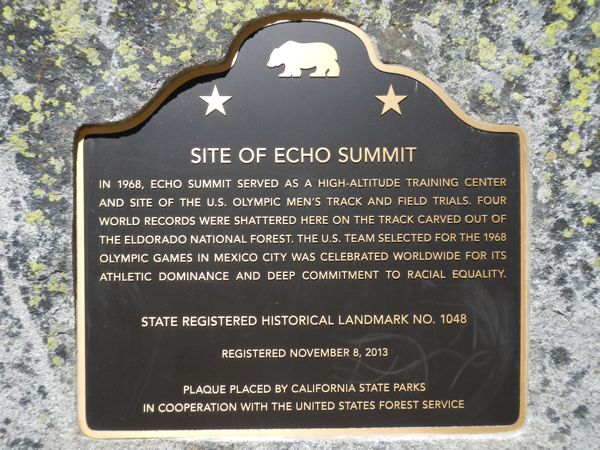
A plaque on a granite boulder commemorates the site. It is located just off Highway 50 where Adventure Mountain is located.

Athletes were also honored Friday night at Sacramento State during the USA Track & Field Championships.


Full moon hike with Nevada parks rangers

Nevada State Parks is putting on an evening hike along the Deadman’s Creek trail to watch the sunset and moonrise. The July 12 full moon is a “super moon,” which means the moon is at its closest point to the earth.

This will be a two-mile moderate hike that is limited to 30 participants; reservations are required. Call 775.687.4319 or email washoelake@hdiss.net to reserve your spot. Submit your name, phone number and the number of people.

Wear sturdy hiking shoes. Participants should also bring water, a camera and a flashlight. Dogs are allowed on this hike, but must remain on a leash.

The event is from 8:30-10:30pm. Meeting location will be made known upon registration.


Drought taking toll on Nev. wildlife

By AP

RENO — Lingering drought is taking a toll on wildlife across Northern Nevada, shrinking deer herds on the high desert, drying up fisheries in the valleys and starting to push everything from bears to snakes into urban neighborhoods they normally don’t frequent.

Mule deer especially are showing signs of stress, and some fisheries may be lost altogether by the end of the summer as a result of a third consecutive year of serious drought, state wildlife officials say.

“It’s stressing the animals, and it’s stressing the habitat itself,” David Catalano, a supervisory biologist with the Nevada Department of Wildlife, told the Reno Gazette-Journal.

Snowpack was low after a dismal winter, leading streams and creeks that normally flow into July or later to go dry in March or April, Catalano said. That’s causing small animals like rabbits and squirrels to flock to neighborhoods where water, grass and insects are plentiful.

“They’ve got a mini-ecosystem that is flourishing, so all these little critters are drawn there,” Catalano said. “Now they are all competing a lot more for shelter and for foraging.”

The rodents in turn attract predators. Catalano said calls regarding snakes on people’s property in the Reno-Sparks area have increased significantly since the drought began.

At Lake Tahoe and across the Carson Range, hungry bears are on the move because they can’t find the berries and other natural food sources they normally depend on.

Meanwhile, since 2012, Nevada’s mule deer herd has declined from an estimated 112,000 animals to about 108,000 this year, said Cody Schroeder, the department’s specialist on the animal.

The grasses and flowering plants mule deer eat in the summer are increasingly scarce, as well as the sagebrush and bitterbrush they consume in winter. As a result, the deer are slowly wasting, and the youngest are most at risk, Schroeder said.

Fish are in trouble, too.

Kim Tisdale, Nevada’s supervisory fisheries biologist, said the Carson and Walker rivers could go dry.

“We could lose those fisheries,” Tisdale said. “It’s a possibility. We’re hoping not.”

They lack the same upstream storage of the Truckee River, which likely will have enough water to protect fish there, Tisdale said.

But Lahontan and Rye Patch reservoirs are down significantly. Very hot weather this summer could kill off fish by robbing those fisheries of dissolved oxygen, Tisdale said.

Wildhorse and Willow Creek reservoirs in Elko County are facing serious risks of a die-off. The state lifted catch limits in the two lakes in mid-May to try to empty them of fish before conditions become uninhabitable.


Sierra waterways stocked with fish

Now is a good time to go fishing because area lakes have recently been stocked with trout.

The California Department of Fish and Wildlife put 15,000 pounds of rainbow trout into Caples Lake last week. Browns and mackinaw are also found in this lake near Kirkwood.

Officials are putting 1,000 pounds of trout into the east and west forks of the Carson River this month. Before the holiday weekend, Alpine County said it plans to stock the river with 1,800 pounds of rainbow.

Silver Lake has also been stocked by the state.


USFS institutes fire restrictions for Tahoe basin

Fire restrictions went into effect in the Lake Tahoe Basin on June 26.

Campfires and charcoal barbecues will be restricted to designated recreation sites, and other fire-related activities will be prohibited until the end of fire season.

National Forest System land fire restrictions mean:

· No open fires or campfires are allowed outside of designated recreation sites even with a valid campfire permit. Portable stoves using gas, jellied petroleum or pressurized liquid fuel are allowed with a valid campfire permit.

· No possessing or using any kind of fireworks or other pyrotechnic device.

· No smoking, except within an enclosed vehicle, building, or designated recreation site.

· No welding, or operating acetylene or any other torch with an open flame.

· No operating or using any internal or external combustion engine without a spark arresting device properly installed and maintained in effective working order.

In addition, campfires are prohibited in all semi-developed sites such as Luther Pass, Blackwood Canyon, and Watson Lake campgrounds, as well as in all dispersed recreation locations, such as the Meiss backcountry area on Luther Pass and the Freel Peak roadless area on the southeast end of the Lake Tahoe Basin. Forest users should obtain specific information about restrictions and the area they are visiting before venturing out.

For more info, call 530.543.2694.