Exercise helps us tolerate pain

By Gretchen Reynolds, New York Times

Regular exercise may alter how a person experiences pain, according to a study. The longer we continue to work out, the new findings suggest, the greater our tolerance for discomfort can grow.

For some time, scientists have known that strenuous exercise briefly and acutely dulls pain. As muscles begin to ache during a prolonged workout, scientists have found, the body typically releases natural opiates, such as endorphins, and other substances that can slightly dampen the discomfort. This effect, which scientists refer to as exercise-induced hypoalgesia, usually begins during the workout and lingers for perhaps 20 or 30 minutes afterward.

But whether exercise alters the body’s response to pain over the long term and, more pressing for most of us, whether such changes will develop if people engage in moderate, less draining workouts, have been unclear.

So for the study, which was published this month in Medicine & Science in Sports & Exercise, researchers at the University of New South Wales and Neuroscience Research Australia, both in Sydney, recruited 12 young and healthy but inactive adults who expressed interest in exercising, and another 12 who were similar in age and activity levels but preferred not to exercise. They then brought all of them into the lab to determine how they reacted to pain.

Pain response is highly individual and depends on our pain threshold, which is the point at which we start to feel pain, and pain tolerance, or the amount of time that we can withstand the aching, before we cease doing whatever is causing it.

Read the whole story


Scientists track drought’s impact on Sierra fish

By Edward Ortiz, Sacramento Bee

SONORA — With a fish net in one hand and backpack in the other, UC Davis fish biologist Peter Moyle set out across the dry Sierra foothills Thursday to look for a fish he feared was destined for extinction because of drought.

What he found puzzled him.

On a dry hill, with the sun blazing, he came across a thriving creek – with plenty of water and fish.

The fish in question is the Red Hills roach, which is found only in the creeks and pools amid the serpentine rock-lined hills south of Highway 120, west of the town of Sonora.

Because of the intense drought, Moyle feared that most of the creeks and pools the fish thrive in were now just rocky bottoms. “We were pessimistic we would even find anything,” said Moyle. “So we brought buckets and an ice chest with an aerator in it to take fish back.”

Whatever fish he could find he planned to bring back to UC Davis.

If none was found, it would have been the first fish extinction in California since the High Rock Spring tui chub disappeared in 1989.

Experts say climate change will eventually threaten many fish species in California.

Read the whole story


Biking, hiking trails open in Tahoe

Cyclists on the new Fallen Leaf Lake path. Photos/U.S. Forest Service

Cyclists on the Fallen Leaf Lake path. Photos/U.S. Forest Service

Monument Trail connects to the TRT.

Monument Trail connects to the TRT.

The U.S. Forest Service has been busy completing paved and dirt trails in the Lake Tahoe Basin.

The new Fallen Leaf Bike Path is approximately 2,000-feet long and 10-feet wide. It connects the Fallen Leaf Campground to the Pope Baldwin National Recreation Trail.

At just more than 3 miles, the Monument Pass Trail connects High Meadows to the Tahoe Rim Trail on the southeast end of Lake Tahoe. The trail is part of a larger group of trail projects known as the Trail Access and Travel Management Plan, a process used by the Forest Service to plan, review, design and construct trail systems in the Lake Tahoe Basin.


Bocce tourney benefits High Fives

The 6th annual Bocce Tournament presented by GoPro and the Truckee River Winery is Sept. 14.

The event raises money and awareness for athletes who have suffered a life-altering injury while pursuing a dream in the winter action sports community. Money raised supports a variety of High Fives Foundation endeavors such as the purchase of rehabilitative and adaptive equipment as well as funding for alternative healing and therapies.

Register at the CR Johnson Healing Center or call 530.587.4453. The cost to participate is $100 per two-person team. Space is limited to the first 40 teams to register. New for this year’s tournament, contestants can dress up for a chance to win a prize.

The tournament begins that Sunday at noon, with registration at 10am.


Ancient Sierra trees barely weathering drought

By Jim Robbins, New York Times

SEQUOIA NATIONAL PARK — High in the Sierra, biologists are struggling to find ways to protect some of the world’s oldest and most storied trees from drought, forest fires and climate change.

The trees are the giant sequoias, some of them 2,000 to 3,000 years old, and they are just one of several ancient Western species, including redwoods and bristlecone pines, that face a daunting future.

Although the sequoias are not at immediate risk, even from California’s current drought, scientists say they were not built to withstand decades of dry and warming weather. Their seedlings and saplings are susceptible to fires, which are likely to increase, especially at higher elevations. And if the drought persists, the lack of melting snow may keep the seedlings from developing a robust root system.

“If there’s long-term drought, within 25 years, we could see seedlings in trouble,” said Nathan Stephenson, an ecologist with the U.S. Geological Survey. “In 50 years, the whole population could be in trouble,” he went on, and within a century “most of the big trees could be gone.”

Sequoias are found in only one place on earth: the Sierra Nevada Mountains in California. There are 65 to 70 groves, most in a narrow 70-mile band on the west side of the range at 5,000 to 8,000 feet. They include one tree here called the General Sherman, the world’s largest by volume. Preservation efforts are hampered by the fact that so little is known about big trees, from their root systems to how they die.

As the climate changes, so do conditions in which sequoias and other big trees grow. The coastal redwoods of California, for example, are fog drinkers, taking as much as 40 percent of their water in through their needles. In the past half-century, the number of days in which the trees are shrouded by fog has declined by 30 percent.

In some places, that appears, paradoxically, to be contributing to increased growth: With less fog cover there is more light, said Todd E. Dawson, a biologist at the UC Berkeley. But on the redwood range’s southern and eastern edges, which are warmer and drier, scientists are documenting changes in the big trees.

Read the whole story


Hikers, bikers, swimmers keep SAR team busy

By Kathryn Reed

One fatality and multiple rescues have kept El Dorado County’s search and rescue team out in the field much of the last week.

As the search team was getting one victim onto a helicopter Aug. 12, they got a call of a person having drowned at Eagle Lake. Because they were in the vicinity it did not take them long to locate the man.

“He was swimming out to the island and got into some trouble,” Deputy Greg Almos, who is in charge of the department’s SAR team, told Lake Tahoe News.

Michael Christensen, 27, of Elk Grove was later pronounced dead at Barton Memorial Hospital.

The earlier incident involved another male tourist. The SAR team got the call at 11:15am Tuesday saying an unresponsive male was by Eagle Lake and not moving.

Almos said a trauma nurse at Renown Medical Center in Reno said when the victim regained consciousness he told the medical staff he had been caught in a flashflood on Monday that swept him down a drainage.

He had been lying there unresponsive for nearly 24 hours before someone found him. Almos said despite suffering traumatic injuries, the man – whose name has not been released – is expected to live.

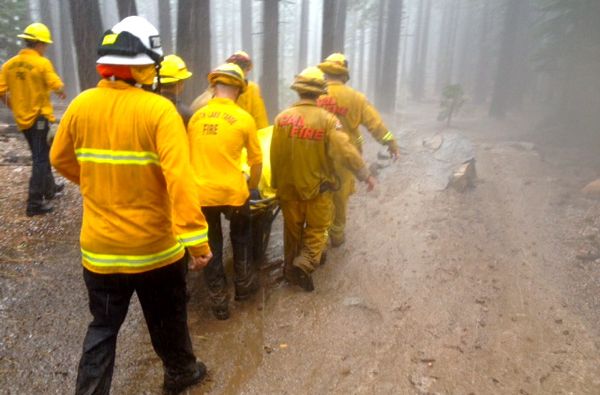
El Dorado County search and rescue, CalFire and Lake Valley firefighters carry a cyclist off Corral Trail on Aug. 11. Photo/Provided

El Dorado County search and rescue, CalFire and Lake Valley firefighters carry a cyclist off Corral Trail on Aug. 11. Photo/Provided

Afternoon thunderstorms contributed to a rescue on Aug. 11, too. A man not from Tahoe – whose name was not released – went down while cycling on Corral Loop in South Lake Tahoe.

The team had to carry him out on a litter in a downpour. He reportedly injured his pelvis.

The team almost was deployed to Pyramid Peak on Aug. 13 to search for a missing hiker when a follow up call came in saying the person had walked out safely.

A multiday rescue in Alpine County last weekend resulted in finding a West Sacramento man who had been lost in the wilderness for five days without food.

Mike Vilhauer, 58, went fishing by himself Aug. 8 at Lower Sunset Lake. He got disoriented when he left his campsite.

A California Highway Patrol helicopter spotted his vehicle last Friday, which gave rescue teams a good idea where to start searching. El Dorado’s search teams from Tahoe and Placerville were called Saturday to assist.

Scott Gabler, a veteran and decorated member of EDSO’s SAR team, located footprints mid-afternoon Aug. 10. Tracking began and then Washoe County’s Raven helicopter eventually found Vilhauer.

“He had spent two days where he we found him. He had written poems to his wife,” Almos said, adding, that Vilhauer’s condition had deteriorated. Vilhauer has recovered from his ordeal.

Almos said it’s been a busy summer for search and rescue, though the year started off slow. From Jan. 1-April 20 the team responded to 16 calls. Normal is closer to 25. As of Aug. 15, there have been 61 calls for all of 2014.


Man survives for 5 days in Sierra without food

By Siemny Chhuon, KXTV

WEST SACRAMENTO – A West Sacramento man was rescued after being missing for five days in the wilderness.

Mike Vilhauer, 58, is now in the comfort of his own home. It’s a place, at one point, he didn’t think he’d see again.

“I started thinking, ‘I’m going to be here and this is going to be it,'” Vilhauer recalled.

He was fishing alone last Wednesday at Lower Sunset Lake in Alpine County when he went looking for bait. He intended to go on a quick hike – 15 or 30 minutes at the most. But then he got lost from his campsite.

Vilhauer went five days without food.

“I did my own version of survivor man, the idiots version,” Vilhauer said. “Drinking out of puddles, dried stream beds.”

Read the whole story


The wolf’s controversial return to California

By Alexandra Ossola, Popular Science

In 2011, a male gray wolf called OR-7 left his pack in Oregon and traversed over 1,200 miles. While this sort of travel isn’t atypical for gray wolves, the terrain that OR-7 covered set him apart from the pack; he became the first confirmed wolf in California in almost a century, making him an apple of the public eye.

Since OR-7 broke away from his group — the Imnaha pack in northeast Oregon — his life looks different. OR-7 traveled a small way back North and found a mate in the Cascades of southern Oregon. The Oregon Department of Fish and Wildlife (ODFW) has confirmed that the pair produced at least three pups, although there may be more.

But OR-7’s notable route to fatherhood has reawakened a debate in California that is almost as old as the state itself: how to manage the gray wolf. With OR-7’s wolf family knocking at California’s door, the state must make a plan for how to manage a species that inspires an entire range of emotions within California’s population.

“The public is fascinated by the issue of wolves in the West,” said Karen Kovacs, Wildlife Program Manager for the California Department of Fish and Wildlife (CDFW). “People have some perceptions of how wolves are that are oftentimes not compatible with the regulatory authorities of the states that manage [the wolf population].”

As recently as the 1970s, the West had no wolves at all. That’s a stark contrast to the 1800s, when settlers found their livestock populations constantly ravaged by wolves. In each state, extermination programs were put in place to ensure the total eradication of wolves; before 2011, the last confirmed sighting of a wolf in California was in 1924.
“The public is fascinated by the issue of wolves in the West.”

But after a small wolf population reappeared in Montana in the 1980s, the U.S. Fish and Wildlife Service (USFWS) was inspired to reintroduce an “experimental population” of wolves to Yellowstone National Park. The ecosystem there, it appeared, was out of balance without wolves at the top of the food chain: elk populations were out of control, and overgrazing drastically reduced the amount of vegetation. The flow of rivers had even changed, as barren river banks eroded more easily.

Much of the public was enamored with the idea; a 1985 survey of visitors to Yellowstone National Park showed that three quarters of those polled were in favor of reintroducing wolves. And since then, the praise has only become more frenzied. Videos and op-eds abound singing the wolf’s praise, calling it a keystone species and “an American hero.”

But not everyone was so happy. A small group of dissenters — especially farmers — were very much against the plan, believing their livestocks would be targeted by the new predator. An intense public debate ensued, but after a nearly decade-long fight, the U.S. Secretary of Interior signed the decision for the reintroduction of gray wolves to Yellowstone; wolves were then captured in Canada and transported to the national park.

Read the whole story


Genetics may be why you don’t like exercise

By Barry Starr, KQED-TV

Here in the U.S., we are bombarded with an almost constant barrage of information about the benefits of exercise. And those benefits are real. For example, exercise may help prevent at least 35 chronic unhealthy conditions and premature death.

Despite all of this, something like 90 percent of us over the age of 12 fail to get as much exercise as we should. This is almost certainly not because we don’t believe in those benefits. Instead, it looks like at least part of the reason may be that some of us are genetically programmed to hate exercise.

The evidence that genes play a big role in people’s interest in exercise comes mostly from twin and family studies. For example, a recent report found that genetics explained 47 percent of the behavior of people who like to exercise and 31 percent of the behavior of those who avoid exercise whenever they can. The rest of the reluctance to or enthusiasm for exercise can be chalked up to environmental factors like already being overweight or coming from a family that doesn’t exercise or about a thousand other possibilities.

What makes the obviousness of exercise motivation genes interesting is that if there is a biological link to lack of enthusiasm for exercise, then there is a chance that we might one day be able to tweak things to make exercise enjoyable for everyone. With a gentle prod from these new meds, people who get no thrill from exercise might now be able to love it. The health benefits of such a treatment would be staggering.

Read the whole story


LTCC soccer teams set to play

Lake Tahoe Community College’s men’s and women’s intercollegiate soccer teams are getting ready to kick off their inaugural season.

ltcc logoThe public may meet the teams Aug. 15 at 1:30pm on the soccer field. The women’s team is hosting an open tryout that day at 3:30pm. Interested players should contact coach Chris DeLeon at cadeleon@mail.ltcc.edu or 530.541.4660, ext. 551. Both coaches will make final player selections based on Friday’s performances.

On Aug. 18 the men’s team plays its first inter-squad scrimmage starting at 7:30 pm.

The return of college athletics to LTCC is also ushering in a new mascot and logo. The kokanee salmon has been replaced by the coyote. Royal blue has been added to the school’s colors of green and white.

LTCC is part of the Golden Valley community college soccer conference, which includes Butte, Feather River, Lassen, Redwoods, Siskyous and Shasta colleges.

LTCC’s first women’s home game (non-conference) is Sept. 11 at 3pm against Yuba College. The first men’s home game (non-conference) is Sept. 23 at 1:30pm against Folsom College. Click here for the teams’ schedules.