STHS grad cut from Jets

By Paul Newbold, Jet Press

Every year Jets fans have to say goodbye to one or more of their favorite players, as cuts are made and aging players are deemed expendable or “washed up”. As I age I guess I’m getting a bit sentimental towards these guys, they are young in real life but their “football age” makes them obsolete. The guy I felt for this year was Garrett Mclntyre.

Garrett Mclntyre had a long journey to get to our team, and it’s an interesting one at that. Garrett was born Nov. 26, 1984, in South Lake Tahoe, and went to high school in the same town, before moving on to play football at Fresno State University. He went undrafted in the 2006 NFL draft before being signed by the Seattle Seahawks. He was signed and cut three times that season, spending brief stints with the Arizona Cardinals, and Tennessee Titans. Failing to make it on the rosters of NFL teams, he sat out the 2007 campaign.

For many players that might have been enough for them to hang up their cleats and move on from the game they love. Not so for Garrett, as he made his professional debut in 2008 with the San Jose SaberCats of the Arena league. Garrett moved on once again, signing with the Hamilton Tiger Cats of the Canadian Football League in 2010.

Read the whole story


How mental toughness gives athletes the edge

By Rachel Jacqueline, Life

At a sudden-death play-off for first place in the World University Championships of golf earlier this year, Hong Kong amateur Tiffany Chan was staring defeat in the face. Watching her competitor sink a difficult putt, she knew she had to match her rival.

After four rounds of play, the two golfers were tied at 10-under-par 278 – and they had wowed the crowds, hole for hole. It all came down to a single shot. Chan took a deep breath, focused and holed a three-meter birdie putt for the win.

“I just told myself to keep calm, take one shot at a time and focus on the present moment,” says the 20-year-old Tuen Mun resident. “I had to be tough – I had only one chance and I had worked hard for it.”

Chan’s fortitude in a moment of immense pressure is known in sports psychology as “mental toughness”. A term championed by sports psychologist James Loehr in the early 1990s, mental toughness has since been recognized as the “X-factor” that gives winning athletes the edge over their competitors.

Despite its significance, health professionals and athletes still struggle to determine what being “mentally tough” means. “Mental toughness is a combination of a few traits like resilience and stoicism. It’s about finding the opportunity in everything,” says Laura Walsh, mental health counselor and applied sports psychologist at LifeShift Hong Kong.

Walsh has first-hand knowledge of what being mentally tough requires. She competes in triathlons and international adventure races, which are multi-day events covering 350 kilometers of mountain biking, kayaking, rope work, running and trekking.

Competing in the Canadian team during the Moroccan Eco-Challenge in 1999, she recalls being on the verge of physical and mental exhaustion from sleep deprivation and altitude sickness. “My stomach felt like it was in my knees and my eyeballs felt like they were being sucked back into my head because my head hurt so much. I was done.”

Yet, she found the courage to continue. “After minutes of blubbering, I stood up and just started to put one foot in front of the other.” The team finished seventh.

The “plough factor” Walsh speaks of – continuing regardless of physical discomfort – resonates with endurance swimmer Simon Holliday, who swam 35km last May, from Hong Kong to Macau, to raise awareness of plastics in the ocean. He completed the swim in a record 10 hours, 20 minutes, and 30 seconds.

Read the whole story


Wildlife populations plummet for 3,000 species

By John Heilprin, AP

GENEVA — About 3,000 species of wildlife around the world have seen their numbers plummet far worse than previously thought, according to a study by one of the world’s biggest environmental groups.

The study Tuesday from the Swiss-based WWF largely blamed human threats to nature for a 52 percent decline in wildlife populations between 1970 and 2010.

It says improved methods of measuring populations of fish, birds, mammals, amphibians and reptiles explain the huge difference from the 28-percent decline between 1970 and 2008 that the group reported in 2012. Most of the new losses were found in tropical regions, particularly Latin America.

WWF describes the study it has carried out every two years since 1998 as a barometer of the state of the planet.

“There is no room for complacency,” said WWF International Director General Marco Lambertini, calling for a greater focus on sustainable solutions to the impact people are inflicting on nature, particularly through the release of greenhouse gases.

The latest “Living Planet” study analyzed data from about 10,000 populations of 3,038 vertebrate species from a database maintained by the Zoological Society of London. It is meant to provide a representative sampling of the overall wildlife population in the world, said WWF’s Richard McLellan, editor-in-chief of the study. It reflects populations since 1970, the first year the London-based society had comprehensive data. Each study is based on data from at least four years earlier.

Much of the world’s wildlife has disappeared in what have been called five mass extinctions, which were often associated with giant meteor strikes. About 90 percent of the world’s species were wiped out around 252 million years ago. One such extinction about 66 million years ago killed off the dinosaurs and three out of four species on Earth.

In the new WWF study, hunting and fishing along with continued losses and deterioration of natural habitats are identified as the chief threats to wildlife populations around the world. Other primary factors are global warming, invasive species, pollution and disease.

“This damage is not inevitable but a consequence of the way we choose to live,” said Ken Norris, science director at the London society. “There is still hope. Protecting nature needs focused conservation action, political will and support from industry.”


Learn about sugar pines at Van Sickle

The Sugar Pine Foundation and Explore Tahoe: An Urban Trailhead Visitor Center, and the Tahoe Rim Trail Association are teaming up for a morning of discovery and fun in the Van Sickle Bi-State Park in South Lake Tahoe.

During the free 1.5-mile trek people will explore forest management of this area, while visiting panoramic vistas and a small waterfall. All the while, we’ll discuss the fate of the magnificent Sugar Pine and what individuals are doing to help the species persevere for future generations.

People will be collecting sugar pine cones from high up in the trees and the director of the Sugar Pine Foundation will share her seed bank of knowledge.

The hike is Sept. 12 from 10am-noon. Go online to register.


International curling experts coming to Tahoe

Lake Tahoe’s only curling club is hosting the World Curling Federation on Sept. 6 from 8-9:30pm.

Lake Tahoe Epic Curling will then host a learn-to-curl session Sept. 7 from 5:30-8pm.

Both events are open to the public and are at the South Lake Tahoe Ice Arena on Rufus Allen Boulevard.

The World Curling Federation, headed by Kate Caithness of Scotland, is the world governing body of the Olympic Winter Sport of Curling and the Paralympic Winter Sport of Wheelchair Curling. U.S. Olympic Curler Ann Swisshelm will be in town for the event as well as local members of LTEC.

Sunday’s learn-to-curl session costs $25 per person ($15 for locals with a valid ID), which includes off-ice and on-ice instruction, plus game play. Wear comfortable sneakers with good tread and appropriate clothing. Send an email to info@tahoecurling.com to reserve a spot.


Enchanting cluster of 5 lakes worth exploring

One of five lakes along a 5-mile roundtrip hike. Photos/Kathryn Reed

One of five lakes along a 5-mile roundtrip hike. Photos/Kathryn Reed


By Kathryn Reed

ALPINE MEADOWS – Small ripples float across the lake in the gentle breeze. A few ducks swim by to check out the four of us – five if you count AJ. She doesn’t faze them, even though she acts like they are intruding on our territory.

But where did all the people go?

There had been so many vehicles at the trailhead and several hikers along the way. But suddenly they were nowhere to be found.

Not that we were complaining. A private lunch spot along a lake in the Granite Chief Wilderness on a Sunday in August can be a rare experience. We embraced it.

Getting here was a bit of a climb at the start. The more than 900-feet of elevation gain is mostly at the beginning. It then levels off to where the ascent is hardly noticeable. Switchbacks are gradual so it doesn’t feel like you are in a spiral. The decomposed granite proved trickier coming down because it was slick. Poles would have been welcome.

The nearly five-mile roundtrip hike starts at 6,660 feet. The five lakes are at 7,520 feet. Maps call this cluster of lakes “5 Lakes” – they don’t have individual names.

One rock outcropping looks like a cumulus cloud made out of granite. Rounding another corner there is a wall of granite that looks like it would be fun if you were into rock climbing, but scary if it were ski season.

With much of the hike being so exposed, we wondered why we started in late morning. Sweat was dripping without exertion. Fortunately, there were shady spots to rest in. But it made sense why we saw so many people on their way out as we were just starting.

The trail starts on private land that separates Alpine Meadows and Squaw Valley ski resorts. Owners of the resorts are getting close to solidifying a deal with the private property owner to link the ski areas.

Chairlifts from both resorts as well as the terminuses are visible from different vantage points. The base lodge for Alpine is a wide spot below us. A reminder of how much snow this slice of the Sierra gets is a sign at the trailhead telling people not to pick up unexploded avalanche shells.

Looking up at all the lifts it proves just how sprawling Squaw is. Plus, it’s a reminder this is not true wilderness.

The lakes are in Granite Chief Wilderness.

It was surprising to overhear backpackers talk about the other lakes in a manner that proved they had not seen them. For us, seeing all five lakes was the goal.

There is a distinct fork in the trail as the landscape changes and the tree canopy becomes denser. Go left to make your way around to all five lakes. If you go straight, you get to what we called Lake 5.

The first two lakes are more swampy, but still beautiful. They just don’t beckon one to swim. The three other lakes seem more swimmable, with Lake 5 being where people were in the water.

No one was at Lake 3 or 4, which were the two lakes the four of us preferred. Everyone was at Lake 5.

Even in the backcountry there are a couple signs of drought. No water is running in what are now dry streambeds. At Lake 3 the water mark on some of the boulders is about 2 feet higher than the surface.

Still, so much of the area around the lakes is lush – almost tropical. A few wildflowers are still out, but nothing glorious. But the hike itself and the lakes are spectacular. An extensive trail network exists here, including the Pacific Crest Trail.
——–
Getting there:

From South Lake Tahoe, go north on Highway 89 to Tahoe City. Turn left at the Y into Tahoe City toward Truckee. Turn left onto Alpine Meadows Road. (River Ranch is on the corner.) Drive 2 miles and the trailhead is on the right at the junction of the second Deer Park Drive.

Notes:
• Dogs are prohibited in parts of Granite Chief Wilderness from May 15-July 15 during fawning season.

ngg_shortcode_0_placeholder (Click on photos to enlarge.)


Placer supes OK Martis Valley Trail funding

Placer County Board of Supervisors this week authorized funding for a section of the Martis Valley Trail.

The proposed Class I bike path will be a corridor away from streets, roads and highways offering recreational opportunitie s not found on conventional roads. The 1.76-mile section of trail OK’d by the board will pass through areas of the Martis Valley, which sits between Truckee and the Tahoe Rim Trail.

The plan is for a 10.4-mile trail to eventually connect Truckee to North Lake Tahoe. The trail will run from the edge of Truckee, through Martis Valley and the Northstar Village, to the Fiberboard Freeway near Brockway Summit above Kings Beach. The project is part of a regional plan to create a paved Class 1 Bike Path connecting Truckee, Martis Valley, Northstar, Kings Beach, Tahoe City, Alpine Meadows, Squaw Valley, and will include existing sections of Class 1 trail that run along the Truckee River, through Squaw Valley, and along the West Shore of Lake Tahoe.

The Martis Valley Trail will be located primarily on Placer County owned trail easements and when completed, will be operated by the county.

The board’s action on Tuesday approved a budget revision that will move $750,000 in park dedication fees collected from Park Dedication Fe
e Recreation Area #1, in the North Tahoe-Martis area and $254,150 from a grant awarded through the Housing-Related Parks Grant Program.


TAMBA working on trails in September

TAMBA’s Armstrong Connector Trail Day is Sept. 7.

Members of the mountain bike organization (and anyone else) will be working on the Armstrong Connector and Upper Corral Trail along with 27 AmeriCorps members. Volunteers receive lunch and a post work barbecue.

Meet at 9am at the Corral Trail dirt parking lot. Some will ride, other will take shuttles up with tools and bikes. Wear sturdy shoes, long sleeves and long pants, helmet or hard hat.

On Sept. 28 the nonprofit will be on working off Highway 28.

Nevada State Parks just gave the green light for a singletrack connector trail from the Tahoe Rim Trail at Twin Lakes down to the Red House Flume Trail.  This bypasses the steep and sandy fire road that is impossible to climb unless you’re on a fat bike.

TAMBA sawyers will be clearing the corridor through September with the groundbreaking Sept. 28.  Meet at 9am at the dirt lot behind Tunnel Creek Cafe for a 4-wheel drive carpool up to the top.


Flexing hips is the best way to avoid injury

By Eric Bernstein, Outside

Your running regimen isn’t going to make up for your workday nine-to-five. All that sitting causes serious problems with hip mobility, which are only exacerbated by the repetitive movements of endurance training.

“Running and cycling combine to make some of the tightest, shortest hips on the planet,” explains Kelly Starrett of MobilityWod.com. And it’s not poor form that’s causing the problems. The repetitive movements of endurance training—coupled with the sedentary lifestyle most athletes lead outside of their sport—restrict range of motion.

Forget about posture: This is bad news for any athlete hoping to maximize efficiency and avoid injury, Starrett says.

For runners, tight hip flexors prevent full rear extension of the leg. To compensate, stiff runners achieve extension by arching their back and tilting their pelvis forward; this shifts the foot strike forward, in front of the runner’s center of mass, and creates an inefficient braking force, as well as a heavy foot strike that takes its toll on ankle, hip, and knee joints, explains USA Triathlon performance adviser Bobby McGee.

Read the whole story


Ropes course a test of strength, balance

Eileen Fingerhut takes her time crossing moving logs. Photo/Carolyn E. Wright/Copyright

Eileen Fingerhut takes her time crossing moving logs. Photo Copyright 2014 Carolyn E. Wright

By Kathryn Reed

Snake Bridge nearly bit Pete Fingerhut as he carefully swung between the logs and held on to the thin ropes.

Vertical logs are linked together five at time, then three. And just when you have your rhythm, there are five single logs that test upper body strength, timing to step from one log to the next and agility to grasp the ropes.

London, a guide at Heavenly, described this feature as one of the more challenging ones. No wonder it is listed as black. (Elements are green for beginner, blue for intermediate and black for advanced just like ski runs.)

While this was Fingerhut’s first go-round at the Discovery Forest ropes course at Heavenly Mountain Resort, he and his family are now well versed at the resort’s courses. The week before he and his wife, Eileen, and daughter, Sydney, had done the Black Bear Challenge Course.

They split their time between Meyers and Moss Beach.

“This course was more challenging,” Fingerhut said at the end of the nearly two-hour session. “The other one is a lot of fun. It’s funner than it looks.”
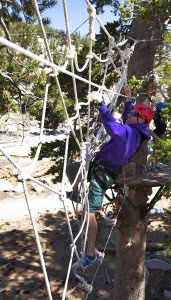
Pete Fingerhut channels Spiderman for this feature. Photo/Carolyn E. Wright/Copyright

Pete Fingerhut channels Spiderman for this feature. Photo Copyright 2014 Carolyn E. Wright
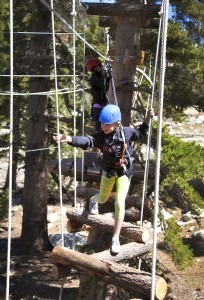
Sydney Fingerhut has not problem navigating the moving logs. Photo/Carolyn E. Wright/Copyright

Sydney Fingerhut has no problem navigating the moving logs. Photo Copyright 2014 Carolyn E. Wright

Heavenly this summer opened three ropes courses at the top of the Gondola to complement other activities in the area.

“All three have a spectrum of difficulty,” explained Liesl Kenney, Heavenly spokeswoman.

This is just the start of what resort operators hope will be widespread on-mountain entertainment that goes beyond skiing and snowboarding. The South Shore resort is in the process of seeking environmental approvals for future expansion.

The plan is to have the courses open in the winter.

“The only time we can’t run them is in high winds or there is moisture on the features,” Kenney told Lake Tahoe News.

Two guides escorted the six of us. Groups max out at 16 people.

“I liked having the guides there to ‘show us the ropes” and watch to make sure that all were safe. They were nice guys and fun,” Carolyn Wright said.

And while London and Kyle were nice and informative about what to expect or how to tackle a feature, the constant oversight on the one hand is great for feeling safe, and on the other hand seemed a bit overkill. (Skiing seems to have more inherent risks; there aren’t nearly the same number of employees on the slopes as there is on the ropes coursed compared to guests.)

Still, the features – at least in the Discovery Forest – are varied, fun and challenging.

Sydney seemed to have little problem keeping up with her parents. Her biggest problem at times was securing the cables to the guide wire. Part of her issue was height related. But my friend and I were having issues at times with getting it locked or unlocked.

From each platform there were multiple options. This cuts down on the waiting, and gives those who are looking for differing challenges the option to play side-by-side without peer pressure. Plus, if there is a feature that is particularly fun, it can be done over and over again.

It allows people to customize their experience instead of being on a set route.

Liesl Kenney demonstrates her balancing skills. Photo/Carolyn E. Wright/Copyright

Liesl Kenney demonstrates her balancing skills. Photo Copyright 2014 Carolyn E. Wright

Something always seems to be moving. Everyone seemed to struggle on the rolling logs.

“It’s really hard,” Eileen Fingerhut said once she reached the platform.

At one point she was nearly fully extended, more horizontal to the ground than vertical. That’s because the logs spin, so it is hard to stand upright while trying to walk. And, of course, all of this is while you are well above terra firma.

—–

Notes:
• Starting in September the ropes courses will be open weekends only. The gondola will close for regular maintenance in October. The resort opens for ski season Nov. 21.
• Weather will dictate if courses are open in winter.
• Must be at least 5 years old, weigh between 20 and 250 pounds, and be 42-inches tall.
• Prices:
o Discovery Forest Course plus gondola ticket: $89 adult, $78 teen/senior, $68 child.
o Discovery Forest Course: $60 with season pass or lift ticket.
o Black Bear Ropes plus gondola ticket: $79 adult, $68 teen/senior, $58 child.
o Black Bear Ropes: $50 with season pass or lift ticket.
o Boulder Cove Ropes plus gondola ticket: $79 adult, $68 teen/senior, $58 child.
o Boulder Cove Ropes: $50 with season pass or lift ticket.