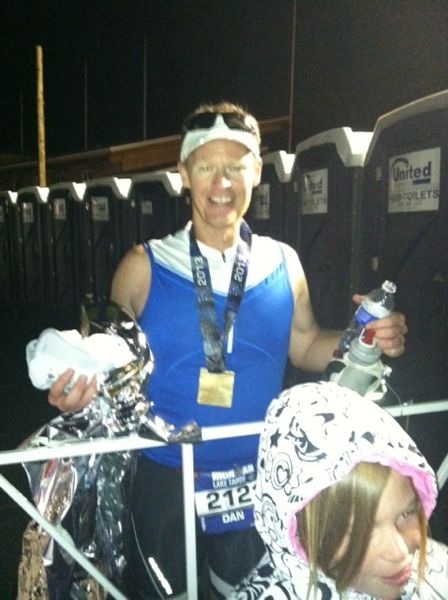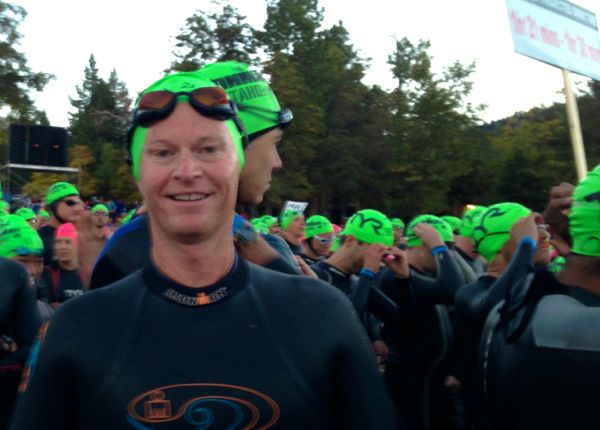
Dan Starkey before he begins the 2013 Lake Tahoe Ironman. Photos/Provided
By Dan Starkey
Born and raised in the East Bay, Lake Tahoe has always held a special place in my heart for winter skiing and summer getaways. Last year, I added another unforgettable experience to my lifelong love of Lake Tahoe. On Sept. 22, 2013, I completed my first Ironman at Lake Tahoe.
This is my experience.
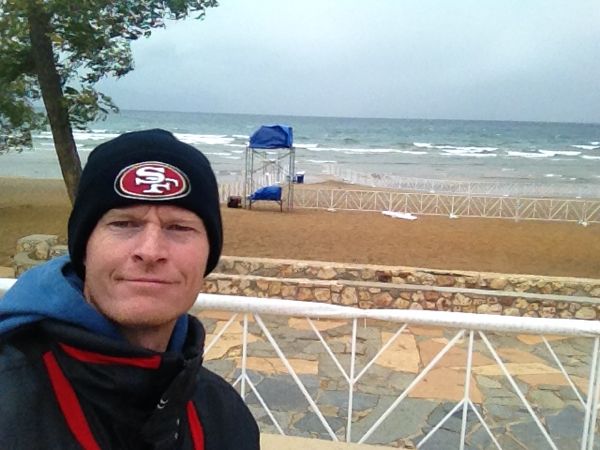
The conditions on race day were challenging, but they could’ve been a lot worse. The whole week leading up to the race was beautiful weather in the mid to upper 70s. Then, on Saturday, the day before the race, the weather turned awful. Cold wind and rain in the 50s, with waves crashing at Kings Beach. It even snowed in surrounding areas.
I spent the night before the race at the Resort at Squaw Creek. After a restless night’s sleep filled with anticipation, I got up at 4am to have a light breakfast of a bagel, yogurt, and a banana with a few sips of Diet Coke for caffeine. On a day that I would burn more than 15,000 calories, you would think I would eat a larger breakfast. However, I found swimming with a full stomach (the first of three legs of a triathlon) can lead to nauseousness. When we woke up on race day, the temperature was 29 degrees with a sunny forecast into the 60s. I took a hot shower to raise my body core temperature before bundling up and heading out to the bus.
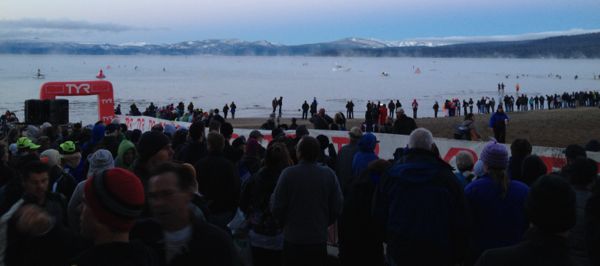
Kings Beach is where the swim takes place.
The bus ride from Squaw Valley to Kings Beach was in the pitch dark and we arrived 6am. I wore sunglasses, a 49ers ski hat and closed my eyes to visualize the day. Naturally, a Blues Brothers quote struck me as we drove away from Squaw Olympic Village knowing that I would return there some 14-plus hours later to cross the finish line: “It’s 140.6 miles to complete an Ironman. I’ve got a full a tank of gas (full stomach). A half of a banana. It’s dark. And I’m wearing sunglasses. Hit it!” – Elwood Blues
At the transition area at Kings Beach, the dangerous surf from just hours before was now glassy water in one of the most beautiful mountain lake settings in the world. The sun was starting to illuminate the sky as we neared the age-group swim start at 6:40am. The water temperature was in the low-mid 60s, providing excellent swimming conditions.
At 6:45am, my Ironman experience would begin telling myself “Pace, don’t race”. The swim course is a two-lap counter clockwise rectangular 2.4-mile course. Nine hundred meters out a long straight, 200 meters to the left then back in for lap one. Lake Tahoe is a dream to swim in, compared to say the Pacific Ocean where I completed my first 70.3 triathlon. In Santa Cruz, the water has a green tint and is freezing relative to Lake Tahoe. I remember wondering if a shark was going to attack. In Tahoe, the water is crystal clear and you can distract yourself watching peaceful sandy bottom, with its occasional boulders or fallen trees.
I maintained a steady stroke and stayed wide to seek calm waters where I would get kicked/punched less by other swimmers. I did get knocked about half a dozen times, but it’s to be expected. At the far turns, you lose sight of the lake floor in depths of more than 40 feet, but you are rewarded with 360 degree views of freshly dusted mountain tops surrounding the lake now illuminated by the rising morning sun.
“I can’t believe how beautiful this is,” I said to myself. “The day is here. I’m doing an Ironman.”
On the final straightaway, I smiled when I started seeing the sandy bottom again. Approaching the shore, as you lift your head out of the water, the underwater silence is shattered with rock music blaring (mind you, it’s still only 8:15am). The crowd is roaring and a guy on the loud speaker yelling out competitors’ names as they head to the first transition (T1). A friend of mine spotted me and cheered me on. It was great to see a familiar face. I achieved my target time of 1 hour and 15 minutes for the swim and kept my heart rate in check the whole time. Good start – but there’s a very long day ahead.
En route to the changing tent, two wetsuit strippers tell you to lie on the ground and they yank off your wetsuit in an instant. This was especially convenient since our hands on this morning were nearly frozen.
The swim-to-bike transition was a challenge. With temperatures still in the 30s, everyone was doing a full uniform change. The changing tent was over capacity so many of us had to change standing up balancing on one leg with racers all around us. While T1 usually takes about 5-10 minutes, it took most athletes 15-30 minutes on this day. Unfortunately, many athletes’ days ended with the swim when they could not recover from hypothermia.
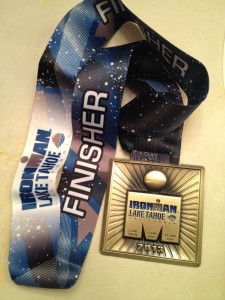
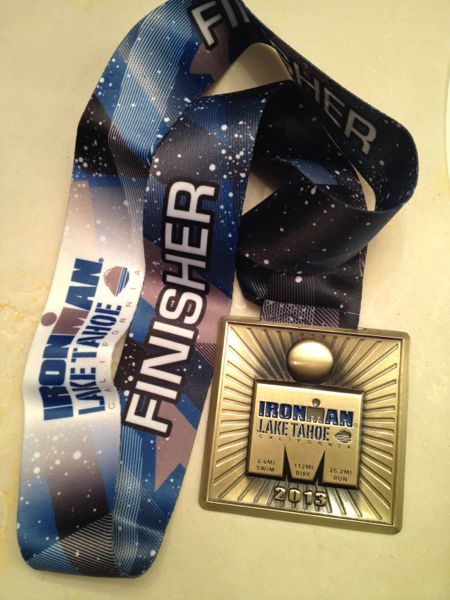
A select few have the coveted Ironman medal.
I left the warm humid T1 tent to jog out to my bike and head out on the chilly ride. The bike covered 112 miles over a 2 1/3 lap clockwise from Kings Beach through Carnelian Bay, Tahoe Vista, Dollar Point, Tahoe City, past Alpine Meadows and Squaw (I’ll see you more later, Squaw), to Truckee down through Martis Camp and Northstar back over Brockway Grade (7,185 feet) back to Kings Beach.
I elected for function over fashion and bundled up in more clothes than I’d worn in training since mid-Spring. My toes were numb for the first two hours of the bike from the wind and cold. I ate a little Clif Bar and water while I settled into my cycling stroke.
The majority of your nutrition is consumed on the bike. It’s hard on your stomach to eat much heavy food on the run. You need to hydrate well early in the race, especially being at 6,000-7,000-foot elevation. If you’re dehydrated by the time you get on the run, you’re probably not going to be able to recover. Ironman combines a physical test that you can’t cram for – and the need to game plan your exertion, nutrition and hydration in the face of extreme fatigue and the elements for up to 17 straight hours.
The first 35 miles along Highway 89 past Squaw up through Truckee are flat-to-downhill so you can maintain a brisk pace of 20 mph or more in the aero position without using too much energy. I really enjoyed the first part of the ride though reserved proper respect for the serious climbing ahead.
I anticipated that Brockway Grade on Highway 267 was going to be among the toughest sections of the entire race based on previous training rides. Martis Camp was the wild card. It was a private community adjacent to Northstar Resort that was off limits to the public prior to race day. We only knew from the course map that there was definitely climbing.
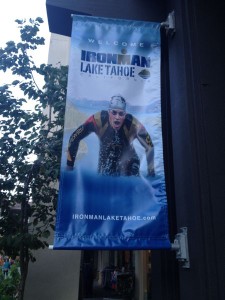
All events are on the North Shore.
It turns out Martis Camp was a million switchbacks and lots of ups and downs that got you sweating, then cold on the downhill, then sweating and cold, etc. I was thrilled to see Northstar signs because it meant I was done with Martis Camp for this lap. Just past the entrance to the Ritz-Carlton was the dreaded Brockway Grade. Brockway is 2.5 miles of unforgiving uphill with grades up to 8-10 percent (that’s hard … wink!). My first ascent up Brockway actually went better than expected. At the top, I couldn’t believe I was thinking to myself that Martis Camp may have been more tiring than Brockway. As I started the 35-40 mph descent on the backside of Brockway into Kings Beach, I was already dreading those back-to-back climbs in about 45 miles.
By 11am, I was almost done with lap one on the bike under clear blue skies. I was right on pace with my pre-race target and feeling strong with nearly two hours of smooth road ahead. But before I got too satisfied, I reminded myself that I still had almost 100 miles of riding/running to go. Reality check.
In mile 60 past Tahoe City, I took my first dip into my Special Needs bag. Before the race, you can put anything you want or need into a bag that’s waiting for you halfway through each the bike and the run. My bag included ibuprofen, Tums, extra energy food and drinks, plus some fun snacks to just break up the monotony like Lay’s BBQ potato chips (tasty salt intake) and a Coca Cola (sweet tasting caffeine). I was fueled up and hoping to see my family in Truckee.
Through historic downtown Truckee, I coasted while standing up out of the saddle stretching my calves, hamstrings and lower back scanning both sides of the barricaded street for my support crew. I was so happy to spot them on the far side of Bridge Street. I stopped and chatted with everyone for a couple of minutes while the kids were jumping up and down and yelling excitedly! I shed my jacket now that it was up to 64 degrees – the ideal race temperature I never thought we’d see 24 hours before when it was snowing.
I hesitated to push off because I didn’t want to say goodbye so quickly. I got such a lift from seeing everyone that I carried with me into the mountain climbs ahead. The roads were definitely less crowded than earlier. On the second climb up Martis Camp, fewer riders nearby made the uphills feel even slower and longer. It wasn’t just a feeling. My second lap was about 1 mph slower than the first one, but I was still going steadily.
Brockway was definitely tougher the second time around. I counted down each 0.1 of a mile through the final steep half-mile section. At the top of Brockway, I stopped at the aid station to collect myself. I made a point of thanking volunteers as often as I could.
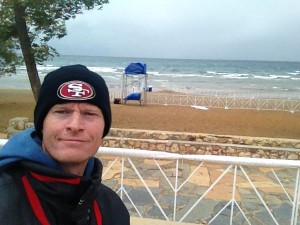
Dan Starkey all bundled up for the bike ride.
The support on this race was truly exceptional thanks to all of their help. They would hold your Needs bag for you while you picked what you needed from it. At aid stations (every 10 miles on bike and every 1 mile on run), they would take your bike bottles from you, twist off the cap, refill it and replace the cap and return it to you while you caught your breath for a moment. They would do anything that would make life easier on you in that moment.
Every gesture of kindness was welcomed on this tiring day. My favorite sign on the road was held by an 11-year-old boy: “I trained 6 months to hold this sign!” Honorable mention: “Pain is temporary. IM is forever.” I was also told, “You’re almost there!” about 12 times. Even in my poor mental state, I was onto them after the first 11 times.
Speaking of kind gestures, there were thousands of cheering people throughout the race course. It was fun to watch the reactions. There was an excitable group of twentysomething guys/girls on the left side of the road near Tahoe City at mile 95. I played along with them and waved my hand up, up telling them to raise the noise level. They ate it up and went crazy! They were as pumped for my participation in their rowdiness as I was to receive their energy. They may have been drunk.
Miles 90-110 to Squaw were pretty leisurely. I ate some Clif Bar, drank as needed and even chatted up a rider I’d seen many times on the ride. He was on his third IM and he called the Tahoe bike “10 times harder than Canada”. This sentiment would be repeated many times over. This was the highest Ironman ever held in North America and the most climbing (7,500 feet) on the bike ever.
Approaching Squaw Village for the second transition (T2), I was treated to lots of cheering family and friends. I was on a high! The swim and bike were done – and I was surprised how good I felt. In the T2 chute (like the end of a leg of the Tour de France), I yelled to no one in particular in the cheering crowd, “This is awesome!”
To make you feel like a champion, as you approach the T2, someone is waiting there to take your bike from you while you jog off in your bike shoes to go change into your running gear. I thought this only happened at Kona on TV. Nice touch.
A few minutes before 4pm, I was in my running shoes and heading off for the run – a 26.2-mile double lap out-and-back course along the Truckee River trail to Tahoe City. I saw more family as I started the run and rounded the corner through the throngs of cheering fans in the village. I actually started the run thinking that I could beat my personal best time for a marathon. This was a humorous delusion.
The first five miles of the run were good, but that’s where my feelings of “This is awesome!” abruptly came to end for good. I was having stomach pains that were aggravated with every step of running. I walked for the next five miles straight. Every time I tried to run again the pain in my gut jabbed at me. I couldn’t stomach eating anything either. No nutrition with 16 miles to go was not sustainable.
After turning around at mile 10 in Tahoe City, the stomach pain subsided enough for me to start mixing some jogging (very little … like 0.2 mile at a time) with the walking. I started extrapolating how long this marathon would take at this pace. Oh geez … this was going to be the longest 5-plus hours in my life.
Still, I reminded myself of Goal No. 1: Finish the Ironman.
I had these images in my mind of people collapsing and not finishing the Ironman. I would rather finish with a longer than expected marathon time than not finish at all.

A smile from Dan Starkey after a grueling day at the Lake Tahoe Ironman.
This race is a test of survival. My stomach would eventually accept some potato chips (to replenish some lost sodium), grapes, oranges and cola. On my return to the Squaw Village area, more family and friends cheered me on. My wife, Erica, ran along with me for several minutes and I got emotional in her confidence that I was on my way to becoming an Ironman. I still had 10 miles of foot numbing walking/jogging ahead.
Though, the last four miles in the dark seemed to take absolutely forever. I saw my buddy Jeff Judson on the course a couple of times on the run so we pumped each other up. I also talked to several multi-Ironman finishers. I asked them all the same question, “How does this one compare?” and I always got the same answer “This is the toughest one I’ve ever done … that bike was brutal.”
After the sun went down, the temp dropped quickly. I wore a space blanket over my shoulders and a headlamp for the last 2.5 hours of the marathon. The temperature had dropped back down to 40 degrees. I tried to stay “present” enough to acknowledge the encouragement of strangers, but to be honest, even a thumbs up (frequent throughout the bike course) was too much to muster.
Within miles of the finish line, the Squaw Village lights shined brightly through the darkness and you could hear the finish line announcer celebrating each finisher’s name. As I entered the final half-mile within the village, I soaked in the crowds along the barricades and slapped five with as many kids as I could. Approaching the grandstands, I was smiling broadly and searching to find my wife and kids. As the announcer boomed “Dan Starkey from Danville, California … You Are An Ironman!”, Erica screamed out my name from just right of the victor’s arch. My experience was complete to have Erica and the kids sharing it with me.
No more than three steps after crossing the finish line, a handler puts his arm around your shoulders — probably so you won’t fall over. He was also the handler for the third place pro, who called IMLT the toughest IM he’s ever done. The best pro time in IMLT (8 hour 55 minutes) was nearly an hour longer than Kona, for example. Most of us in IMLT found this race to take at least an hour longer than expected.
Finishing time: 14 hours, 44 minutes, 0 seconds.
After my photo was taken in front of the IM backdrop and I got hugs from the family, I scarfed down about seven pieces of pizza and a plate of chicken and pasta before getting a massage in the heated medical tent. It was also amazing to stay until almost midnight and watch some of the finishers who could barely stand upright shuffle across the line to earn their medals.
The memories of completing my first Ironman in Lake Tahoe remain a daily inspiration to me. The experience profoundly embodies the Ironman motto that “Anything Is Possible”.
Note: I’m looking forward to returning to complete the Ironman Lake Tahoe 70.3 on Sept. 21.