ACC partnering with Warrior Open

This week’s 4th annual Bush Center’s Warrior Open in Las Colinas, Texas, will act as a feeder tournament for the American Century Championship.

The Texas winner will receive an all-expense paid trip to the 2015 ACC at Edgewood Tahoe in July.

The idea to do this came after retired Army Cpl. Chad Pfeifer at last July’s American Century Championship became a crowd favorite and placed fifth.


Study: Access to local trails lowers youth obesity

By Nathan Hurst, Springfield News-Leader

COLUMBIA, Mo. – Researchers at the University of Missouri and the University of Minnesota have found that local governments can help cut record levels of youth obesity by expanding public lands available for recreation.

Sonja Wilhelm-Stanis, an associate professor of parks, recreation and tourism in the MU College of Agriculture, Food and Natural Resources, found that counties with more non-motorized nature trails and forest lands have higher levels of youth activity and lower youth obesity, while counties with more nature preserves have lower activity levels.

Wilhelm Stanis, along with her co-authors Andrew Oftedal and Ingrid Schneider from the University of Minnesota, studied data from every county in the state of Minnesota, comparing youth activity rates and youth obesity rates to amount of public non-motorized nature trails, motorized nature trails, nature preserves, parklands and forest land.

Read the whole story


ZCES students walk to raise money

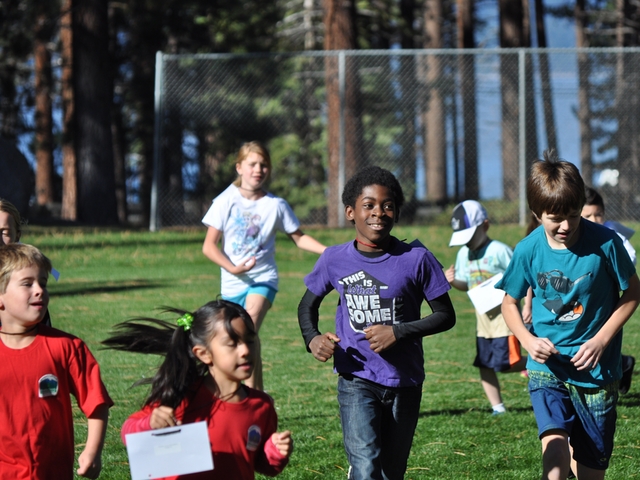
Zephyr Cove Elementary students raise money Oct. 2 during the annual walk-a-thon. Photo/Provided

Zephyr Cove Elementary students raise money Oct. 2 during the annual walk-a-thon. Photo/Provided

Zephyr Cove Elementary School students participated in the school’s annual walk-a-thon Oct. 2 to raise funds necessary to support school activities.

Now in its fifth year, the walk-a-thon represents 15 to 20 percent of the Parent Club budget which helps to support school programs, such as field trips and class projects. With school enrollment up almost 10 percent this year, the funds are well needed and will support a new “place-based” education focus at ZCES. This focus immerses children in the ecology and history of the Lake Tahoe Basin through hands-on projects, special programs and field trips.

More than 30 parents volunteered to assist the 185 students. Several parents and many of the staff also participated by walking and running with the students. The annual event is conducted on the field across from Zephyr Cove Elementary. Each lap represented one-twelfth of a mile. At least five students surpassed the 100 lap mark (over 8 miles).


Bears keeping wildlife officials busy

By Scott Sonner, AP

You’d be hungry too if you couldn’t find any food and were used to eating the equivalent of more than 80 cheeseburgers a day.

An already busy bear season has exploded in the Sierra Nevada with nine hungry bruins captured since Wednesday morning near Reno and Lake Tahoe as an ongoing drought continues to make food scarce in the mountains. A 10th was hit and killed by a car Thursday in south Reno.

Since July 1, Nevada Department of Wildlife officials have caught 42 black bears and released all but two back into the wild. They said two repeat offenders had to be killed — one so bold it was rummaging through picnic baskets in July on a busy Tahoe beach.

Cars have killed an additional 10 bears as the animals move into more populated areas from the parched foothills on the Sierra’s eastern front, where streams are down to a trickle and the usual supply of berries and insects is lacking.

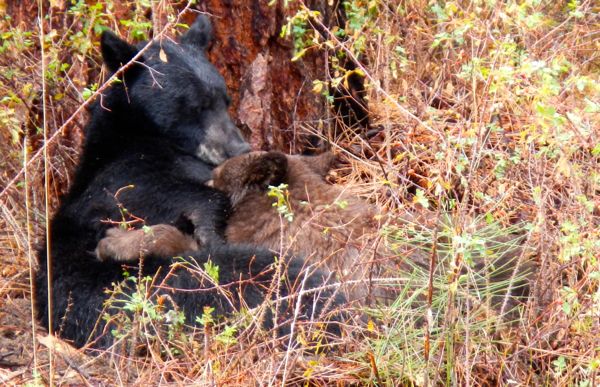
Bears and cubs are prolific on both sides of the state line. Photo/Kathryn Reed

Bears and cubs are prolific on both sides of the state line. Photo/Kathryn Reed

A surge in activity is expected with cooler temperatures this time of year, when a typical bear’s food intake jumps from 3,000 to 25,000 calories a day, said Chris Healy, Department of Wildlife spokesman. That’s the human equivalent of 83 McDonald’s cheeseburgers.

The animals are going through hyperphagia, a physiological change in which they eat as much as they can to store fat for winter hibernation.

“Nothing much gets in the bear’s way when they are this hungry,” said Carl Lackey, the agency’s chief wildlife biologist. “Nature’s dinner bell is ringing.”

He noted a third consecutive year of drought has exacerbated bear encounters with humans.

The Nevada Department of Wildlife captured 97 bears last year and 83 in 2012, mostly between July 1 and Dec. 1. The 10-year highs and lows were 159 in 2007 and 40 in 2009.

On Thursday, game wardens and wildlife biologists were back on the trail of nuisance bears raiding garbage cans and climbing trees near residential areas in search of fruit. Over the past two days, they’ve trapped two mother bears and three cubs in the same part of west Reno, a sow and two cubs at south Tahoe near Stateline, and a 2-year-old near Carson City.

“It’s pretty wild,” Healy said Thursday after they captured the latest one near Carson City. He said the separate bear families caught in Reno on consecutive days were “literally at the exact same spot.”


USFS loosens fire restrictions

The U.S. Forest Service Lake Tahoe Basin Management Unit lifted fire restrictions on National Forest System lands beginning starting today.

Campfires are still not allowed in any wilderness areas including the Desolation Wilderness. In 2004, the LTBMU adopted a set of fire regulations that restrict where campfires are allowed year-round. Most of the Lake Tahoe backcountry is “stove only” with a valid campfire permit.

For more information about backcountry fire regulations and how to obtain a campfire permit, call 530.543.2694.

To learn more about residential burning, contact CalFire or your local fire department or fire protection district.


Trail to put cyclists-walkers along waters’s edge

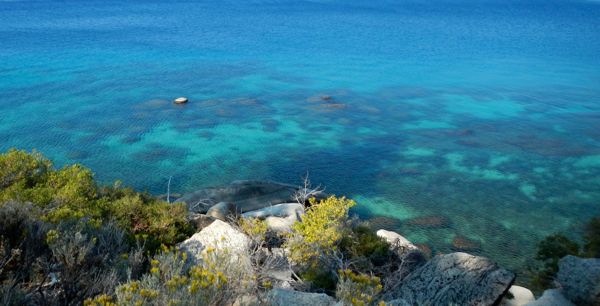
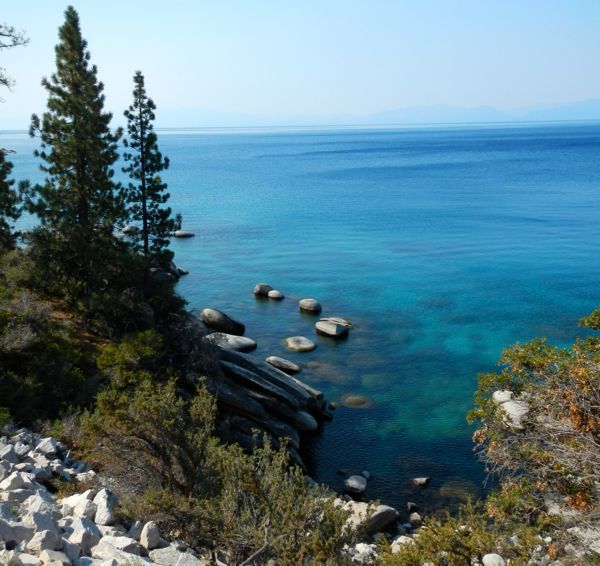
Lake Tahoe's multitude of colors are along the Incline trail. Photos/Kathryn Reed

Lake Tahoe’s multitude of colors can be seen where the Incline trail will go. Photos/Kathryn Reed

By Kathryn Reed

INCLINE VILLAGE – It’s possible people won’t be able to pedal the Incline Village to Sand Harbor bike trail that is slated to break ground next summer.

And it has nothing to do with the grade – that is expected to be no more than 5 percent. Nor even the length to begin with – it will be three miles when this demonstration plot is finished in what could be 2016.

It’s the views that may keep people from progressing far at once. People likely will be pulling over to snap photo after photo.

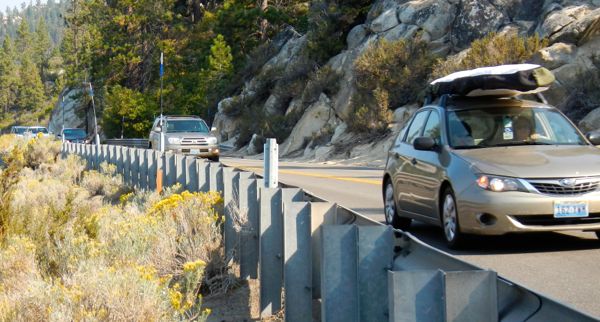
From the road this windy stretch of Highway 28 looks like it could fall into Lake Tahoe. The truth is there is a wide swath of land before reaching the water – and not just in drought years. This is where the bike path is going to be built.

The Incline section is one small part of what eventually will be the 30-mile Stateline-to-Stateline Bike Path. It will encompass all of Nevada at the lake. The even larger plan is to have a path around the entire lake.

The first phase of the Stateline-to-Stateline trail was completed in 2013 with 2.2 miles that go from Rabe Meadow in Stateline to Round Hill Pines Beach.

This past summer the Tahoe Fund launched a fundraising drive to secure $750,000 to help leverage $12 million in public dollars for the project as well as put some aside for a future endowment fund for maintenance. Tahoe Transportation District is the lead agency to get the trail built, but this section would be Nevada State Parks responsibility for upkeep.

The trail will mean no longer having to walk along the highway.

The trail will mean not having to walk along the highway.

The nonprofit raised the money in seven weeks. The 16 vista points ranged from $15,000 to $100,000 depending on size and access. Those with more modest budgets can still donate $100 to have recognition at the start of the trail, and donors will also be recognized at kiosks at different locations.

Near where Tunnel Creek Café sits today will be the addition of 90 parking places. Already a bike trail exists on Lakeshore Drive. Eventually the Stateline trail will go to Crystal Bay.

The section breaking ground in May will head from the café on the mountain side. Where the actual Tunnel Creek flows is where cyclists/walkers will cross Highway 28 – either underground or via a bridge. This is about one mile from the café. People will be adjacent to the lake the rest of the way to Sand Harbor.

Amy Berry, CEO of the Tahoe Fund, said, “It’s like building a highway alongside the highway.”

This is because it will be 10-feet wide, entails potential over and underpasses, cantilever bridges, grades to meet American with Disabilities Act rules, signs and other necessities. Plus, building at Tahoe – and so close to the water – requires hurdles to be leaped before contractors are hired.

Scenery will be a main draw to this route.

Scenery will be a main draw to this route.

People will be walking or riding at a level that is lower than the state highway. And while this may sound noisy, the normal passenger car just made a hum on a recent morning. The beauty, even on a smoky day, could not be interrupted or derailed by anything above.

There will still be spots for motorists to stop, like at Memorial Point.

Stairs descend from the road to the water. Not all of these will be saved or in their same configuration when the trail is built. Besides getting people from Point A to Point B, the route is designed to stop people from parking on the narrow highway, reduce accidents, improve the environment and get people closer to Lake Tahoe. Estimates are that 100,000 people will use this trail once it is in the ground.

“It is a trail that takes you someplace, but the journey is the destination,” Berry said.


Drought causing pumpkins to ripen early

By Anjali Hemphill, CBS 13 

DIXON  — A Dixon farm says the drought is certainly affecting this year’s pumpkin crop and some other holiday favorites.

Usually owners at Cool Patch Pumpkins tell customers not to buy their pumpkin now because they aren’t ready. But this year, the advice is the exact opposite.

Matt Cooley says it’s almost frightening how fast his pumpkins are turning this year.

“Usually the bigger ones take longer, but this year they are already ready,” he said.

The persistent drought and lack of winter rain has caused his pumpkins to ripen two to three weeks early.

Read the whole story


Study: Physical activity helps kids think better

By Deborah Netburn, Los Angeles Times

Here’s another reason to get your kids off the couch and make them run around instead: It will help them think better.

In a paper published in Pediatrics, researchers report that kids 7 to 9 years old who attended a daily, after-school fitness program showed an increased ability to pay attention, avoid distraction and switch between tasks at the end of a nine-month period, compared with a control group that did not attend the program.

“Our study shows that brain activation was different in the ‘FIT Kids’ group compared to a control group,” said Charles Hillman, a professor of kinesiology and community health at the University of Illinois at Champaign-Urbana and lead author of the paper.

The study involved 222 elementary-school-aged children. Half of them were accepted to a free fitness program called “FIT Kids” (for “Fitness Improves Thinking”) that met daily after school on the campus of the University of Illinois. The other half were put on a wait list for the program, and were used as a control group.

Read the whole story


LTCC soccer program netting more than goals

Midfielder Hector Hernandez, No. 15., goes for the ball Sept. 15 at LTCC. Photo/Jessie Marchesseau

Midfielder Hector Hernandez, No. 15., goes for the ball Sept. 15 at LTCC. Photo/Jessie Marchesseau

By Jessie Marchesseau

Lake Tahoe Community College kicked off the 2014-15 school year with a new mascot, the coyote, and two new soccer teams to wear it on their jerseys.

LTCC has been devoid of an intercollegiate athletic team since it did away with Nordic skiing in 2001. Volleyball and cross country running were discontinued a few years before that. More than a decade later, re-entering the collegiate athletic field was no snap decision. The new soccer program has been years in the making, with numerous proposals, discussions and studies along the way.

Ultimately, LTCC President Kindred Murillo believes the addition of a soccer team fit perfectly into the college’s new vision and goals for increased enrollment.

“It started out of our desire to reach into local high schools, and expanded into fitting our desire to be a destination college,” she told Lake Tahoe News.

Murillo sees the soccer team as a way for LTCC to meet its goal of attracting more students from local and nearby high schools by offering athletes a means to continue playing soccer without having to travel far away.

She also pointed out how students and young adults often come to Lake Tahoe from other areas because they enjoy a variety of outdoor sports. By offering the opportunity to play intercollegiate soccer Murillo hopes the college can tap into the supply of potential students already considering a move to Lake Tahoe.

And so far, it seems to be working.

“I believe we hired the coaches that will bring this program to the forefront of California community college soccer and bring student athletes to the program,” said Tim Johnson, LTCC physical education and health department chair, who originally proposed the idea of a soccer team to the school’s administration.

The head coach for the women’s team, Chris DeLeon, coached at South Tahoe High from 2001 to 2013. With such deep-rooted connections in the local soccer community, it is no surprise that 15 of the 21 players on the women’s roster hail from South Lake Tahoe.

“One of our biggest goals for starting teams was giving local flavor a chance to play,” DeLeon told Lake Tahoe News.

On the men’s side, head coach Benjamin Wade came to LTCC from Lassen Community College in Susanville. He brought 12 players from Lassen with him, chose a handful more at tryouts and used his web of international soccer connections to fill out the men’s team with 18 international players originating from Europe, Australia and South America.

The athletes, no matter where they come from, are not eligible for athletic scholarships, a variation from four-year institutions. This means every new player results in additional tuition dollars for the school.

In all, DeLeon said the soccer program brought in more than 50 students this year. About 20 of those were from other countries.

The unexpected influx of international students for the teams even influenced LTCC to implement an international student program. These international students are a welcome addition to the school for more reasons than one.

First of all, Johnson said, they bring different cultures and a more worldly air to the campus. In addition, they pay a significant amount of tuition to the school.

But, still, Murillo said she would like to see more local players and students.

“I think it’s surprising to local students how rigorous your life is going to be being involved in a college sport,” she said.

Many potential players struggled with balancing work and school schedules. Murillo said they are learning as they go, and the school may make some changes for next year to encourage more local athlete involvement.

Overall, the program has exceeded the expectations of pretty much everyone involved. From the turnout of more than 150 spectators at the first women’s home game, to the men’s team being ranked as high as No. 1 in the state in recent weeks, LTCC Coyotes soccer is off to a running start.

“It opens that door to the possibility of exploring another sport,” Johnson said.

This may happen sooner rather than later. Murillo indicated they are not leaning toward one sport or another, but the administration may begin exploring other intercollegiate athletic options as early as this winter.

The next Coyote soccer home game is Oct. 3. Team schedules are online.


Heavenly makes pitch for summer expansion

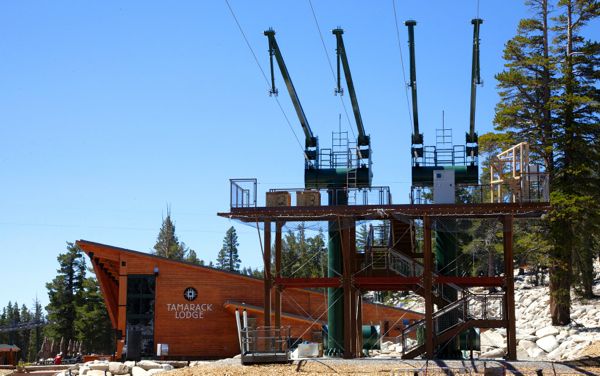
The four-line zipline being built near Tamarack Lodge will open in summer 2016. Photo/Carolyn E. Wright/Copyright

The four-line zipline being built near Tamarack Lodge will open in summer 2015. Photo Copyright 2014 Carolyn E. Wright

By Kathryn Reed

STATELINE – Snow isn’t the only thing Heavenly wants to be known for. The South Shore resort is making substantial efforts to be a playground in the summer, too.

The Tahoe Regional Planning Agency Governing Board on Sept. 24 got a taste for what Heavenly Mountain Resort wants to become.

“Guests want more than a sightseeing experience,” Heavenly COO Pete Sonntag said.

When the gondola opened in 2000 it was about getting skiers at the state line bed base onto the mountain without driving. A viewing deck near the top was about being a scenic lookout. Gradually the resort has added non-winter activities, with this summer being the inauguration of three ropes courses and the resurrection of a zipline. But the resort is just beginning.

Ziplines, canopy tours, sky cycles, alpine coaster, and a mountain bike park are part of the resort’s plans that are being studied in environmental documents.

The TRPA board heard a presentation Wednesday about the multi-million dollar on mountain transformation.

The mountain bike park will be on the Nevada side, outside the Lake Tahoe Basin – therefore outside TRPA’s jurisdiction. It will not be as difficult as Northstar’s park. It will have a connector route to the Tahoe Rim Trail and access via Van Sickle Bi-State Park.

A Governing Board member questioned how Heavenly would be able to manage capacity if people are in the park who have not paid. Andrew Strain, government affairs chief for the resort, said that is part of the monitoring that is being worked out.

A member of the public wondered if air quality issues had been addressed when it comes to taking people on guided mountain tours via vehicles. The roads to be used for this are ones that already exist.

Most of the development will be in three primary hubs that already are considered disturbed land because of the ski resort. The alpine coaster will be a modern day version of an alpine slide. It uses gravity to whisk people through the trees on an elevated course. The sky cycle has people pedaling 20 or 30 feet off the ground in the forest. It is proposed to go near the top of the gondola. A replica of a fire lookout will be constructed and used as a way to teach people about fire.

Education is a component Heavenly wants to weave into many of its summer activities.

“It’s a different market for us than winter. For some it’s the first time they’ve set foot on a national forest,” Strain told the board. “We are partnering with the Nature Conservancy. They will drive the education experience.”

Ryan Galles, principal of Sierra House Elementary, said he could see how this will benefit his students. The school, which has an emphasis on fitness, already partners with Heavenly in the winter. He hopes to have similar opportunities when snow isn’t on the ground.

“Learning happens inside and outside the classroom,” Galles said.

Strain said careful planning has been done to ensure the structures that are built don’t impede the experience of skiers and snowboarders. Resort officials realize they are still primarily a winter destination. Most of the structures will be in the ground year-round even if they aren’t used.

“We will not be operating the ropes courses or ziplines this winter,” Sally Gunter, resort spokeswoman, told Lake Tahoe News.

That could change in future winters.

The mountain at complete build-out could handle 17,000 skiers a day. Today Heavenly sees about 10,000 a day at peak periods. This compares to summer where about 108,000 visit the resort all season. Projections are for that number to grow to 160,000 with the added amenities.

Most of the 13 people who spoke at the meeting had favorable things to say and recommended the board approve the project. (A vote will come after the final EIR/EIS are released. Comments on the draft are being taken until Oct 27.)

Besides the construction dollars that could start to flow to the region next summer if the project is approved, it means an economic stimulus in other ways. What the current summer operations – one zipline and three ropes courses – have meant is 120 full-time jobs that didn’t previously exist.

“We were able to take our best winter employees and offer them year-round employment,” Sonntag said.

Besides transitioning from a gaming-dominant economy to recreation, another emphasis of the powers that be has been on providing more than seasonal employment.

If the project is approved in the spring, construction would begin in phases in summer 2015. Some features would open in summer 2016, others the following year.