Free backcountry demo day at Alpine

The Lake Tahoe Backcountry Demo Event, North America’s largest venue for all things alpine touring, telemark and splitboard returns Jan. 10.

Alpenglow Sports has once again partnered with Alpine Meadows for the 9am to 3pm event at the ski resort.

Participating vendors will include DPS, Dynafit, G3, Scarpa, NTN, Salomon, K2, Scott, Marker, Volkl, Twenty-Two Designs, La Sportiva, Voile, Moment, Julbo, Fly Low, Smith Optics, Jones Snowboards and more.

In addition to the opportunity to try more than 100 styles of skis, Alpenglow and Rich Meyer Alpine Guide will also provide a free, informal avalanche companion rescue class. It will include beacon searches, strategic shoveling, and probing and will begin at 1pm at the Alpenglow registration tent.

The event is free, but participants must possess a valid lift ticket or season pass purchased from Alpine Meadows or Squaw Valley, along with a driver’s license and credit card for deposit.

Call 530.583.6917 with questions.


Birders flock to South Shore for annual count

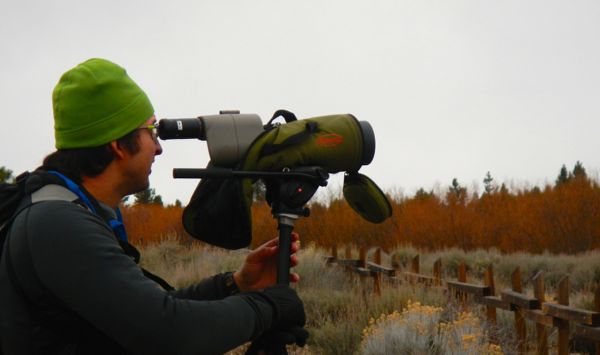
Scott Dietrich uses his scope Dec. 15 to better identify a bald eagle. Photos/Kathryn Reed

Scott Dietrich uses his scope Dec. 15 to better see a bald eagle. Photos/Kathryn Reed

By Kathryn Reed

With more than 300 bird species in the Lake Tahoe Basin, Scott Dietrich is on a quest to see as many as he can this year. Prior to the Dec. 15 Christmas bird count he was at 185.

Armed with binoculars to scan Cove East, Dietrich was quick to find the bald eagle perched atop a tree across the river and on the far side of the Upper Truckee Marsh. With a scope, there was no mistaking that white headed raptor.

The Incline Village resident has been birding for about seven years. While he does this mostly for fun, he has given birding tours and plans to again starting next May.

Dietrich’s most rare find was a short-eared owl that he saw in the Upper Truckee Marsh earlier in the fall. It’s unusual for this species to be at an elevation like Lake Tahoe’s.

His adventures take him to all parts of the lake, but it’s the South Shore he likes the most.
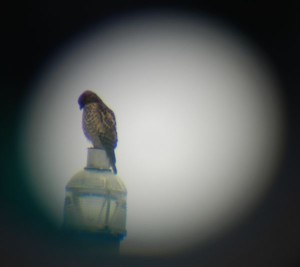
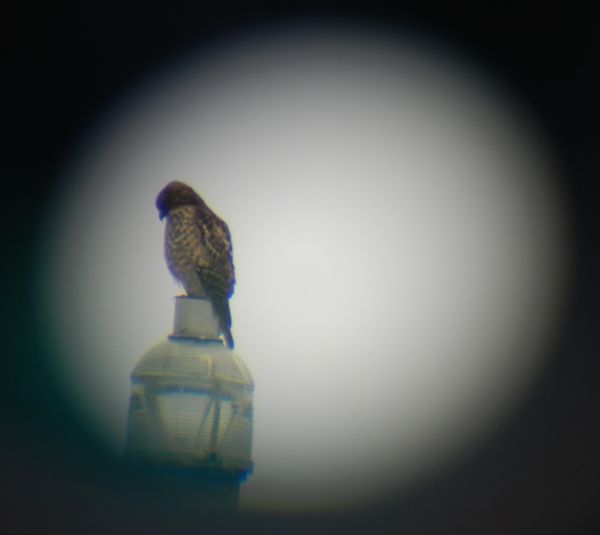
A red-shouldered hawk as  seen through a scope.

A red-shouldered hawk as seen through a scope.

“The Upper Truckee Marsh is probably the best area in Tahoe to look for rare birds,” Dietrich told Lake Tahoe News. “Lake Forest in Tahoe City is the other area for shorebirds.”

Dietrich was part of Monday’s annual bird count that takes place across the United States. This is the Audubon Society’s 115th annual bird count. Tahoe has been doing it since the early 1980s.

Data from the 2,300 counts will be tabulated by the national organization, which will document migration, breeding and other patterns.

Local numbers are still being calculated.

A 7½-mile radius, with the Upper Truckee Marsh being the center, is scoured for birds. Between 60 and 70 species have been documented the last few years. It’s the only bird count in the basin.

It didn’t matter that the temperature was in the 30s and snow was swirling in the air – this was the largest group to assemble for the annual count. They started at Cove East in South Lake Tahoe and then broke into groups stretching from Meyers to D.L. Bliss State Park to Cave Rock.

Before the group of 20 birders could get out of the roadway at Cove East the scopes were lined up looking at a red-shouldered hawk that was sitting on top of a pole at the Tahoe Keys Marina.

This bird used to be rare in Tahoe, but in the last few years it is common to find them at this higher elevation. Will Richardson, director of the Tahoe Institute for Natural Science, told Lake Tahoe News, “Bird populations are a dynamic thing. There are some natural contractions and expansions. Some is a result of climate change.”

But there is no disputing the avian population is changing.

“The Eurasian collared dove showed up a couple years ago. They came across the whole continent,” Richardson said.
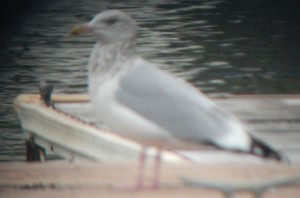
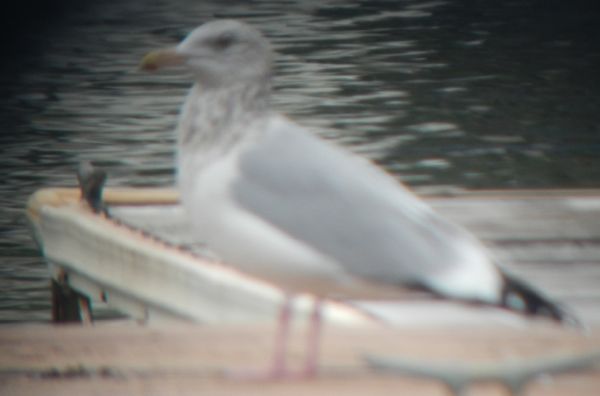
A herring gull through a scope.

A herring gull through a scope.

Grace Mannell was probably the only one interested in seeing magpies. She recently moved here from the Bay Area, where this long-tailed bird is a rarity.

Some of the birders were on their first official count, others were veterans.

For Lynn and Don Harriman they have been counting birds every Wednesday for the last six years – either at Cove East or in the Upper Truckee Marsh.

“We wanted to see how the birds change through the years,” Don Harriman said of their avocation.

Almost everyone had binoculars, many had notepads to record what they saw, there were field books to help with identification and high-powered scopes — all tools of the trade.

Some of the birds were sitting still in trees, some flew overhead – like the two dozen robins, while others were on the water, and some were on the docks of the Keys – like the herring gull.

Three types of gulls call the Lake Tahoe Basin home – the herring, California, and ring billed. The herring is the most rare of the three. It’s here only in the winter. Those pink legs distinguish it from the others.

—–

Notes:

There will be a bald eagle count on Jan. 9. For more info, go online.


Skiing as it was before chairlifts

By Kelly Dinardo, New York Times

Beads of sweat trickled down my back, forming an icy pool where my thermal top had ridden up. My heart, drumming a furious, hard-rock beat, accompanied the loud gasping of my breath. Reaching forward with one arm, I stabbed my pole into the snow-covered ground, slid the opposite leg forward and continued to ski up the mountain at La Fouly, a small, four-lift resort in the Valais region of Switzerland.

Known as ski mountaineering, Alpine touring or skinning, this is skiing much as it was before chairlifts: you propel yourself up the mountain before swooshing back down.

For years, skinning remained primarily the domain of backcountry skiers, those adventurous athletes who ventured off slope to ungroomed, unmarked, unpatrolled terrain. Today, people skin to reach isolated sections of a mountain, to search out fresh, deep powder or for the calorie-torching workout. And, it’s no longer limited to off-piste ground.

“It’s taking over at resorts,” said Tyler Cohen, managing editor of Backcountry Magazine. “It’s a good way to get in shape before the conditions are ready for backcountry skiing. It’s a great way to squeeze in a run and a workout before or after work. And, it’s a different way to experience skiing.”

An enthusiastic downhill skier, I spotted my first skinners battling uphill a year before my own huffing-and-puffing attempt. From the comfort of a gondola, I would pull up my neck warmer or yank on my mittens and study a man dripping with sweat or a woman in just short sleeves, working his or her way up the slopes of the Swiss Alps below.

Curious, I grilled all the people I met who mentioned they skinned until, in late January, my friend Greg Stewart said, “I’ll take you tomorrow.”

Read the whole story


Guldemond takes Dew Tour title

By USSA

BRECKENRIDGE, Colo. — On the final day of competition at the 10th annual Dew Tour, veteran slopestyle rider Chas Guldemond (Reno) walked away with the second Dew Tour win of his career. Landing a solid first run with his brand new switch double wildcat and three double cork 1080s, Guldemond would prove to be unbeatable posting a 92 score after his first run.

Canadian Sebastien Toutant, put together a solid second run with back-to-back double cork 1080s that moved him into second just in front of fellow Canadian Tyler Nicholson.

Winning run: 270 onto the Nixon 20+ handrail, 450 off the Mountain Dew handrail, switch double wildcat, switch backside double 1080, cab 270 onto Toyota rainbow rail, cab double 1260, backside double 1080.

U.S. Snowboarding athletes have earned six of the twelve podium spots at the 2014 Dew Tour with Taylor Gold, Kelly Clark, Jamie Anderson and Guldemond winning their events.


How to make skiing fun for beginners

By New York Times

For first-time skiers, expectations and reality can often diverge on the slopes. They imagine gracefully swishing down an Alpine mountain, but then spend their first day falling. After that, most give up.

Indeed, according to the National Ski Areas Association, 83 percent of first-time skiers and snowboarders never return to the slopes for a second visit.

To combat this high attrition rate, Joe Hession, president and chief executive of Snow Operating, has worked with dozens of resorts, from Jiminy Peak in Massachusetts to Snowbasin in Utah, to redesign their ski areas and programs for beginners, making the learning process smoother and much less frustrating.

In lieu of bunny slopes, what you find at these resorts are hills with turns and banks shaped to let beginners really ski, even if they haven’t mastered turning or stopping. With the terrain guiding you, Hession explained, “you can make turns without a lot of skill, so it’s fun.”

Fun is the objective here, he added. “The perfect first day is someone has fun and learns something. The second best is they have fun and learn nothing.”

Read the whole story


Wise second at Dew Tour

By USSA

BRECKENRIDGE, Colo. — Under a setting sun at the 10th annual Dew Tour on Dec. 13, Torin Yater-Wallace and David Wise would put down some of the best halfpipe runs of their freeskiing careers to take the top two spots on the podium in men’s halfpipe — Wallace in first and Wise in second.

In what appeared to be a battle of one-upmanship, Yater-Wallace took the lead with a huge double cork 1260 on the first hit and landed what is arguably the biggest double flat spin alley-oop ever which moved him into first with a 92.25.

Then Reno’s Wise, who won last weekend’s opening Sprint U.S. Grand Prix, dropped into what he says was “the best run of my life” linking back-to-back 1260 doubles and moved ahead of Wallace with a 94.75.

But it was Wallace’s second run an even bigger frontside 1260 and linked back-to-back alley-oop double corks that would ultimately take the lead and the win with a 95.25. With Wallace and Wise swapping last week’s podium spots it’s’ fair to say that the Wallace-Wise rivalry is back.

Top qualifier, Gus Kenworthy finished just shy of the podium in fourth and Alex Ferreria followed suit in fifth.

  1. On the women’s slopestyle course, hometown hero, Keri Herman would reign supreme taking home her first Dew Tour title. Herman’s first run packed with 720s, spinning in all directions landed her on top of the podium just ahead of Emma Dalstrom and U.S. Freeskiing teammate, Julia Krass. Rookie skier Krass landed her second run and with a corked 720 and a solid rail section to step onto her first Dew Tour podium. Slopestyle favorite, Maggie Voisin, fell in her first run and decided to sit out her second.


Camelback Mountain provides sweeping views

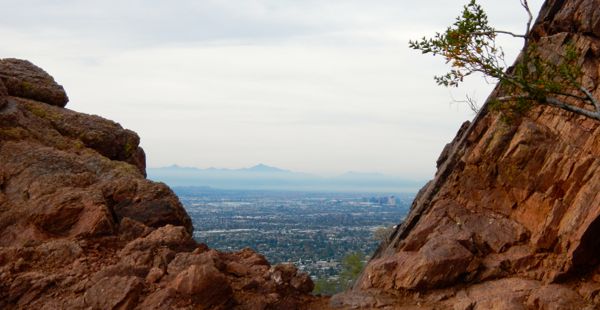
Downtown Phoenix is in the distance as seen from along the Camelback Mountain trail. Photos/Kathryn Reed

Downtown Phoenix is in the distance as seen from along the Camelback Mountain trail. Photos/Kathryn Reed

By Kathryn Reed

PHOENIX – Mileage is not always the determining factor in how sore one will be after a hike. Terrain has a lot to do with achy muscles, too.

Nine days ago I found out how true that statement is.

Camelback Mountain is considered by some to be the toughest hike in the city limits of Phoenix. (It’s on the border of Scottsdale.) There are two routes to the 2,704-foot summit – Echo Canyon and Cholla. Penny and I did the latter trail, which is longer. Echo is steeper.

We gained 1,300 feet in elevation over the course of 1.6 miles.

The layered sandstone was harder on my legs than Tahoe’s dirt and decomposed granite trails. It was even more pronounced coming down. I wish I had shock absorbers built into my shoes.

That night I could not climb or descend the stairs at the condo without pain and looking like there was something out of whack.

This is definitely not a trail for everyone, especially because of the scrambling that is involved. A backpack with water is recommended over carrying a bottle because many times both hands are needed to get up or down a pitch. There’s nothing technical about the climb, but it does require being in shape.

We just shook our heads at the people jogging up and down the trail.

But what got us to really turn our heads was when we saw members of the Scottsdale Adventure Club hauling up multiple Christmas trees to erect at the top. Last year the one 10-foot tree was a bit cumbersome, so this year they did a few smaller trees – all just to be festive.

The name of the mountain comes from its looking like a camel because of the two formations that are split by a saddle. From the top it’s a 360-degree view of the valley.

Fortunately, the area had been getting rain before I arrived, and was still overcast the morning of our hike. Even in the 70s it was a warm hike. You are completely exposed all the time – no big pines for shade.

While there are a few cacti growing, there did not seem to be much life on this massive rock. Luckily we didn’t see one of the more common critters – rattlesnakes.

Starting out we see the sprawling Phoenician resort below us. Civilization is everywhere below us and in the distance.

There was a time when Camelback was going to be an Indian reservation. Then development kept encroaching on the mountain. Finally, Preservation of Camelback Mountain Foundation led by Barry Goldwater was able to get the federal government involved in the 1960s to preserve the summit.

ngg_shortcode_0_placeholder (Click on photos to enlarge.)


Drought intensifies Christmas trees’ eco-friendliness debate

By Sarah Parvini, Los Angeles Times

Before they picked out an eight-foot Christmas tree, Tara White and Ed Dilks wondered whether an artificial tree might be a more eco-friendly choice.

But after doing some research, the Glendale couple decided that the convenience of an artificial tree didn’t stack up against the fresh scent and homey feel of a real tree.

“I felt guilty at first,” White said, studying the towering noble fir for gaps. “But it’s not like they go into the great forest and kill the trees. It’s not deforestation.”

The question of which tree is more environmentally friendly — real or artificial? — is resurrected each Christmas season.

But the discussion has gained urgency as California limps through a third year of drought. The debate now hinges on whether plastic trees give the environment a break because they don’t soak up a scarce resource, water.

U.S. customers bought about 33 million real trees last year compared with 14.7 million artificial trees, according to the National Christmas Tree Assn., which represents tree farmers. The artificial tree industry cites different figures: About 25 million real trees were sold in 2013 compared with nearly 11 million artificial trees, the American Christmas Tree Association said.

The two groups disagree on plenty of other things.

Read the whole story


Bowman, Anderson on top of podium at Dew Tour

By USSA

BRECKENRIDGE, Colo. – Olympic champion and Meyers resident Maddie Bowman came back to the contest season swinging, earning her second consecutive Dew Tour win and sharing the podium with fellow U.S. Freeskiing teammate and Olympian Annalisa Drew.

Bowman, who is coming back from a knee injury, picked up right where she left off last season, riding strong and landing both right and left 900s in her runs on Dec. 12.

“I just wanted to come out here and have fun and get my runs together. It’s a great first comp after knee surgery. I felt a different pressure (after the Olympics) when I came out here, but I just decided to go skiing and have fun. And you always do better when you just go ski and have fun,” Bowman said.

A top qualifier from the semi-finals, Drew put down a solid first run with an alley-opp flat 540 and a left 900 earning her second place and her first Dew Tour podium finish. Japan’s Ayana Onozuka put together an impressively large second run to clinch the third place spot just ahead of last week’s Visa U.S. Freeskiing Grand Prix halfpipe winner Janina Kuzma.

The competition continues today with the women’s freeskiing slopestyle final where young guns Julia Krass and Maggie Voisin will continue to make their mark on the slopestyle scene. Olympic champion David Wise of Reno will look to continue his halfpipe domination in the men’s freeskiing superpipe final.

For the third year in a row, Jamie Anderson of Meyers walked away with top honors at the Dew Tour, over Finland’s Enni Rukajaravri and New Zealand’s Christy Prior.

Anderson — known for putting together consistent gold medal runs — showed up on Friday nursing a rib injury sustained in practice earlier this week. But it didn’t seem to matter, as she landed a cab 900 in her first run. It looked like Anderson was on the mend and on her way to the top of the podium with a 96.25 score. While Rukajaravri and New Zealand rider Christy Prior put down 90-point runs, Anderson’s first run would prove to be unbeatable.

Snowboarding Dew Tour action continues Dec. 13 with the men’s and women’s halfpipe finals.


Jitloff earns World Cup points

By USSA

ARE, Sweden — Ted Ligety (Park City ) slayed his way to second place in Are, Sweden, behind Marcel Hirscher from Austria, who collected his 25 career World Cup win, and ahead of Stefan Luitz of Germany.

Tim Jitloff (Reno) grabbed more giant slalom World Cup points, finishing 22. The win moved Hirscher back atop the Audi FIS Ski World Cup GS standings and set the stage for an epic battle for the globe with Ligety, which will continue next weekend in Alta Badia.

With the sun setting just after 2pmin Sweden, the giant slalom took place under the lights. The Norwegians set a super technical first run on the steep and injected course. Without much room for error, the course spat out DNFs — 18 racers first run, including David Chodounsky (Crested Butte, Colo.). But Ligety and Jitloff both skied solidly, with Ligety sitting third and Jitloff 19 after the first run.

The Americans set a much more open second run, allowing the men to let their skis run a bit more. Jitloff had a few mistakes. Ligety looked calm when he pushed out of the starting gate, losing a little time on the top section of the course, but putting the hammer down in the second half. With his infamous angles, Ligety skied through the finish in first place, only surpassed by Hirscher, who slaughtered the field by over a second.

Along with Chodounsky, Brennan Rubie (Salt Lake City), Mark Engel (Truckee) and Nolan Kasper (Warren, Vt.) did not qualify for the second run.