Prescribed burning on South Shore to begin

The Tahoe Douglas Fire Protection District and the U.S. Forest Service will continue prescribed fire operations this week on Kingsbury Grade near Buchanan Road, Ski Run Boulevard near Heavenly, Luther Pass and Spooner Summit.

Operations will last through the next several weeks as conditions allow.

Each operation follows a prescribed fire burn plan, which considers temperature, humidity, wind, moisture of the vegetation, and conditions for the dispersal of smoke. This information is used to decide when and where to burn.

The Tahoe Fire and Fuels Team gives as much advance notice as possible before burning, but some operations may be conducted on short notice.

Smoke from prescribed fire operations is normal and may continue for several days after an ignition depending on the project size. Agencies coordinate with state and local county air pollution control districts and monitors weather conditions closely prior to prescribed fire ignition. They wait for favorable conditions that will carry smoke up and out of the basin.

Before prescribed fire operations are conducted, agencies may post road signs around affected areas and make email or phone notifications. The Forest Service updates the local fire information line at 530.543.2600, ext. 6. To receive prescribed fire notifications, send an email to pa_ltbmu@fs.fed.us.


Nevada wants park users in Tahoe to pay

By Benjamin Spillman, Reno Gazette-Journal

It’s no surprise business is booming at Nevada’s Lake Tahoe State Park, Spooner Backcountry.

The park is home to stunning Lake Tahoe views, its own alpine lake and the Flume Trail which is probably the best mountain biking experience in Nevada.

The only problem is not everyone who visits pays the entrance fee, especially if they’re coming from the north via Tunnel Creek Road.

That’s the explanation behind a newly posted sign at Tunnel Creek Road reminding hikers about the $1 fee to walk in and mountain bikers about the $2 fee for riders. It’s one of a few projects State Parks has in the works to improve fee collection in the coming year, said Eric Johnson, Nevada State Parks administrator.

Read the whole story


Drought taking toll on Washoe Lake fish

By Paul Nelson, KTVN-TV

Three years of drought is taking its toll on Washoe Lake. The water is a few hundred yards away from the boat dock, where the water used to reach. That is leaving behind nothing but a muddy mess and thousands of dead fish.

Chris Healy is a spokesman for the Nevada Division of Wildlife. He says the lake’s water has receded much more quickly in the past few weeks.

“This kind of thing happens, periodically, at Washoe Lake,” Healy said. “Unfortunately, all too often in the past couple of decades.”

The fish line the old shoreline for hundreds of yards down the east side of the lake. Almost all of them are carp, and Healy says if they are dying, you know it’s a bad situation.

Read the whole story


Ganong on top of podium for first time

By USSA

SANTA CATERINA, Italy — Travis Ganong (Squaw Valley) took advantage of a new course for the men’s Audi FIS Ski World Cup tour and punched through for his career first victory on Dec. 17, winning the Santa Caterina downhill.

Austria’s Matthias Mayer was the only one who got close to Ganong, finishing in second, nine-hundredths back. Italy’s Dominick Paris was third.

A traditional site for women’s downhill including World Championships in 1985 and 2005, it was first time for the men on the Deborah Campognini downhill, which Ganong used to his advantage.

“It was a perfect run.” said Ganong. “I love to take on a new challenge and a new slope. I love the hill — the mountains are huge here and it’s fun skiing.”

Ganong took advantage of information from teammate Steven Nyman (Sundance, Utah), who won last weekend’s Val Gardena downhill and was on the podium in Beaver Creek. Nyman started out for the U.S. in the eighth starting position, executing his planned line but finding clearly where time could be gained. His radioed advice to Ganong that proved beneficial. Starting 16th, Ganong took charge of the race from the outset. He skied a very straight line to build a lead, then nailed a perfect sweeping turn through the final carousel to take the lead. It was his second career podium after finishing third in Kvitfjell, Norway, last February.

Nyman ended up 15 as the Americans notched back-to-back downhill wins. Jared Goldberg (Holladay, Utah) was 24 with Marco Sullivan (Squaw Valley) 29. Bryce Bennett (Squaw Valley) was 50, while Andrew Weibrecht (Lake Placid, N.Y.) did not finish.


Squaw Valley patroller tests her endurance in outdoor reality TV show based in Alaska

Lel Tone of Tahoe City is one of two women on this season's "Ultimate Survival Alaska" television show. Photos/National Geographic channel

Lel Tone of Tahoe City is one of two women on “Ultimate Survival Alaska” TV show. Photos/National Geographic channel

By Kathryn Reed

Lel Tone bounced like a ragdoll on the frozen tundra of Alaska as the dog sled team forged ahead; oblivious she was no longer in control. But she wasn’t about to let go. You never let go of the sled.

That is the lesson she learned as a ski patroller at Squaw Valley – and the mantra she maintains today when she is carrying someone downhill in a toboggan.

She is a force to be reckoned with, but that’s not obvious just by looking at her.

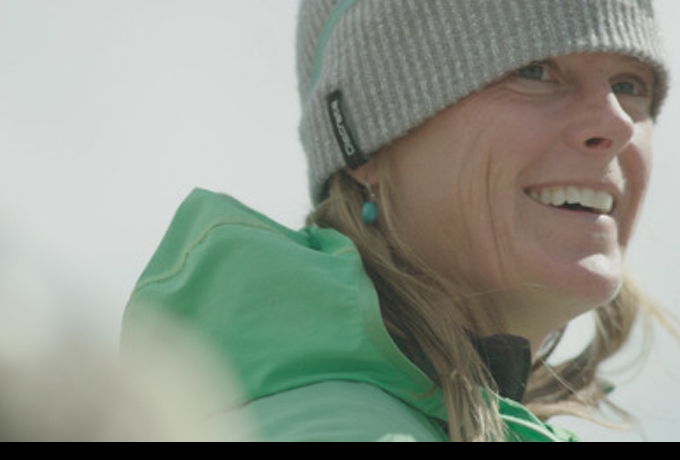
Don’t be fooled by the 44-year-old Tahoe City resident being barely 100 pounds. Her strength, tenacity and mental fortitude were put to the test this past summer when she spent three months participating in “Ultimate Survival Alaska”. The next season of the reality show airs Jan. 4 on the National Geographic channel.

“It was such an adventure … to have an opportunity to run around the wilderness in Alaska, to sleep under the stars (for 90 nights) in one of my favorite places on the planet,” Tone said. “It did feel really weird in mid-August to be under a roof again. I ended up sleeping on my porch to acclimate.”

Tone was picked for the show’s third season because of her heli ski guiding experience, mountaineering skills and avalanche forecasting abilities.

Talent_21_UltimateSurvivalAlaskaIII

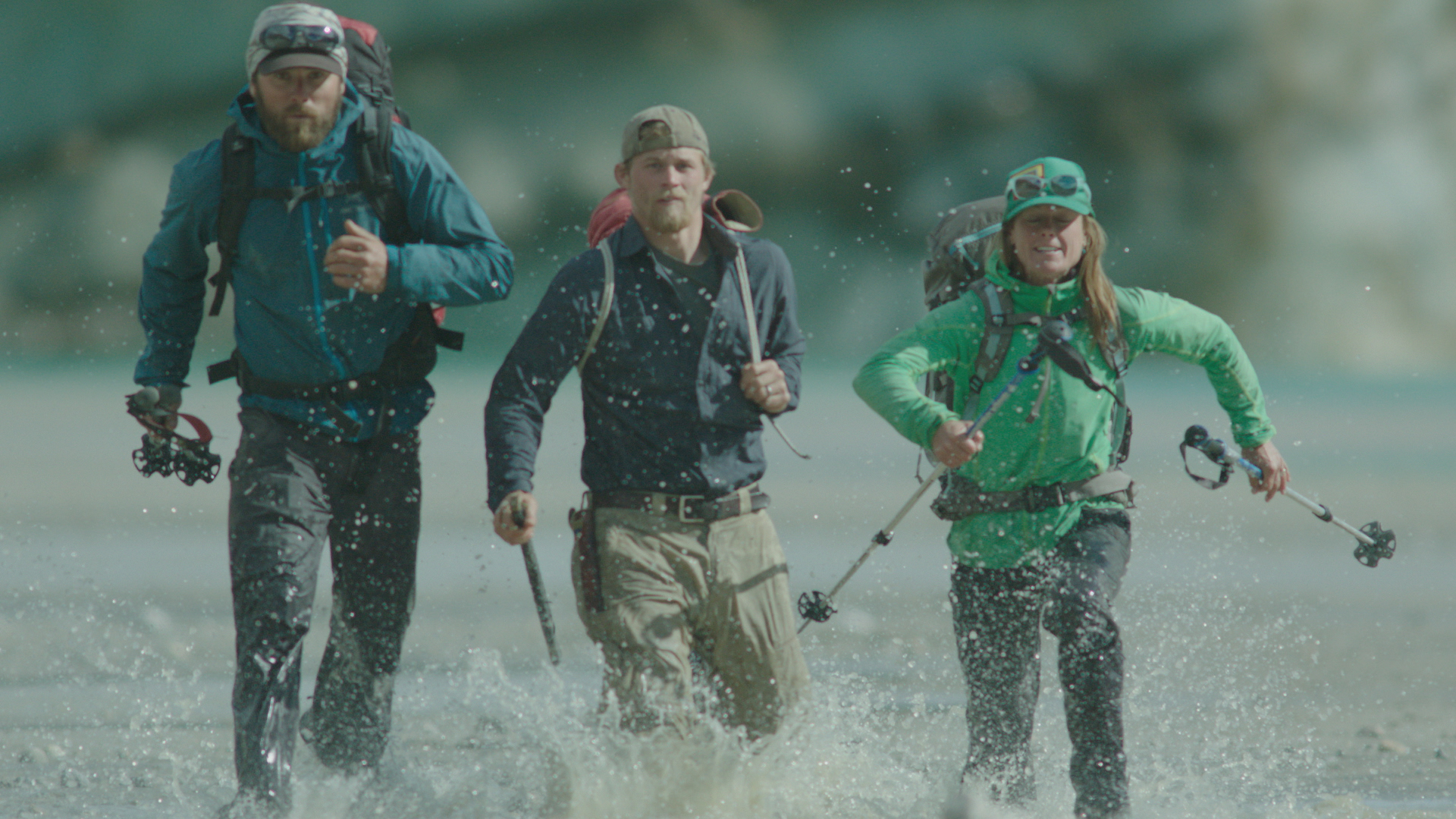
Lel Tone, right, holds her own with her male teammates.

She grew up in Switzerland, started skiing when she was a toddler, moved to the East Coast where she started ski racing while in college in Vermont and has been in Lake Tahoe for nearly two decades.

Tone was part of Team Endurance which consisted of two-time Iditarod champion Dallas Seavey, 27, of Alaska and mountain guide-rope access supervisor Ben Johns, 32, of Banff, Canada. But they didn’t know each other until they were thrown together in this adventure.

She is used to being on expeditions, like climbing Denali, where it’s a team, where you understand each other’s strengths and weaknesses.

A week before they met, Tone sent an email to the guys saying what gear she had and asking them what they had. Knowing they were about to entrust their lives to each other, the lack of coordination seemed a bit daunting.

Four teams of three participated in 13 challenges that required them to cross glaciers, raft whitewater, face predators, use means of travel – like dog sleds – they aren’t familiar with, scale mountains, bush whack and live off the land. They have the packs on the their back – Tone’s being about one-third her weight and equally as heavy as the guys’. No GPS, no phones.

At one point Tone whips out a .454 Casull, which makes one of her teammate’s weapons look like a child’s toy in comparison.

“My biggest concern was bear abatement and protection so I chose I gun that would do that job,” Tone told Lake Tahoe News as she took a break in the patrol shack at Siberia lift at Squaw. “I knew we could forage for food and fish for fish. The only thing in season for game was porcupine and ground squirrel.”

Large swaths of Alaska are bear country – and not the garbage variety black bears Tahoe is known for. She kept that .454 close by for quick, easy access.

“I have so much respect for big breasted women because I carried a chest harness. It weighed 7 pounds,” Tone said.

Her shoulders and neck were sore from carrying the gun and at times running with it strapped on.

Lel Tone in a snow cave for night with her teammates.

Lel Tone in a snow cave for the night with her teammates.

It was the water, though, that truly tested her grit.

“We ran a class 5 river at the end of the summer. That was probably one of my most frightening moments,” Tone said. “I have respect for fast running water, a respectful fear. I had to confront my fear of crossing rivers.”

Trusting her instinct got her through those sketchy situations.

Her ski patroller and guide jobs have taught her how to make cuts, when to throw bombs and when to hold back. Listening to her intuition when things didn’t feel right served her well during the filming.

Each team had a cameraman and producer. But they were extracted at the end of the day, able to eat real food and sleep off the ground. The teams were left to their own. If it wasn’t raining, they staked out a spot a little farther from one another; otherwise they were all under a tarp for protection.

On one of the more solo sleeping nights Tone was tempted to pull our her monster gun to eliminate a squirrel that wouldn’t stop squawking, but she knew it would freak her teammates out.

With it staying light out for hours, the production crew made sure each team took a mandatory four-hour break.

One of the hardest parts for Tone was making sure she had enough to eat. As an athlete competing in mountain bike and paddleboard races, Tone knows the importance of nutrition. But she didn’t have the luxury of well-balanced meals with unlimited ingredients at her disposal.

Rice, beans and foraging – those were her staples.

She came back 10 to 15 pounds lighter, but said it wasn’t a problem to put it back on since returning home.

Tone is happy to be back in Tahoe, but said she would jump at the chance to do something like “Ultimate Survival Alaska” again. For now she is part of Squaw’s patrol team. She will also be teaching avalanche courses this winter.

“I’m really passionate about teaching people how to be safe in their environment,” Tone said.

In mid-February she is off to Alaska where she is a heli ski guide for Chugach Powder Guides and Trudillo Mountain Lodge.

Summers find Tone racing paddleboards, being a mountain bike guide, piecing together guide work that often takes her to the Southern Hemisphere.

This year Outside magazine nominated Tone as one of the world’s top 10 guides. She was featured in the 2011 Warren Miller film “Like There is No Tomorrow”.

—-

Notes:

• “Ultimate Survival Alaska” two-hour season premiere is Jan. 4 at 9pm on National Geographic channel.


Vonn: Hard work, single-leg squats keyed comeback

By James S. Fell, Los Angeles Times

Dec. 6, 2014, was a good day to sit down with Lindsey Vonn. Her return to competition after a knee injury that crushed her Sochi Olympic dreams in February saw the star skier lead an American sweep in the World Cup downhill in Lake Louise, Canada, on Dec. 6. Vonn, a gold and bronze medalist in the Vancouver 2010 Olympics, started her career in Minnesota, a state not known for its long ski runs. But a move to Colorado and later making friends with her physical therapist has kept this 30-year-old downhill racer in the snowy spotlight.

The big story right now is your return to competition after injury. Tell me what happened.

The first injury in February 2013 was an MCL-ACL tibial plateau fracture [torn knee ligaments coupled with a knee fracture] and the second the following November was ACL meniscus…. One was during the World Championships and the other was right before the Olympics. To miss out on a race that happens once every four years is extremely disappointing.

Read the whole story


Vail has no desire to change Kirkwood’s vibe

Vail Resorts' wants to maintain Kirkwood Mountain Resort's character. Photos/Kathryn Reed

Vail Resorts’ wants to maintain Kirkwood Mountain Resort’s character. Photos/Kathryn Reed

By Susan Wood

KIRKWOOD – The power of Vail Resorts has shown its light on the remote ski area straddling El Dorado and Amador counties since the Colorado ski industry giant took it over for $18 million in 2012.

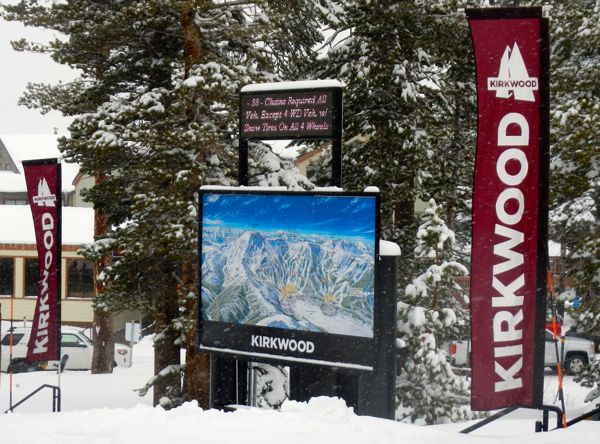
Upgrades and efficiencies at Kirkwood Mountain Resort range from the K Bar, an outdoor umbrella bar in the main area with views of the mountain, to permits for backcountry tours at Thunder, Avi and Reuter bowls, to a new kiosk to pick up tickets bought online, to a sign with real-time conditions, to all the safety bars that were installed on the chairlifts in year one.

“Over the past two seasons, we have focused our investment in the areas of maintenance and infrastructure. Some of our larger projects such as the K-Bar in the village mountain plaza and the ski patrol facility atop of the Wall are both guest centric and based on operational efficiency that greatly enhances our guests’ experience when they visit Kirkwood,” Casey Blann, Kirkwood general manager, told Lake Tahoe News.

Even though Vail Resorts releases the dollar figure for improvements at other resorts, Kirkwood officials were not forthcoming with the amount invested at their resort; only saying it’s been in the millions.
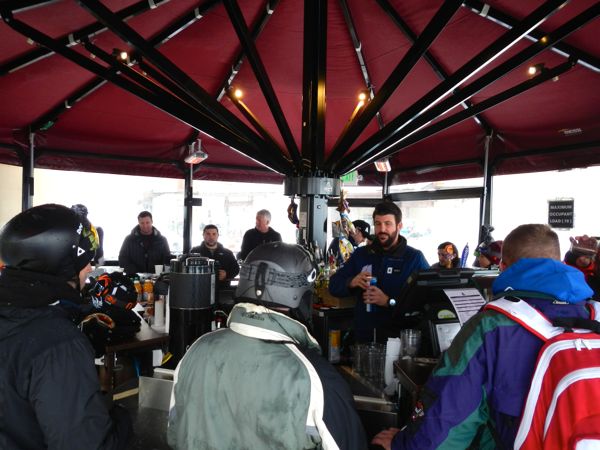
The K Bar in the plaza has views of the upper mountain.

The K Bar in the plaza has views of the upper mountain.

There are also Americans with Disabilities Act improvements, cellular phone upgrades, a new roof and windows for the Red Cliffs building, and new digs for ski patrollers – big enough to house a snowcat – at the top of the Wall chairlift.

Some upgrades are more subtle than others. New flooring was added to the Kirkwood Inn located down the road next to the Nordic Center.

One of the biggest improvements became effective Nov. 1 — the Wood is now on the grid. Following a huge fire on New Year’s Day 2010 that burned its powerhouse to the ground, the separate Kirkwood Meadows Public Utility District now gets its power for its 700 residents and the resort through Pacific Gas & Electric. The upgrade resulted from $263 million of loans secured by the U.S. Department of Agriculture. Kirkwood’s power has had periods of on and off electricity issues. But that incident left the community in the dark for a few days.

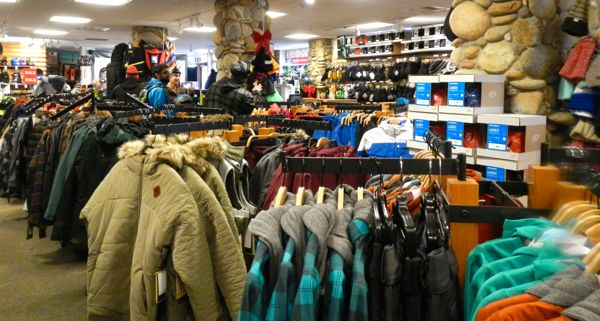
Retail offerings have been expanded.

Retail offerings have been expanded.

What’s different is how efficient things run since Pacific Gas & Electric lined up the ski area enclave.

Even with the windstorm earlier this month that knocked out power to much of South Lake Tahoe, Kirkwood had power. It went down, but within a few minutes came back up – unlike its lakeside counterpart. But it had nothing to do with being on the grid. The old diesel generators are now the resort’s backup supply.

“Being on the grid helps (for reliability),” Kirkwood spokesman Coop Cooper told Lake Tahoe News.

With all this said, upgrading Kirkwood is a different experience than Heavenly, Northstar and Park City, Utah – all resorts which Vail has bought in the last decade and poured cash into in order to appeal to a more upscale crowd. Kirkwood is not Northstar, nor is it Park City – Vail’s latest conquest that just got a $50 million pledge of money for improvements. A chairlift that links the northern Utah resort to nearby Canyons, another Vail property, was announced right away.

With Kirkwood, Vail has been assessing what’s needed and what the guests want. Whether that involves what’s outlined in the current master plan on file with the U.S. Forest Service remains to be seen.

Groomers/patrollers have better quarters, which expedites getting the mountain open.

Groomers/patrollers have better quarters, which expedites getting the mountain open.

“It’s Kirkwood. They know what they got. We’re going to keep the soul. But the neat thing about being in the Vail family is they’re taking a look at things and assessing (what to do next),” said Cooper, who dropped a few of the mantras the staff is working by: “operational efficiencies” and “reimagination.”

There’s even a separate mantra thrown out for single-day lift ticket buyers – “buy online, skip the line.” The kiosk sits flush with the most commonly used lift, Cornice as in Chair 6. And “real time” is used to describe the new sign next to it so guests can plan their day accordingly.

Efficiencies were also enhanced. One of them involved the new 2,048-square-foot “hut” on top of Chair 10, aka the Wall. The new one replaced the old structure that nearly tipped over in one of Kirkwood’s notorious windstorms. Now groomers starting their day at 6am can have the mountain from Palisades to Eagle Bowl ready by 9:40am.

Still, Cooper emphasized how Vail is dedicated to maintaining the undaunted character of the resort. Kirkwood is known for deep snow and expansive terrain with a hint of mountain funk that many old-timers want to see kept intact.

With his father-in-law Dick Reuter being one of the founders more than four decades ago, Cooper knows what that personality looks like. He even mentioned the bar and restaurant located across the street from the resort going back to the original name when Reuter frequented the place. It’s the Cornice Grill again.

It's often frosty at the Wood.

It’s often frosty at the Wood.

Kirkwood may mean deep snow and challenging terrain to many. It’s also a place for families to get away.

“Kirkwood is everything. We do have diverse terrain. It’s not just America’s deepest snow. We would alienate a lot of people that way,” Cooper said, referring to the Timber Creek beginning area set aside from the rest of the mountain.

A family of 21 people assembled at Kirkwood one recent Saturday seeking that special Kirkwood experience.

“We came here for one thing – to get our butts whipped,” said Alex Simon, who learned to ski 15 years ago at Kirkwood at age 6 and never forgot the feeling. As a self-identified intermediate skier, the Jupiter, Fla., resident insists Vail keep Kirkwood’s character. “We like just that rustic mountain vibe and that everyone’s friendly,” she said, while taking a break in the new K Bar.

The bar, which can collapse its umbrella with a push of a button and keep its windows erect, sits in the village on top of where the chiller that froze the skating rink once was located. Her father, Ron Simon, agreed about the need to keep Kirkwood, Kirkwood.

“No (big) changes (to the character) are why we keep coming back. We’ve been coming here as a family since the ’70s. It’s all about the skiing,” Simon said, while walking up to the bar table. The bar was picking up about 11am during a snowstorm with skiers and boarders seeking refuge and libations.

Signs alert riders to what is open.

Signs alert riders to what is open.

“If Kirkwood becomes another Northstar, I’m not coming,” Charles Christolini of San Francisco said, making his preferences known at the bottom of the Cornice Express. Christolini comes up about every week in the winter and has no desire to get Champagne served at 3pm like Northstar’s offering.

“We expected Kirkwood would be modernized. But Kirkwood needs to be about the mountain. People come here to ski first. It’s not about the après,” he said.

Christolini has noticed his favorite resort is more crowded with the coordinated Epic Vail pass that connects the Colorado, Utah and California resorts on one, as well as the pass for the three California resorts. Still, the buzz heard most often from the diehards is of accepting Vail’s piecemeal improvements that maintain the integrity of this resort known for its terrain, snow base and counterculture.

Goats to feed on discarded Christmas trees

By Marcella Corona, Reno Gazette-Journal

It’s that time when decked-out Christmas trees covered in lights, glass ornaments and tinsel are at many homes. But what happens when it’s all over?

Most trees are tossed away outside or in landfills, creating potential fire hazards, said Vince Thomas, a volunteer firefighter with Truckee Meadows Fire Protection District.

“I’ve seen them everywhere, all you have to do is get off the beaten path a ways and you’ll see trees all over,” said Thomas, who’s worked as a firefighter for 26 years. “It was amazing to me to see how many Christmas trees people would just toss out there.”

But Thomas found an easy solution.

About 40 goats are leading the way for a new Christmas tree recycling program, launching Dec. 26.

Read the whole story


New Year’s Day guided hike at Spooner

Celebrate the new year with a free guided hike at Spooner Lake State Park.

This will be a snowshoe hike if there is adequate snow. The outing will follow the Spooner Lake loop trail, which is a little more than two miles. There is little change in elevation.

Park entrance fees are waived for hike participants.

Children are welcome, but dogs are not permitted. Dress warm and bring a snack and water. In the event of severe weather, the hike may be canceled.

The event is Jan. 1 from 10am-noon.


USFS reworking where to play in Sierra snow

By Benjamin Spillman, Reno Gazette-Journal

There’s a reason why during winter it can be hard to find a parking place along Mount Rose Highway near the Tahoe Meadows and Chickadee Ridge.

The short stretch of road is the best place to access some of the most scenic backcountry in Nevada, an area that includes snow-covered meadows, alpine peaks and Lake Tahoe views.

It’s also the epicenter of a debate over winter access to public land in the Sierra Nevada as U.S. Forest Service units throughout the range are in the process of reworking their winter travel management plans.

Six separate Forest Service units, Lake Tahoe Basin, Tahoe, Eldorado, Lassen and Stanislaus, and Plumas are in varying stages of reworking their plans, some of which haven’t been updated for decades.

The result could be new boundaries that limit where people can ride snowmobiles and set aside areas that are restricted to human-powered recreation such as snowshoeing and backcountry skiing.

Read the whole story