2 U.S. Ski Team athletes die in avalanche

By Ski Racing

SOELDEN, Austria – The U.S. Ski Team is mourning the loss of two promising development level ski racers killed Monday morning in an avalanche in Soelden. The two were among a group of six athletes freeskiing at the Austrian resort. The other four skied out of the slide and were not injured.

Killed in the avalanche were Ronnie Berlack, 20, of Franconia, N.H., and Burke Mountain, Vt., and Bryce Astle, 19, of Sandy, Utah.

“Ronnie and Bryce were both outstanding ski racers who were passionate about their sport – both on the race course and skiing the mountain,” said U.S. Ski and Snowboard Association President and CEO Tiger Shaw. “Our hearts go out to the Berlack and Astle families, as well as to their extended sport family. Both of them loved what they did and conveyed that to those around them.”

Read the whole story


County launches website for West Slope parks

El Dorado County has launched a website to provide people with interactive maps, news, events and alerts about trails and parklands.

ParkWatchReport also has a tool for reporting illegal activity, conflicts, safety hazards and/or maintenance issues. To make a report a user must log in and cannot report information anonymously.

The website went live in December.

“This program was developed by a group of volunteers from the Horseman Association after an accident on one of the trails outside of our county,” Vickie Sanders, county parks manager, told Lake Tahoe News. “It will also provide links to other rec providers. We do not have all the links on the program yet but that is the goal. This program ties into the master plan and is not in conflict.”

But only parks on the West Slope are listed. The county doesn’t operate any parks in the basin.

Sanders said, “This is just another tool for the public.”

— Lake Tahoe News staff report


Family turns snowboarding death into opportunity to save lives at Sierra-at-Tahoe

By Susan Wood

TWIN BRIDGES – Kristin Jacobson remembers almost dying like it was yesterday.

The Benicia attorney, an advanced skier, had waited a while for a powder day in 2012. She finally got her wish on St. Patrick’s Day at Sierra-at-Tahoe where she volunteers. She and husband Eric were negotiating the black diamond Upper Dynamite run off Grandview chairlift when he suddenly stopped on a boulder. Just as he turned to warn her of a depression in front of them, she had skied by him. Next thing she knew, the snow gave way underneath her.

“I thought I was just swept up in an avalanche,” she said.
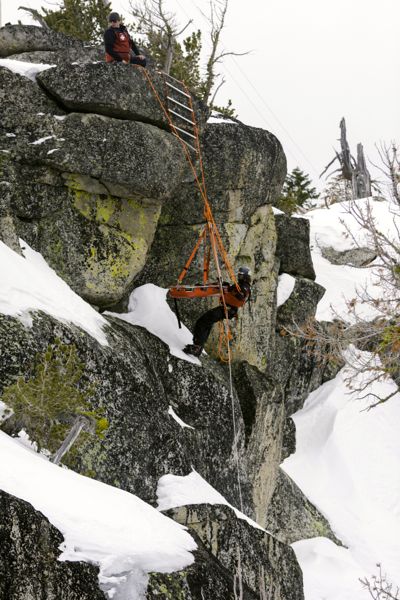
Sierra-at Tahoe patrollers practice high angle rescues. Photo/Merick Rickman

Sierra-at Tahoe patrollers practice high angle rescues. Photo/Merick Rickman

At a mere 5-foot, 4-inches, the snow enveloped her. She was conscious and knew not to struggle in order to conserve energy – especially since the snow was particularly wet and encased her like concrete.

Since the temperatures had been high, the water had been flowing in the creek below. She tried to make an air pocket, but attempts were futile in the eventual 10-foot tomb.

“I believed I was upside down,” she said.

Jacobson could feel snow embedded in her nose and ears. She was uncomfortable, frustrated and knew she was running out of oxygen.

“I blacked out. I thought that was it. I was going to die,” she told Lake Tahoe News.

Meanwhile, her husband had been working feverishly to get help. He tried to dig her out without being encased himself. She was buried so solidly, he pulled her glove off when trying to dig her out.

Luckily, a ski patroller and paramedic were on the lift and caught word of the incident.

After the longest 45 minutes of her life, the patrol team had dug her out using ropes and harnesses anchored to trees in order to keep the snow relatively stable. Jacobson was purple from being hypothermic and very close to being gone.

“Even the ER doctors were baffled,” she said.

Jacobson attributes her survival to the equipment the team used that day.
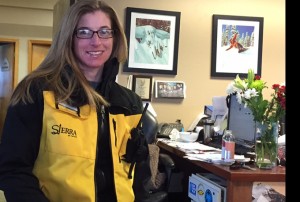
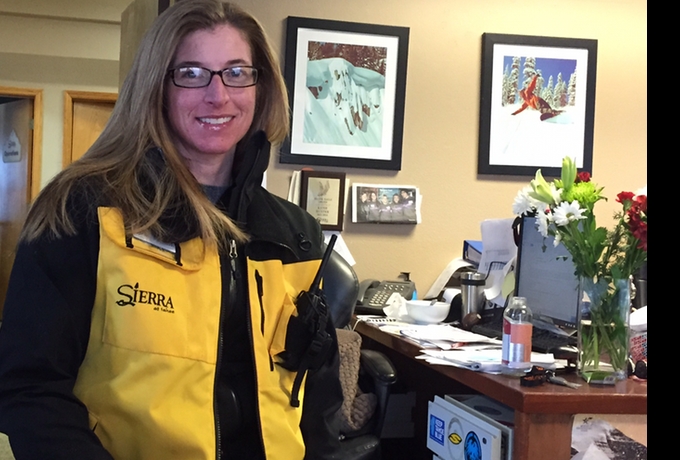
Kristin Jacobson knows she is lucky to be alive. Photo/Susan Wood

Kristin Jacobson won’t let the near-death experience keep her off the slopes. Photo/Susan Wood

“I don’t know how they would have done it. I’m just incredibly grateful,” she said of the 10-minute rescue dig once patrollers arrived.

Sierra-at-Tahoe gained one victory and later others as a result of losing a tragic one. The equipment used to save Jacobson was bought with a fund established by the family of 22-year-old Philip Walker, a snowboarder who died in a tree well the year before Jacobson’s near miss.

“This was a really sad event that happened, but we’re happy we got good equipment to train for future rescues,” said Hugh Ham, Sierra’s assistant ski patrol director.

With about $1,100 left in reserve, the Philip Walker Rescue Fund has secured about $6,000 in clear goggles to help find lost riders in the evenings, ropes for both low- and high-angle rescues, headlamps, radio batteries and deep immersion snow signs. The hope is signs that read, “Stay clear of tree wells” and “Always ride with a buddy” would permeate the minds of those who want to venture into the trees.

That’s the message the father of the young snowboarder, who one day wanted to work at Sierra-at-Tahoe, wants to get across.

“There’s nothing we can do to bring (Philip) back. If anything, continuing on for him and saving someone else and possibly preventing this from happening again – that’s why we do this,” Steve Walker told Lake Tahoe News from his San Jose home.

“Tree wells are dangerous, even for an intermediate skier or snowboarder like Philip,” Walker said.

The family started the fund with $5,000 in seed money, notifying relatives from across the nation to donate in lieu of flowers at the boarder’s funeral service a week after his death on March 26, 2011.

The young Walker was skiing with his brother, Ben, and a friend when he went into the trees alone. Ben called his father at 5pm to tell him he couldn’t find Philip.

“That was gut-wrenching,” Walker said.

The ski resort was forced to call off the search that night because of a fierce storm and resumed it the next day. Walker, his wife and other family members waited out the news in General Manager John Rice’s office.

“I knew something was up when two sheriff’s deputies walked in the room. Unfortunately, I can’t get that image out of my mind,” Walker said while choking back tears.

He described the event as a sense of despair, helplessness and sobering.

“A friend asked me how long it took me to get over,” Walker said.

You don’t.

“I told him it’s like jumping into an icy lake. It takes your breath away, then slowly you get used to it. But you don’t want to,” he said.

The whole family went into grief therapy. Starting this fund is all a part of the bereavement process for them. The family’s goal of the fund isn’t necessarily monetary. It’s to ensure the equipment “makes a difference and to help others,” Walker insisted.

Beyond Jacobson’s story, there have been others who have benefited by a highly skilled and geared Sierra-at-Tahoe.

Rice shared in a letter to Walker the story of a skier who had fallen through a snow bridge between two large rocks and was stuck in a hole of 25 feet off the Huckleberry Canyon area. The patroller who responded requested the harness and pulley system purchased through the rescue fund.

“He was fortunate to have been skiing with a friend who knew where to locate him, but more so that our crew had the right gear to get him out,” Rice wrote. “Thank you to all of your friends and family who honored your son through the cause.”

—–

Notes:

To donate, send checks to the Sierra-at-Tahoe Education Foundation, c/o The Walker Rescue Fund; 1111 Sierra-at-Tahoe Road, Twin Bridges, CA 95735.

Discovering wild mushrooms in the woods

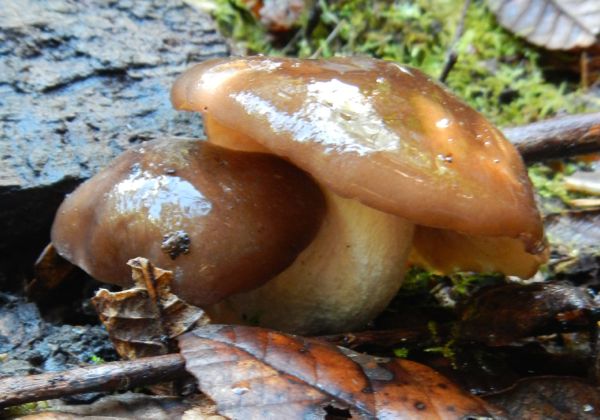
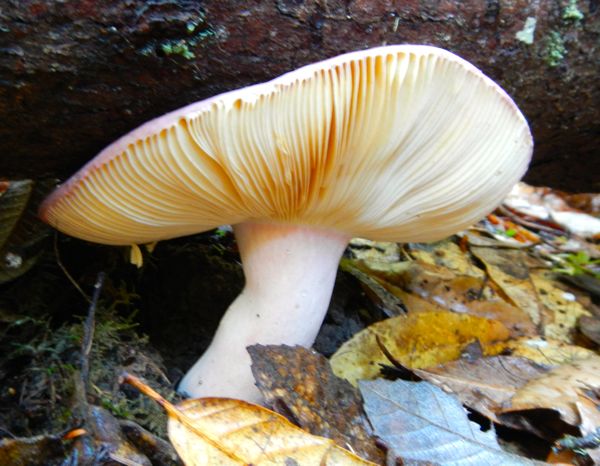
Wild mushrooms come in a variety of sizes and colors. Photos/Kathryn Reed

Wild mushrooms come in a variety of sizes and colors. Photos/Kathryn Reed

By Kathryn Reed

SALT POINT STATE PARK — Red, yellow, orange, brown, white, green. Tiny and huge. Slimy and delicate. Spongy and bulbous. Edible and non.

These were clearly not your grocery store variety of mushrooms. And, yet, we kept picking them. What we didn’t do was eat them.

Sue and I were on our first mushroom foray in October. While I have hunted for mushrooms in Lake Tahoe, that was always for personal consumption. This was more for education.

Mushrooms often blend in with the environment.

Mushrooms often blend in with the environment.

The Sonoma County Mycological Association (SOMA) led us into the woods of Salt Point State Park, which is one of two California state parks to allow people to forage for wild mushrooms. The limit is 31 pounds per person.

Nearly 300 varieties of fungi grow in this coastal park, with many of them OK to eat.

“It’s more of a quest than anything else,” Jim Wheeler, board member of the mycological association, said. “We are not hunting because the mushrooms don’t move.”

But they do hide.

Wild mushroom on Sonoma coast.

Wild mushroom on Sonoma coast.

Some are tucked under foliage, others grow under downed trees, while a few are able to camouflage themselves. Then others are out in the open, bright and ready to be plucked like a wildflower.

Many of the nearly 40 people on the foray were first-timers. It was like we were on a treasure hunt as we whispered to one another. Fog seeped through the dense redwoods, adding a sense of mystery to our outing.

SOMA has forays September-May, with a three-day camp in January. And the mushrooms in the Bay Area, well, they are multiplying in ways that haven’t been seen the last three years. This is all because the December rains are just what the fungi love.

All mycological groups are serious about their mushrooms. But most are also inclusive, eager to share their knowledge and bring more people into the inner circle.

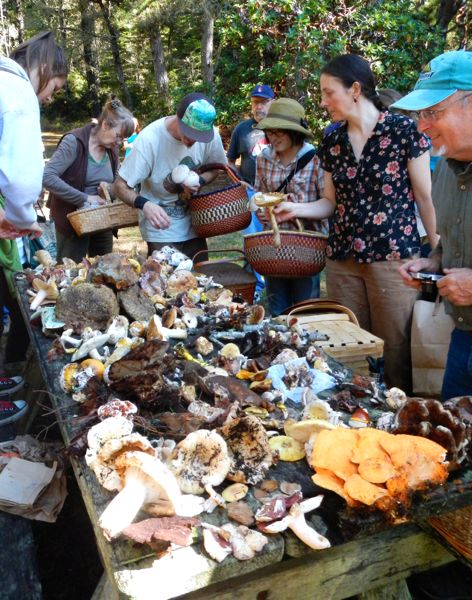
Sorting through the haul.

Sorting through the haul.

People are separating their finds with wax paper. Some photograph the specimens and take notes in journals. Baskets and canvas bags are slowly filling up with mushrooms of all shapes, sizes and colors.

Experienced shroomers know the scientific names and which are edible. They seem to find them faster as well.

On this particular day we spread out a haul that more than filled a picnic table. Porcini, slippery Jacks, golden chanterelles, coral, spy are just a few of the varieties.


Plenty of exercise equipment outside of a gym

By Christopher McDougall, Outdoor

I was waiting at the checkout counter of a drugstore in Lancaster, Pa., when a human cannonball sailed past the window. I glanced around. Did anyone else just…?

A second body flew by, right behind the oblivious cashier’s head, looking like it had been flung by one of those medieval catapults that hurled rotten cow carcasses over fortress walls.

I swiped my card, grabbed my bag, and hustled outside to see what was going on.

I could have taken my time, it turned out. The two guys were still there and totally absorbed by the handicap-ramp railings: vaulting, swinging, tightrope walking, basically wringing a crazy amount of movement out of two blue bars. When I’d spotted them through the window, they were practicing “precisions” — broad jumping back and forth between the railings and sticking precise landings on top of the bars.

“You start practicing parkour,” one of the guys told me, “and whole nights disappear.”

Technically, he’s talking about l’art du deplacement, more universally known by the funkified French version of its other name, parcours, for “obstacle course.”

Parkour was born in the late 1980s when a band of mixed-race kids living in the outskirts of Paris got tired of being roughed up by bullies. They created their own “training method for warriors” and called themselves the Yamakasi. Being rebels and outsiders, they detested the idea of organized competition; even after parkour became a phenomenon, the Yamakasi never bothered cashing in with how-to stuff. They were innovators, not explainers.

If you wanted to come to Paris and follow in their footsteps, fine—but that meant being yanked out of bed at 2 a.m. to train in a midwinter rainstorms. Otherwise the Yamakasi had just about zero interest in sharing their skills with the rest of the world. That left two places you could go if you wanted to learn parkour: France or YouTube.

Not surprisingly, my two new parking lot buddies got their start at YouTube U. “I got into it because I was so fat,” one of my new buddies, Neal Schaeffer, told me. He’d begun partying after high school and by age 20 had bloated up from 175 pounds to 240.

One afternoon, he was in a nearby park watching some strangers “kong vault” picnic tables—they’d charge a table, plant their hands, and shoot both feet through their arms like gorillas and fly off the other side—and they talked Neal into giving it a try. He was shocked to discover that even out of shape, once he got over his fear, he could master skills that at first looked impossible.

Read the whole story


Subaru WinterFest at Sierra-at-Tahoe

Sierra-at-Tahoe will host the second annual Subaru WinterFest this weekend.

This free event includes a freeride skills course, equipment demos and autograph signing by Olympian and Meyers resident Maddie Bowman in the Subaru tent from 11am-1pm Jan. 3.

This year, Subaru brings along partners LibTech, Nordica and Yakima, which will be offering equipment demos on the latest technology in skis and snowboards, along with car racks for gear transportation. Subaru WinterFest is open to guests of all ages and will be staged on Sierra’s Solstice Plaza.

All guests with a valid lift ticket may participate in the freeride skills course.


Winter Trails hike on the South Shore

Tahoe Rim Trail Association Executive Director Mary Bennington will be on hand Jan. 10 for the Winter Trails Day Hike on the South Shore.

The free guided hike starts at 10am.

Meet at Explore Tahoe, 4114 Lake Tahoe Blvd., at Heavenly Village in South Lake Tahoe.

Space is limited and reservations are recommended. Call Explore Tahoe at 530.542.4637 for questions and to make reservations.


Controversy surrounds Nevada coyote hunt

By Yvonne Beasley, Reno Gazette-Journal

Local hunters have organized a coyote hunt, which has raised hackles of animal protection groups.

The Saturday event, called a coyote calling contest, is similar to hunts in other parts of Nevada and Western states. Coyotes are an unprotected species in Nevada; a license or permit is not required to hunt them, according to the Nevada Department of Wildlife.

“This was set up for local people to get together,” said Jason Schroeder, one of the organizers. “It’s a very small gathering of probably 20 to 40 people.”

The hunting will take place on BLM land around the state, Schroeder said.

Read the whole story


LTWC receives 2 cubs at end of year

Lake Tahoe Wildlife Care received two unexpected packages at the end of the year – bear cubs.

Both are from the Eureka area and weigh about 24 pounds.

The first one had been seen for several days near Fortuna. Mom was nowhere to be found.

California Department of Fish and Wildlife picked the cub up and took it to regional headquarters in Rancho Cordova on Dec. 23. Tom and Cheryl Millham, who run the wildlife rehabilitation center on the outskirts of South Lake Tahoe, drove the cub to Tahoe in the wee hours of Christmas Eve.

The second cub arrived at the center about 3:30pm New Year’s Eve. This one came from the Hoopa Indian Reservation.

State officials want the local care center to fatten the cubs up so they could be released in the spring.

— Lake Tahoe News staff report


Trail angels help keep hikers going on PCT

By Chris Erskine, Los Angeles Times

By any measure, the Pacific Crest Trail is a beastly thing, an angry anaconda that slithers up the entire length of California and all the way to Canada, some 2,650 rugged miles. That’s approximately 6 million steps — some of them glorious, many of them merciless.

But along the way, mercy is at hand.

Near the southern trail head, Sandy and Barney Mann open up their five-bedroom San Diego home to up to 60 hikers a night. They even pick them up from the airport and ferry them and their gear to the starting point an hour east.

Up the trail, in Agua Dulce, Donna and Jeff Saufley not only provide a night’s rest to more than 1,000 hikers a season, they offer food and shelter to their dogs, horses and the occasional llama.

East of the Bay Area, Hank Magnuski functions as a sort of outdoors concierge, erecting a pop-up cafe to provide hot coffee and fresh fruit topped by whipped cream to hikers coming off a particularly grueling 300-mile stretch.

They are all part of a small network of outdoor Samaritans called “trail angels.”

Read the whole story