How exercise keeps us young

By Gretchen Reynolds, New York Times

Active older people resemble much younger people physiologically, according to a new study of the effects of exercise on aging. The findings suggest that many of our expectations about the inevitability of physical decline with advancing years may be incorrect and that how we age is, to a large degree, up to us.

Aging remains a surprisingly mysterious process. A wealth of past scientific research has shown that many bodily and cellular processes change in undesirable ways as we grow older. But science has not been able to establish definitively whether such changes result primarily from the passage of time — in which case they are inevitable for anyone with birthdays — or result at least in part from lifestyle, meaning that they are mutable.

This conundrum is particularly true in terms of inactivity. Older people tend to be quite sedentary nowadays, and being sedentary affects health, making it difficult to separate the effects of not moving from those of getting older.

In the new study, which was published this week in the Journal of Physiology, scientists at King’s College London and the University of Birmingham in England decided to use a different approach.

They removed inactivity as a factor in their study of aging by looking at the health of older people who move quite a bit.

Read the whole story


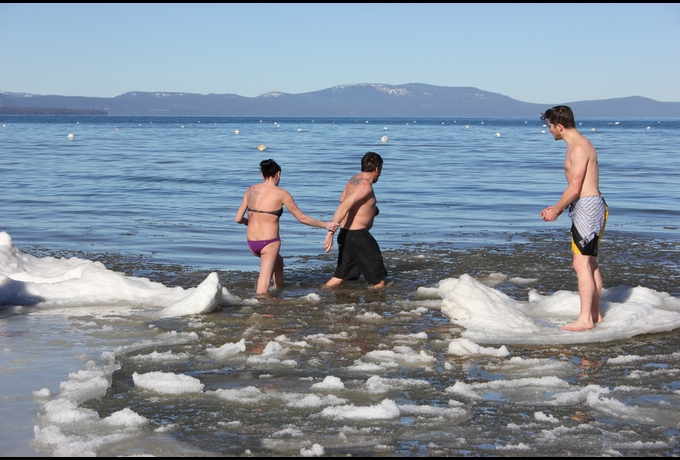
Polar plungers don’t let a little ice stop them

Ice greeted New Year's Day polar plungers at Lake Tahoe. Photo/Terry Ogg

Ice greeted New Year’s Day polar plungers at Lake Tahoe. Photo/Terry Ogg

It was a little more difficult this year for those participating in the sixth annual Steamers Bar and Grill polar plunge.

Before any plunging could occur, some ice breaking was necessary. The shoreline of Lake Tahoe is frozen because of the low lake level and below freezing temps at the first of the year.

The annual New Year’s Day event attracted more than 80 people — all just to have bragging rights for having braved the frigid waters of Tahoe.


Snowshoe Cocktail Race tests agility, speed

Can you run in snowshoes? Can you run and carry a tray full of drinks in snowshoes? How about just watching people try?

Camp Richardson’s first Snowshoe Cocktail Race of the season is Jan. 17 at 7pm.

Racers run with cocktail trays in hand through obstacles and up and down the beach. The winner is the fastest and cleanest at the finish. Spilling drinks is not a winning strategy.

Signups start at 5pm at the  Beacon Bar and Grill. Snowshoes will be provided. All levels welcome.

The next races are Feb. 21 and March 21.


Horticulture classes in Nevada

University of Nevada Cooperative Extension, in collaboration with the Nevada Department of Agriculture, will offer a series of eight classes for those in the green industry beginning Feb. 3.

Attendees will be taught science-based, sustainable horticulture practices to manage plants and landscapes efficiently and safely.

The program benefits people wanting to enter the industry, beginners in the industry and established industry professionals.

The trainings will be from 9am-noon on Tuesdays and Thursdays, Feb. 3-26. Classes are $15 each or $80 for all eight. Further discounts are available to organizations enrolling multiple employees. Classes are at the Washoe County Cooperative Extension office in Reno at 4955 Energy Way.

To register, go online. For more information on classes or certification, contact Ashley Andrews at andrewsa@unce.unr.edu or 775.336.0231.

Class schedule:
Feb. 3: Plant Disease Basics
Feb. 5: Integrated Pest Management (IPM) and Pesticide Safety
Feb. 10: Soils, Potting Mixes and Fertilizers
Feb. 12: Pruning Landscape Plants
Feb. 17: Insect Identification
Feb. 19: Sustainable Turfgrass Maintenance
Feb. 24: Weeds and Weed Law
Feb. 26: Woody Plant Identification.


Rangers to lead hikes at Washoe Lake State Park

Washoe Lake State Park has two ranger-led hikes scheduled in January.

Deadman’s Creek guided hike is a one-mile roundtrip hike to the gazebo at the top of Deadman’s Creek. Dress warmly and bring a hat, coat, gloves and good walking shoes for this moderately easy hike. Rangers will talk about the park and cover a brief history of the Washoe Valley.

This hike is Jan. 11 at 1pm. Meet at the overflow parking lot; after entering the park, turn left, and it is the first parking lot on the right

The Dune Trek and Beach Stroll is Jan. 25 at 1pm.

This hike is approximately two miles and is moderately easy. Dress warmly, bring a hat, coat, water, gloves and a camera. Participants should wear good walking/hiking shoes, as the trail will be sandy or snow-covered in some areas. Rangers will be pointing out a variety of plants and wildlife.

Meet at the equestrian parking area; after entering the park, turn right, pass the campground, and it is the gravel parking lot next to the pavilion

These hikes are free, however, there is an entrance fee of $7 per vehicle. Nevada residents receive a $2 discount.

Washoe Lake State Park is 18 miles south of Reno and five miles north of Carson City. Take the Eastlake Boulevard exit off Highway 395 and park entrances are on the west side of Eastlake Boulevard. Contact 775.867.4319 or washoelake@hdiss.net for more information about theses event.


Liability concerns prompt cities to limit sledding

By Scott McFetridge, AP

DES MOINES, Iowa — As anyone who has grown up around snow knows, part of the fun of sledding is the risk of soaring off a jump or careening around a tree.

But faced with the potential bill from sledding injuries, some cities have opted to close hills rather than risk large liability claims.

No one tracks how many cities have banned or limited sledding, but the list grows every year. One of the latest is in Dubuque, Iowa, where the City Council is moving ahead with a plan to ban sledding in all but two of its 50 parks.

“We have all kinds of parks that have hills on them,” said Marie Ware, Dubuque’s leisure services manager. “We can’t manage the risk at all of those places.”

A study by Columbus, Ohio-based Center for Injury Research and Policy at Nationwide Children’s Hospital found that between 1997 and 2007, more than 20,000 children each year were treated at emergency rooms for sledding-related injuries.

In meetings leading up to the ban, Dubuque council members lamented the move but said it was the only responsible choice given liability concerns and demands from the city’s insurance carrier. They pointed to judgments in sledding lawsuits in the past decade, such as a $2 million judgment against Omaha, Neb., after a 5-year-old girl was paralyzed when she hit a tree and a $2.75 million payment when a man in Sioux City, Iowa, slid into a sign and injured his spinal cord.

Some cities have opted for less drastic measures in the last several years rather than an all-out ban, including Des Moines, Iowa; Montville, N.J.; Lincoln, Neb.; and Columbia City, Ind. By banning sledding on certain slopes or posting signs warning people to sled at their own risk, cities lessen their liability if someone is seriously hurt, but they’re still more vulnerable to lawsuits than if they had adopted an outright ban.

And then there’s the small central Illinois city of Paxton, where park district officials removed the sledding hill in 2013.

It was more of a dirt mound, created years ago to cover a pile of concrete, metal and other junk, recreation director Neal McKenry said, but given how flat the area is, the 20-foot rise often was crowded with sledders. There was concern someone would slam into trees that had grown on the mound.
“Obviously, many people used this area to sled in the winter, but the park district never promoted it as a sled hill,” McKenry said. “It was simply a built-up mound of dirt that people happened to sled on.” The area is now being used as a dog park.

In Omaha, the city banned sledding at a popular hill as a test one winter after losing a lawsuit, but decided to allow it again after most people ignored the restriction.

“It wasn’t practical,” assistant city attorney Tom Mumgaard said. “People wouldn’t abide by the ban.”

Instead, the city has posted signs warning of sledding risks and workers at the site of the failed ban put pads around posts and hay bales around trees. Mumgaard said courts in Nebraska have decided cities must protect people, even if they make poor choices.

Most people realize that cities must restrict potentially dangerous activities to protect people and guard against costly lawsuits, said Kenneth Bond, a New York lawyer who represents local governments. In the past, people might have embraced a Wild West philosophy of individuals being solely responsible for their actions, but now they expect government to prevent dangers whenever possible.

“It’s a great idea on the frontier, but we don’t live on the frontier anymore,” Bond said.

That doesn’t sit well with Natasha Koss, 40, who frequently sleds with her 5-year-old daughter Elsa in Marquette, Mich.

Koss sometimes requires Elsa to wear a helmet. When they try a particular hill for the first time, her husband does a few runs solo as a precaution. She said she’d report any safety issues to city authorities but couldn’t imagine filing suit over a sledding mishap.

“I would most certainly take personal responsibility,” she said. “You need to have a mindset to make the best decisions for your own safety.”

However, Steve King, who runs a website that promotes sledding, said he understands why cities impose restrictions. He notes that most sledders don’t wear helmets and it’s near impossible to steer away from trees, rocks or signs.

“We live in a lawsuit-happy society and cities are just being protective by banning sledding in areas that pose a risk for injury or death,” King said.


Panoramic views of Desolation via snowshoes

Sue, AJ, Cody, Rosemary and Donna make their way to Granite Lake. Photos/Kathryn Reed

Sue, AJ, Cody, Rosemary and Donna make their way to Granite Lake. Photos/Kathryn Reed

By Kathryn Reed

EMERALD BAY STATE PARK – Maggie’s cleavage took our breath away.

That’s what we called the saddle of Maggie’s Peak because, well, these two peaks in Desolation Wilderness are named for a woman who was well endowed. And that strip of land in between the peaks has some outstanding views.

Desolation Wilderness appears to go on forever. So expansive it seems a bit foreboding – even though we were immersed in it for nearly the entire snowshoe.

No wonder Eagle Lake is chilly in the summer – it’s frozen right now.

On this particular day Emerald Bay could have been renamed Sapphire Bay because of the rich, deep blue hue that spilled forth.

Snowshoeing to Granite Lake was pretty; making the final push to the saddle of Maggie’s Peak was spectacular. Granite Lake was our original destination last Saturday.

Getting there was more of a vertical ascent than a leisurely switchback. I could tell I had been fighting off a cold because I needed to stop more than usual. But this was not a trek to set speed records, so Donna, Rosemary and Sue – and dogs AJ and Cody – were fine with a few extra stops.

The path is well worn with plenty of snowshoers having been there before us. It’s single track. At times all we can hear is the crunching of the snow beneath the claws strapped to our boots.

Large boulders near the lake and protruding from the ice provided a lunch spot. Plenty of tracks across the frozen mass proved the ice was thick. Not a cloud could be seen. It was one of those idyllic Tahoe blue skies. One of Maggie’s Peaks rises from the far end of the lake.

Donna and Sue peruse the map, figuring out the cleavage isn’t that much farther, so we carry on.

The trailhead is at 6,890 feet. Granite Lake is at 7,700 feet and the saddle is at 8,330 feet. It’s about 1½ miles to the lake and another eight-tenths of a mile to the saddle.

While there had been wonderful views along the way, the best were definitely at the saddle.

—–

Getting there:

From South Lake Tahoe go north on Highway 89. Park at the Bayview Campground on the left. This is before you reach the parking lot for Vikingsholm. Walk through the campground. There will be a sign going left for Cascade Falls, to the right for Desolation Wilderness. Go right.

ngg_shortcode_0_placeholder (Click on photos to enlarge.)


Freeskier to talk about international feats

Tahoe freeskier Meghan Kelly will talk this month about her 2014 sailing and skiing expedition that began in Iceland and finished along the rugged southwest coast of Greenland.

The trip was created in cooperation with the Climate Reality Project and Polar Bears International in order to document the severe climate change of the region. Along the way Kelly and her team sough out first descents in a rarely accessible winter zone.

The Home Brew Series, presented by Alpenglow Sports and Tahoe Art Haus & Cinema, is designed to showcase local athletes who live regular lives and accomplish extraordinary feats in the mountains. The series is designed to be mellow, free, and community-centric for all ages and abilities.

Kelly’s show is the third installment in a four-part series that runs once per month from November through February. Her talk is Jan. 9 at 7pm at Tahoe Art Haus & Cinema, 475 North Lake Blvd., Tahoe City.


Derby Dames looking for new recruits

The Tahoe Derby Dames, theSouth Lake Tahoe’s all-female amateur flat track roller derby league, is looking for skaters for its eighth season.

All skating abilities are invited.

The Dames offer general training for the new-on-your-skates to the well seasoned derby girl transferring to the lake. Practices are coed (offering everyone the chance to skate) while bouts follow the association’s guidelines.

Equipment borrowing is on a first come/first serve basis. Bring a mouth guard.

Training is indoors at Kahle Community Center in Stateline through the winter on Sundays and Tuesdays from 8-10pm.

Email tahoederbydames@sbcglobal.net for info about becoming a Dame.


Garbage bears staying awake during winter

By Jeff DeLong, Reno Gazette-Journal

That Christmas visitor to Troy Brown’s place wasn’t Santa, it was a bear.

And that bear captured by wildlife officials in South Reno, like another in the same spot six days before, was demonstrating behavior noted by wildlife experts for more than a decade now – at a time of year when the animals are usually lying down for a winter’s nap, many remain awake and on the prowl in search of food.

For the black bears of western Nevada, hibernation has become optional.

“You can keep bears up during the winter if you feed them,” said Jon Beckmann, a biologist and bear expert with the Wildlife Conservation Society.

And feeding them we are, primarily with garbage.

That same human-provided food source that has led to mounting conflict between people and bears across the Reno-Tahoe area is not only making bears bigger, it’s also altering fundamental aspects of their behavior.

Read the whole story