Ice carving competition in Truckee

Truckee River Winery is hosting its fourth annual Ice Carving Competition, as part of SnowFest, on March 4 from 1-7pm.

Watch talented local professionals transform large blocks of ice into works of art while listening to DJ Chango.

Cost is $10, which includes souvenir wine glass, mardi gras beads, as well as a donation to High Fives Foundation.

Mountain Valley Meats will be selling food, with proceeds going to High Fives.

The winery is at 11467 Brockway Road, Truckee.


Fitness training offered for LT running events

Barton Health’s is initiating a Train for an Event Fitness Challenge from March to June.

Fitness experts will provide the training, skills, and workouts to prepare participants for the Rock Tahoe Half Marathon or Burton Creek Trail Run. This includes sports performance clinics, individualized weekly workout plans, and training sessions.

The 16-week training challenge starts March 2 and runs through June 21.

Barton Health’s certified coaches will lead six training sessions each week on Mondays, Tuesdays, Thursdays and Saturdays. Sessions will focus on cardio and core workouts, speed and interval training, cross-training, and distance walk and/or run sessions.

The training culminates with the Rock Tahoe Half Marathon on June 20 or the Burton Creek Trail Run on June 21. Burton Creek options include a 6K (3.7 miles), 12K (7.5 miles), half marathon (13.1 miles), or 50K (30 miles). The Rock Tahoe Half Marathon will end at the Hard Rock Casino with a pool party.

All participants receive a Barton Health tech-shirt, unlimited access to training sessions, and team discounts on event registration. Discounts are $15 off the Rock Tahoe Half Marathon and 15 percent off any Burton Creek Trail Run.

This program costs $99. For details or to register, email Krista Carson at kcarson@bartonhealth.org or call 530.600.1958.


U.S. men make stunning leap in downhill

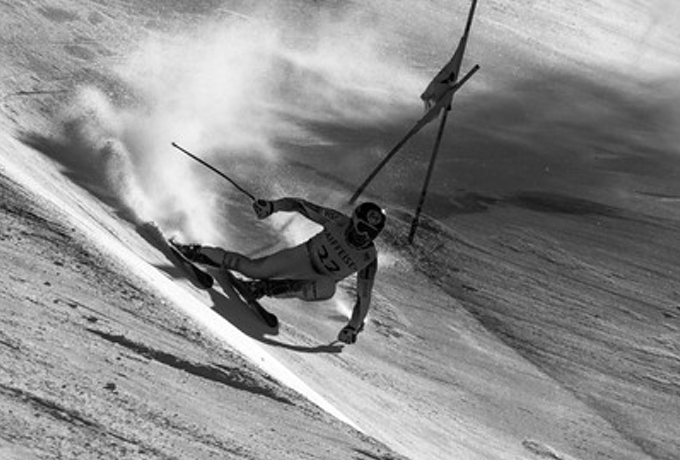
Travis Ganong of Squaw Valley at Beaver Creek on Feb. 7. Photo/Cody Downard

Travis Ganong of Squaw Valley at Beaver Creek on Feb. 7. Photo/Cody Downard

By Bill Pennington, New York Times

BEAVER CREEK — When the Alpine world ski championships were last on American soil, in 1999, no member of the United States team won a medal. With the championships back in Colorado this month, the event was expected to be a chance for the American racers to show how far they had come as an international power.

Instead, during the first week of competition, the Americans’ lone reason to celebrate was Lindsey Vonn’s bronze medal in the super-G.

By Saturday, the pressure on the Americans was mounting. The United States racers, many of whom were unheralded in the country, had to enter the men’s downhill, the championships’ marquee event, without their best-known teammate, Bode Miller, who severed a hamstring tendon in a tumbling crash Thursday.

But in a startling recovery, three American racers burst into the top 10, led by Travis Ganong of Squaw Valley, who won the silver medal Saturday with a fearless, stirring descent that left him 0.24 of a second behind the winning time of Patrick Küng of Switzerland, who finished in 1 minute 43.18 seconds. Another Swiss skier, Beat Feuz, was third, 0.31 of a second behind his countryman.

Read the whole story


Bowman clinches win in Mammoth

By USSA

MAMMOTH MOUNTAIN – Olympic champion Maddie Bowman’s solid run during halfpipe skiing qualifications at the Visa U.S. Freeskiing Grand Prix on Feb. 4 translated to a first place podium on Friday when the finals competition was canceled due to adverse weather.

Teammate Devin Logan finished third.

Strong winds once again forced event organizers to make the difficult decision to cancel finals.

“It’s unfortunate that finals were canceled, but Mammoth always puts us up really well, so I had a great time,” Bowman, who lives in Meyers and skis for Sierra-at-Tahoe, said. “I’m happy to be skiing here and I’m happy that California is getting weather, so I guess I’ll take it. I just tried to throw down a really good run and I’m happy that I did.”

On the men’s side, Canada’s Justin Dorey took the win, with Olympic champion David Wise of Reno finishing second. In his qualifying run, Wise kept things consistent and went for tricks he knew he could land, including a double cork 1260. Wise was one of three athletes to land a 1260 during this competition. Teammate Gus Kenworthy made improvements from his first to second qualifying run, landing himself in third overall.

“They told us that was a possibility [finals would be canceled] heading into qualifying,” said Kenworthy. “I had that in the back of my mind and I tried to do the best run I could. I’m stoked I got a podium. It feels good. Obviously I would have liked to skied finals, but I’d rather stay safe and take a result than try and push it in bad weather and maybe get hurt.”


Ganong earns first World Cup medal

By USSA

BEAVER CREEK — In front of an enormous crowd of 20,000 screaming fans, the U.S. packed three guys into the top 10 on Birds of Prey. Travis Ganong (Squaw Valley) grabbed the silver medal at Saturday’s FIS Alpine World Ski Championships downhill. Steven Nyman (Sundance, Utah) was fourth and Andrew Weibrecht (Lake Placid, N.Y.) was ninth.

Ganong was surrounded by the Swiss on the podium, as Patrick Kueng took first place and Beat Feuz third.

It was a gloriously sunny day and the place was packed. Crowds extended up the side of the race course, reaching above the finish jump. The cowbells and cheers were deafening as the Americans reached the finish.

“I could actually hear everybody off the jump,” said Jared Goldberg (Holladay, Utah).

Goldberg ran bullet for the men, and had a solid run at his first World Championships appearance, finishing 20th. The crowd really exploded when Nyman got into the gate. Nyman, who was third in December’s Birds of Prey World Cup, had a spectacular run, taking the lead for a few racers. Eventually, he was bumped down to fourth, just off the podium by 0.03.

“I was hammering. It was so cool. I was tucking in places I’ve never tucked and was just charging down the hill — giving it everything,” said Nyman. “I’m happy with my run. It was really cool to come down to this, in the lead by a couple tenths, people just going nuts.”

But the story of the day was 26-year-old Travis Ganong, who took home his first World Championships medal. He skied down in second place and didn’t give up the spot for the rest of the race.

“I’ve trained so hard the last couple of years. I love to ski. All day long, I was just super relaxed and having a good time,” said Ganong, who only has two podiums in World Cups. “It’s unbelievable. Skiing is the most fun thing you can do, and when it works out well in a venue and on a stage like this, it’s so special.”

Weibrecht was the last American down the hill, wearing bib 35, and stunned the crowd by posting the fastest splits at the top. He lost a little time when he got low after Harrier, landing him in ninth place. Still excited, he says he’s looking forward to the alpine combined on Sunday.

“These are guys I ski with every day,” said Weibrecht. “They were a little ahead of me today, so I’ll try to get them tomorrow.”


Prescribed fires to be ignited in basin

The California Tahoe Conservancy, Nevada Division of Forestry and U.S. Forest Service may continue prescribed fire operations in numerous areas around the Lake Tahoe Basin beginning Feb. 9.

On the South and West shores, operations may take place south of Tahoe City near Sunnyside, Gardner Mountain near South Tahoe High School, Christmas Valley, Luther Pass near Grass Lake, and Ski Run Boulevard near Heavenly. On the East Shore, operations may take place on lower Kingsbury Grade off Easy Street, Logan Creek Drive, the north side of Spooner Summit, Slaughterhouse Canyon and near Memorial Point at Sand Harbor.

Operations will last through the next several weeks as conditions allow.

Smoke from prescribed fire operations is normal and may continue for several days after an ignition depending on the project size. Agencies coordinate with state and local county air pollution control districts and monitors weather conditions closely prior to prescribed fire ignition.

Before conducting prescribed fire operations, agencies may post road signs around affected areas and make email or phone notifications. The Forest Service updates the local fire information line at 530.543.2600, ext. 6.


Wood cutting permits available for TNF

Woodcutting permits for the Tahoe National Forest may be purchased beginning Feb. 12.

Permits are valid for the entire Tahoe National Forest; however, the cutting season varies by district. The American River and Yuba River Ranger Districts will allow cutting starting Feb. 12, while the Truckee and Sierraville Ranger Districts will open cutting April 24. Firewood season for all districts will extend through Dec. 31 or until wet conditions make it necessary to close the season.

In general, the woodcutting permit allows for removal of dead or down wood on TNF system lands unless otherwise designated. It does not allow cutting on private land. Trees may not be cut if marked with paint, wildlife signs, boundary signs, and other official signs, or in areas closed to woodcutting.

Woodcutting hotlines, established for each district, will have information regarding any fire danger or wet weather restrictions. Woodcutters must call the hotline each day before cutting.

Woodcutters are required to keep a serviceable shovel at least 46-inches long and an approved fire extinguisher (2 pound dry chemical or 1 pound foam type – ABC or greater) within 25 feet of where saws are being operated. All power saws and other internal combustion engines such as motorized splitters must have a U.S. Forest Service-approved spark arrester installed.

The price for permits is $15 per cord with a 2-cord minimum and an annual 10-cord maximum per household. Permits can be obtained at all TNF Ranger Stations, the Forest Headquarters, or by mail. Applications for mail-in permits can be found online and then by clicking on “Passes and Permits.”


Efforts made to keep LT Water Trail afloat

By Kathryn Reed

Twenty years ago images of people playing on Lake Tahoe all involved motorized watercraft. Today it’s almost always human powered vessels that are in photographs and video.

Some of that change has to do with a project that started 20 years ago – Lake Tahoe Water Trail. The idea then and now is to promote non-motorized boating. The Lake Tahoe Water Trail Association has been active for the last 11 years.

The California Tahoe Conservancy board on Feb. 5 further committed to this goal by authorizing up to $50,000 on planning activities for the trail and in large part turned control over to the Sierra Business Council. The money is coming from a donation the state agency received years ago.

“We use it as incubator money to spin things off of us,” Executive Director Patrick Wright said of this pot of cash.

He equated it to how the CTC helped the Tahoe Fund get started and how it is now run as a standalone entity. Wright foresees the water trail doing the same thing under the guidance of SBC.
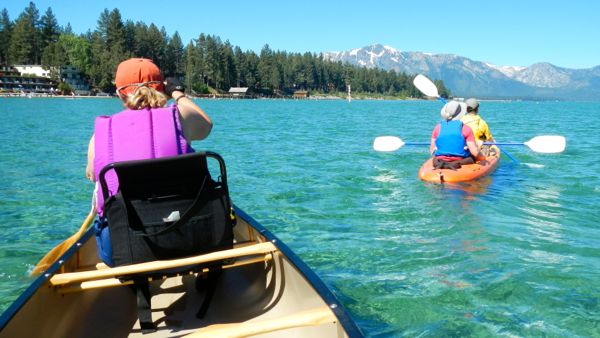
Paddling is a growing attraction for locals and visitors at Lake Tahoe. Photo/LTN fle

Paddling is a growing attraction for Tahoe locals and visitors. Photo/LTN file

SBC hired Becky Bell as the project manager. One of her tasks will be to find more money. It’s anticipated Nevada Commission on Tourism grants will be applied for so then there will be money from both states funding the trail.

Initial goals of SBC are to improve trail maps and signs, do outreach and education, work on the lodge-to-lodge network, and create a business plan.

The trail is the 72-mile perimeter of Lake Tahoe. But not everyone knows where to go once they launch a canoe, kayak or paddleboard or how faraway a destination is or rules about public-private beach access. Signs and education would help answer those questions.

Education is also going to come in the form of explaining about aquatic invasive species and the mantras clean-drain-dry to prevent their spread.

Bell, who has been active in outdoor issues in the basin for a couple decades, also was instrumental in developing Tahoe Keepers, the group promoting clean human-powered watercraft on Lake Tahoe.

“I’ll create a marketing plan for stewardship,” she told the board Thursday.

Bell said 6 percent of the U.S. population is into paddling, with there being 19.2 million kayakers in 2012 and 8 million standup paddlers. She envisions this being a new type of traveler who will venture to the basin.

Greg Jones, vice president of SBC, said he wants to connect the business community to the trail – to make it an economic driver. And then he wants it to be a destination for national and international travelers. He envisions its being the equivalent to the Tahoe Rim Trail as a draw for locals and visitors, but on water.

The lodging component has been talked about for years, but has not taken off. That is something SBC expects to develop.

Bob Kingman, who is considered the father of the water trail, returned to Tahoe for the meeting. He is a former CTC employee who now works for the Sierra Nevada Conservancy.

“We have the opportunity to create the flat paddle mecca in the Sierra Nevada,” Kingman said. “Lake Tahoe is the gem of this.”

U.S. women miss podium at Beaver Creek

By USSA

BEAVER CREEK — The FIS Alpine World Ski Championship women’s downhill was run down the famed Raptor course in Beaver Creek on Friday. With uncharacteristically warm temperatures baking the Beaver Creek snow, conditions were challenging and the female racers put on a show for the fans packed into Red Tail Stadium. Lindsey Vonn (Vail) was the top finishing American, taking fifth place.

Slovenia’s Tina Maze displayed unparalleled skill during her gold medal-winning run. Earning the silver, only 0.02 seconds behind Maze, was Austria’s Anna Fenninger. And, Lara Gut of Switzerland rounded out the women’s downhill podium.

The unseasonably warm temperatures created variable snow in the course’s top and bottom flat sections, which played a role in the downhill’s final standings.

“You have to hit the line right in a couple of key sections,” said Vonn after her fifth place finish in the women’s downhill. “Today with the faster speeds, my timing was just a little bit off. Sometimes I was little too early, sometimes a little too late. I haven’t really had a great feel for the course yet. I’m the only one who didn’t do the World Cup downhill [on the Raptor] last year. It just wasn’t my day, unfortunately.”

Even though Vonn missed the podium, she said she was still happy with her result. “I did the best I could. I fought my whole way down. I was so focused,” said Vonn. “I visualized the course a thousand times. I did everything I could do and more. It just wasn’t a great run. It was a good run — a top five-worthy run — but it wasn’t a good enough run for a medal today.”

Vonn was the highest finishing racer for the U.S. Ski Team. Julia Mancuso (Squaw Valley) was next, ending up in 16, and was immediately followed by Laurenne Ross (Bend, Ore.) in 17. Mancuso and Ross were just a shade over two seconds off Maze’s winning time. Stacey Cook (Mammouth Mountain), who had a brutal crash in Thursday’s downhill training run, rounded out the American effort in Friday’s downhill, finishing 19 out of a field comprised of 39 international skiers.

As each American skier pushed out of the starting gate, the loud cheers of the fans at the finish line seemed to pull the skiers down the course.

“It was harder snow today and I just couldn’t feel my skis coming around for me. It didn’t work out how I wanted it to,” said a smiling Mancuso. “But it was still a lot of fun to ski and really fun to come to the finish with all the amazing fans.”


Snowmobilers damaging snowless terrain

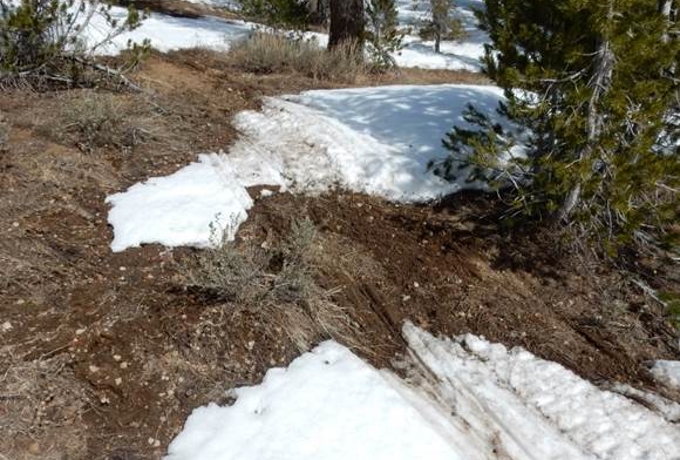
Rutted soil and vegetation damage from operating a snowmobile on inadequate snow coverage is visible near the Mt. Rose Highway.  Photo credit:  U.S. Forest Service

Rutted soil and vegetation damage from a snowmobile near the Mt. Rose Highway. Photo/U.S. Forest Service

Snowmobilers riding on dirt are causing problems on U.S. Forest Service land.

The feds are telling snowmobilers to avoid bare dirt and patchy snow, and to not ride across streams or over small trees or brush. Doing so creates ruts in the soil and crushes vegetation.

“We are asking snowmobilers for voluntary cooperation in moving their activities to suitable locations,” LTBMU acting Forest Supervisor Jeff Marsolais said in a statement. “Riding snowmobiles on too little snow not only causes resource damage, but can damage the machine as well.”

Causing resource damage can result in a citation punishable by a fine of $5,000 or more and/or six months in jail.

Tahoe Sierra Snowmobiling Club is supporting the USFS in its efforts.

Information on areas where snowmobiles are allowed is available in the online.