Federal money available for Nev. recreation projects

The Nevada Division of State Parks has $300,000 in federal funds for local park and recreation improvement and acquisition projects through the Land and Water Conservation Fund program.

All local governments, including counties, cities, towns, general improvement districts, and Native American tribal governments are potentially eligible for the 50:50 matching grants offered through the program.

The Land and Water Conservation Fund Act of 1965 was enacted to assist in preserving, developing and assuring recreational accessibility to local parks for present and future generations.

The application package and grant manual are available online. The deadline to apply is May 8 at 5pm.


Lake Tahoe temps keep setting record highs

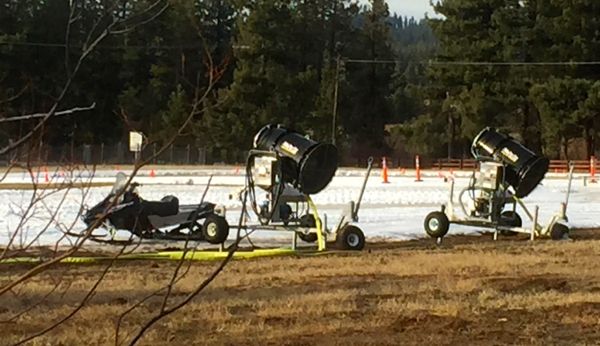
Just enough snow is being made at Stateline for a snowmobile oval and tiny sledding hill. Photo/LTN

Just enough snow is being made at Stateline for a snowmobile oval and tiny sledding hill. Photo/LTN

It’s shorts weather in Lake Tahoe and it’s going to stay that way through the weekend.

South Lake Tahoe hit a record high on Feb. 12 and Feb. 13, and is likely to do so Valentine’s Day.

The mercury soared to 61 on Thursday, with the old record being 58 set just last year. On Friday it was even hotter. The high was 65, breaking the 2011 record of 57 degrees. The Feb. 14 record high of 56 set in 1996 is likely to be broken because the forecast is for 62 degrees.

“It’s going to be warm this whole weekend. There is a high pressure over the West Coast that is bringing very warm temperatures and light winds,” Alex Hoon, meteorologist with the National Weather Service in Reno, told Lake Tahoe News.

He said nothing big is on the horizon in terms of moisture – just more of the same. The temperatures will drop a bit, getting into the 50s. But normally the highs are in the 40s this time of year in the Lake Tahoe Basin.

— Lake Tahoe News staff report


Ligety wins GS, Jitloff 9th

By USSA

With only a few days left in the 2015 FIS Alpine World Ski Championships, spring-like temperatures and a slick, fast course made for a men’s giant slalom to remember. When it was all said and done, Ted Ligety (Park City) won the event in historic and thrilling fashion in front of the home crowd on Feb. 13. Rounding out the giant slalom podium were Austria’s Marcel Hirscher and France’s Alexis Pinturault in second and third, respectively.

The GS at the World Championships is known as the most technical of all the disciplines, and this year’s event was rife with drama. Prior to Friday morning’s first run, experts were calling this a three-man race. Giant slalom is Ligety’s specialty and he has dominated it for more than half a decade, but Hirscher and Pinturault had joined Ligety as odds-on favorites to compete for the GS gold medal.

The level of skiing was off-the-charts throughout the second runs of giant slalom, including great runs by Americans Tim Jitloff (Reno), David Chodousky (Crested Butte, Colo.), Brennan Rubie (Salt Lake City), and Tommy Ford (Bend, Ore.).

All of the U.S. men finished in the top 30. Jitloff broke into the top 10 with a ninth place result. Ford, who had to sit out the entire 2014 Olympic season to recover from a freeskiing crash in 2013, took 19. Rubie was 26, his second ever World Cup-level finish, and Chodounsky was 29.

Despite Ligety’s indisputable supremacy in giant slalom for years, Hirscher came into the World Championships hot and ranked No. 1 in the World Cup standings — having won four GS races this year to Ligety’s one victory. And after first run, Hirscher was sitting pretty, having laid down a first-place gem that gave the remaining 100 skiers a time to shoot for.

Ligety, or America’s “Mr. GS,” wore bib No. 6, and finished 0.24 off Hirscher’s time with a more cautious first run. He railed turns up high, but got stuck on a low line towards the bottom of the run, scrubbing speed. But Ligety went into the second run in the afternoon with Hirscher in his sights.

“Conditions are great, and the course is in great shape. So, we’ll see,” said Ligety in between runs. “There are five guys within 24 hundredths of a second, so it’ll be a tight one next run.”

The second run began with temperatures hovering in the mid-40s. The warm weather made for a softer, more rip-able track than the slick morning surface. With nine competitors within a second of Marcel Hirscher, the GS title was up for grabs.

The excitement amped up in Red Tail Stadium as soon as Ligety’s start neared. And as it was a turnier course than the morning, it was a perfect course for him to shred. The pressure was on to perform in front of thousands of American fans in the finish stadium and lining the course.

Ligety stepped up and showed that he still is the best giant slalom skier in the world. The American skied fluidly through his second run. Railing turns on-edge, he milked speed out of every transition and put together a perfect run. As he crossed the finish line, Ligety’s time was 1.23 seconds ahead of the field. The crowd went wild and Ligety pumped his fists, but four of the best GS skiers in the world were still to ski.

Pinturault followed Ligety down the course, skiing well but ending 0.88 slower than Ligety to take third place. Hirscher, the last skier to compete after his first run win, put together another solid attempt on his second run. But in the end, Ligety’s time was 0.45 seconds faster than his Austrian rival and Ligety yelled in celebration, javelining his skis through the finish.

In winning the 2015 FIS Alpine World Ski Championships’ giant slalom at Beaver Creek, Ligety earned his fifth consecutive GS win in a row on the fabled Birds of Prey terrain and became the first man ever to win three World Championships GS races in a row.

“It’s hard to rank them, but this win is a little more emotional that some of the other ones just because this year has been a little more of a struggle,” said Ligety, of his Birds of Prey domination. “To be able to come through and pull it off is awesome.”


Still time to participate in Polar Bear Swim

Hundreds of people are expected to line the pier and deck at Gar Woods Grill & Pier on Feb. 28 to watch the annual Polar Bear Swim.

The event is part of the annual North Lake Tahoe SnowFest. Participants swim approximately 250 yards in 39-degree water. Hot Tubs, complimentary appetizers and raffle prizes have been donated.

The swim is after the parade.

To sign up for the swim in Carnelian Bay, fill out this form.


Squaw cancels major competitive events

Snow conditions have forced the cancellation of two competitions as Squaw Valley in March.

The ski cross and snowboardcross World Cup scheduled for March 4-8 at Squaw Valley is off the calendar as is the U.S. Ski and Snowboard Association’s Hole Shot NorAm and U.S. Revolution Tour ski cross and snowboardcross scheduled for March 9-13.

Even though the resort just received more than 2 feet of snow, the amount of snow needed to build the World Cup courses is significant, and the resort has chosen to allocate its resources to focus solely on the guest experience.


Dogs major players in NDOW bear program

By Guy Clifton, Reno Gazette-Journal

Carl Lackey doesn’t go anywhere without his Rooster.

That includes trucks, ATVs, helicopters, ski lifts, classrooms and everywhere else Lackey’s job as a bear biologist with the Nevada Department of Wildlife takes him.

Rooster is Lackey’s 10-year-old Karelian Bear Dog, who – when he isn’t being a slightly oversized lap dog at home – is an integral part of the team when it comes to releasing bears captured in populated areas. Rooster, and his 10-month old daughter, Dazzle, have a job – to harass the bear by chasing it, barking in its face, and making it run away or climb a tree.

Combined with a shotgun firing rubber bullets, the idea is to make the bears not want to return. NDOW has had more success with this procedure than by relocating the bears, many of which return to the capture site within days or weeks if no aversion techniques are used.

Read the whole story


TRTA taking sign ups for summer hikes

Enrollment is open for the Tahoe Rim Trail Association’s Segment Hiking Program and the annual Through Hike.

Both groups will circle the 165-plus mile rim of the Lake Tahoe Basin. Both treks offer participants a supported method to complete the entire trail, the opportunity to meet hiking friends, the chance to disconnect from modern life and a traveling adventure through some of the most beautiful scenery in the Northern Sierra Nevada and Carson Mountain Range.

The Through Hike is a 15-day, fully supported backpack trip. The Segment Hike completes the route on a series of day hikes.

For information about dates, cost and details, go online.


Storms good for the lake, ski resorts

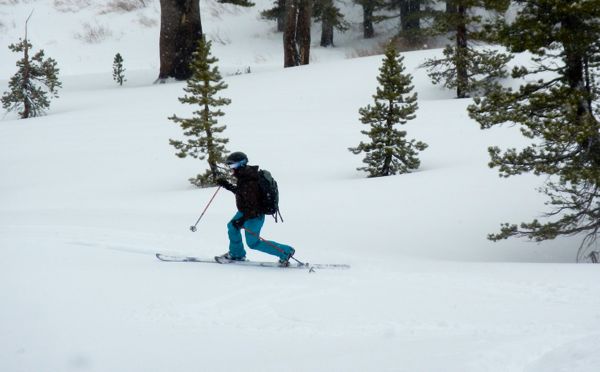
Backcountry skiers play in the fresh snow near Carson  Pass on Feb. 8. Photo/LTN

A backcountry skier plays in the fresh snow near Carson Pass on Feb. 8. Photo/LTN

According to the National Weather Service in Reno, the precipitation runoff since Friday has caused Lake Tahoe to rise 4.8 inches. Another way of looking at it is the last two storms added 16 billion gallons of water to the lake.

While the storms that blew through the basin were at times warm and never brought enough snow to stick at lake level, some ski resorts are reporting a foot or more of white stuff. Enough fell that today Mount Rose is opening its chutes. Other resorts are expanding their offerings. Homewood Mountain Resort is reopening Friday in time for the long Presidents weekend.

But the Lake Tahoe Basin is in for a dry spell for at least the next week. Temperatures are expected to be balmy by Thursday when highs will be in the low 60s.

— Lake Tahoe News staff report


Tahoe trees are more than scenery on a hike

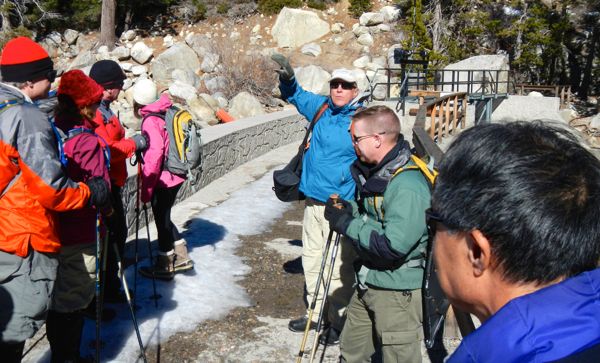
TRTA leader Jim Mrazek, in blue, pauses on the dam at Echo Lake to talk about the area. Photos/Kathryn Reed

TRTA leader Jim Mrazek, in blue, pauses on the dam at Echo Lake to talk about the area. Photos/Kathryn Reed

By Kathryn Reed

ECHO SUMMIT – It was a bit like a scavenger hunt, with everyone looking for pine cones, insects and animal tracks.

Pine cones were in abundance, especially because the snow was lacking. Insects were hiding, which is a good thing because that’s what they should be doing in winter. The tracks were limited to squirrels, but this, too, could have had something to do with the scarcity of snow.

Four leaders (one in training) with the Tahoe Rim Trail Association led a group of 13 on a trek to Echo Lake on Jan. 31.

It was supposed to be a snowshoe, but Mother Nature did not cooperate. Instead, many put Yaktrax on their hiking boots to combat the icy portions of the trail.

It was part hike, part educational experience, part environmental stewardship.

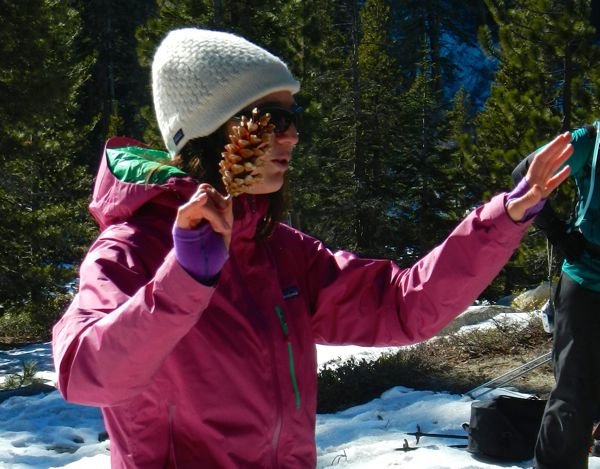
Maria Mircheva with the Sugar Pine Foundation explains the different pine cones.

Maria Mircheva with the Sugar Pine Foundation explains the different pine cones.

“When you walk in the forest it just looks like trees, but there is so much than trees,” Maria Mircheva, executive director of the Sugar Pine Foundation, says. “Sometimes when you look at a tree you can see its life story.”

Big gaps between branches can signal a big water year because of the growth spurt. Sometimes when there are no branches on one side it could mean another tree had been standing next to it and prevented the limbs from growing.

On this excursion there are Western white pine, red fir, Jeffery pine (the most popular tree in Lake Tahoe), lodgepole and white bark.

Blister rust is decimating the white pines and could one day wipe out this species of trees.

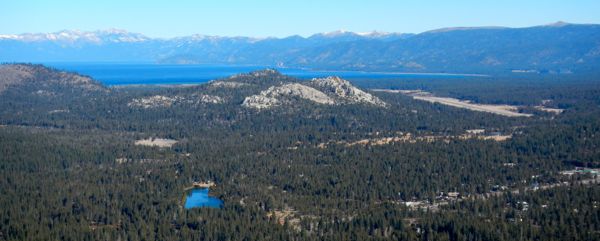
Views along the ridgeline look out to Lake Tahoe.

Views along the ridgeline look out to Lake Tahoe.

The group comes across a huge fir that has been uprooted. Mircheva shares how different diseases are taking hold of pines and firs. This tree was probably weakened by disease and came down in the Dec. 11 storm.

The foundation focuses its efforts on saving the sugar pine. This is done through education as well as plantings. Each year volunteers climb the tall trees, harvest the cones so the seeds may be extracted and then seedlings are planted in the forest. To date, about 10,000 have been planted since 2008. But the survival rate is only 20 to 25 percent.

Mircheva explains how the pitch coming out of trees is their healing mechanism. The difference between pitch and sap is sap is harvested and turned into syrup – and it comes from a different type of tree.

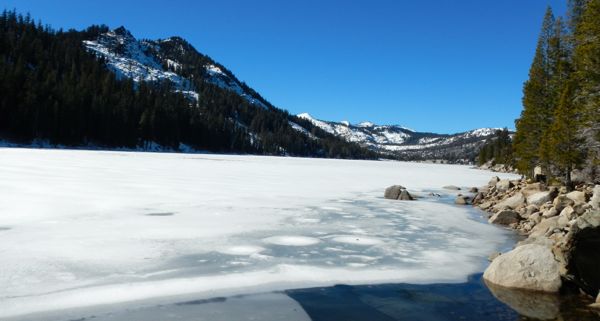
Lower Echo Lake is partially frozen.

Lower Echo Lake is partially frozen.

Pointing to the moss on the trees, Mircheva says it doesn’t go to the ground because snow should be covering the lower part of the trees. With that not happening this winter, it’s possible the moss will start growing on the lower portion.

The TRTA leaders – Jim Mrazek, Sue Henson, Renee Gorevin and Alan Catron – impart information about poles – safety and stability issues; about the need to make loud noise when a bear is on the trail; how this area of the Tahoe Rim Trail intersects with the Pacific Crest Trail and the role of trail angels.

This particular three-mile hike was free and open to the general public. Other excursions the TRTA does are open only to members. For information about future treks, go online.


Challenging day on slopes for U.S. women

By USSA

BEAVER CREEK — It was another day full of action on Monday at the FIS Alpine World Ski Championships in Beaver Creek for the women’s alpine combined. Slovenia’s Tina Maze displayed speed in the morning’s downhill and technical prowess in the afternoon’s slalom to win her ninth career World Championship medal. Rounding out the women’s combined podium were Nicole Hosp and Michaela Kirchgasser, both from Austria.

Hopes were high for Lindsey Vonn (Vail), who took seventh in the downhill before straddling in the slalom and did not finish. Laurenne Ross (Bend, Ore.) was the top finishing American in 14.

The U.S. Ski Team started four athletes in the women’s combined — Jacqueline Wiles (Aurora, Ore.), Ross, Julia Mancuso (Squaw Valley), and Vonn. The four American athletes skied hard and courageously on Monday against an international field comprised of the best 27 female skiers in the world. However, the downhill and slalom runs in the combined event proved to be a tough challenge for the American women.

The one-day women’s combined event was full of action. The morning’s downhill track was very fast due to the slick, icy surface and the technical course. Maze sat atop the downhill standings after the morning run, trailed by Lara Gut of Switzerland and Austria’s Anna Fenninger. Vonn, the highest American in the combined downhill, sat in seventh place. Vonn’s downhill time was 1.31 seconds off Maze’s, meaning she would have to ski a flawless slalom run in the afternoon to have a shot at medaling. Ross was the second American finisher, taking 10th, while Mancuso was 17 and Wiles 18.

After trading long skis for short skis, the athletes transitioned from a downhill mindset to the technical slalom course. Salted because of warm temperatures and set by Maze’s Slovenian coach to favor the speed skiers, the slalom track was in prime condition for the female skiers to set an edge. However, the slalom specialists put on a clinic and left an indelible mark on the women’s combined event.