Photo shows mountain lions roaming Georgetown

By Kathy Park, KCRA

GEORGETOWN — A photo exists showing a pack of mountain lions roaming around the property of a Georgetown resident, near Graybar Mine Road.

The picture was snapped at 2:39am Feb. 19, from Tami Sutton’s game camera, mounted in her front yard to capture images of wildlife.

“People would very rarely ever get a photo of four lions at one time, so this is kind of a unique photo,” Patrick Foy, with the California Department of Fish and Wildlife, said. “A group of four lions is usually a family.”

Foy said it’s likely a mom and her cubs, brought to the area because of their favorite prey: deer.

Read the whole story


Secret to performing at altitude — train your diaphragm

By Alex Hutchinson, Outdoors

Five years ago, as the members of a British military expedition trekked up the Barun Valley in Nepal toward 27,766-foot Makalu, the world’s fifth highest peak, the levels of oxygen in their blood began to drop — a normal but troublesome physiological response to the thin air of altitude. By the time they reached Base Camp, at just over 16,000 feet, their arterial oxygen saturation was 20 percent lower than it had been at sea level.

Not everyone felt the same effect, though. Fourteen of the climbers had volunteered to be part of a study run by Mitch Lomax, an exercise physiologist at the University of Portsmouth. And half of those volunteers were randomly assigned simple exercises to strengthen the muscles involved in breathing — a technique called inspiratory muscle training — for four weeks leading up to the expedition. When the IMT group got to Base Camp, they had desaturated by only 14 percent, a significant six-percent advantage over the control group that persisted as they kept climbing to the advanced base camp at over 18,000 feet.

Lomax’s results, which were published in the journal Aviation, Space, and Environmental Medicine in 2010, sparked interest from guides, climbers, and other mountain athletes who all wondered: Can you beat the energy-sapping effects of altitude by strengthening your breathing muscles?

Read the whole story


Warm weather has bugs starting to come out

By Paul Nelson, KTVN

The warm and sunny weather has more than just the birds enjoying the outdoors.

People are also taking advantage of the spring-like weather along with those of the six-leg variety. “Insects, being cold-blooded, as soon as it starts warming up, things start happening with them,” says Jeff Knight, entomologist, Nevada Department of Agriculture.

Knight says what’s happening now is more common around the first of April. “I’m seeing a lot of activity in my own yard of things that are not normal for another month or so.”

Knight says box elders and clover mites tend to come out first. And if the warm weather continues, we’ll see even more species. “Definitely, the honey bees will come out and go out and explore. They’re not going to find much, at this time.”


Ganong top U.S. finisher in super G

By USSA

SAALBACH-HINTERGLEMM, Austria — In a turny, technical super G set by American coach Forest Carey that did not excuse any mistakes, the Austrian Matthias Mayer once again emerged victorious. That makes for two gold medals in two days for the Austrian who figured out this challenging track full of blind gates, fallaways and big jumps on an aggressive, bumpy surface. Travis Ganong (Squaw Valley) was the top American finisher, toughing out a ninth place finish after falling ill and missing the downhill.

France’s Adrien Theaux, who launched off the final jump with flair into a spread eagle in Friday’s downhill training run, finished second and Norway’s Kjetil Jansrud in third.

While many racers battled visibility, with thick fog in the middle of the course, Ganong had a different battle to fight. A gnarly stomach bug kept him in bed all day Saturday, forcing him to miss the downhill on the challenging Schneekristall-Zwolfer track. Ganong, who hasn’t been able to break into the top 20 this season in super G, battled the sickness to score his best result of the season — ninth place. With the exception of hitting a hole at the bottom of the course at a right foot double with a tricky fallaway that gave many competitors problems, Ganong maintained a good pace throughout his run.

“I really was not expecting anything,” Ganong said. “Yesterday I was really sick — like the most sick I’ve felt in my life. I was throwing up and I spent the whole day in bed sleeping. I had to skip the downhill race. So this morning I didn’t even spin on the bike or do any warm-up or anything. I just showed up and skied and I had no plan, really, I just went gate to gate. Maybe that’s a good thing. Maybe that’s better for me, mentally, for super G.”

This is a brand-new track for these guys, and with no training run and so much terrain, there is a lot to learn. What’s more, athletes fought damp mist and thickening fog. Visibility worsened at the mid-section of course where the bumps and ruts were also at their worst. When Canada’s Manuel Osborne-Paradis skied out in that section of the course, he exclaimed, “Can’t see two gates!”

It was a deep American field, eight skiers competed in today’s super G. Andrew Weibrecht (Lake Placid, N.Y.) finished 19, Jared Goldberg (Holladay, Utah) 30, Ted Ligety (Park City) 35, Wiley Maple (Aspen) 38, and Tim Jitloff (Reno) 42nd. Steven Nyman (Sundance, Utah) and Marco Sullivan (Squaw Valley) did not finish.

Being mindful — one way to jump-start exercise routine

By Gretchen Reynolds, New York Times

By now, many of us, beset by bad weather and declining motivation, are struggling to maintain our New Year’s exercise resolutions. But a timely new study offers encouragement, suggesting that by paying more attention to the experience of exercise itself, even the most reluctant of exercisers might begin to find pleasure in movement.

Scientists, like the rest of us, have long wondered why some people stick with exercise and others do not. The possible explanations involve everything from genetics and personality to practicalities like work schedules and access to showers. But in multiple studies of exercise behavior, one of the most reliable indicators of whether people will continue to exercise is that they find exercise satisfying. They gain enjoyment from being active.

The problem with that finding is that it does not explain what makes exercise satisfying and so is not very helpful on a practical level. Simply advising unenthusiastic exercisers to start enjoying their workouts more seems unlikely to have the desired effect.

So for the new study, which was published last month in The Journal of Health Psychology, researchers at Utrecht University in the Netherlands and other institutions recently decided to more closely parse the psychological underpinnings of exercise satisfaction, hoping to tease out what makes exercise feel pleasurable to some and like drudgery to others.

They wondered in particular about the role of mindfulness.

Read the whole story


Passion for skiing is No. 1 lesson at Sugar Bowl Academy

By Ellen Garrison, Sacramento Bee

Sitting around tables in a science classroom, wrestling with chemistry equations, Sugar Bowl Academy students look like your typical high school students – except for the distinctive goggle tans on their faces.

Skiing every day, snow or shine, will do that to you. The private high school, nestled in the Sugar Bowl Village at the base of Donner Summit outside of Truckee, caters to competitive skiers in grades eight through 12, aiming to give them a complete education while they do what they love to do – ski.

Classes, in all the traditional high school subjects such as physics and American literature, are arranged around a rigorous practice schedule on Sugar Bowl’s slopes – for alpine, Nordic and freeride skiers – and a grueling travel schedule to competitions nationally and abroad.

Sugar Bowl Academy is the only school in California to focus its sports program entirely on skiing, though other schools, like North Tahoe High School, offer flexible class schedules to make competing easier for high school athletes. There are about 20 similar ski academies across the U.S. in Colorado, Idaho, Utah and on the East Coast.

Read the whole story


Winter returns for Carson Pass snowshoe

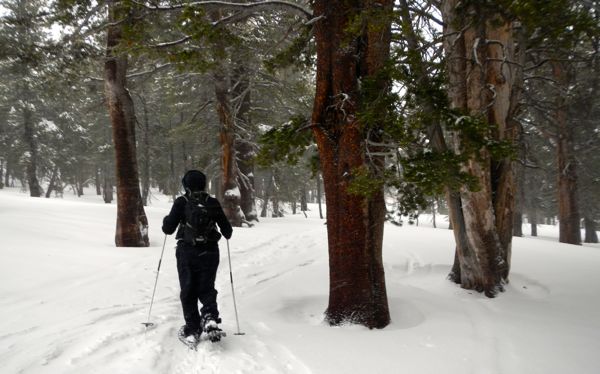
Rosemary Manning makes her way along a snowshoe trail at the Carson Pass. Photos/Kathryn Reed

Rosemary Manning makes her way along a snowshoe trail at the Carson Pass. Photos/Kathryn Reed

By Kathryn Reed

CARSON PASS – Sometimes it’s not about the destination.

At least that was the philosophy we embraced when we didn’t make it to our desired end point. Arriving in a blizzard not knowing exactly where we were going was bound to have that outcome.

But what this trek two weeks ago proved is that exploring the outdoors of the greater Lake Tahoe area is more about the journey and friendship.

Rosemary and I plus our four-legged companions left South Lake Tahoe where there was no sign of nasty weather. By the time we arrived at Carson Pass we were in a different world. Visibility was limited, the snow was coming down horizontally and there was no trailhead sign.

We had been told to park on the right side of Highway 88, just beyond the main parking lot for the trail that leads to Winnemucca Lake, Round Top and other destinations. But what we weren’t told is that the trail required us to walk down the road a bit. While we knew the road to Woods Lake was just down the road, we were under the impression we could get to the trail from where we parked if we just crossed the highway.

We tried. We failed.

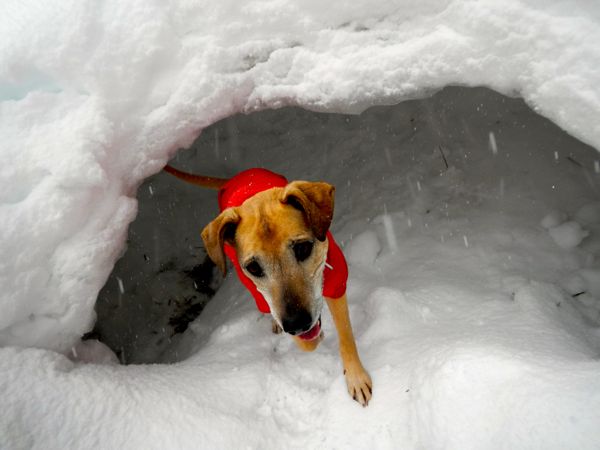
AJ explores a mini snow cave.

AJ explores a mini snow cave.

We started our snowshoe by following those who had been there before us. And we headed to the right, which we at least knew was the correct direction. But it didn’t take long before it was a dead end.

Circling back, we found a path that eventually met up with the main trail out of Carson Pass.

It was eerie and beautiful at the same time. The trees seemed dense compared to a day when the sky is blue and sunlight is coming through. Snow pelting our faces was like a constant exfoliation.

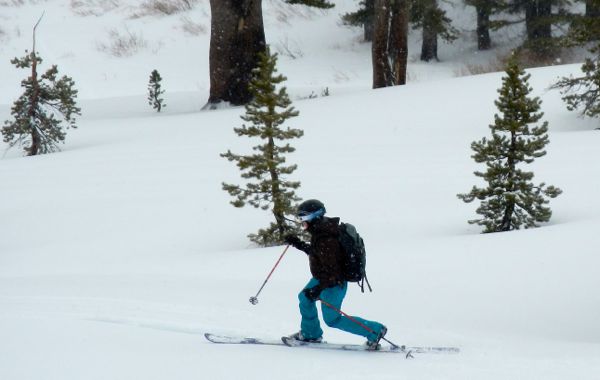
We come to a wide-open space where backcountry skiers are schussing through the fresh snow.

Behind us we see Caples Lake in the distance.

A backcountry skier enjoys freshies.

A backcountry skier enjoys freshies.

We are losing our trail that those ahead of us had made. We don’t see those people or even know if they had been out that morning. Now the wind and snow is coming down in such a way that the imprints from our snowshoes are disappearing.

It’s time to turn around. Even though we are not far from Winnemucca Lake, it didn’t make sense to go forward considering the nasty weather was deteriorating.

By the time we reach the car we are soaked. It’s raining now – and we’re at 8,500 feet. It’s been one of those winters. But what a joy to finally experience winter.


Virginia City edges Whittell in D-IV thriller

By Reno Gazette-Journal

Brothers Clint and Colt Hess combined for 27 points as the Virginia City boys basketball team defeated Whittell, 37-33, for the second consecutive year in the Division IV Northern Region championship game on Saturday at Spring Creek High School.

For the Warriors, Palmer Chaplin scored 14 points and Quinn Kixmiller added 10.

Both Virginia City and Whittell advanced to next week’s Division IV state tournament in Las Vegas. The teams met in last year’s state-title game, with the Warriors winning.

Read the whole story


Tahoe National Forest looking at over-snow use

The Tahoe National Forest is preparing an environmental impact statement on a proposal to designate over-snow vehicle use on roads, trails and areas on lands within its boundaries. The EIS will also identify snow trails available for grooming.

Designating OSV use on the forest will ensure over-snow vehicle activity, such as snowmobile riding, is effectively managed to provide access; ensure OSV use when there is adequate snow; promote the safety of all users; enhance public enjoyment; minimize impacts to resources; and minimize conflicts among users.

The Forest Service has developed a proposed action, however, a decision has not been made regarding the project.

Comments are being taken until March 25 during this initial scoping phase.

Five meetings are planned. All meetings are form 4-7pm:

March 2 — Tahoe National Forest Headquarters Office, 631 Coyote St., Nevada City.
March 3 — Truckee District Ranger Station, 10811 Stockrest Springs Road, Truckee.
March 4 — Sierraville District Ranger Station, 317 South Lincoln St., Sierraville.
March 5 — Sierra City, Sierra City Community Hall, 13 Castagna Alley, Sierra City.
March 9 – Foresthill Fire Department, 24320 Main Street, Foresthill.

For additional information and how to comment, go online.


Calif. may make bike helmets mandatory

By Lydia O’Connor, Huffington Post

Legislation that would make California the first state requiring adult bicyclists to wear helmets has some biking advocates worried the mandate would discourage people from becoming bike commuters.

A bill introduced last week by state Sen. Carol Liu, D-La Cañada Flintridge, would extend California’s youth helmet requirement to adults, mandate reflective clothing while biking at night and fine cyclists $25 for not complying.

Liu pointed to National Conference of State Legislatures claim that 91 percent of cyclists killed in 2009 were not wearing helmets. Research on the effectiveness of helmets, however, is spotty. One study suggests there have been fewer injuries in the 21 states with helmet laws for young riders, but another shows no effect.

Read the whole story