Mancuso may end season early

By Jessica Kelley, Ski Racing

The U.S. might be missing one familiar face at next week’s World Cup Finals in Meribel, France. Julia Mancuso of Squaw Valley has announced that she will be taking a brief break from racing and is heading back to the U.S.

Mancuso, who has been troubled with hip pain her entire career, decided to sit out last Sunday’s super G in Garmisch-Partenkirchen in attempts to alleviate the persistent pain. She then announced via social media that she would be returning to the U.S. to seek treatment and a solution for her long-running hip injury.

Mancuso had surgery in 2006 following her Olympic gold medal in Torino on the same hip she is struggling with currently and was able to come back strong the following season. This year looked to be a promising one for Mancuso with a string of three straight top-10 results in Lake Louise, including a podium in the second downhill, which was part of the first-ever American sweep in a World Cup. She took a brief break following World Championships and missed the next World Cup weekend. Since returning, she has struggled to find her early season form and according to reports, she has not felt “right” all season long.

Read the whole story


New partnership seeks to restore Sierra forests

By Matt Weiser, Sacramento Bee

The Sierra Nevada is many things to California: a mountain playground in winter and summer, a swath of public land stretching nearly the length of the state, and vital habitat for a broad variety of wildlife. It also provides the majority of California’s freshwater supply.

With a fourth year of drought looming, state and federal agencies have launched an ambitious partnership to improve the Sierra’s ability to store and filter water, as well as reduce fire risks, by restoring its forests.

Called the Sierra Nevada Watershed Improvement Program, it aims to coordinate the diverse activities of government agencies, property owners and nonprofit groups to focus on the Sierra’s most serious problems. Goals include restoring streams and meadows, improving habitat and thinning overgrown forests, while also protecting economic uses of the land, such as logging and grazing.

The effort is being led by the Sierra Nevada Conservancy, a state agency, in partnership with the U.S. Forest Service, the primary landowner in the Sierra.

Read the whole story


Sports betting turns a corner

By J.D. Morris, Las Vegas Sun

Sports betting is having a big moment in the United States.

Prominent voices from professional sports and politics have indicated they’re willing to discuss expanding sports gambling, which is legal only in a handful of states. Meanwhile, Nevada has broadened the types of wagers it offers, and people appear to be betting on sports more than ever before.

The Professional and Amateur Sports Protection Act, passed by Congress in 1992, made sports betting illegal in almost every state. Nevada, Oregon, Montana and Delaware are exempt from the law, but beyond Nevada, wagering is allowed only on a limited basis.

So for now, Nevada is the only state with full-fledged legal sports betting, but that could change in the not-too-distant future.

Adam Silver, commissioner of the NBA, has said he supports legal sports betting. He told ESPN he spoke with commissioners of other sports leagues, and “all of them are interested in having a better understanding of the issue.”

Read the whole story


Truckee men complete historic PCT winter trek

By Associated Press

CAMPO — Moments after finishing a historic wintertime trek of the Pacific Crest Trail, Justin Lichter reassured bystanders the pale, desquamated look of his rain-soaked hands was “totally normal.”

The difference between what looks like a serious problem to the average backpacker and what Lichter and hiking partner Shawn Forry were able to laugh off as an afterthought demonstrates the significance of their most recent accomplishment – a 2,650-mle trek from Canada to the Mexican border.

By completing what’s thought to be the first wintertime through-hike of the iconic trail Lichter and Forry broke a huge American hiking barrier and raised the bar for what’s possible when it comes to adventure.

Lichter is a professional ski patroller at Sugar Bowl Resort and Forry is an Outward Bound instructor based in Truckee.

“It is like anything else, if you watch a champion ice skater they make it look easy,” said Pea “Girl Scout” Hicks, who was among the hiking fanatics who waited in the rain to meet Lichter and Forry at the southern terminus of the trail. “These guys make it look easy. It is not.”

Among the many reasons the accomplishment is impressive is the fact Lichter, who has the trail name “Trauma” and Forry, whose trail name is “Pepper,” broke a barrier so many have thought about and discussed but very few have even attempted. While the Pacific Crest Trail runs within a relatively easy drive of several major cities, has been the subject of an Oscar-nominated film as recently as last year, and sees several hundred through-hikers annually, completing the trail in winter has long been considered a near impossibility.

“Before they did this doing the PCT in winter was kind of the great unknown,” said Elizabeth “Snorkel” Thomas, who in 2011 set a women’s, unsupported speed record for through-hiking the Appalachian Trail. “It was one of the last things on the hiking frontier.”

The barrier remained in place for so long in part because of the notoriety of winter conditions in the regions through which the trail passes. From north-to-south, the direction Lichter and Forry hiked, the trail passes through the Cascade and Sierra Nevada ranges before descending into the Mojave desert then heading back up into the San Gabriel, San Bernardino and San Jacinto ranges. The most treacherous stretches for winter travel are the Cascade and Sierra sections because those ranges are known for having remote terrain that’s subjected to harsh winter conditions with massive snowstorms.

Not only would whoever broke the winter barrier need to be a proficient hiker, they would need to be able to travel on snowshoes and skis if they were going to get through the imposing ranges.

Forry’s dad, Randy Forry, summed up the thoughts of many who have pondered and dismissed the notion of completing the trail during winter.

“When he told me it has never been done before I kind of said ‘you know there is probably a reason’,” he said.

The risk associated with the winter trek was such that before Lichter and Forry decided to attempt it, many within the hiking community would have considered it foolhardy. The credentials Lichter and Forry brought to the trek, however, made people take notice of their attempt. Lichter has hiked more than 35,000 miles, done an unsupported swim around Lake Tahoe and developed a hiking route between Durango, Colorado and Las Vegas. Forry has hiked more than 20,000 miles in seven countries, including New Zealand where he and Lichter completed a precursor route to the Te Araroa trail.

“In most cases if someone said they were going to through-hike the PCT during winter you would try to talk them down from the cliff,” Hicks said. “But these guys got a lot of encouragement.”

During the summer, a hiker in trouble on or near the trail could expect dozens of people to be in the vicinity, improving the likelihood of finding help, but that’s not the case in winter. Lichter and Forry traveled 1,700 miles from Snoqualmie Pass in Washington to Walker Pass in California without seeing anyone along the trail. Their only human contact was when they left the trail for resupply or went through towns.

“Once you are in the High Sierra it is not an easy out,” Forry said. “There is always that looming cloud of anything could happen at any moment.”

They were almost derailed before Christmas when they both suffered frostbite on their feet near Bend, Ore. At another point they forced to swim across swollen Grider Creek in the Klamath National Forest early one morning in December after discovering a bridge they had planned to use was washed out.

The intellectual challenge began long before the duo set foot on the trail. They had discussed the idea for about five years, Lichter said, but it took more than talk to make it a reality. A tuneup trip on skis through the Sierra Nevada a couple seasons ago helped to jump start the process of deciding what gear they would need and how it might perform on the trek. They also spent a lot of time studying resupply options because many of the standard summertime access points are closed in the winter.

The biggest deviation from plan came shortly before the trip started. That’s when they decided to scrap the original idea of going south-to-north and instead go north-to-south.

“This seemed like a smart thing to do so we could get through Washington before they built up a lot of snowpack and higher avalanche risk and then get into the Sierras, an area that we are most familiar with, in the heart of the winter,” Lichter said.

Lichter and Forry needed more than their outdoors skills to complete the trek. They also needed to stay sane. It was a challenge because the harsh environment meant any given day could be an emotional roller coaster for either or both of the men, meaning each had to not only manage his own emotions but be attentive to how the other was feeling. Communication got to the point each hiker could anticipate what the other was about to say or do, they said.

“You know when to back off and when to pry,” Forry said. “Trauma knows if he sees me snapping trekking poles over my knees not to ask any questions.”

The mental aspect, according to Thomas, might have been the most difficult part of the accomplishment.

“There is sort of a mental stamina that I think is what really makes what they did impressive,” she said. “If you don’t have the mental stamina you are just going to quit.”

Lichter confirmed as much during an interview with the Pacific Crest Trail Association when responding to a question about the skills needed for a winter through-hike. In addition to knowing about winter camping and avalanche safety he added one more item to the list, “Short term memory failure.”

Eldorado Forest working on over-snow plan

Eldorado National Forest is beginning to prepare an environmental impact statement for over-snow vehicle use on national forest roads, trails, and areas. The proposed action also designates trails for grooming.

The comment period ends April 6.

The Forest Service’s goal in designating OSV use on the Eldorado National Forest is to ensure that the use of OSVs is well managed to minimize impacts to natural resources, to provide access for OSV use, to promote the safety of all users, and to minimize conflicts among the various uses. The Eldorado is not proposing any change to the number of miles of snow trails and acres of OSV areas where OSV use would be allowed, subject to snow depth restrictions. Current restrictions to OSV use will be made permanent in the EIS.

For additional information, go online or call 209.295.5960.


Hiking adventure proves it’s a dog’s life

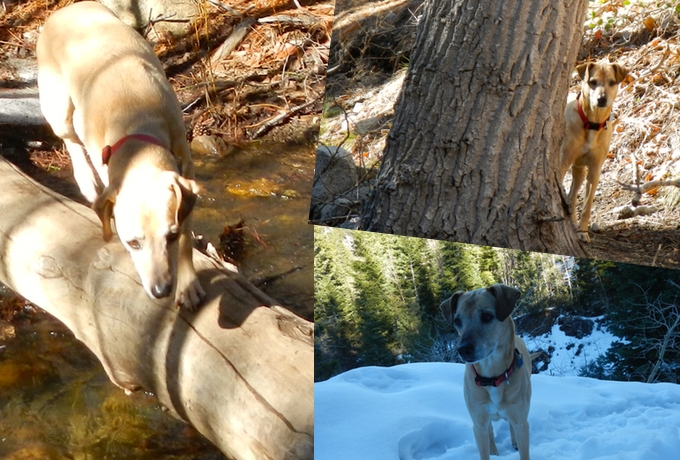
Aj spends her 12th birthday exploring the Mount Rose Wilderness. Photos/Kathryn Reed

Aj spends her 12th birthday exploring the Mount Rose Wilderness. Photos/Kathryn Reed

By Kathryn Reed

RENO – AJ’s birthday hike was no piece of cake.

This 12-year-old – that’s 84 in human years – is much sprier than her much younger mommies. As if we needed a reminder. What was a 9.2-mile loop for us had to have been at least 1½ times that amount for the dog. She can be like the Energizer Bunny – she just keeps going and going and going.

This is what she lives for – being in the outdoors, romping in new terrain, sniffing all those delicious scents that never cross my olfactory senses and quenching her thirst from pristine water flowing from higher elevations.

When we first planned this for Feb. 14, snow had not fallen in a while and the U.S. Forest Service said the trail was free of any white stuff. Naturally, it snowed the week we were going. But because it is much lower in elevation we figured we would be OK in just hiking boots. And we were, despite going down on the slick snow a few times. Poles would have been a tremendous help, but they were in the garage.

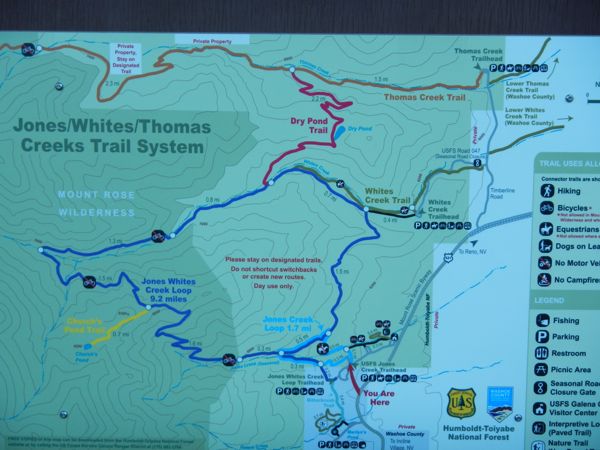
The Jones-Whites-Thomas creeks trail system could keep us entertained for days.

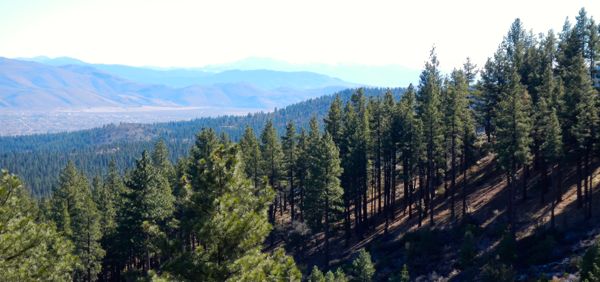
It doesn't take long for pretty views to unfold.

It doesn’t take long for pretty views to unfold.

This loop has a little bit of everything. We went in a counter clockwise rotation based on the advice of visitor center staff. From the parking lot it is 0.6 miles to the start of the loop.

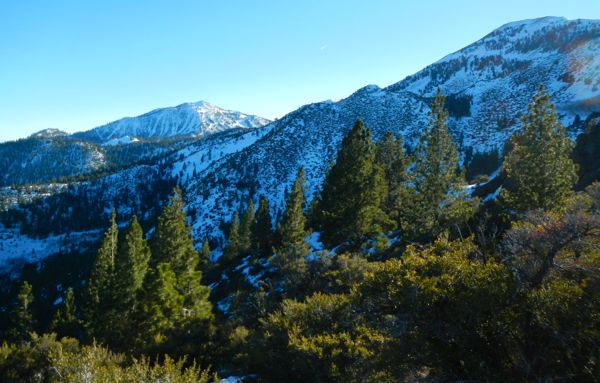
From there the terrain is similar to being in the Lake Tahoe Basin, but more barren. Plenty of pines loom overhead, but it’s not dense. It doesn’t take long before we are climbing. This provides spectacular views of far off mountains as well as parts of Reno. Behind us the slopes of Mount Rose are all covered in white.

A segment of this trail is open to mountain bikers. All were courteous to let us know they were approaching.

Farther along we come across some downed trees that require scrambling to get over. AJ, showing off her part Greyhound agility skills, leaps across the debris as though it’s a fun obstacle course.

Plenty of water is running in the creeks so AJ didn’t need any bottled water. She even trotted across logs to get to the other side. Her people were a little less confident in their ability to balance.

While we made it across the water without getting wet, there are four stream crossings that in a more typical winter or heavy spring runoff might prove to be a bit more challenging.

As we start a long trek west we know at some point we need to head south to get back to our starting point. But we’re in a canyon and the terrain to our left looks steep. We didn’t really descend that much, did we? Won’t there be some sort of cutoff to get us back without going up?

Mount Rose Ski Area, in the distance, is visible at different points.

Mount Rose Ski Area, in the distance, is visible at different points.

Up we go. And that’s when the snow goes from spotty to consistent. Luckily, others had gone before us. While there had been good trail markers, in the snow we would have had no clue where to go without others first “paving” the way.

At times we punch through to thigh-high snow. It becomes slow going. But it is still so incredibly beautiful that our whining is short-lived.

We make it to the top – again. More views, more picture taking. It’s an easy descent, but by this time we are getting chilled and fatigued. (At one point I was in shirtsleeves.) AJ on the other hand looks like she could keep going, right until she curls up on the blanket in the back of the Jeep.

—–

aj bday hike-3

Getting there: The scenic route from South Lake Tahoe – go east on Highway 50. Turn left on Highway 28 at the top of Spooner Summit. Turn right onto the Mount Rose Highway in Incline Village. There is a sign for the Jones Creek trail system on the left. This is well beyond Mount Rose Ski Resort. The visitor center is on the right; drive a little farther to the trailhead.

The less scenic route from South Lake Tahoe would be to drive to Carson City and then come up Mount Rose Highway from the other side.


Agencies to start controlled burns in basin

The Nevada Division of Forestry and the U.S. Forest Service may conduct prescribed fire operations in several areas around Lake Tahoe beginning March 9.

Operations may take place southwest of Meeks Bay, on Gardner Mountain near South Tahoe High School and off Gardner Street, Luther Pass near Grass Lake, Ski Run Boulevard near Heavenly, near Logan Creek Drive on the East Shore, Slaughterhouse Canyon and Lake Tahoe Nevada State Park north of Spooner Summit. Operations may last through the next several weeks as conditions allow.

Smoke from prescribed fire operations is normal and may continue for several days after an ignition depending on the project size. Agencies coordinate with state and local county air pollution control districts and monitors weather conditions closely prior to prescribed fire ignition.

Before conducting prescribed fire operations, agencies may post road signs around affected areas and make email or phone notifications. The Forest Service updates the local fire information line at 530.543.2600, ext. 6.


Collect water now to irrigate garden later

By Melinda Myers

Too much or not enough water and never when you need it. That seems to be the long-time plight of gardeners. Add to this extended droughts, flooding and watering bans. What is a gardener to do? Become a water-wise gardener.

Water wise is not just about growing drought tolerant plants or eliminating plantings. It is a holistic approach to managing water to avoid flooding that overwhelms sewer systems, improper watering that wastes water, and poor landscape designs that generate too much work and require too many resources.

Make this the season that you incorporate a few waterwise habits into your gardening. You’ll find it is good for your garden, the environment and your pocketbook. Start with one or more of these strategies this year.

Collecting rain in rain barrels when it is plentiful and storing it until it is needed is an effective way to manage water for the landscape. Melinda has over 30 years of experience as

Rain barrels are an effective way to manage water for the landscape. Photo/Melinda Myers

Select the right plant for the growing conditions. Plants that thrive in normal growing conditions for your area will be healthier, require less care and need less water. Look for drought tolerant plants that require less water once established.

Keep water out of the storm sewers and in the garden instead. Prevent flooding while improving your garden. Adding several inches of compost to the top 8 to 12 inches of soil increases the soil’s ability to absorb and retain water. This means less runoff into the storm sewers and less frequent watering.

Use plants to prevent runoff and conserve water. Plant trees, shrubs, and groundcovers to slow the flow of rainwater, increase the amount of water that stays in your landscape for your plants, and to filter water before it enters the groundwater. Install one or more rain gardens to intercept surface water runoff for use by rain garden plants and to help recharge the groundwater.

Provide plants with a healthy diet. Use a slow release non-leaching organic nitrogen fertilizer like Milorganite (milorganite.com). You’ll encourage slow steady growth, so your plants will require less water and be less prone to insect and disease problems. Plus, the slow release nitrogen encourages healthy growth and does not prevent flowering and fruiting.

Water wisely. Water plants thoroughly and only when needed. Water the soil, not the plant, using a watering wand, drip irrigation or a soaker hose so less water is lost to evaporation. Water early in the morning whenever possible to reduce water loss during the heat of the day and diseases caused by wet foliage at night.

Manage your lawns to reduce water use. Select drought tolerant grass varieties to reduce watering needs. Prepare the soil before seeding or sodding or aerate and spread a thin layer of compost over existing lawns to increase water absorption and reduce runoff. Mow high to encourage deep roots that are more drought tolerant and pest resistant. Allow lawns to go dormant during hot dry weather. If irrigating, water thoroughly when needed, that’s when your footprints remain in the lawn.

Conserve water and reduce time and money spent on plant care. Mulch the soil around trees, shrubs and other plants with several inches of woodchips, shredded leaves, evergreen needles or other organic material. Mulching reduces watering frequency, prevents soil compaction from heavy rainfall thus increasing water absorption. It also adds organic matter to the soil as it decomposes.

Repair leaking faucets, fittings and garden hoses. A slow leak of one drip per second can waste up to nine gallons of water per day.
Look for and use wasted water. Collect the “warming water” typically wasted when preparing baths and showers. Use a five-gallon bucket to collect this fresh water and use it for your containers and gardens. Collect water from your dehumidifier and window air conditioners for use on flowering plants. Do not, however, use this water if environmentally harmful solvents have been used to clean this equipment.

Check with your local municipality if you are considering using gray water. Once you wash clothes, dishes or yourself, water is classed as gray water and most municipalities have guidelines or regulations related to its use.

Harvest rainwater if your municipality allows. The ancient technique of capturing rainwater in jugs, barrels and cisterns has made a comeback. Collecting rain when it is plentiful and storing it until it is needed is one way to manage water for the landscape. But first check local regulations before installing a rain harvesting system. Several states have banned rain harvesting, while others offer rebates or rain barrels at a discount to gardeners.

Gardening expert, TV/radio host, author and columnist Melinda Myers has more than 30 years of horticulture experience and has written more than 20 gardening books.


4 U.S. men in top 15 in downhill

By USSA

KVITFJELL, Norway — In the penultimate Audi FIS Ski World Cup downhill of the season, the men were thirsty for results — looking to tighten the race for the overall downhill globe. Hannes Reichelt of Austria had a nearly perfect run on the Kvitfjell track and took the win, while the Americans stacked four racers in the top 15. Travis Ganong (Squaw Valley) was the top American downhiller of the day, finishing in sixth place.

The conditions were strange in Kvitfjell, with fog and high winds rolling through the sunny morning in Norway causing the start to be lowered to the super G start. It’s a low-altitude resort — the base is about 600 feet above sea level — and the snow warmed up quickly. The track, slick and fast at the top of the course, quickly degraded as the racers made their way down the hill. But even with the varying conditions and lowered start, racers were still hitting 90 mph at the bottom of the course.

Reichelt nailed the line on the Kvitfjell track and came through the finish 0.30 seconds ahead of the pack. Reichelt was looking for the win ahead of Kjetil Jansrud, attempting to steal the downhill globe from the famed Norwegian downhiller. So far so good for Reichelt, as Jansrud couldn’t pull it off at Kvitfjell — a track he grew up skiing on — finishing seventh. Canadian Manuel Osborne-Paradis surprised the crowd and took second place—his only podium and top-10 result since Lake Louise at the beginning of the season. Werner Heel of Italy was third, after holding the lead for 20 races.

Not fazed by the snow, Ganong threw down a blazing fast run — making up time at the bottom and finishing in sixth place, even after hurting his knee in the training run.

“Yesterday in the training run I was eighth, but in the middle section, I caught an edge and hyperextended my right knee,” said Ganong after the run. “It was really, really sore last night. I woke up this morning and was really sore and was a little worried. But I got some treatment and got some ibuprofen and taping. It still hurt today, but I was able to ski through it.”

As his teammates have been saying for the last couple of weeks, Marco Sullivan (Squaw Valley) has figured something out in his skiing. With a fast top that would have placed him in the top five, he lost a little on the bottom and finished in 12.

“Personally, I wish [the season] would keep going!” said Sullivan. “I’m just heating up. I’ve had some good results the past three weeks. For some reason this year, I don’t want it to end.”

With a similarly fast top section, Andrew Weibrecht (Lake Placid, N.Y.) also had a solid run, finishing in a three-way tie with Sullivan and Austrian Vincent Kreichmayr. Jared Goldberg (Holladay, Utah) was 15, just a tenth behind Sullivan and Weibrecht — his best result in a World Cup downhill this season.

Steven Nyman (Sundance, Utah) was the favored American skier after winning Friday’s training run, but the lowered start did not favor the classic downhiller. Nyman got caught up in the soft snow at the bottom to finish in 25. Wiley Maple (Aspen) finished just out of the points in 31 and Bryce Bennett (Squaw Valley) was 50.


Fake snow may save Calif. ski industry

By Evelyn Spence, BloombergBusiness

Most skiers at Heavenly in Lake Tahoe never even notice the snowmaking pump house, which is just a shed next to the day lodge at the base of the mountain. You can’t hear the hum of the pumps and motors until you’re inside. The whole operation is designed to be unobtrusive: A day on the hill should be exhilarating, free of any reminder that the resort company is engaged in an all-out battle with the weather.

That little pump house is, in fact, Heavenly’s weather center, where every day a crew of 38 decides exactly how much snow it can manufacture and when and where to do it. There are maps on the wall and three white boards that help them plan out the day. Four computers constantly monitor the temperature, humidity, air pressure, and water flow of Heavenly’s 66 fully automated fan guns.

“I usually have four or five weather websites up at the same time. It’s the major part of my job,” says Barrett Burghard, senior manager of snow surfaces for Heavenly. “We will make snow 24-7, if it’s cold enough.”

Next to one of the computers sits a book the color of sunset: “The Teaching of Buddha”. Burghard has legitimate need for stress management. For the second year in a row, snowfall has been abysmal. Statewide, the snowpack was 25 percent of the historical average—“dismally meager,” according to the California Department of Water Resources. January was the driest on record. By mid-February, almost every hill in Tahoe had received less than 50 percent of its average snowfall.

Less snow means fewer skiers, and that means decreasing revenue for the state’s $1.3 billion ski industry. As of last season, skier visits — the industry’s metric of days skied per person — were down 28 percent from the 2010-11 season. Smaller resorts at lower elevations couldn’t survive: Badger Pass, which is in Yosemite National Park, and Dodge Ridge, which is just outside it, opened in December, then closed a month later. China Peak followed in mid-February.

“This has been what I’m now calling the ‘cruelest’ winter I’ve ever seen,” China Peak Chief Executive Officer Tim Cohee wrote in an open letter on Facebook. “We have not only dealt with no snow, but also with incredibly marginal snowmaking conditions. … In nearly four decades I have never worked for a resort that closed mid winter; now I have.”

Heavenly is in a different position. It’s owned by Vail Resorts, a $3.1 billion, Colorado-based resort company that has equipped Heavenly with some of the most sophisticated and expensive snowmaking equipment in the U.S. The snowmaking staff manages more than 200 air water guns, boom guns, and Super PoleCat fan guns that blow piles of crystals — sometimes a thousand hours a season — for a grooming team of 20 to transform into skiable trails. With 30,000 feet of pipes and hoses, the system can cover 73 percent of the resort’s 4,800 acres. In ideal conditions, snowmakers can fabricate winter at the rate of a foot of snow over 43 acres in just 12 hours. Even so, last year Vail reported a 28 percent drop in skier visits at its California resorts, and the company warned investors that its financial results would be worse than anticipated.

Read the whole story