Drip irrigation helps conserve water

By Melinda Myers

Reduce your workload, increase productivity and be water wise, whether you are planning, planting or already harvesting produce or enjoying beautiful floral displays from your garden.

Container gardeners may want to invest in self-watering pots. These containers have built-in reservoirs to reduce watering frequency. Commercial and homemade self-watering devices can also reduce watering frequency. Just make sure to test their effectiveness before leaving town. Or consider a one-time investment in a drip irrigation system especially designed for container gardens.

Drip irrigation and soaker hoses are also a great way to water in-ground plantings. These irrigation systems apply the water directly to the soil which reduces water lost to overspray, evaporation and runoff. They also reduce the risk and spread of disease by preventing water from settling on the leaves of the plants.
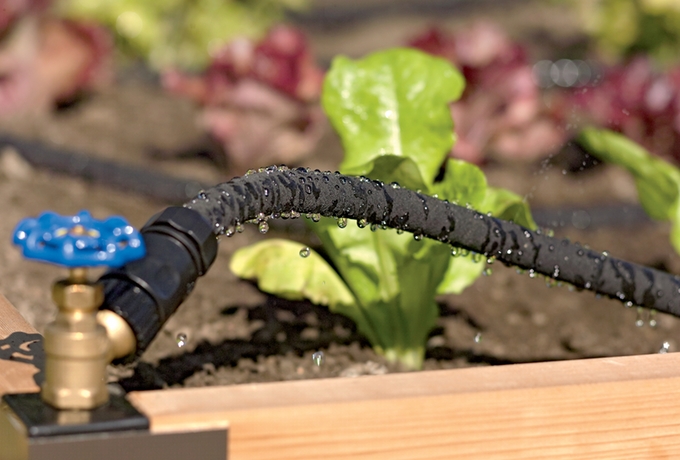
Drip irrigation systems apply the water directly to the soil which reduces water lost to overspray, evaporation and runoff. Photo/Gardener’s Supply Company

Drip irrigation systems apply the water directly to the soil which reduces water lost to overspray, evaporation and runoff. Photo/Gardener’s Supply Company

Opt for a micro irrigation system if your water has a high mineral content. These minerals can build up and clog soaker hoses. Micro irrigation systems experience fewer problems and the nozzles can be cleaned to prevent clogs. Because the nozzles can be clipped onto stakes, tomato towers or other supports, this system makes it easy to deliver water right to the plants.

Raised bed gardens will also benefit from irrigation systems. Elevated gardens often dry out more quickly than their in-ground counterparts and need more frequent watering. Some, like the Raised Bed Snip-n-Drip soaker system, are easy to assemble and allow you to water when needed. Further save time by using preformed corners with built-in spigots when constructing raised beds. Simply slide the boards into the metal corner pieces to create the raised bed. Some corner systems, like Aquacorner, have built-in spigots to make irrigation even simpler.

Correctly installed irrigation systems can help conserve water by ensuring you water properly and only when needed. Plus, using a timer and an irrigation system allows you to apply water at the best time for the plants. Just set the timer for early in the morning – when less water is lost to evaporation – and the plants will be watered even if you are not home.

Always water thoroughly and only as needed to encourage plants to develop deep root systems that are more drought-tolerant. Be sure to avoid high nitrogen, fast release fertilizers that promote lush succulent growth which needs more frequent watering.

Further conserve water and time spent watering by grouping moisture-loving plants together. You can provide needed water more efficiently and avoid overwatering nearby drought-tolerant plants.

And remember to mulch your garden. A thin layer of shredded leaves, evergreen needles or other organic matter helps conserve moisture and reduces erosion. As the mulch breaks down, it helps improve the soil, while decreasing its’ water needs.

So make this the year you take a break from watering, while continuing to enjoy beautiful and productive gardens.

Gardening expert, TV/radio host, author and columnist Melinda Myers has more than 30 years of horticulture experience and has written more 20 gardening books.


Planners plotting Tahoe’s cycling future

By Kathryn Reed

Cycling in the Lake Tahoe Basin can be compared to driving in rush hour traffic. It’s a lot of stop and go, along with frustration.

With the lack of connectivity, routes abruptly stopping and harrowing experiences when having to interact with vehicles, two-wheelers in Tahoe are often relegated to second-class citizens – at least on the roads. Planners, with the help of the public, want to change that reality.

“We are transitioning into an active transportation plan,” Nick Haven, transit planner with Tahoe Regional Planning Agency, told Lake Tahoe News. “Historically, we’ve been focused on circulation and transportation.” Now health and other modes of transit like skateboarding are part of the bigger picture.

The bi-state agency is updating its bike and pedestrian plan – something that is done every four years.

On April 14 more than 20 people gathered at the South Lake Tahoe Library to offer input about what planners should focus on when designing trails, what overall goals should be, where missing links in the trail system exist, and where bike racks should be installed.

Greg Kendall of Marla Bay voted for buffered or protected bike lanes, as did many others. While he prefers a separated bike path, he told Lake Tahoe News he knows that isn’t realistic for his part of the South Shore where the roads are narrow. Kendall also believes it’s necessary to accommodate the different types of cyclists – those out for a leisurely ride, and those who are more serious, going faster and would be encumbered by a multi-use path.

Morgan Beryl, who is TRPA’s project manager for what is now called an active transportation plan, told Lake Tahoe News the document would prioritize projects for funding, be a guide for what should be implemented and be a source for designers.

TRPA has found that people are sticking to their vehicles because they don’t feel safe on the roads or in intersections – whether on a bike or foot. Working to make intersections safer is a goal. Caltrans recently added a class 4 designation to bike trails. This allows for two-way travel on the same side of the street along the road. Bike boxes are being tested in Sacramento and Davis. These put cyclists in front of vehicles at an intersection. Removable signs in the roadway and flashing lights to alert motorists of the presence of cyclist are other innovations.

—–

Notes:

• Feedback on the bike-pedestrian plan is also being sought via an online survey that will be up through June.

• A draft plan – which will seek more public comment – should be ready by October, with the final document completed by the end of the year.

• There is a meeting at Kings Beach Elementary on April 16 from 5:30 to 7:30pm about the plan.


Should foot races be booted from the PCT?

By Yitka, Outdoor

You’re hiking through a grove of spruce trees on the Pacific Crest Trail when you hear voices up ahead. Fifty yards away you spot a few pop-up tents and several dozen people hanging out, cheering. They offer you a cold soda and some chips and cookies. They’re hosting a trail running race, they explain — so watch out for runners coming the opposite direction.

Despite its reputation as a Mecca for through-hikers, the PCT is host to a growing number of trail races, which draw between 75 and 400 trail-runners to small sections of the trail during about a dozen weekends between March and October. The atmosphere of these events may not call to mind the type of meditative experience Cheryl Strayed chronicled in her best-selling book, Wild, but does sharing the trail with a few hundred runners on a given day diminish the experience of the individual? That question is at the heart of an emerging controversy over the overarching purpose and meaning of the trail as a public resource.

In October, a trail-race director in Washington named Candice Burt had hoped to use a 50-mile stretch of the trail for a new 200-mile ultramarathon she is organizing for August. She contacted the Pacific Crest Trail Association (PCTA), the nonprofit that partners with the U.S. Forest Service to manage the PCT, and a representative “basically told me [the race] wasn’t going to happen.” Even though the PCTA doesn’t issue race permits, the group’s influence over the permit issuing Forest Service is undisputed.

Read the whole story


Advanced ski helmet coming to U.S. market

By Frederick Reimers, Outdoor

During a high speed impact, a camera attached to a helmet becomes a weapon. In order to protect wearers, the Grimnir’s carbon fiber shell is reinforced beneath its two built-in camera mounts. Photo: Courtesy of Sweet Protection

Starting next fall, Norwegian helmet maker Sweet Protection will bring what it’s calling “the most advanced snowsports helmet on the market” to North America.

The Grimnir ($450), which was available in Europe this past winter, stakes those superlatives on a host of new technologies. But the innovation we’re most excited about is the claim that the Grimnir is the only lid available that will protect you from your action-cam mount in a crash.

As Outside reported last year, there’s a growing demand for accessories—including helmet mounts and selfie sticks—that let you attach an action camera to your body to capture better footage. But these tools come with risks: many require making modifications to your gear, which can severely compromise products designed to keep you safe. A camera stuck to a helmet turns into a weapon during a high-speed impact. It’s like gluing a rock to your lid, says Sweet spokesman Scott Kaier. “We don’t want the camera to crash through the shell.”

Read the whole story


Panel discussion to focus on AIS on North Shore

The Tahoe Fund and the Tahoe City Rotary are hosting a panel discussion and dinner with local aquatic invasive species experts to learn about current efforts to control the spread of aquatic invasive weeds at the Tahoe City Dam and down the Truckee River.

he event will take place at 6pm May 19 at Moe’s Original BBQ in Tahoe City. Admission is free to attend the panel discussion. A barbecue buffet will be offered for $25 per person. Space is limited. Please RSVP to Patti Boxeth at pdboxeth@charter.net.

The panel will feature the following experts:
Dan Shaw, California State Parks
Dennis Zabaglo, Tahoe Regional Planning Agency
Nicole Cartwright, Tahoe Resource Conservation District
Sudeep Chandra, UNR
Marion Wittmann, UNR.


Volunteers sought for bike race in S. Lake Tahoe

The Amgen Tour of California Women’s Race at Lake Tahoe is seeking community members, businesses, service groups, and cycling aficionados to volunteer during the two stages, May 8-9.

The Local Organizing Committee is seeking 300 volunteers for the first stage and 200-250 for the second. Participants may get involved either or both days and commitment of four to six hours is anticipated. All volunteers will receive an Amgen volunteer shirt and hat.

Positions consist of a course marshal where the individual assists race staff and local law enforcement authorities along the route. Other jobs involve media support, security, check-in, monitoring pedestrian traffic, surveying barricades, road closures, and communications — keeping spectators informed as the race progresses while collaborating with the cyclists and their teams. No experience is needed and a brief training session will take place prior to the event.

Those interested in assisting on either or both of the race days can register online. Registrants must be at least 18 years old, or accompanied by an adult. Interested applicants can contact Volunteer Committee co-chairs Sean Sweeney sean@athletesunited.org or Jason Collins jason@epictahoe.com


USFS set to burn throughout Tahoe basin

The U.S. Forest Service may continue prescribed fire operations beginning April 13, weather permitting. Operations may take place in Blackwood Canyon between Tahoe City and Tahoma, on the south side of Meeks Bay, at Ski Run Boulevard near Heavenly and on the East Shore near Logan Creek Drive.

Operations may last through the next several weeks as conditions allow.

Each operation follows a prescribed fire burn plan, which considers temperature, humidity, wind, moisture of the vegetation, and conditions for the dispersal of smoke. This information is used to decide when and where to burn.

Smoke from prescribed fire operations is normal and may continue for several days after an ignition depending on the project size. Agencies coordinate with state and local county air pollution control districts and monitors weather conditions closely prior to prescribed fire ignition. They wait for favorable conditions that will carry smoke up and out of the Basin.

The Forest Service updates the local fire information line at 530.543.2600, ext. 6.


Rotary event to raise money to eradicate polio

The public is invited to join Rotarians on May 16 for a 3K Lake Tahoe Walk To End Polio starting in the back parking lot of Harveys.

The walk is a gentle stroll of 1.87 miles suitable for all ages and fitness levels. It is from 8:30-10:30am.

The cost is $15 per person and includes a T-shirt to commemorate 30 years of Rotary International’s efforts to eradicate polio in the world. Register online at or call Cheryl Zarachoff at 775.588.1142.

The Lake Tahoe Walk To End Polio is part of the Rotary District 5190 Conference at Harrah’s Lake Tahoe from May 14-17 that will bring more than 600 visitors to the South Shore. More than one million Rotarians have donated their time and money over the last 30 years to raise $1.3 billion to eradicate polio in the world.


King Fire burn area being reforested

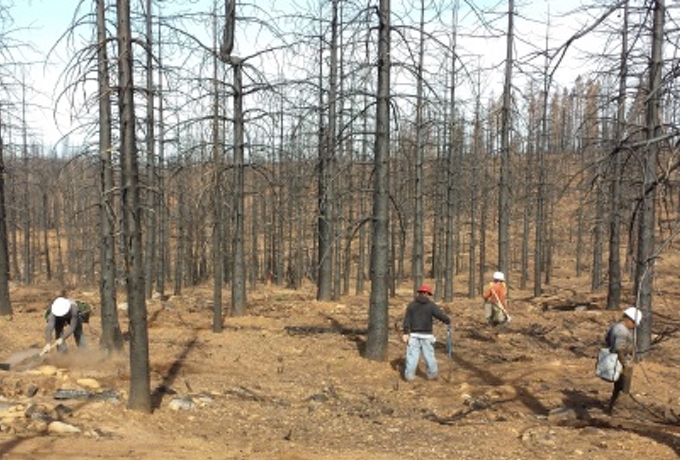
 Contractor crews from Sierra Nevada Forestry Service planting seedlings.  USFS photo by D. Walsh

Crews from Sierra Nevada Forestry Service planting seedlings. Photo/D. Walsh/USFS

Crews spent hours last week manually replanting 324 acres in Eldorado National Forest burned in the King Fire last fall.

The seedlings currently being planted will re-establish plantations in units that were previously planted after timber harvests in the early 1990s, as well as units planted after the 1986 Hale Fire, and other units that were planted as part of a soil study in 1992. These plantations all burned severely in the King Fire, leading to greater than 90 percent tree mortality. Replanting conifers during the first spring after a fire is advantageous because trees can get established before competing vegetation recaptures the site which increases the chances of seedling survival, according to U.S. Forest Service officials.

The young trees being planted are from a diverse stock of species native to the Sierra Nevada — ponderosa pine, sugar pine, and white fir.

The trees in the current plantation re-establishment project are being planted in low-density groups with wide spacing between the groups.

Up to 12,081 additional acres may be planted after the King Fire Restoration Environmental Impact Statement (EIS) is completed.  This hazard tree removal project will remove dead, dying, and other trees that present a hazardous condition to campgrounds damaged during the King Fire.


Drought may not hurt whitewater rafting season

By Tom Stienstra, San Francisco Chronicle

In the strange and continuing saga of California’s weather and water, the three best whitewater-rafting destinations — the South Fork American, Tuolumne and Middle Fork American — should have sensational conditions this summer in spite of the drought.

The rivers are not expected to be in crisis in spite of the record-low Sierra Nevada snowpack, 8 percent of the historical average and the lowest measured in 65 years of records.

The numbers show that Northern California’s winter was not so dry as it was warm. So warm that it rained more than snowed in the high country for most of the winter, although rainfall totals are still below average for most of the state.

Read the whole story