King Fire burn area to reopen Saturday

Sections of the Eldorado National Forest that have been off limits because of the King Fire will reopen April 25.

Roadside trees killed in the King Fire that were identified as an immediate threat to public safety have been felled. Further hazard tree assessment will be done as part of the ongoing King Fire Restoration effort.

There are still a few hot spots in the fire area. A recent flight over the fire area using infared technology for heat detection found 11 small spots remaining. Eight of these are in the Rubicon Canyon. Three others are near the fire perimeter. This is not unusual in a fire as large as the King Fire, and these hot spots are being monitored, according the Forest Service.

The public is reminded that permits are required for the collection of mushrooms, firewood and all other forest products. The District Offices at Georgetown and at Pacific will be open on Saturday to accommodate visitors who want to get permits or recreation information.


Controlled fire operations set for this week

Weather permitting, the U.S. Forest Service Lake Tahoe Basin Management Unit may continue prescribed fire operations starting April 20. Operations may take place in Blackwood Canyon between Tahoe City and Tahoma, at Ski Run Boulevard near Heavenly and on the East Shore near Logan Creek Drive. Operations may last through the next several weeks as conditions allow.

Each operation follows a prescribed fire burn plan, which considers temperature, humidity, wind, moisture of the vegetation, and conditions for the dispersal of smoke. This information is used to decide when and where to burn.

Smoke from prescribed fire operations is normal and may continue for several days after an ignition depending on the project size. Agencies coordinate with state and local county air pollution control districts and monitors weather conditions closely prior to prescribed fire ignition. They wait for favorable conditions that will carry smoke up and out of the Basin.

The Forest Service updates the local fire information line at 530.543.2600, No. 6.


USFS working on defensible space in neighborhoods

This spring, federal, state and local agency personnel will conduct defensible space inspections and provide recommendations on ways to create defensible space around homes to comply with defensible space regulations. While these regulations require residents to create defensible space on their own property, the defensible space zone often extends beyond the property line.

The Forest Service Homeowner Defensible Space and Fuels Reduction Stewardship programs allow homeowners adjacent to National Forest System lands the opportunity to work with the Forest Service to extend defensible space onto NFS lands in order to meet recommended clearance standards.

Homeowners may conduct low-impact defensible space clean up on any portion of NFS lands within 100 feet of their home. Specific guidelines are included in the Homeowner Defensible Space Agreement issued by the Forest Service or the local fire protection district responsible for conducting defensible space inspections. Defensible space treatments include removing pine needles and other forest debris, pruning trees and removing brush. Homeowners are required to follow Forest Service standards and guidelines to protect soil, prevent erosion and protect forest resources while working on NFS lands. The removal of standing trees is not allowed under this agreement. In most cases, the work is light and manageable, as Forest Service personnel already engage in large-scale fuels reduction on NFS lands. The free agreement can be implemented annually without being reissued.

When removal of trees or clearance beyond 100 feet is recommended, homeowners can clean up excessive fuels under a Fuels Reduction Stewardship permit. The Fuels Reduction Stewardship permit authorizes homeowners to remove excessive fuels beyond 100 feet of their home and with prior approval from the Forest Service, may allow homeowners to remove standing trees at the homeowner’s expense. If tree removal is recommended, Forest Service personnel will mark trees that need to be removed.

Prior to authorizing the work, a Forest Service employee will assess the adjoining NFS land, determine if homeowners qualify for the Fuels Reduction Stewardship Program, determine the scope of work, and answer any questions. A free permit will be issued authorizing the work to occur within a specified period. The permit expires at the end of the calendar year in which it was issued.

The benefits of implementing defensible space treatments on or adjacent to, private property include reducing the speed and intensity of a wildfire, improving forest health and providing increased protection to neighborhoods and communities. With drought comes increased fire risk, so it is crucial for communities to implement these strategies to better prevent the spread of a devastating wildfire.

For more information, or to set up a free consultation with Forest Service personnel, call 530.543.2759. Provide a detailed message including name, return phone number and address.


Why student athletes continue to fail

By Daniel Oppenheimer

Seventy-four college underclassmen have been declared eligible for the NFL’s upcoming draft, but Ohio State’s quarterback Cardale Jones won’t be among them. A few days after winning the national championship game in January, Jones shocked fans and football analysts by saying he wasn’t ready to go pro, that it was important for him to graduate from college first. What made the announcement all the more surprising, beyond the fact that Jones may never again be as desirable an NFL prospect as he is the year he won a national championship, was that his previous claim to fame was a notorious tweet posted two years ago in which he complained about the “college” part of being a college football player. He wrote that he’d gone to Ohio State to play football, not “to play school,” and that classes were pointless.

Jones now regrets and disavows that tweet. Earlier this month, he was tweeting that nothing is more important than education, under the hashtag “StudentBeforeAthlete.” It’s hard to know how sincere his attitude adjustment has been, or how sincere his initial dismissal of academics was. What is clear is that Jones and his conversion represent a messaging coup for his university and for the NCAA, which has maintained for decades that its primary goal is to help scholar-athletes receive an education that would prepare them for life beyond sports.

Despite the NCAA’s insistence that it is concerned about student athletes’ academic growth, it often feels as though “student” plays second fiddle to “athlete.” Indeed, on a typical day, a visitor to the NCAA homepage will be overwhelmed by the articles (and videos) about athletics but will not find a single article (or video) about the academic achievements of the athletes.

This also seems to hold true for many of the NCAA’s member schools. The University of North Carolina and Syracuse are just two of the most recent universities to be under the spotlight for academic scandals involving student athletes. UNC offered a “no show” class for student athletes (where students received grades for phantom classes that they didn’t attend), and Syracuse allowed academically ineligible athletes to compete. And while these cases are the ones currently grabbing headlines, they are hardly unique; the “Chronicles of Higher Education” is reporting that 20 additional schools are being investigated for academic fraud.

And what about the student athletes themselves?  Student-athletes tend to take easier classes and get lower grades than non-athletes. This is not only true for schools from power conferences in big-money sports, it has been observed in Division III liberal arts colleges and Ivy League schools, neither of which even offer athletic scholarships.

It’s tempting to believe that student athletes care only about their sport, and not about their schoolwork, as many popular commentators have suggested – and as Ohio State’s Jones once tweeted — except that in the dozen years that I’ve been teaching in university settings, that hasn’t been my experience at all.  I’ve taught hundreds of Division 1 student athletes at several different schools, and they have been among the hardest working students I’ve encountered.  The student athletes I’ve worked with have viewed their sport as a complement to, not a replacement for, their studies.

My observations were hardly unique. One of my students, Josh Levine, ran a youth hockey clinic and was upset by the widespread perception that the students he worked with did not care about school.  After several conversations about the issue, we decided that the only way to find out the truth was to run a study.  And so we did, surveying 147 student athletes (including some still in high school) involved in various team sports from football and basketball to lacrosse and golf about how much both they and their teammates cared about sports and academics.”

Here’s what we found: When student athletes were asked how much they care about athletics, they rated their interest a healthy 8.5 on average, on a scale of 1 to 10. But when asked the value they place on academics, the result was higher than 9 on average. If anything, the average student athlete cares more about his studies than his sport. #StudentBeforeAthlete indeed.

So why do they underperform in their classes?

One possible and intriguing reason suggested by our study is that student athletes don’t think their teammates take academics as seriously as they do. When asked to assess how much their teammates cared about athletics, the athletes were close, guessing 8.8. However, when asked to evaluate how much their teammates cared about academics, those same athletes guessed only 7.8 – far below the 9+ average.

Why is this important?  Because when an athlete thinks that the rest of the team doesn’t care about academics, that athlete tries to fit in by pretending not to care either. In a perverse form of peer pressure, Cardale Jones’s tweet about classes being worthless may be what student athletes tell each other in an effort to fit in, based on the mistaken belief that if they care about academics, they are in an uncool minority.

All of this creates a distressing and self-perpetuating cycle. Tight-knit student athletes will seek ways of fitting into a culture that they perceive as neglecting academics (by defaulting into majors of dubious merit and spending less time doing homework), knowing that their habits are observed by teammates. When their teammates observe those habits, it reaffirms the (false) conviction that caring about academics is an unfortunate aberration, best suppressed.

One of my co-authors on this project, Sara Etchison, has described this process particularly well: “There are student athletes who want to excel in the classroom, but think their teammates would judge them for it, so they study a little less, or take an easier major. And it turns out, that’s how virtually everyone on the team feels, but there’s never an opportunity to realize, ‘Oh wait, all of us really care about what’s happening on the academic side.’”

This is a phenomenon that psychologists call “pluralistic ignorance” – when private preferences differ from perceptions of group norms. It leads people to engage in public behaviors that align more with the perceived norms than with their true preferences. The tragedy is that the norms are false – in reality, everybody would be happier if they just behaved in line with their true preferences.

Pluralistic ignorance has also been shown to underlie the phenomenon of binge drinking on campuses. A study conducted at Princeton University revealed that a majority of students who drink excessively did so not because they wanted to, but because they felt that was what their friends wanted to do. Once they all had a more accurate assessment of what the group norm was, the amount of alcohol consumed declined.

This suggests that helping student athletes do better in the classroom may be as simple as letting them know that their teammates care as much about academics as they do. Many of them care deeply about the education they are receiving, and should care, because financial success in professional sports will elude the vast majority of them.

As the NCAA and the media focus more attention on athletes’ academic performance, one of the best ways to improve the education of student athletes is to give them license to pursue their academic goals by making it clear that their teammates, and society as a whole, support them in their academic endeavors. For this to happen, we will need many more stars like Cardale Jones speaking out about the importance of education, instead of tweeting about the pointlessness of going to class.

Daniel Oppenheimer is a professor of psychology and marketing at the Anderson School of Management at UCLA.  He is the author of over 30 peer-reviewed journals, and several books, including Democracy Despite Itself: Why a System that Shouldn’t Work at All Works so Well.  In addition to numerous awards for his teaching and research, he won the 2006 Ig Nobel science humor award. He wrote this for Zocalo Public Square.


Trout season about to open in California

The general trout opener in many counties throughout California begins April 25 one hour before sunrise.

Because of the popularity of this annual event with the angling public, the California Department of Fish and Wildlife is making every effort to stock trout in all accessible waters approved for planting prior to the season opener. Lingering winter conditions and this year’s unprecedented drought could play a major role in determining how many rivers, creeks, lakes and reservoirs can be stocked before April 25.

Most lakes, rivers and streams have a limit of five trout per day and 10 in possession. However, regulations differ on season opening and closing dates, bag limits, minimum and maximum size limits, and gear restrictions.

Anglers are advised to check specific area regulations and opening dates in the 2015-16 California Freshwater Sport Fishing Regulation booklet online.

Anyone16 and older must possess a valid California fishing license to fish within state lines. Freshwater fishing licenses may be purchased online.


Amgen bike race to impact vehicle travel

Motorists can expect delays May 8-9 when riders in the Amgen Tour of California make their way around Lake Tahoe.

Cyclists will start and finish at Heavenly Mountain Resort. Partial road closures and delays will affect drivers from approximately 11 a.m. through noon.

Fourteen of the top women’s cycling teams from around the world will take part in the Amgen Tour of California Women’s Race Title, which takes place in three stages. The Lake Tahoe Road Race is the first stage. Stage 2 will take place in and around Heavenly, and the third in Sacramento.

Cyclists will travel clockwise around Lake Tahoe May 8, entering Tahoma at approximately 12:01pm. They are expected to reach Tahoe City at 12:23; Kings Beach at 12:45; crossing through Stateline in Crystal Bay at 12:50; Highway 28 at 1:04; and Highway 50 at 1:29pm.

Travelers should expect 20-minute delays along the course.


California wildlife officials setting up checkpoint

California Department of Fish and Wildlife offiicials will be conducting a wildlife checkpoint operation in the Eastern Sierra in late April to promote safety, education and compliance with laws and regulations.

CDFW wildlife officers will be conducting the inspection on westbound Highway 108, north of Bridgeport, on April 27 from 8am-4pm, weather permitting.

The wildlife checkpoint is being conducted to protect and conserve fish and wildlife, and to encourage safety and sportsmanship by promoting voluntary compliance with laws, rules and regulations through education, preventative patrol and enforcement.

All anglers and hunters will be required to stop and submit to an inspection. CDFW officers will also be providing informative literature about the invasive quagga mussel and New Zealand mudsnail.


Drought ‘devastating’ for Tahoe ski industry

By Kathryn Reed

Adapting to change is the only way ski resorts are going to survive.

That was the message John Rice, general manager of Sierra-at-Tahoe, delivered to more than 40 people on Wednesday afternoon at Lake Tahoe Community College.

He refused to engage in the debate of why things are changing, but he said there is no denying things are changing.

Sierra averages 480 inches of snow a season. It received 140 inches this season – a record. The resort near Echo Summit was open for 94 days. Another record. It closed March 16 – the earliest on record. These aren’t the kinds of records any resort wants.

Sierra had 1,200 people from Intel booked in March. The resort had to cancel because of conditions.

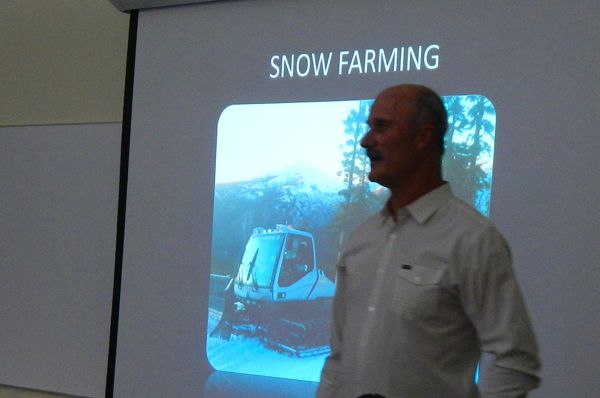
John Rice with Sierra-at-Tahoe on April 15 talks about the impact of drought on ski resorts. Photo/LTN

John Rice with Sierra-at-Tahoe on April 15 talks about the impact of drought on ski resorts. Photo/LTN

Rice said the drought is having a “devastating” affect on the industry. Less money being generated means fewer people to hire, which ultimately affects so many businesses in town.

It used to be people would book ski trips months, even years in advance. Now it’s more spontaneous. With weather data at people’s fingertips and more accurate ski reports from resorts, the guesswork has been eliminated. People can go to where the snow is or stay away from the sparsely covered slopes.

For the resorts without snow this is not a good thing for the bottom line. And with the greater Lake Tahoe area suffering from its fourth winter of lousy conditions, Rice said, all resorts are dealing with a slump in season pass sales and group sales. Skiers aren’t willing to take a gamble on Tahoe right now even though in winter 2010-11 Sierra had 869 inches of snow.

Snow totals at Donner Summit have been kept since the late 1800s. Multi-winter low snow years are not unusual, Rice pointed out. But there is no crystal ball to know when Mother Nature will change her ways.

To cope with dry cycles resorts are going to have to be creative with what they offer. Sierra was bringing in people to its 30,000-square-foot plaza with music and events. People who often avoid Tahoe in the winter because of the roads could come experience snow. It’s about providing an experience they can’t get at home.

Sitting by a fire pit surrounded by pine trees, roasting s’mores, wine tasting, tubing, ice skating are all things various Tahoe resorts offer. It’s not just about the skiing and snowboarding.

A resort in Vermont has an indoor water park. Camp Woodward, the nearest being at Boreal, is extreme sports indoors.

While many resorts boast about their snowmaking capabilities, Sierra can only cover 4 percent of its slopes with man-made snow. Industry numbers are that between 17 and 25 percent of the water used for snowmaking is lost, the rest returns to the aquifer.

Sierra is more known for snow farming – taking the white stuff off parking lots and areas of the mountain and repurposing it on skiable terrain. Last winter an employee used a 5-gallon bucket from home and a resort shovel to start filling in bare spots.

Rice praised his initiative that turned into a 100-person bucket brigade. It was about employees trying to be resourceful, stay employed and doing their part.

Summer grooming helps Sierra open with a decent layer of snow. Take a look at a run like Lower Main. It’s pretty smooth. Without boulders and uneven terrain, it means it will be covered faster and sooner than some other runs.

Places like Northstar and Heavenly are turning to active summer activities like ropes courses and mountain biking. Rice said without a closer bed base Sierra does not see this as a viable option. It will, though, be expanding into the wedding business in the summer.

Resorts are also putting together season pass programs that involve multiple resorts. This is good when the home resort’s conditions are sketchy. While it means free skiing, the resorts benefit because people buy food, souvenirs and may extend their stay. Plus, people see this as added value.

—–

Notes:

• The next Tahoe Talks Brown Bag lunch is May 20, noon-1:30pm in LTCC’s board room. It will be a panel discussion about cycling’s impact on Tahoe’s economy


Ceremony at Truckee baseball field to honor former player, coach

By Jim Krajewski, Reno Gazette-Journal

Truckee will honor two former members of the baseball team with an appreciation ceremony on Saturday at the baseball field.

Former coach Mike Ellis, who died April 5, 2014, and former player Andrew Metlenko, who was killed in a car accident in spring of 2013, will both have plaques dedicated to their memories at the ceremony.

Truckee principal John Carlson said the ceremony will be held between games of a doubleheader against Lowry starting at 11am Saturday.

Read the whole story


Firewood permits available from USFS

The U.S. Forest Service Lake Tahoe Basin Management Unit will begin the sale of fuelwood permits at the Forest Supervisor’s office at 35 College Drive in South Lake Tahoe today.

Although weather conditions allow for the early sale of permits, areas to obtain fuelwood will be limited because not all gates and roads are open. As gates and roads open, more areas will become accessible.

The public should purchase permits and collect wood early as fire restrictions are likely to go into effect early and there may be days when no cutting is allowed.

The Forest Service North Shore office will begin selling permits in May.

Permits cost $20 per cord, with a two-cord minimum purchase and a limit of 10 cords per household. Permits have specific conditions and complete information is provided when the permit is issued. Maps to designated cutting areas are provided and must be in the permit holder’s possession along with the valid permit.

The permit is for collection of “down-dead” wood up to a 30-inch maximum diameter in designated fuelwood areas within the Lake Tahoe Basin. “Down-dead” means the tree is down on the ground and dead, rather than dead and standing. Cutting any standing tree, whether dead or green, is not allowed.

No off-road travel is allowed and permit holders must comply with all permit conditions.