Aquatic mammals thrive at Lake Tahoe

By Kathryn Reed      

When you go swimming in Lake Tahoe you aren’t alone. Besides the fish that call this body of water home, so do a handful of aquatic mammals.

Many of these critters are elusive and seldom seen. The work of some, like the beaver, is more apt to be visible than the actual animal.

Will Richardson, co-founder of the Tahoe Institute for Natural Science, gave a talk last week about the various  aquatic mammals that call Tahoe home. More than 40 people attended the Friends of the Library lecture.

The criteria he used for aquatic mammal was a “significant portion of their body is in contact with water most of their day.”

Minks are what Richardson called a “semi-aquatic.” They are native to Lake Tahoe, are about 2-feet long and weight 2 to 3 pounds.

“To swim they kind of undulate. They have a long, flexible spine,” Richardson said.

The problem is mink look a lot like river otter so people often confuse the two. The otter have a broader, flatter head than mink. Outside the family unit, mink are solitary, while otter are social. Both are part of the weasel family.
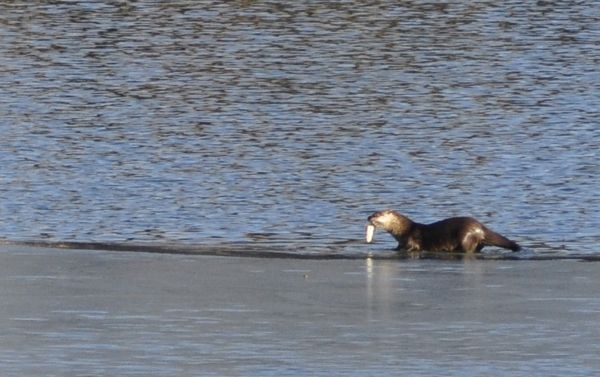
A river otter in January  finds plenty to dine on at Lake Tahoe. Photos/Bob Sweatt

A river otter in January finds plenty to dine on at Lake Tahoe. Photo/Bob Sweatt

River otter were in the basin in abundance prior to 1950. Then they were not seen from about 1950 to 2000. Richardson said scientists don’t know where they went or why.

Otters tend to be about 3½-feet long, with a tail that is 18-inches long.

They have been seen near the Tahoe Keys, Taylor Creek and Fallen Leaf Lake.

Water shrews are rodents that are semi-aquatic.

They eat close to their body weight every day.

“They are incredibly buoyant. They are so buoyant they can run on water,” Richardson said.

Because they are nocturnal, secretive, shy and nervous, they are seldom seen.

Mountain beavers are not actually beavers. They make burrows instead of dams. They were the least aquatic of the animals Richardson spoke about. However, they always need to have their feet wet, he said.

Their closest relative is a squirrel, they have opposable thumbs, and the only place they are found in Nevada is at Lake Tahoe.
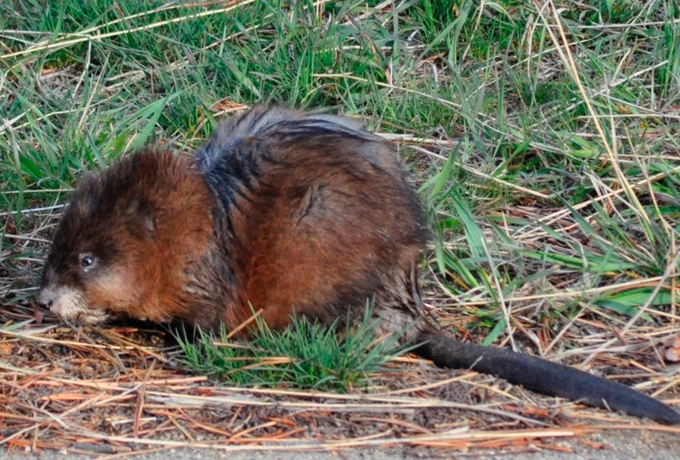
A muskrat in the Tahoe Keys in South Lake Tahoe.  Photo/Bob Sweatt

A muskrat in South Lake Tahoe. Photo/Bob Sweatt

Muskrats are about 2-feet long and weigh approximately 4½ pounds. They close their ears when they swim and they have partially webbed feet.

Stories of beavers being trapped at Tahoe go back to at least 1785.

“The beaver was trapped out of the Sierra by the mid-19th century.

To help with wetland restoration and erosion control nine beavers from Idaho were released into the Truckee River watershed between 1934-45, according to Richardson. It is descendants of those beavers that can been seen today in the Tahoe basin.

Their teeth never stop growing.

Richardson said beavers can be great for the environment, but they create problems and conflicts with people.



Thinning project designed to reduce wildfires

The Nature Conservancy, federal, state and local agencies, as well as a private landowner are collaborating on a forest restoration project designed to reduce the risk of catastrophic fires, protect onsite and neighboring structures, protect water supplies for people and enhance wildlife habitat near Carson City.

The restoration work will include thinning trees on at least 800 acres in the upper Clear Creek watershed.

“By thinning the trees in this area, there will be more plant and wildlife diversity and fire behavior will change dramatically,” says Ryan Shane, Nevada Division of Forestry’s community protection program coordinator, said in a statement. “For example, flames can reach up to eight feet high and climb into the tree crowns, making an uncontrollable crown fire in an overgrown forest, versus a reaching only a foot high in an area that has been thinned properly.”


Sierra Club hosting hikes

The Tahoe Area Sierra Club is guiding two hikes.

The first one is on May 13 to Dardanelles Lake. It is approximately 7 miles round-trip and starts at the Big Meadows trailhead on Highway 89. Start time is 9am. Space is limited. Please RSVP to tahoehikers@gmail.com.

The next hike is on June 5 and is to Showers Lake. It is a 10 mile round-trip. It will be begin at 9am at the trailhead on Carson Pass. Space is limited. RSVP to tahoehikers@gmail.com.


High Fives helps Tahoe photographer recover

The High Fives Foundation is awarding Jason Abraham, 35, an empowerment grant to help aid in his recovery from a life-altering injury he sustained while skiing in the Palisades at Squaw Valley in April.

The injury happened when Abraham fell while skiing in Main Chute. The impact broke his neck and resulted in a subluxation of his C5/C6 vertebrae, causing temporary paralysis from the shoulders down. He is undergoing intensive rehab at Craig Hospital in Englewood, Colo.

Abraham is a professional photographer in the Tahoe area and has photographed High Fives athletes in the past.

Abraham’s recovery goals are to return to enjoying Tahoe with his wife and 3-year-old son.

Since the High Fives Foundation’s January 2009 inception, the empowerment program service has assisted 79 athletes from 20 states in nine respective funding categories which include: living expenses, insurance, travel, health, healing network, adaptive equipment, winter equipment, programs and “stoke” (positive energy, outlook and attitude).


WHS baseball team headed for state tourney

Whittell High School’s baseball team will be traveling to Las Vegas this week in a quest to become state champions.

The Whittell softball and South Tahoe High School baseball teams did not make it past the Northern League Softball Tournament this weekend.

Seeded second in the tournament, the Warriors will face Pahranagat Valley on May 14. Win or lose, they play a second game the following day. The championship game for Division IV is May 16.

WHS finished the regular season with a 22-5 record. The last time the Warriors were in contention for the state title was 2011 when the school was in Division IIA.

The softball team traveled to Wells over the weekend to determine whom from Northern Nevada would be vying for the state championship. The Warriors lost to Eureka 11-1 and then to Coleville 10-8.

The STHS Vikings lost the first round of the Northern League postseason play to Elko 6-5, then beat Spring Creek 10-9. On May 9 it was a rematch with Elko, with the same outcome, a 9-4 loss.

— Lake Tahoe News staff report


Worrack wins women’s Tour of California

The overall race leader changed three times Sunday, with Velocio-SRAM’s Trixi Worrack’s winning the inaugural three-day, three-stage Amgen Tour of California women’s race.

Sixty-five cyclists battled in Sacramento in a 17 lap all-out race totaling 34 miles.

Amgen 2015:

Trixi Worrack

Worrack, the 2013 German National Road Race Champion who placed third Saturday in South Lake Tahoe, swept the first three of four sprints. This put her at a 6-second advantage leading to the final laps. She finished the three days with a time of 6:24.16.

“It was such a really nice race, especially with the organization,” Worrack said in statement. “It was a really nice [Amgen] Tour of California. The first two stages were really hard for us because it was at altitude and today was a crit, also really hard. But with lots of spectators, it was really good.”

Optum’s Leah Kirchmann was second (6:24:21), and also claimed the stage for the second day in a row as well as the Visit California Sprint Jersey.

Kirchmann said, “It really means a lot for women’s cycling that the organizers have stepped it up and held an internationally sanctioned race with such a quality field. The venues were spectacular this week. The crowds were enthusiastic and big every day. And I just can’t wait to return to this race next year. It’s been awesome.”

Twenty16’s Lauren Komanski, the only rider of the top three overall to podium every day, earned third place overall – 6:24:22.

Katie Hall with UHC, the race leader after riding around Lake Tahoe on Friday, finished in fourth place.

— Lake Tahoe News staff report


Study: Stressing the mind helps train the body

By Bradley Stulberg, Outside

In an until-recently classified report funded by the UK’s Ministry of Defence, researchers revealed something remarkable: you can reap enormous performance gains by altering your perception of effort—and anyone can do it.

Historically, scientists and athletes have thought of the stress that leads to fitness gains as being physical—training longer, running faster, or jumping higher. In recent years, researchers have begun to explore the mental component of training—how visualization can improve performance. But until now, few researchers have examined how mental stress can lead to training adaptations similar to physical stress.

In the MOD study, thirty-five soldiers trained three times a week on stationary bikes for the experiment, riding each time for the same duration and intensity relative to their own baseline fitness. In addition to the physical effort, half of the soldiers were also asked to engage in a mentally demanding task—watching combinations of letters appear on a computer screen and clicking only when certain combinations appear—while they pedaled.

Read the whole story


Reclaiming federal land has strong allure in West

By Nigel Duara, Los Angeles Times

American Lands Council promises cash-strapped Western communities a chance to win back federal acreage
Utah has passed legislation demanding return of all federal land; experts say it will never happen
Proponent sums up Western land transfer movement: ‘It’s the principle’
Spread over 6,500 miles of sparse scrub and alkaline soil, Millard County is one of Utah’s poorest. But for five years, the cash-strapped county so remote it was the site of a Japanese American internment camp in World War II still found $1,000 to send to the American Lands Council.

The Lands Council’s goal is grand but simple: to wrest control of vast swaths of land from the federal government and turn them over to the states.

At stake are hundreds of millions of dollars, even billions, that could be made off land administered by the federal government. The big-dollar opportunities include oil leases in Utah grassland, all-terrain vehicle tourism in Arizona and rare-earth mineral mining in Nevada.

Read the whole story


Fatter tires faster than skinny and pumped

By Blair Anthony Robertson, Sacramento Bee

If you’re one of the 50,000 spectators expected to turn out for the Amgen Tour of California’s Sacramento stage on Sunday, you’ll notice that pro road racing amounts to very lean athletes riding bikes with very skinny tires.

But those tires are not as skinny as they used to be.

It turns out that fatter is faster.

While that may seem counterintuitive, a tire that’s slightly wider than the industry standard of 23 millimeters experiences less rolling resistance. Tests have proved it and pros, who make their living by being efficient and going fast, have inspired a trend in recent years that’s just now trickling down to amateur cycling enthusiasts.


South Shore tennis club to kick off season

Zephyr Cove Tennis Club kicks off its season May 23 at noon with the second annual Viva La Tennis mixer.

The doubles tennis event is for current, new and perspective players of all levels. The kickoff party is free for 2015 club members, $10 for others. It includes a barbecue and lots of tennis.

Membership is $80 per year. Anyone paying membership dues that day will have the event fee waived.

Participants are encouraged to bring a side dish or dessert, as well as beverage of choice that does not come in a glass container.

Zephyr Cove Tennis Club Foundation, the nonprofit formed last year to operate the six courts at Zephyr Cove Park, is sponsoring the event. For those who cannot make the event, membership information is available online.

For more information, email zctennisclub@gmail.com.

Zephyr Cove Tennis Club is on Warrior Way off Highway 50 in Zephyr Cove.