CalFire instituting residential burn ban

CalFire has suspended all burn permits for outdoor open residential burning within the State Responsibility Area of Amador, El Dorado, Sacramento and Alpine counties.

This suspension takes effect 8am June 22. It bans all residential outdoor burning of landscape debris including branches and leaves.

Similar to last year, CalFire has already responded to significantly more wildfires than in an average. CalFire is asking residents to ensure that they are prepared for wildfires including maintaining a minimum of 100 feet of defensible space around every home.

Here are some tips to help prepare your home and property:

  • Clear all dead or dying vegetation 100 feet around all structures.
  • Landscape with fire resistant/drought tolerant plants.
  • Find alternative ways to dispose of landscape debris like chipping or  hauling it to a biomass energy facility.


USFS thinning trees off of Hwy. 267

Thinning of trees for fuels reduction and forest health has resumed on approximately 340 acres of National Forest System lands on the east side of Highway 267 north of Speckled Avenue above Kings Beach.

The Forest Service will close the area from 7am-6pm daily through Oct. 15 for public safety due to heavy equipment operations and falling trees. The closure notice and map will be posted in the project area along with signs to indicate the location of thinning operations. Hazards may be present even when operations have ended for the day and the closure is not in effect. Individuals disregarding the closure order may be cited, with subsequent fines and jail time.

The forest thinning is part of the Carnelian Hazardous Fuels Reduction and Healthy Forest Restoration Project, which will treat approximately 3,300 acres on North Shore of Lake Tahoe to reduce the risk of severe wildfire, improve forest health, and provide defensible space to neighboring communities.


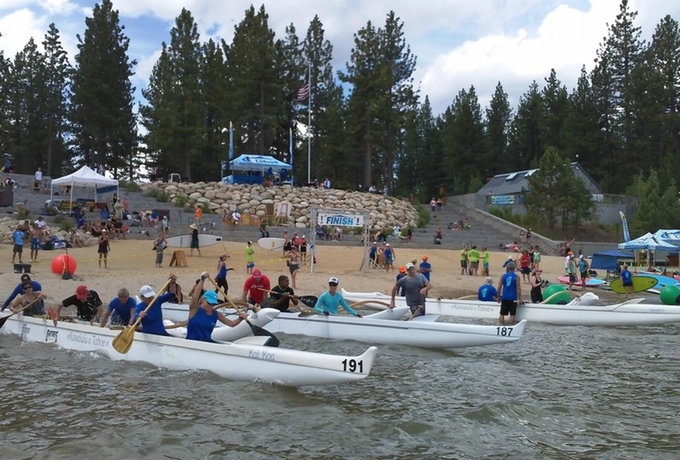
Outrigger races coming to South Lake Tahoe

Racers prepare for the 2014 Waterman’s Challenge. Photo/Provided

Racers prepare for the 2014 Waterman’s Challenge. Photo/Provided

The second annual International Lake Tahoe Outrigger Challenge is July 18-19. The races will start and end at El Dorado Beach in South Lake Tahoe.

That Saturday will feature the keiki (juniors) 4-mile race, the novice 6-mile race and the women’s, coed and men’s 10-mile races.

It is considered a spectator-friendly venue.

The Waterman’s Challenge is Sunday. It is a test of strategy and skills in a three-leg relay with six-person teams competing on stand up paddleboards and OC-6 canoes. This event will take place entirely in front of El Dorado Beach.

Kawai’ulu ‘O Tahoe Outrigger Canoe Club is a nonprofit promoting Polynesian culture, physical fitness and community service through outrigger canoe paddling.

For a complete race event schedule, race course maps, or more information about the club, go online.


Signups being taken for S. Tahoe swim program

Tahoe Swim Club’s three-month developmental program starts June 22 at 6pm at the South Lake Tahoe Recreation Center Pool.

This developmental program is dedicated to teaching swimmers valuable life skills, exercise and competition. Swimmers should be able to swim one lap of the pool.

Cost is $295, which includes USA Swimming Registration and insurance.

The program is Monday through Thursday. For more information, contact Coach Jerry at 530.541.1046 or come to the pool Monday through Thursday 4:30-6:30pm.


TRT Challenge looking for participants

There is still time to sign up for the Tahoe Rim Trail Challenge. Outdoor and trail enthusiasts of all levels may participate.

Now in its third year, the challenge is for novice and seasoned hikers, mountain bikers and equestrians. Each participant has until Dec. 31 to complete the six challenge sites. Progress may be tracked via the TRTA’s website.

By joining people receive the tools needed to successfully complete the challenge including: Special web access to download six maps and trail descriptions, driving directions to each trailhead, a TRT challenge tech T-shirt, a one-year membership to the Tahoe Rim Trail Association, invitation to special hikes and giveaways, as well as, an online tracking system to log the challenge and share pictures.


The cost is $55 for individuals and $85 for families.

For more info or to enroll, go online.


Bike Challenge to close with big celebration

The end of the 2015 Tahoe Bike Challenge will be celebrated June 20 from noon-4pm at Heavenly Village.

There will be a variety of bicycle-themed activities for the whole family: bike swap, kid zone (bike rodeo, turtle race, bike jeopardy), mini-yoga sessions, bike parade, photo booth, flat tire changing contest, raffle prizes, and bike tune-up booth.

The Cycle Celebration will highlight winners of the 2015 Tahoe Bike Challenge, as well as feature the presentation of the 2014 Lake Tahoe Bicycle Coalition Achievement Awards. This year’s winners are:

  • Karen and Peter Fink for their personal and professional commitment to improving bicycling in Tahoe;
  • Truckee for the passing Measure R: Local Funding for Trails and Bikeways.


South Tahoe offering variety of youth camps

South Lake Tahoe Recreation Department is offering a South Tahoe Adventure Camp for area youth.

The camps are now through Aug. 21, Monday-Friday from 8:30am to 5:30pm

The goal is to provide an active, healthy, and safe environment for youth to learn and play. The emphasis is on inspiring a love for the outdoors through exposure to the natural playground in and around the Tahoe region.

The cost of the STAR Youth Camp is $35/day or $150/week.  These are for grades K-5.There is an additional cost for some trips at no more than $10 per child. A 10 percent discount is offered for multiple children registered from the same family. Pre-registration is highly recommended for one day, multiple days, or five full days. Drop-in’s are welcome and based on availability.

The STAR Teen Camp is designed for ages 12-16. The Tahoe Rim Trail Association is offering an introduction to backpacking course. Each camp includes two days and one night in the backcountry for $150 per camper, including backpacking equipment and food. The trip dates are July 9-10 and Aug. 6-7. Preregistration is required and space is limited to the first 12 campers.

For more information, go online.


Tahoe Tennis Academy moves to Zephyr Cove

Former South Tahoe High School tennis coach Justin Clark is moving his Tahoe Tennis Academy to Zephyr Cove Tennis Club this summer.

The program is for ages 5-14. All abilities are welcome.

Clark has been running the 18-year-old Tahoe Tennis Academy since 2004 when he took it over from founder Pat Fagen.

The Tahoe Tennis Academy is six weeks from June 29-Aug. 12. It is possible to sign up for the entire program or one week at a time. Full tuition for ages 7-14 is $375, which includes 4½ hours of instruction per week for six weeks, a T-shirt and junior racket. Cost for ages 5-6 is $275, with three hours of tennis per week, a shirt and racket.

Weekly play is $75 for ages 7-14 and $55 for ages 5-6.

The Slammer Program is for ages 5-6. It is from 4-5pm on Monday-Tuesday-Wednesday. The Challenger Program has two levels for the older kids – 2-3:30pm and 3:30-5pm, Monday-Tuesday-Wednesday. It is possible for youngsters to participate in both groups.

Space is limited. More information and the registration form are available online.


5 foolproof strength exercises

By Michael Beck, Outside

You’re in a slump, reading these words hunched over a keyboard or your smartphone. It’s habit that’s throwing your body out of whack and resulting in a musculoskeletal system that’s about as architecturally sound as that 1950s-era Springbar tent gramps left you.

“Our bodies adapt to the positions we put them in the most,” says James Wilson, owner of MTB Strength Training Systems. “When you sit hunched over a desk all day a lot of areas become tight, off kilter, and weak.”

If you’re the kind of athlete who supplements outdoor sports with strength work in the gym, performing some of the most popular and oft-prescribed exercises—like barbell back squats, conventional deadlifts, and military presses—can set you up for injury. “Classic barbell exercises are great if you can do them right,” says Ben Bruno, C.S.C.S., a Los Angeles-based trainer. “But they’re the most commonly butchered because they’re highly technical and require a lot of mobility.”

Read the whole story


Drought increases need for forest thinning

By Susie Kocher

Lake Tahoe’s forests are beloved by many for their beauty. Yet they are vulnerable. Tahoe forests, like those throughout the Sierra Nevada, have lost much of their resilience due to overcrowding caused by a century of fire suppression.

The number of large trees in the Sierra Nevada has decreased by half while small trees have doubled since the 1930s. There are nine times as many dead standing trees and three times as many logs on the ground than in 1929. And, the dead wood in the forest today is smaller and more flammable. As a result, the percentage of forests burning at high severity — where most mature trees are killed — has increased dramatically, from roughly 5 to 10 percent a century ago, to more tha 40 percent in the 2013 Rim Fire and the 2014 King Fire.

Conditions are exceptional this year as we enter our fourth year of drought. The wildfire forecast is bleak. And we are currently experiencing a die off of trees in the Sierra. In April, the U.S. Forest Service conducted aerial surveys of over 4 million acres of forest in the southern Sierra (from Sonora south) and found that 20 percent was covered with trees killed by insects, totaling over 10 million dead trees.

Mortality was especially severe in pines at lower elevations in the foothills. Surveyors found 5 million dead trees on the Sierra and Sequoia national forests. Conifer mortality was much less at higher elevations though surveyors said it was too early in the season to be certain.

The insects killing trees in the Sierra are all native insects that are multiplying because of drought conditions. Native insects are a necessary part of the forest ecosystem that speed decay of wood, prey on other insects, and provide food for wildlife. They are normally present at low levels and cause tree mortality only in localized areas.

However, drought weakens trees and reduces their ability to withstand insect attacks. Normally trees use pitch to repel beetles trying to burrow through the bark. Weakened trees cannot produce the pitch needed to repel beetles, which allows beetles to tunnel in and lay eggs that turn into larvae that feed on the inner bark. Attacking beetles release chemicals called pheromones that attract other beetles until a mass attack kills the tree.

In the Tahoe basin, there are three predominant trees, white and red fir, which are vulnerable to the Scolytus beetle and Jeffrey pine which is vulnerable to the Jeffrey pine beetle. These beetles typically take a year to reproduce but two generations may be produced in warm years without much of a winter. Once a tree is killed, emerging beetles tend to attack the next closest green trees, causing group kills that enlarge every year until the epidemic collapses. This is what happened in the Tahoe basin during the multi-year drought of the early 1990s when many Jeffrey pine were killed.

Since spring arrives later in Tahoe and the drought is generally not as severe here, we don’t yet know whether local forests will experience the bark beetle outbreaks occurring south of here and at lower elevation. However, an upswing in beetle activity has been noted by area foresters, particularly in larger trees growing in higher densities.

The best way to protect forests from wildfire and insects is to thin them out. Widely spaced trees are healthier and less susceptible to bark beetles since they face less competition for moisture, light, and nutrients compared to densely growing and overcrowded trees. Thinning forests and reducing surface fuels is also the best way to reduce the impacts of wildfires and increase the chances the fire can be suppressed before getting out of control.

Government agencies and fire protection districts within the Lake Tahoe region have been working together to reduce fire hazards and improve forest health in the basin for many years. Thinning to remove overcrowded trees and surface fuels has been done on 36,890 acres of public forests since 2008.

Fire and forest management agencies goals this year include thinning of 3,765 acres, about half by hand with tools and the other half with heavy equipment. Prescribed burning is planned on about 4,900 acres — about 85 percent of that is burning piles of dead wood from previous thinning activities. Chipping to reduce fire risk is planned on 1,175 parcels. Almost 6,000 defensible space inspections of private property are planned.

In addition, the U.S. Forest Service is responding to current insect outbreaks at Tahoe. They removed several very large Jeffrey pines in the Kiva beach area this spring that were successfully attacked and killed by Jeffrey pine beetles last year. Foresters plan to conduct a survey of all developed recreation sites this fall to identify trees killed this summer for removal over the winter.

Lake Tahoe is celebrating Wildfire Awareness Month in June.  Keeping Tahoe forests healthy by thinning and removing beetle infested trees is one key way to prepare for wildfire and improve the odds that Tahoe communities will survive the next wildfire.

Susie Kocher works for the University of California Cooperative Extension.