Tips to keep wildlife on the outside of a home

By Carol Singleton

Have you ever woken to the sound of a scampering animal in the ceiling above your bed or been startled by a strange scratching noise in your walls? If so, you understand the frustration of having wildlife take up residence in your home. Skunks, squirrels and raccoons are among the common culprits that end up inside people’s homes and businesses. These unwanted visitors can cause extensive property damage and transmit diseases to people and pets.

The key to keeping wild animals out of your home and off your property is to make your home an unwelcome place for wildlife. Start by walking around your home looking for any holes where wildlife may enter or spaces where they may nest. Even the tiniest holes should be fixed, as bats, mice and other small animals can squeeze through cracks as small as one-quarter inch.

Before you begin boarding up areas around your home, make sure that there are no animals or active nests inside. Other wildlife-proofing steps include:

  • Block any access points around your home and outbuildings where wildlife may enter.
  • Block access under stairways and decks and fill any holes around your foundation.
  • Fix tears in window screens and vents and cover any openings under your eaves.
  • Install a chimney cap.
  • Trim trees a minimum of 4 feet from your roof to avoid jumping animals.
  • Remove woodpiles, debris and low-growing, dense plants such as ivy that provide potential habitat for wildlife.
  • Never leave pet food or water outside.
  • Clean up fallen fruit and bird seed and tightly cover compost piles.
  • Keep barbecue grills clean and never leave food or trash out in the yard.
  • Make sure that garbage cans and recycling bins are secured.

It is unlawful to disturb the nests of songbirds as well as threatened and endangered species, so proceed with caution when you find a nest or burrow. CDFW also discourages the use of poison baits (rodenticide) to control rats, mice and other rodents as this can result in secondary poisoning to pets and other non-target wildlife such as owls, hawks and bobcats. Animals that eat dead or dying rodents that have consumed these baits will also be poisoned.

If you choose to trap nuisance wildlife, it is important to know the rules. You must release the animal immediately or kill it in a humane manner. You may wish to hire a pest control specialist to do this for you. According to the Fish and Game Code, it is illegal to relocate wildlife without a permit to do so.

People often think the most humane thing to do is to release the animal in a nearby park or woods, but this simply moves the problem to someone else’s backyard. Also, relocating wildlife can lead to the spread of disease, cause conflicts with other wildlife and may result in injury to the person transporting the animal.

Carol Singleton works for California Department of Fish and Wildlife.


Torrential rains possible in Tahoe on July 4

Updated 11:18pm:

Fireworks set up on the South Shore have temporarily halted as the thunderstorm rolls through. Workers are sheltering in place and making sure the fireworks do not get wet, as well ensure they are not discharged by the lightning charges.

—-

The Lake Tahoe Basin and Alpine County, including the Washington Fire area, are under a flood watch today from 11am-8pm.

“Unstable conditions will allow showers and thunderstorms to develop this morning and continue through the evening hours,” according to the National Weather Service in Reno. “A few strong thunderstorms may develop and produce torrential rainfall. Those heading outdoors today should have a plan to quickly return to a sheltered location.”

Streams, dry washes and the Washington Fire are at risk for flash flooding on July 4.

While the Washington Fire near Markleeville is 94 percent contained, the threat of mudslides is serious based on the forecast. Earlier this week there were road closures because debris had washed onto the pavement.

The producer of the South Shore fireworks show told Lake Tahoe News the pyrotechnics can be shot from under a layer of plastic if need be.

Thunderstorms are in the forecast through most of next week for Lake Tahoe.

— Lake Tahoe News staff report


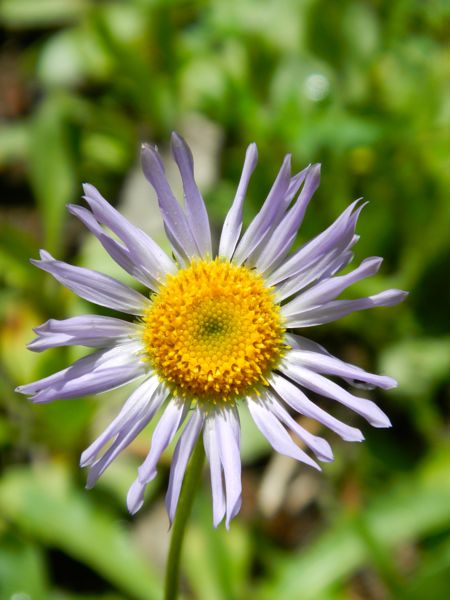
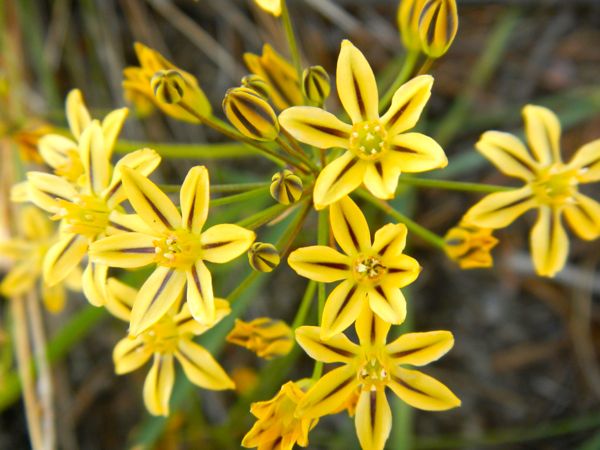
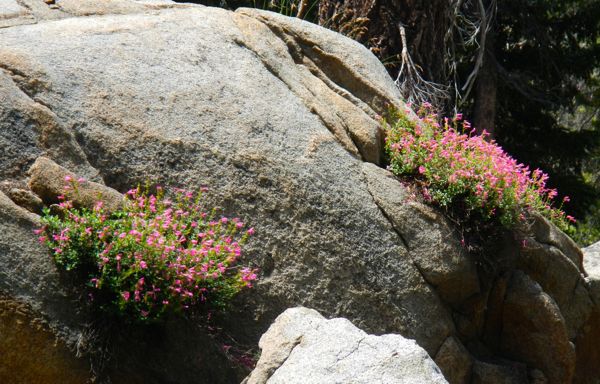
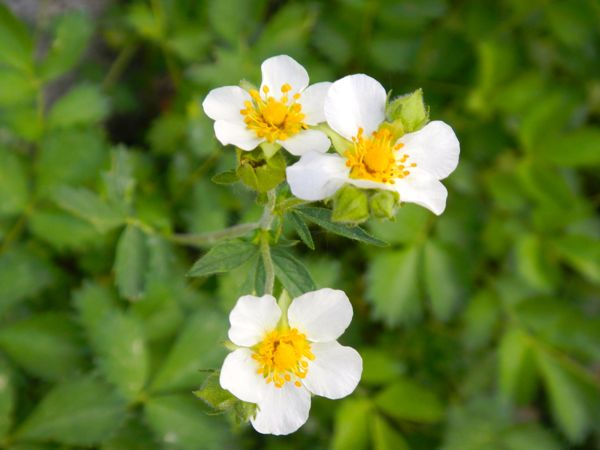
Wildflowers in full bloom in Sierra

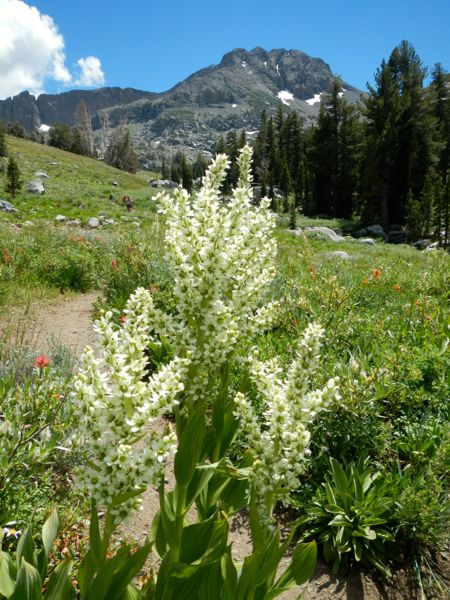
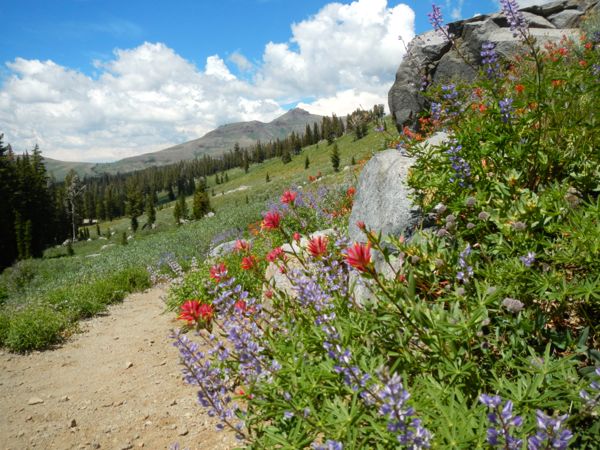
Wildflowers are peaking in the High Sierra. Photos/Kathryn Reed

Wildflowers are peaking in the High Sierra. Photos/Kathryn Reed

By Kathryn Reed

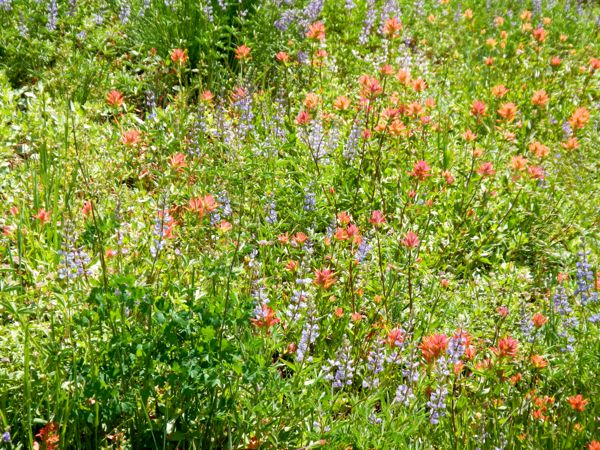
CARSON PASS – Wildflowers as far as the eye could see. Some are more than 5-feet-tall, others look like ground cover. The kaleidoscope of color is mesmerizing.

Even in the parking lot at the Woods Lake trailhead the water is rushing and the flowers are blooming. While the lot was full, as was the Carson Pass area, the number of people on the trail was not overwhelming. Getting a late start meant we passed more people on their way out.

Wildflower hike, Winnemucca and Round Top lakes with Sue and AJ

Wildflower hike, Winnemucca and Round Top lakes with Sue and AJ

We started the loop by going toward Winnemucca Lake. This is the route where the bulk of the flowers are.

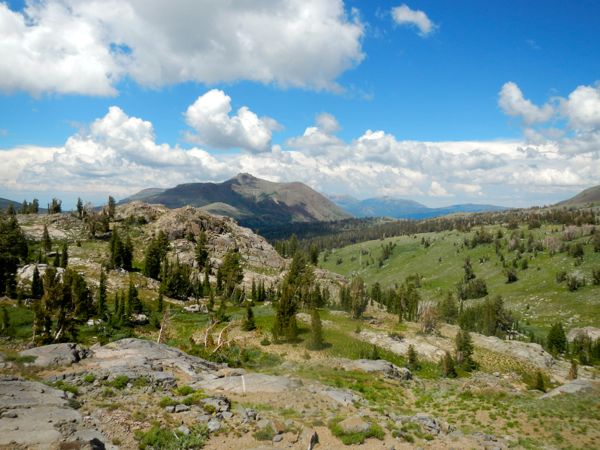
The open terrain was glorious. It was as though the hillside had been painted green and then dollops were splattered about to provide a rainbow of color. Granite boulders provided a steel grey contrast.

It didn’t take long before columbine, then Wildflower hike, Winnemucca and Round Top lakes with Sue and AJIndian paint brush and a variety of daisies, joined lupine. Soon it was a cornucopia of wildflowers. It was like a painter’s palette.

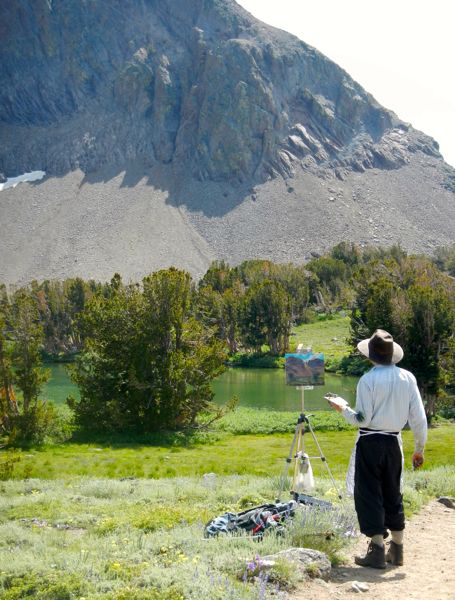
This was appropriate considering David Yapp of San Francisco was with his palette and easel at Round Top Lake capturing the Sierra’s summer beauty.

It was one of those magical days where clouds danced in the sky, providing shade when needed, but enough sun to necessitate a good dose of sunscreen. At Winnemucca it was as though the sky had been splashed with grey paint.

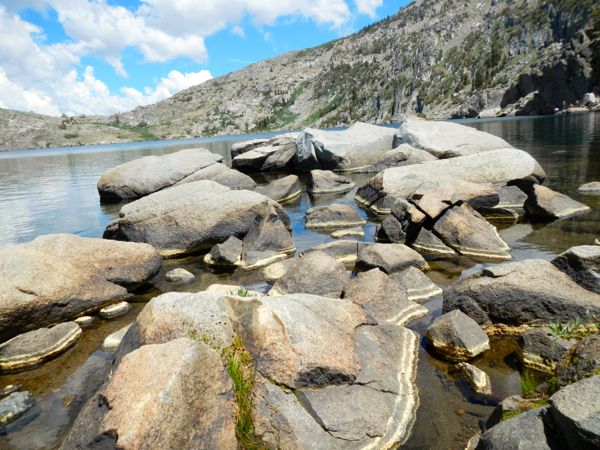
Here people were fishing, sitting on the shore having lunch and swimming. We hopped out to the boulders to have a bite to eat.Wildflower hike, Winnemucca and Round Top lakes with Sue and AJ

Round Top peak in the background.

Round Top peak in the background.

The smell of rain was still in the air Friday afternoon as we took our time on this six-mile round trip trek in the Carson Pass area. The amount of water and dampness brought out the skeeters as well as other biting bugs – at least along the first part of the trail.

Round Top peak towers above Winnemucca Lake at 10,381 feet. Our top elevation of the day was 9,400 feet, having gained about 1,200 feet.

The steepest section seemed to be the one mile trek between Winnemucca Lake and Round Top Lake. The decent from Round Top seemed steeper than the ascent on the other side. Few wildflowers were on this side. The conifers, especially at the base, were denser.Wildflower hike, Winnemucca and Round Top lakes with Sue and AJ From the trail down we could see Woods Lake, but never came close enough for AJ to take a swim. There is plenty of water on this hike, though, for the dog to stay hydrated and cooled off.

Pollen on the rocks at Winnemucca Lake.

Pollen on the rocks at Winnemucca Lake.

Wildflowers weren’t the only reason people were out on July 3. The dichotomy of interests of the trail users was interesting. Several had fishing poles, with a few saying they caught some brook trout. Two others had their skis on their backs. They had taken a few turns on Round Top. This was hard to believe based on how little snow is still there.

David Yapp paints Round Top Lake.

David Yapp paints Round Top Lake.

Originally our destination was Fourth of July Lake, which is another 1½ miles past Round Top Lake. My cold had me at times wondering if I was going to be spending the night in the wilderness, so we stuck to the loop. Not one step were we disappointed. It is near peak wildflower season in the High Sierra.

—–

Wildflower hike, Winnemucca and Round Top lakes with Sue and AJ (Red Lake Peak)

Red Lake Peak

        Getting there:

From South Lake Tahoe, go west on Highway 50. Turn left onto Highway 89 in Meyers.

At Picketts Junction, go right on Highway 88.

Go beyond the Carson Pass parking area. Woods Lake turn off is on the left. Trailhead parking is clearly marked on the right. It costs $5 to park.


Benefits of sports at an early age

By Patti Neighmond, NPR

Amy Roegler and her husband, Octavio Herrera, live with their young kids, Jake and Alyssa, in Los Angeles. When it comes to pro baseball, they’re all Dodgers fans. And Jake loved balls even as a baby, Octavio says.

“Meanwhile his sister, 8-year-old Alyssa, has a passion for gymnastics. She, too, was a natural, her parents say — swinging on the monkey bars at age 2 and practicing splits on a balance beam today.

The parents know that the physical exercise their kids are getting is good for their health. But that’s not their only motivation for encouraging the children to participate in organized athletics.

The majority of parents in NPR’s recent poll on the role of sports and health in America seem to agree. The poll, done in conjunction with the Robert Wood Johnson Foundation and the Harvard T.H. Chan School of Public Health, finds that the majority of adults say they played sports when they were younger.

Read the whole story


Double amputee to swim from Incline to TC

A double amputee is set to swim 12 miles across Lake Tahoe towing his 11-year-old son in a kayak for charitable cause on July 12 beginning at 9:30am.

Harry Boucher, 44, of Turlock will be swimming to raise awareness for the need to have more accessibility for children and adults with disabilities via nonprofit organizations like the Society for Disabilities, which helps establish Miracle League baseball fields for disabled children and playgrounds, including adaptive swings for disabled children.

He will start at Sand Harbor and plans to finish at Skylandia Beach near Tahoe City.

Boucher contracted meningitis at 18 months old, resulting in the amputation of his feet.


Boats entering Tahoe need inspecting

With sunny skies and warm temperatures predicted for the 4th of July weekend, boaters are urged to clean, drain and dry their boats before arriving at the roadside inspection stations in Tahoe to avoid delays and decontamination fees.

All stations close at 5:30pm.

Boat inspectors are required to inspect every boat for the presence of aquatic invasive species prior to launching in Lake Tahoe. Since May, inspectors have intercepted and decontaminated nine boats containing invasive species bound for the waters of Lake Tahoe. Without natural predators, these invasive species pose serious threats to the ecology, recreation and local economies of the Lake Tahoe Basin.


Quick tips for boaters visiting the Lake Tahoe Basin this summer:

  • Go online for inspection locations, hours, fees and information about boat inspections and invasive species.
    Weekdays and mornings are typically less congested at roadside boat inspection stations. Friday evenings, Saturdays and holidays are typically the busiest.
  • Returning Tahoe boats with a Lake Tahoe wire seal still affixed to the boat and trailer may head directly to a launch ramp to purchase a 2015 Tahoe Only inspection sticker.
  • Prior to arriving, make sure your vessel is clean, drained and dry. Check that all systems are working, batteries are charged, the boat has gas in the tank and that you have the key to start the engine. Bring any specialized flushing adapters to the inspection station, as inspectors only have the most common types and sizes.
    If flushing your engine at home prior to inspection, make sure to drain all residual water. If inspectors find water they are required to decontaminate.
  • Annual watercraft inspection fees range from $35 for personal watercraft and vessels under 17 feet up to $121 for vessels over 39 feet.  The annual Tahoe Only sticker fee is $30. An additional fee of $35 is charged for any boat requiring decontamination, with an additional $10 fee for ballast systems. Fees are payable via Visa or MasterCard (no cash or check).
  • Paddlers of kayaks, canoes and other non-motorized watercraft are encouraged to stop by an inspection station for a free inspection and urged to visit TahoeKeepers.org to learn how to self-inspect boats and gear and receive a free Tahoe Keepers sticker.


Time to tune up property’s BMPs

Publisher’s note: This article first appeared in Tahoe In Depth and reprinted with permission.

By Shay Navarro

Any homeowner knows that winter can take a toll on your property. The snow melts and leaves behind all manner of debris and damage.

But at Lake Tahoe, spring cleanup can mean more than just raking up. Tahoe properties need to have erosion-control landscaping measures known as best management practices, and spring often means tuning up your BMPs to make sure your property isn’t sending polluted runoff to the lake.

Springtime also brings the added responsibility of maintaining defensible space around your property.

BMP maintenance

BMPs are important in that they minimize the impacts of development on water quality. TRPA requires properties to capture and infiltrate water from impervious surfaces, such as roofs and driveways, and to stabilize sources of dirt and debris with vegetation and mulch. Properties in compliance receive a BMP Certificate of Completion. Just like a car cannot be driven without changing the oil, BMPs need routine maintenance in order to continue functioning properly. Routine maintenance preserves the lifespan of BMPs and minimizes the potential for polluted storm water runoff to reach Lake Tahoe.

Single-family properties

BMP maintenance activities for a single family residential property typically include:

• Maintaining a 5-foot, noncombustible perimeter around each structure by removing dead vegetation, dried leaves, and pine needles. Keep only irrigated herbaceous vegetation in this area.

• Sweeping sediment off driveways, walkways, and patios.

• Removing pine needles, debris, and sediment from slotted channel drains, swales and gutters. Replace or repair any damaged conveyance structures.

• Removing pine needles and debris from gravel infiltration systems and rock lined swales. Remove gravel clogged with fine sediments, sift clean and replace. Repair or replace borders, filter fabric, and sediment traps as needed.

• Replacing dead vegetation in infiltration swales and basins and adding 1-2 inches of mulch to insulate plant roots and conserve moisture.

• Maintaining a minimum 3-inch layer of rock armor under roof drip lines and decks.

• Stabilizing any exposed bare soil and stabilize slopes with visible signs of erosion using rock mulch and/or vegetation.

• Repairing any failing retaining structures and removing accumulated sediment to achieve 6 inches of space from the top of the structure.

• Maintaining parking barriers to block vehicle access to all unpaved areas.

Commercial, apartments

Commercial and large multi-family residential properties complete online inspection and maintenance logs to show that BMPs have been maintained. BMP maintenance on these properties is critical in preventing polluted storm water runoff from reaching Lake Tahoe and helps local jurisdictions meet total maximum daily load requirements. Once maintenance is verified, TRPA will re-issue the BMP certificate of completion.

For more information on BMP maintenance requirements and to view step-by-step instructional maintenance videos, go online.

Shay Navarro is the storm water program manager at the Tahoe Regional Planning Agency.


Landscaping trainings tailored to Tahoe

The Tahoe Resource Conservation District in partnership with the South Tahoe Public Utility District is hosting free Tahoe friendly landscaping trainings for the month of July.

Whether you’re a landscaper, landscape manager or do-it-yourself gardener these trainings will present the knowledge needed to stay ahead of the drought.

Classes are:

  • Growing Your Business with Smart Irrigation Technology – July 8, 5:30-7:30pm

This training will be at the South Tahoe PUD offices and will discuss new irrigation technology that can save you or your client’s money, time and water.

  • Irrigation Controllers: Timing is Everything – July 29, 5:30-7:30pm

This training will be at the Tahoe City PUD offices, focus will be on the changing field of irrigation technology. You will learn how to update your irrigation knowledge and practices with the use of high efficiency irrigation tools.

  • Understanding & Implementing Micro-irrigation – Aug. 5, 5:30-7:30pm

This training will be at the North Tahoe Events Center in Kings Beach. Understand your irrigation controllers and program option features to support healthy landscapes during watering restrictions.

RSVP for these events is requested by contacting Jennifer Cressy at jcressy@tahoercd.org or 530.543.1501, ext.107


Climate changes can throw off wildlife patterns

Publisher’s note: This article was first published in Tahoe In Depth and is reprinted with permission.

By Ruby Lyon

A shifting climate affects the timing of important events in the plant and animal world. These important life cycle events — known as phenology — happen when the wildflowers bloom, when plants make fruit or new leaves, or when birds migrate or build nests. The timing of these life cycle events is intricately connected to many environmental factors, including elevation and weather.

For example, a long winter with heavy precipitation will result in many phenological events happening later in the season, while a mild, dry winter, such as those in recent years, is linked to the early arrival of spring.

Some phenological processes may be responsive to weather events and therefore can react quickly as climate shifts. For example, local sparrows, robins, and bluebirds may only descend to lower elevations during the harshest winter weather, then return after a couple of mild weeks.

Migrating animals

This is not the case for many other organisms. Western tanagers wintering in Central America have no idea if Tahoe is having a mild winter and an early spring. They try to get here early to secure the best territory and capitalize on the brief summer flush of resources, but if they arrive too early, they may be faced with limited food and freezing weather. Migration patterns develop over many generations, and it can take a while for these patterns to shift to match changing conditions at Lake Tahoe.

With small feet and heavy bodies, Tahoe’s mule deer are not built to cope with deep snow. To make matters worse, their principal food source gets buried. Therefore, Tahoe’s deer typically move to lower elevations for the winter, with many making the shortest trip possible by heading east. Many of Truckee’s Loyalton herd will descend the Truckee River canyon to Verdi; others head north. The Carson Range deer have an easy migration to lower elevations, while deer in Christmas Valley and the Angora Burn area migrate up over Luther Pass to Hope Valley, and then down the Carson River.

It is not unheard of for deer to be caught by early snowfall and get trapped in the Tahoe basin, and such animals usually are seen in the vicinity of Emerald Bay, where they spend the winter at lake level. Quite a few deer have been seen at Tahoe mid-winter in recent years, and earlier this year a few young bucks were seen swimming off Pope Beach in February. The timing and routes of deer migrations are worked out over many generations, and are passed down culturally by older members of the herd. After four years of drought, it is safe to assume that many of the deer now overwintering at Tahoe have never experienced a “real” Tahoe winter, and have never learned to migrate away from an average Tahoe snowpack. Mule deer only live around 10 years on average, so additional mild winters may bring about a significant drop-off in the numbers of deer that know how to migrate.

Early insects

Plants seem to be more responsive than animals to warming temperatures, leafing out or flowering as soon as possible. However, danger lies in that flowers may open up before their pollinators are available.

Another challenge is that flowers are vulnerable to spring storms and frost damage. This latter issue is equally problematic for the insects that try to emerge earlier in an attempt to sync up with the plants. Many insects may not have a choice, and butterflies are a classic example. Plants develop chemical compounds to make themselves unpalatable to insects. Butterflies then evolve defenses and a tolerance to these compounds, and as a result they begin to specialize in only eating certain plants as caterpillars. Therefore, most butterflies have a fairly narrow range of options for larval host plants. If the plants are growing earlier in the season, the caterpillars must be active earlier in the season as well, and often that means the adults must fly earlier in the season to find the right plants on which to lay their eggs.

Research has shown many different adaptations to shifting climate as it relates to butterflies and their host plants. Most commonly, we see the butterflies flying earlier in the season, but emerging earlier is still a risky move in the mountains, and spring storms are always likely. Many butterfly species are shifting habitats or ranges. Some are showing disrupted migration patterns, while other species are showing more novel shifts like staying locked in their typical timing, but shifting host plants instead. However, many species have shown a complete lack of adaptive response, falling out of sync with their host plants, and these species and populations may be disappearing.

Future monitoring

The understanding of life cycle events and their consequential effects on birds, insects, and mammals will be an important factor to monitor in the future. Anecdotal evidence is already demonstrating a shift in the behavior of Tahoe’s organisms due to unseasonably warm winters and drought conditions. A more permanent shift in our weather patterns could have effects on everything from successful gardens and ski seasons to larger-scale impacts related to food security. In response, the Tahoe Institute for Natural Science has created the Sierra Seasons Project, a citizen science program monitoring Tahoe’s phenology. It is our hope that long-term observations from local school kids, hikers, and residents will result in data that can be used to determine how climate change is affecting the phenology of Tahoe.

Ruby Lyon is an outreach manager and AmeriCorps member with the Tahoe Institute for Natural Science.


Time to register for Reno-Tahoe Senior Summer Games

Registration is open for the 2015 Reno-Tahoe Senior Summer Games, a program dedicated to promoting and implementing fitness.

Anyone 50 years of age or older may compete in sports such as track and field, swimming, bowling, golf — even a slot tournament.

There will be opportunities to compete individually, as a doubles team, or as part of a team of five or more. Gold, silver, and bronze medals will be awarded. New sports for the Summer Games include fly casting and a golf tournament at Sierra Sage Golf Course.

An early base registration fee of $25 per person (plus an additional $10 per-sport fee) will be offered through July 31. After July 31, the base registration fee will increase to $30. Registration includes a T-shirt, sport bag, and closing ceremonies lunch dance ticket.


To register, or for more information including a schedule of events, go online or call 775.657.4602.