DC receives funds to complete valley trail

Douglas County was awarded $106,000 from the Nevada State Parks Recreational Trail Program for the construction of a trailhead on Buckeye Road to serve the proposed Martin Slough Bike Path.

The Douglas County project was one of 12 selected out of 22 applicants.

When complete, the Martin Slough Bike Path will connect Jakes Wetland in Minden to the Gilman Ponds in Gardnerville.  he path will be 2.61miles long and consist of a 10-foot wide paved section.

The trailhead will consist of several parking spots, including ADA parking, educational signage, and paved access from the trail to the parking area. The grant requires a 20 percent match of local funds. Douglas County provided $20,000, and Minden and Gardnerville each kicked in $3,000.

Existing parking is available at the north end of the project at the Jake’s Wetland Trail Head and at the south end of the project at the Gilman Ponds, but parking was limited mid-trail. These parking spots will also allow for easy access to proposed fishing pond just South of Buckeye Road.

Martin Slough Bike Path is nearly 90 percent complete. Douglas County is working with NDOT to complete acquisition of the required easements to accommodate the bike path. A construction schedule will be set once all necessary easements have been acquired.


Alpine County trails lead to dry lakebeds

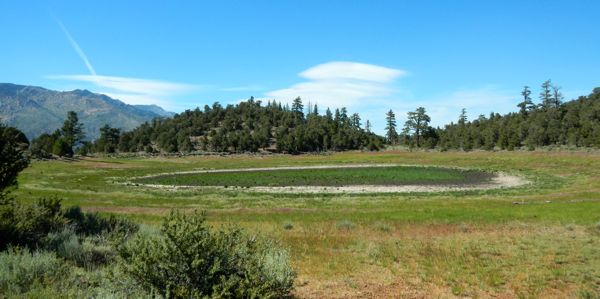
Views along the Curtz Lake interpretive trail in Alpine County. Photos/Kathryn Reed

Views along the Curtz Lake interpretive trail in Alpine County. Photos/Kathryn Reed

By Kathryn Reed

MARKLEEVILLE – Bring water because despite the destination being to a couple lakes there is no water to be found.

Dust bowls. That’s what Curtz and Summit lakes are. Lake is a bit of a misnomer. A ring outlines both. A muddy patch, at least two weeks ago, was at the center of them.

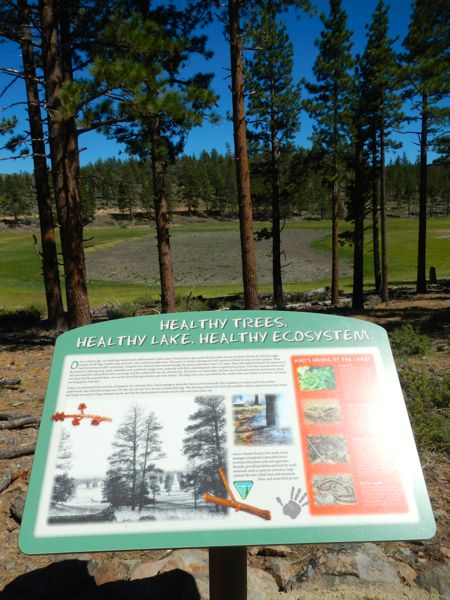
Multiple signs explain things about the land, wildlife and history of the area. One explains how it is not unusual by mid-summer for the lakebed to be dry. This year it was dry before the calendar even said summer.

Summit Lake without any water.

Summit Lake without any water.

The nonprofit Alpine Trails Association recently completed the 1.1-mile interpretive loop around Curtz Lake.

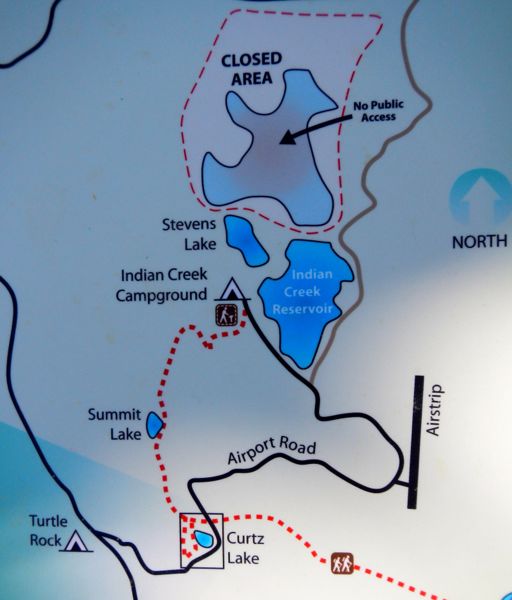
These trails are in the Indian Creek Recreation Area. Indian Creek Reservoir does have water.

Rural and remote define Alpine County. The trails underline this. What’s nice is that the trails are so close to Lake Tahoe, but provide such a different experience.

Pinyon pines dot the landscape, along with Jeffrey and ponderosa.

An interpretive sign above a dry Curtz Lake.

An interpretive sign above a dry Curtz Lake.

More volcanic rock than granite is prevalent. Signs say volcanic eruptions 10 million years ago created the rock mounds. Other rocks are strewn about as though it might have once been a lava field.

The views are varied – from the lakebeds to distant Sierra peaks with splotches of snow to mounds of rock to grassy areas.

Both lakes are easy hikes. Even in the middle of the day in late June the temperature wasn’t that bad. The interpretive route is a mix of shade and sun, with the trek to Summit Lake much more exposed.

—-

alpine-mapGetting there:

From South Lake Tahoe, go west on Highway 50. Turn left on Highway 89 in Meyers. Turn left onto Highway 88 at Picketts Junction. Turn right onto Highway 89 toward Markleeville. Turn left onto Airport Road. (If you pass Turtle Rock Park, turn around.) The trailhead is the first left. There is no sign.


Fond memories of the Placer-Nevada League

By Mark McDermott, Sacramento Bee

One of the Sacramento region’s oldest semipro leagues was the Placer-Nevada League, founded by Allen “Scoop” Thurman of Colfax in 1923 and run by him until its demise in 1968.

Six teams competed in its inaugural season: Lincoln, Roseville, Colfax, Auburn-Newcastle, Grass Valley North Star Mine and Grass Valley Empire Mine.

The league had its share of memorable characters and moments.

▪ In 1950, Tommy Glaviano (Sacramento High School) hit three home runs in one game for the Lincoln Potters against the Placerville Bartletts. After the third homer, pitcher Edwin Jack Carpender (El Dorado) met him at home plate and shook his hand. Glaviano just completed his rookie season with the St. Louis Cardinals, hitting .267 in 87 games.

Read the whole story


Search and rescues often come with a bill

By Jimmy Tobias, Outside

In 2012, 59-year-old Ed Bacon attempted a solo hike through New Hampshire’s White Mountains. While in the backcountry, on a windy, rain-drenched day, he tried to jump onto a rocky ledge, dislocated his artificial hip and found himself incapacitated in the wilderness. He was stuck, so he did what you’re supposed to do: he called for help.

The New Hampshire Fish and Game Department, which runs search and rescue in the state, mobilized fast. It sent 50 people, mostly volunteers, to his aid. After a nighttime operation in rough weather, they delivered him to safety. He was unharmed, save for an injured hip and a bad scare.

That’s where you might expect the story to end, but not in Bacon’s case. Shortly after his ordeal, he received a bill for more than $9,300. The state said he owed big money for the mission that saved him.

New Hampshire is not the only state where hikers, climbers, and other outdoor enthusiasts can be hit with hefty bills for search and rescue (SAR) services that save their lives. At least six other states have controversial laws that enable officials to recover SAR costs. Some of those laws are broad, and just about anybody can be forced to pay. Others are narrow, and you’ve got to do something reckless to get a bill. In any case, many SAR providers across the U.S. believe the prospect of forcing individuals to pay out of pocket for help in times of crisis further threatens the lives of the people in danger.

Other states can charge for search and rescue under limited conditions. Colorado and Vermont can bill people who travel out of bounds at ski areas, and Idaho can charge hikers who venture into areas closed to the public. Sheriffs in California, meanwhile, can charge an individual’s county of residence for a mission that costs more than $100.

Read the whole story


Kings Beach runner sets TRT record

A Kings Beach man now holds the record for the fastest time to complete the Tahoe Rim Trail without support.

Mike Tebbutt, 44, started from the Brockway trailhead on June 25. He returned there 54 hours and 17 minutes later.

The previous record of 58 hours, 43 minutes was set in 2013 by J.B. Benna.

Records for fastest assisted run around on the 165-mile trail are also kept.

The Tahoe Rim Trail Association does not have an official record book for these accomplishments, but they are tallied on a website.

— Lake Tahoe News staff report


SLT, LTCC, LTUSD working to build ball fields

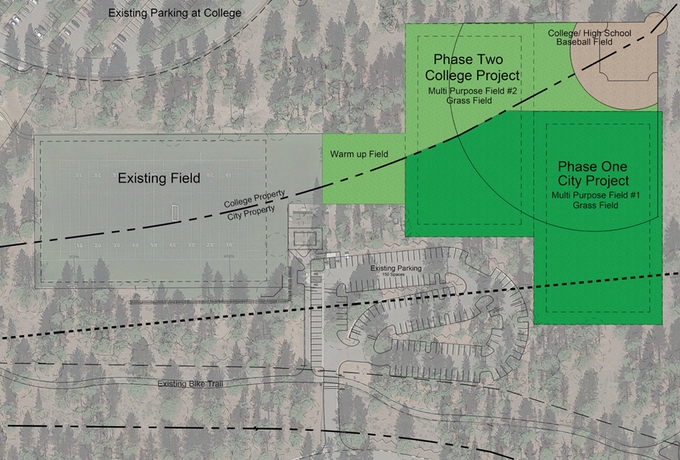
The proposed fields are in green and brown. The existing community field is to the left in grey. Rendering/Design Workshop

The proposed fields are in green and brown. The existing community field is to the left in grey. Rendering/Design Workshop

By Kathryn Reed

By the end of 2016, there could be two new ball fields in South Lake Tahoe – and not a dime of additional taxpayer money is needed to build them.

Designs are such that the fields could be used for football, soccer or baseball – just not all at the same time.

When Measure S was passed in 2000 it said four community ball fields would be built. Only one ever was. In large part this had to do with the recreation measure not generating enough money and the ice rink costing more than originally planned. When it was revised to be Measure R, it said three ball fields.

The Measure S field is next to Lake Tahoe Community College, with the property being  owned by the college and city. The new fields would go to the right of that field if looking at the area from the community ball field parking lot.

The project is a joint endeavor between the city, college and Lake Tahoe Unified School District. To do so the three are creating a recreation joint powers authority. This proposal is on the July 7 City Council agenda. The college board should vote on it in August. The school district time line and funding source are unknown because Superintendent Jim Tarwater did not return a phone call.

Once the respective boards approve the JPA, permits will be sought with the goal of construction starting in May. The exact work plan will be devised to have the least impact on the current field users.

The city on Tuesday could allocate $1.2 million to the fields project. This money is from excess budgeted hotel taxes. Through April, the transient occupancy tax is up 19 percent. For the fiscal year, an excess of $2 million is expected to be collected.

“All of our community surveys say collect taxes from tourists and spend it on things that are valuable to residents. We are delivering on that without asking for new taxes,” City Manager Nancy Kerry told Lake Tahoe News.

The partnership will in effect deliver what Measure S/R intended to do. It will also help resolve scheduling problems.

The new fields are expected to be grass. One reason for grass is to not have to contend with Tahoe Regional Planning Agency coverage stipulations.

Kerry also said artificial turf is expensive, there are potential negative health side effects, and that it’s hard to keep clean.

“The college believes this is a way to bring multiple agencies and funding to facilitate the recreational fields that were promised years ago under Measures R and S. The college realizes that our soccer program has strained the use on the community field, and by collaborating, the community, LTUSD, and the college are all getting more recreational space,” LTCC President Kindred Murillo told Lake Tahoe News. “Our next steps will be to bring easement documents to the board for dedication of the 5.62 acres to the new joint powers authority, draft an agreement for a new joint powers authority that includes appropriate language so the college can invest bond funding in the community field as we promised in Measure F. This is anticipated to start in early August.”

Measure F, which was approved by voters last fall, includes funds for recreation facilities. A caveat is that money cannot be spent on facilities the college does not own. The college has $1.1 million for the fields, some of which will be spent on new artificial turf at the current field. There is $300,000 in Measure S/R money that is also dedicated for turf replacement.

Besides the turf, bleachers are also expected to be built. Murillo said artificial turf is less expensive to maintain and that it is safer for soccer conference play.

Other field improvements are also in the works.

“We are still looking at investing bond funds on the field at South Tahoe Middle School. Under the stipulations of bond funding we must have irrevocable rights to use the field for the length of the bond funded improvements,” Murillo said. “The rationale is that it will expand use of the field for the community, LTUSD, and our soccer program. We are working on a shared facilities agreement between LTUSD and LTCC which will leverage the taxpayers dollars by not duplicating facilities.”

After Tuesday’s meeting, the city and unified district will then work on a plan that is likely to come before the council in August. This has to do with amending the agreement between the entities so the school district is paying for the lights and water for its fields. Currently, the city is doing so.

“The end result will be more efficient management and operation of these fields,” Kerry said.

A side note, this will be last year SnowGlobe, the three-day outdoor concert, will be at the current field even though this is only the second year of the three-year contract. It’s possible the festival could be on the new grass fields. That type of hardscape is more conducive to such activities. The city is also considering 30 acres near the airport for outdoor events.

Drinking too much water during exercise can be bad

By Ariana Eunjung, Washington Post

The idea that you should always stay hydrated has been ingrained in many of us since childhood by everyone from Little League coaches to parents. For many athletes that advice has been translated into drinking a lot and drinking often while exercising.

Now a panel of experts says that practice is not only outdated but dangerous. On Tuesday, a group representing sports medicine doctors, physiologists and trainers issued new guidelines telling people to stop drinking in excess during physical activity. Practically speaking, that means you should only drink when you’re thirsty.

Writing in the Clinical Journal of Sport Medicine, the specialists said that “aggressive drinking to prevent dehydration is unnecessary and carries with it greater risk.”

Read the whole story


Genetic research lays foundation for conservation

By Cally Carswell, High Country News

Back when he was in his 30s, Tom Whitham would have been leery of the meddlesome approach to conservation that he is laying the foundation for today. Whitham came out West in 1973 to pursue a doctorate in biology at the University of Utah. He had just finished a tour as an Army photographer at a hospital in Hawaii filled with soldiers injured in Vietnam, a difficult experience that had one positive result: He encountered buzzing, singing and tangled rainforests, and became enchanted with wild places, which were rare in his native Iowa. He decided to move to the American West because, he says, “we hadn’t plowed it under yet.”

He imagined it as an untamed frontier. Though not naive about the human tendency to damage the environment, he thought the West was still too big and sparsely populated to be threatened in any existential sense. One good way to protect or heal the environment, he believed, was to leave it alone. Given time and space, nature could often fix itself.

Today, Whitham is a meticulous and accomplished ecologist based at Northern Arizona University in Flagstaff. He wears round glasses, a gray goatee and, when outdoors, an oiled leather cowboy hat. His love of nature hasn’t wavered. At last count, his home garden boasted 120 species of native conifers, poplars, shrubs and grasses. In the field, he always carries a camera, and even at sites he’s studied for decades, he still finds things worth photographing. But he thinks the frontier is dead. He is no longer optimistic about nature healing itself. The challenges — a climate in disorder, a looming sixth extinction, and people, always more people, always seduced by short-term gain — have grown too big, too fast.

Whitham believes the answers lie in an unexpected place: The DNA of species so common we usually take them for granted. As Whitham and his colleagues have researched the Southwest’s cottonwoods and piñon pines, they’ve introduced groundbreaking new ideas about how these trees’ genetic traits influence the community of surrounding organisms, and even shape entire ecosystems. If their discoveries hold true in kelp beds, coral reefs, tropical forests and desert shrublands — and so far, they have — they may transform our understanding of how everything in the web of life is connected.

Read the whole story


Recovery time important for athletes

By Amanda MacMillan, Outside

Any time you increase the duration or the intensity of your workouts, you also increase your risk of injury—especially if you’re not tending to those body parts that are seeing the most wear and tear. The solution, says renowned physical therapist, Kelly Starrett, is to do just that: Devote 10 to 15 minutes, every single day, to basic maintenance on your body.

By maintenance, he means a mix of active recovery and mobility work—a routine he teaches in his books “Becoming a Supple Leopard” and “Ready to Run” as well as his popular Mobility WOD blog. These techniques, he says, bring fresh blood into tight muscles, increase joint and tissue range of motion, and improve mechanics and flexibility.

“When you do nothing on your days off, all you’re doing is resting and perhaps catching a mental break from training,” says Starrett. “But when you perform mobility work, you’re potentially shortening your recovery time and improving yourself as an athlete. And the best part is you’re not compromising your recovery or doing anything that will tax you mentally.”

Read the whole story


Product aims to prevent drowning

By Bob Shallit, Sacramento Bee

A Gridley company is off to a great start in its plans to raise capital for an emergency flotation device targeted at surfers, boaters and other water sports participants.

Kingii Corp. initially planned to raise $65,000 to start production. But money raised from investors, retailers and consumers via a crowdfunding campaign launched Monday on Indiegogo has pushed funding over $427,000 as of Friday afternoon.

The company’s lightweight product – called Kingii and named after an Australian lizard that raises a frill over its neck when alarmed – is worn around the wrist and quickly expands when a user triggers an attached carbon dioxide cartridge. It’s aimed at people who regard life vests as too bulky.

“If you’re swimming and you get tired or get a cramp when you’re out too far, it’s nice to have something to get you through” to safety, said Crystal Bullard, the company’s sales and marketing director.

Read the whole story