Calif. weighs cheerleading as high school sport

By Associated Press

California lawmakers are sending Gov. Jerry Brown a bill that would recognize competitive cheerleading as a high school sport.

The state Senate on Monday unanimously approved a bill requiring the California Interscholastic Federation to oversee competitive cheerleading as it does other high school sports.

Democratic Assemblywoman Lorena Gonzalez of San Diego says at least eight other states treat competitive cheerleading as a sport. Formal recognition would mean consistent safety rules and training for coaches.

Her bill, AB949, would make the change by the 2017-18 school year. Gonzalez is a former high school and college cheerleader.

Brown signed another of her bills this year, requiring minimum wage pay and overtime for professional sports team cheerleaders.


Wild animals part of talk on South Shore

Live animals will be taking over the Lake of the Sky Amphitheater on Aug. 28.

Wild Things Inc. is a nonprofit that provides homes for displaced wildlife and shares these animals as wildlife ambassadors in a public education form. All the animals housed with Wild Things either have injuries that keep them surviving in the wild or animals that individuals have tired to keep as illegal pets.

The event starts at 7pm. The $5 cost benefits the Tahoe Heritage Foundation.

The amphitheater is at Taylor Creek Visitor Center located approximately three miles north of South Lake Tahoe on the lakeside of Highway 89.

For more information, call 530.544.7383.


Remote road in Eldorado National Forest opens

The upper part of the Richardson Lake Road in the Eldorado National Forest is open for motorized vehicle use, completing the final phase of corrective work on this route.

Richardson Lake Road is on the far northeastern end of the forest, and must be accessed through roads leading from the Lake Tahoe area. This 2.65 mile road is used to access Richardson Lake for camping and fishing, and travel to the top of Sourdough Hill to enjoy the scenic vistas, including a good view toward the Rubicon Trail. The route also provides access to the Pacific Crest Trail. A four-wheel drive vehicle must be used to reach this road.

The first phase of work allowed the Richardson Lake Road to be reopened up to the Pacific Crest Trail beginning in July 2014. Recently, improvements to the upper part of the road were completed in which a rolling dip was installed; an existing sediment basin was emptied and enlarged; and rock was placed over areas of bare ground.

The Richardson Lake Trail was identified as one of 18 routes in the Eldorado National Forest travel system which needed corrections to comply with the environmental protection guidelines in the Sierra Nevada Plan. These routes were closed in 2012 to complete further analysis and make corrections to ensure the hydrologic connectivity of meadows would not be significantly impacted by motorized vehicle use.


Anderson dominates on New Zealand slopes

By USSA

QUEENTOWN, New Zealand — The men’s snowboard slopestyle final of the Audi quattro Winter Games NZ 2015 saw dramatic changes of fortune in a very tight contest that wasn’t decided until the last trick. Chris Corning (Arvada, Colo.) made the very last qualifying spot for the FIS Snowboard World Cup, and shocked the crowd to win the finals at Cardrona Alpine Resort. Jamie Anderson (Meyers) took the win for the women, while Hailey Langland (San Clemente) stepped on the podium in third.

This was only Corning’s third FIS World Cup. The 15-year-old nailed the top position in the first heat, which saw the highest-placed qualifiers well down the list. From then, everyone was playing catch-up, laying down impressive tricks under a beautiful blue sky. But Corning ramped up the ante on his last run and reclaimed the top spot from Ciccarelli, scoring an 87.55 with a backside Miller flip, backside 270 to boardslide, a front 180 on, switch front bluntside 270 out, a switch backside bluntside 450 mute out, a frontside 10 mute, a backside 12, backside grab and a cab 12 tail.

Garcia Knight from New Zealand came up with his best run of the day, taking third with only two riders to go. Canada’s Max Eberhardt’s last run didn’t provide the fireworks he needed, leaving only Japanese favourite Yuki Kadono to contest the leaders. He failed to fire in the first two heats, but he stunned the crowds with a spectacular last run, pulling off the highest-scoring trick of the day on the final kicker – a triple 1440 mute gaining him a 9.75 out of 10, the only triple of the day. Kadono ended up a close second behind the Corning, scoring a 85.81.

Corning put part of his win down to spending time at Cardrona before the event, and landing a new move for the first time in competition. “I’ve been here a while and ridden the course a bit,” he said. “It gave me the chance to learn some new tricks like that cab 12 I put down in my run, so it’s awesome. I’m super stoked. It was super fun and I guess I was riding well today and it all worked out.”

In the women’s event, Anderson asserted her dominance from her first run. Second placed qualifier, Canadian Laurie Blouin, scooped the silver medal on her second run although she was driven hard by Langland who finished in the bronze medal position. Langland had started as fifth-placed qualifier, but a very strong first run put her in second behind Anderson, and an even better last run kept her in third in just her first FIS World Cup.

“I’m really stoked to even be out here, with this beautiful weather and the great jumps,” Langland said. “I just had a ton of fun which is all that matters and I’m just happy I made it from top to bottom. The course is probably the best course I’ve ever ridden. I’ve never liked jumps this much.”

With Anderson being more than 10 points ahead of the field, there was no pressure to perform on her last run, but she went all out on her victory lap landing a new trick in competition for the first time and improving her score to 87.88.

“Doing my backside rodeo 5 was also awesome. The course is really fun and even better than during qualifiers since we got to go earlier in the day,” said Anderson. “I’m stoked to win and to be back visiting New Zealand, which is one of my favorite countries.”


SUP event benefits SLT Cancer League

Stand Up to Cancer is an opportunity to help the South Lake Tahoe Cancer League.

The Sept. 12 event is supported by SUP Paddle South Lake Tahoe. The $50 fee includes lunch. The event is form 9am to 3pm.

Meet up at El Dorado Beach. Boards are $15 to rent. Registration begins at 9am and paddling will begin sometime after. The course will be right off the beach and after paddling a lunch will be provided courtesy of Lake Tahoe Hard Rock.

The South Lake Tahoe Cancer League is an all volunteer nonprofit organization that offers grants and rides to our local cancer patients.


Volunteers sought for Markleeville Creek Day

Alpine Watershed Group needs volunteers to participate in the 16th annual Markleeville Creek Day on Sept. 12 from 9am-2pm.

This is a community work day that focuses on stabilizing stream banks, removing invasive weeds and other environmental restoration projects.

This year’s projects include:

  • Willow planting and stream bank stabilization in Hope Valley
  • Invasive weed removal, stream bank stabilization, and native garden planting in Grover Hot Springs State Park
  • Great Sierra River Cleanup
  • Carson River riparian plantings
  • Storm drain stenciling in Markleeville.

Participants will meet at the Markleeville Library Park at 9am. Groups will then head out to their desired work sites. Participants of all ages are encouraged to attend, however children must be accompanied by an adult.  Bring work gloves, sunscreen, lunch and sturdy shoes. After restoration activities there will be an ice cream social at Library Park.

If interested in attending, sign up online.


Mountain biker and wilderness relationship: It’s complicated

By Grayson Schaffer, Outside

On Aug. 7, President Obama signed into law a bill that converted just over 275,000 acres among the Boulder and White Cloud Mountains into federal wilderness — three separate areas collectively known as the Boulder–White Clouds.

For years, it’s been obscure and sparsely trafficked by hikers, mountain bikers, off-road motorcyclists, skiers, hunters, and cattlemen. The president’s signature brings to a close a long and sometimes ugly debate. But it has also left many local mountain bikers, who’ve long ridden trails in the Boulder–White Clouds, disappointed that they’ll no longer be allowed in.

The entire process has put riders in the increasingly familiar and uncomfortable position of opposing wilderness legislation.


According to the Outdoor Foundation’s most recent participation report, there are roughly 8 million mountain bikers in America and 10 million backpackers. And mountain biking, which didn’t exist to have a seat at the table when the Wilderness Act was passed in 1964, is only getting more popular.

For bikers, the insult is compounded because older and more clearly detrimental practices like cattle grazing and mining are grandfathered into wilderness areas, as are many airstrips.

Read the whole story


USFS drains Seneca Pond before restoring area

U.S. Forest Service crews are in the process of restoring Seneca Pond. Photos/Kathryn Reed

U.S. Forest Service crews are in the process of restoring the area where Seneca Pond was. Photos/Kathryn Reed

By Kathryn Reed

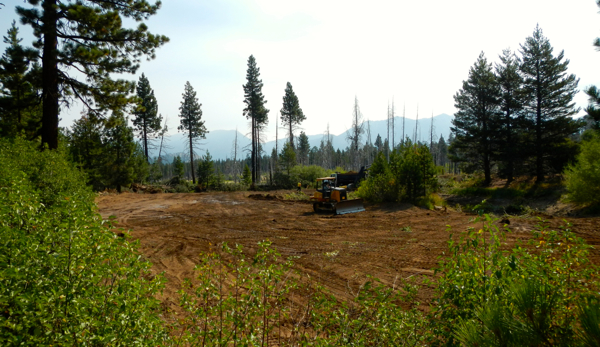
Seneca Pond is no more. The 51-year-old manmade lake has been drained, and excavators are moving dirt and vegetation with the goal of the site being restored this fall.

Today it is a mudflat. In a couple years U.S. Forest Service officials hope it will be hard to tell they had heavy equipment in there.

The pond was about a half acre, but by the time the work is done 2 acres of stream environmental zone will have been restored in the forest off North Upper Truckee Road in El Dorado County.

At the deepest point it was about 4 feet. For the last two weeks the water was siphoned off into the forest. By the end of next week the excavation should be completed, with restoration work continuing through the fall.

Seneca Pond has long been a favorite spot for area residents. User created trails – many of which will be removed in this process – are intertwined, providing a mountain biking and hiking mecca mostly used by locals.

The pond is most famous for being the ignition point of the 2007 Angora Fire. It was an illegal campground that had not been fully extinguished that led to 254 houses being destroyed. No marker will commemorate that tragedy, but the boulder near where it started still exists.

It was after the fire that a set of protocols was developed for the area. The forest supervisor at the time signed off on the decision in 2010. Getting rid of the pond and working on Angora Creek are the last projects to be completed, and they will be finished this fall.

The pond was built in 1964 and enlarged a year later. This was when the land was privately owned. A hippie commune was out there, including teepees. It was in the early 1970s that the Forest Service became the landlord.
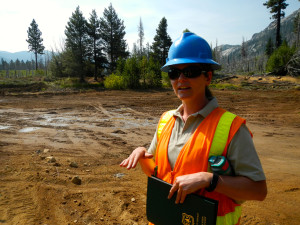
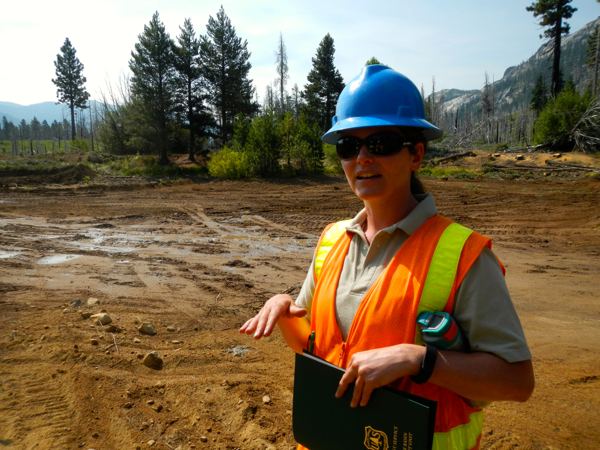
We are trying to make it an equally pleasing experience, just different,”
“We are trying to make it an equally pleasing experience, just different.” — Stephanie Heller, USFS Seneca Pond project manager

Stephanie Heller, project manager for the USFS, said the main reason to remove the pond is that as a manmade entity it isn’t natural.

“It’s typically not something we have in the forest to manage,” Heller said as she walked along side what would have been the shore of the pond.

In the early 1990s the Forest Service took measures to keep the pond full of water year-round. Clay was added as a liner and a conveyance system from the uphill spring was created.

Post-Angora the water table rose significantly because there were no longer the trees to absorb the moisture. This led to the conveyance system breaching, which caused issues.

The hillside above this area with the charred trees is a stark reminder of the 2007 fire. There is also lush undergrowth that proves the area is wet even during the fourth year of a drought.

This pond was also home to the American bullfrog, an invasive species that will eat nearly anything that comes into its path. This in turn has hurt the native Western toad and Pacific tree frog populations.

Heller said amphibians are in such a state of decline that her agency is doing what it can to protect their habitat. As crews continue to work through the fall to return the Seneca Pond area into a setting more like what it would have been like pre-human interference, the goal is the contours and undulations will create pockets of water in normal and wet years where amphibians could thrive.

The little island that was in the pond is staying, though it will be thinned. It will be a landmark of sorts.

Heller said neighbors have an emotional connection to the pond and have voiced their displeasure with the change.

“We are trying to make it an equally pleasing experience, just different,” Heller told Lake Tahoe News.


Triathlon to cause traffic delays on West Shore

Caltrans is advising motorists to expect delays this weekend on Highway 89 along the West Shore during the Lake Tahoe Triathlon.

There are four events scheduled – a sprint course Saturday; and Olympic, half and duathlon courses Sunday. All events start from Sugar Pine Point State Park and all will use Highway 89 for the cycling portion. Runners will also be crossing Highway 89 back and forth from the Ron Beaudry Trail, but will not be running along the highway.

Highway 89 will not be closed during the events, but CHP officers will be conducting traffic control at several locations along the courses.

Work on Caltrans’ construction projects in the area will be wrapped up today at 10am and won’t resume until Sunday night.

Cyclists should be off the highway by 9am Saturday during the sprint triathlon and by 1pm Sunday during the half, which features a 56-mile bike ride, the longest of the events and the only to use 89 north of the park. Sunday the course is between Ward Creek on the northern end and Baldwin Beach Road on the southern end.


Wolf pups caught on tape in NorCal

Wolf pups in Northern California. Photo/CDFWS

Wolf pups in Northern California. Photo/CDFW

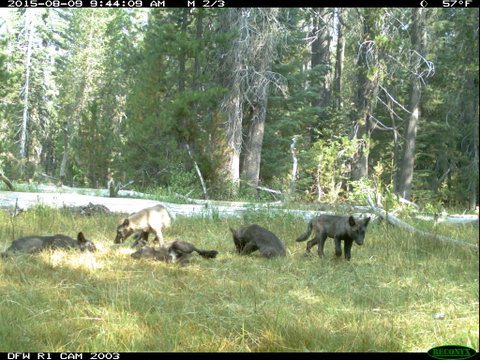
The California Department of Fish and Wildlife has photographic evidence of five gray wolf pups and two adults in Northern California.

After trail cameras recorded a lone canid in May and July, CDFW deployed additional cameras, one of which took multiple photos showing five pups, which appear to be a few months old and others showing individual adults. Because of the proximity to the original camera locations, it is likely the adult previously photographed in May and July is associated with the group of pups.

CDFW has designated this group (comprised of two adults and five pups) the Shasta Pack.

Wild wolves historically inhabited California, but were extirpated. Aside from these wolves and the famous wolf OR7 who entered California in December 2011, the last confirmed wolf in the state was in 1924. OR7 has not been in California for more than a year and is currently the breeding male of the Rogue Pack in southern Oregon.

In June 2014, the California Fish and Game Commission voted to list gray wolves as endangered under the California Endangered Species Act. The gray wolf is also listed as endangered in California, under the Federal Endangered Species Act of 1973.