Calif. offers one day of free fishing

The California Department of Fish and Wildlife is putting on a free fishing day Sept. 5. This means no need to buy a sport fishing license.

All fishing regulations, such as bag and size limits, gear restrictions, report card requirements, fishing hours and stream closures remain in effect. Every angler must have an appropriate report card if they are fishing for abalone, steelhead or sturgeon anywhere in the state, or salmon in the Smith and Klamath-Trinity river systems.

Free fishing days provide a low-cost way to give fishing a try.

Anglers should check the rules and regulations for the waters they plan to fish because wildlife officers will be on duty to enforce them. For more information, go online.


Nevada firewood permits to go on sale

Nevada Department of Conservation and Natural Resources will sell firewood permits starting Sept. 12.

Approximately 150 permits available on a first-come, first-served basis. The wood consists of a mixture of pine and fir, some seasoned and some green.

The permit sale starts at 7am on the 1st floor of the Richard H. Bryan state office building,901 South Stewart St. in Carson City. Permits are $65 per cord – cash or check only – limit one cord per address/family. The sale will close when all permits have been sold.

Permit holders may pick-up firewood from the last week of September through the first week of October at the North Canyon area of Spooner Lake State Park.

Access into North Canyon requires navigation through areas of loose, sandy soils. Four-wheel drive or heavy duty two-wheel drive vehicles are strongly recommended. Trailers may be permitted at the discretion of State Parks personnel.

Contact Jill Alves at 775.684.2793 for more information.


Nevada officials kill Kingsbury Grade bear

For the second time this week the Nevada Department of Wildlife euthanized a black bear in Lake Tahoe.

A female bear, about 18 months old, was trapped between Thursday night and Friday morning in the Kingsbury Grade area.

The trap was set earlier this week after a bear in the area, fitting the description of the bear caught Aug. 28, had entered two houses in search of food. The bear was euthanized as a threat to public safety.

It was the fifth bear euthanized this year as a threat to public safety. A 9-year-old male bear was captured and euthanized this past Aug. 25  in Incline Village as a threat to public safety.

“We hate having to do this, but a bear entering a house is a dangerous bear and the Nevada Department of Wildlife is obligated to manage the situation,” NDOW spokesman Chris Healy said in a press release. “We have an obligation to public safety that we do not take lightly. People have called and asked us to move the bear, but we cannot move a bear that we know to be dangerous, that just would not be prudent.”

Healy advises that people in “bear country” have a special obligation to not attract bears to their property.  “Garbage that is carelessly managed and left available to bears is what creates situations like today. If you want to keep bears alive and wild, then you need to not attract them to your property where they become habituated to human sources of food.”


— Lake Tahoe News staff report


League needs help with Stewardship Day

The 18th annual Tahoe Forest Stewardship Day is Sept. 12.

This is a day of planting, weed pulling, and other restoration activities to preserve and protect Lake Tahoe’s watershed. Refreshments, lunch and prizes will be provided.

Bring water, wear clothes that are comfortable.

The event is put on by the League to Save Lake Tahoe. It is from 9am-noon.

Meet at the intersection of Barbara and Lodi avenues in South Lake Tahoe.


RSVP at keeptahoeblue.org/rsvp. For questions or for more information, email events@keeptahoeblue.org or call 530.541.5388.


Partnership to test if forest thinning can grow groundwater

By Edward Ortiz, Sacramento Bee

The purchase of 10,000 acres of watershed land west of Lake Tahoe is slated to launch a living laboratory testing whether the answer to drought lies in fewer trees.

Research by the environmental group the Nature Conservancy has shown that thinning forests of small- to medium-size trees and bushes allows forests to trap more rain because it lets more water run off to streams and into groundwater stores. In winter, thinned areas may also allow more snow to be deposited on the forest floor as snowpack, said Edward Smith, a forest ecologist with the Nature Conservancy.

The Palo Alto-based Northern Sierra Partnership, which includes the conservancy, seeks to put that theory into practice on former logging land it’s bought for $10.1 million about 10 miles west of Lake Tahoe and south of Interstate 80 in Placer County. It’s one of the largest pieces of unprotected land south of Donner Summit and the Tahoe National Forest.

Read the whole story


ZCTC to host tennis social

The final tennis mixer of the season at Zephyr Cove Tennis Club is Sept. 9.

The theme of this Hump Day is logo wear – as in players wearing as much club apparel as they can. And for those who don’t have any or need more, the pro shop has shirts, jackets, vests and jackets for sale.

The event is open to non-members as well. It’s an opportunity to play casual tennis, have fun, eat dinner and socialize. The tennis is adult doubles round robin for all ability levels. Play starts at 5:30pm.

The mixer costs $10 for club members, $15 for non-members, and $5 for spectators (meal only).

Participants are encouraged to bring a side dish or dessert, as well as beverage of choice. No advance sign-up is required.


Reeling in the fun — and Kokanee — on Lake Tahoe

Capt. Andrew Lubrano, center, shows Mike Zamarripa and Logan Daniels of Reno the basics of fishing for Kokanee salmon at Lake Tahoe. Photos/Kathryn Reed

Capt. Andrew Lubrano, center, shows Mike Zamarripa and Logan Daniels of Reno the basics of fishing Kokanee salmon. Photos/Kathryn Reed

By Kathryn Reed

CAVE ROCK – “He just gave us the fin and swam away.”

That’s Capt. Andrew Lubrano’s way of saying the fish won that round, time to put some new bait on the hook and cast the line out again.

There was a lot of that going on last Sunday. There were also two happy fishermen who went home to Reno with nine Kokanee salmon. Five per person is the limit.

Trolling near the Cascade area of the South Shore, other boats are doing the same thing. They are all close to the mouth of Taylor Creek, where these salmon will soon make their way upstream to spawn. They will have changed color from blue-green to fiery red, and their jaws will change to be more protruding. One of the fish caught last weekend was already was starting to have its jaw transform.

Now is the time to catch these salmon that call Lake Tahoe home. Normally they are biting between July and the end of September, though they started to do so later this summer.

Lubrano operates Nor-Cal Charters; with three boats in his fleet. The 22-year-old has been fishing on Lake Tahoe since he was 5. He got his captain’s license at age 18 and started the business a year later. Today he is getting his master’s in education administration from Sierra Nevada College, with the goal of being a fishing captain on a seasonal basis.

Once October rolls around it will mostly be mackinaw at the other end of the line. Rainbow and brown trout start biting as it gets cooler. Lake Tahoe is one of the few places where fishing is allowed year-round.

The day starts early for fishing charters at Lake Tahoe.

The day starts early for fishing charters at Lake Tahoe.

Changing the ecosystem

Lubrano said he and other captains believe the drought is contributing to a less robust fishing season because fewer nutrients were carried into the lake with the decreased runoff.

Kokanee aren’t native to Tahoe.

“Kokanee were ‘accidentally’ introduced into Lake Tahoe in 1944 from holding ponds that overflowed at the old Tahoe City Fish Hatchery. Three years after their accidental introduction, the salmon returned to Tahoe City to spawn,” Lisa Herron with the U.S. Forest Service told Lake Tahoe News. “Knowing that the Kokanee would survive in Lake Tahoe, it was decided that the hatchery would do a yearly planting of fingerlings in the tributary streams. These plantings began in 1949. Today, California Department of Fish and Wildlife continues to plant fingerlings in Taylor Creek to maintain a healthy population.”

Between 1963 and 1965, California and Nevada officials introduced mysid shrimp to Tahoe with the belief this would be a food source for the Kokanee and in turn would be a boon to the sport fishing industry. Instead, messing with the ecosystem had the opposite affect.

“This freshwater shrimp has been known to prey on other zooplankton; however, due to the limited food sources in Lake Tahoe, this large omnivorous shrimp increased predation on native zooplankton and led to the near-extinction of the zooplankter Daphnia, an important prey species for Kokanee,” according to the Tahoe Environmental Research Center. “Ironically the introduction of mysis did not only fail as a food source, it also significantly reduced and important natural prey species. This highlights the need for a science-based component when conducting ecosystem management.”

Logan Daniels and Mike Zamarripa show off their catch.

Logan Daniels and Mike Zamarripa show off their catch.

Reeling in the fun

Rods dot the back of the vessel. Eyes are on the lines that have disappeared about 250 down in water that is about 400-feet deep. Lubrano points to one and has either Mike Zamarripa or Logan Daniels reel it in.

“Keep steady pressure. If it pulls hard, slow down, but never stop,” Lubrano says as the men reel in what they hope is a fish at the end.

Lubrano tells the fishermen not to pull on the line because with the Kokanee having such soft lips it will just rip them.

Corn is used as bait – and just one kernel.

“More corn doesn’t mean more fish. If it did, we would use the whole cob,” Lubrano says.

Zamarripa is the last to land a fish, but then comes on strong. It was his line, though, that got the most bites.

Fishing is all about the peacefulness for him. On this particular day there was plenty of that.

The three men talk about different fishing shows. There’s camaraderie among those who fish – even if they’ve just met.

Kokanee salmon are likely to be biting through September.

Kokanee salmon are likely to be biting through September.

Life on the lake

Leaving Cave Rock about 6am it was chilly and the sun was not up. This is one of the few boat ramps at Tahoe that is able to accommodate the cadre of fishing boats because of the lake level. They are lined up waiting for the ranger to unlock the gate.

Soon the ball of yellow came over the mountains and illuminated the lake like a spotlight. Smoke from the fires burning throughout Northern California made it so it was hard to see land at all ends of the lake.

By 8:30am five Kokanee were in the bucket.

And by this time the world beyond fishermen started to come to life on the lake – water skiers, paddleboarders and kayakers.

Still, the peacefulness ensued and the lines continued to be dropped and reeled in until it was time to let the fish swim in their own serenity without a hook in the water.


N.J. court ruling may not stop spread of sports betting

By J.D. Morris, Las Vegas Sun

Efforts to open legal sports books outside Nevada suffered a major setback Tuesday when a federal appeals court denied New Jersey’s attempt to bring betting on athletics to its casinos and racetracks.

Still, the possibility remains that sports books will eventually spread to other states — just on a longer timeline than if New Jersey had been victorious this week.

The 3rd U.S. Circuit Court of Appeals held that New Jersey violated the Professional and Amateur Sports Protection Act in its latest stab at allowing sports books within its borders. The law restricts sports betting to a handful of states, and although limited forms of wagering are allowed elsewhere, Nevada is the only one where patrons can bet on individual games.

Read the whole story


Hues of autumn showing up prematurely

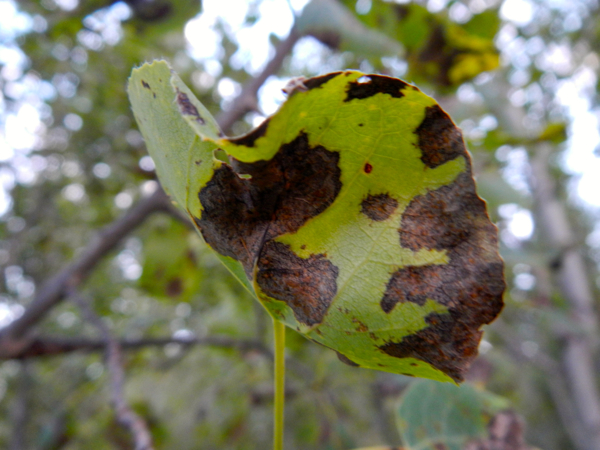
Aspen leaves at Taylor Creek on the South Shore are showing signs of stress from lack of water. Photo/Kathryn Reed

Aspen leaves at Taylor Creek on the South Shore are showing signs of stress from lack of water. Photos/Kathryn Reed

By Susan Wood

If a leaf or a cone falls in the forest, will anyone see the symptoms of change?

That’s the question botanists, foresters, climatologists and arborists may be asking in the age of an unprecedented Western drought.

Come fall, aspens represent the most recognizable tree that changes color in the Sierra Nevada. But from Rabe Meadow to Taylor Creek and Hope Valley to the Carson region, they appear stressed.

It’s August, and many leaves have either fallen to the ground, already prematurely turned yellow, started drooping or have been reduced to a crispy brown in some places.

“We’ve noticed in dry years they start to change color earlier than usual. They’ll run their course a little faster if they don’t get the moisture,” said Kelly Redmond, Western Regional Climate Center climatologist based in Reno, told Lake Tahoe News.

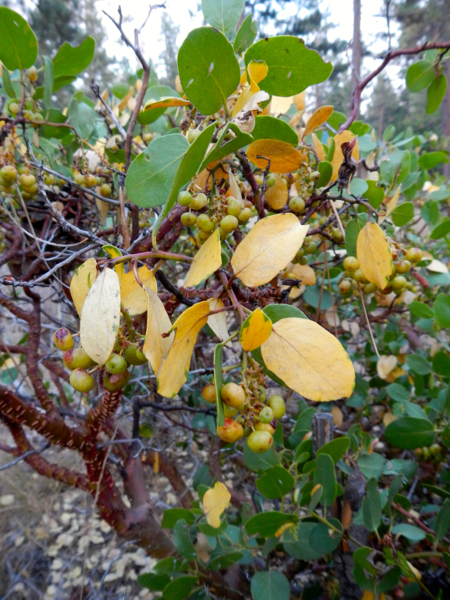
Manzanita bushes are turning yellow.

Manzanita bushes are turning yellow.

Redmond said there are two issues he looks at – timing and color. He’s also noticed this year the shades of colors are dimmer. Although Redmond is a regional El Nino expert, he doesn’t associate the trees trending differently with the weather phenomenon. He does point to drought, but believes more needs to be analyzed to clearly understand “phenology” – the study of plant life cycles and how they’re influenced by seasonal variations of climate.

“The whole business of what makes leaves change is not well established in the climate world,” he said.

Agreeing to some extent is Courtney Rowe, the Lake Tahoe Basin Management Unit forest botanist. She’s seen enough to assume that the aspens as well as our Jeffrey, sugar and lodgepole pines in addition to the white and red firs are in survival of the fittest mode. The willows change early anyway and haven’t deviated from that trend this year.

The aspens will drop leaves that consume too much energy to maintain with a lack of precipitation in the hopes of a better year ahead. Pine trees will unload the cones and needles because they become a pricey commodity.

“The lack of water is a cue to make the decision to get rid of leaves and wait for next year,” Rowe said of the environmental trigger. Dumping the leaves helps to reduce water use and stay alive.

It appears scientists aren’t the only ones noticing the change in the change of seasons.

Lindsay Gusses, who runs the LTBMU visitor center at Taylor Creek for the U.S. Forest Service, said visitors are often asking what is going on with the leaves in the groves characteristic of the South Shore region off Highway 89.

“Now with four years of drought we’re seeing it more and seeing it sooner,” Gusses said.

According to the U.S. Forest Service, 12.5 million trees have died off in California.

The fear is if the drought continues, the trees may produce fewer leaves or seeds, or worse yet, tree mortality could be more prevalent – whether it’s through the seedling dying or the tree itself taking a direct hit. And weaker trees tend to welcome more pathogens like the mountain pine beetle to invade.

The eco genetics of the trees weave their way into interpretive talks at Taylor Creek that Gusses hosts on the Rainbow Trail three times a week. Even children ask about the current conditions and the effects, Gusses said.

“They get curious,” she added.

And the trend travels away from Lake Tahoe.

Sorensen’s Resort in Hope Valley has built a business on mass visitation in the fall to view the leaves changing. Its customer base has already been asking questions about the tree’s abnormal behavior this summer, while noticing the wilted, fallen leaves.

“They seem a little more stressed this year. I think the whole forest is stressed,” Sorensen’s co-owner Patty Brissenden said, putting the whole West Coast into the eco equation.


NDOW kills nuisance black bear in Incline

By Jeff DeLong, Reno Gazette-Journal

A problem-causing black bear that wildlife officials said was becoming increasingly dangerous was killed Tuesday in Incline Village.

The bear, a 9-year-old, 450-pound male, was captured Monday night or early Tuesday morning, tranquilized and subsequently euthanized with drugs, said Chris Healy, spokesman for the Nevada Department of Wildlife.

The bear was determined to be the same one that had been raiding trash, breaking into cars and knocking over fences in the area and was killed as a threat to public safety, Healy said.


Read the whole story