SLT bike park to be dedicated for Wendell
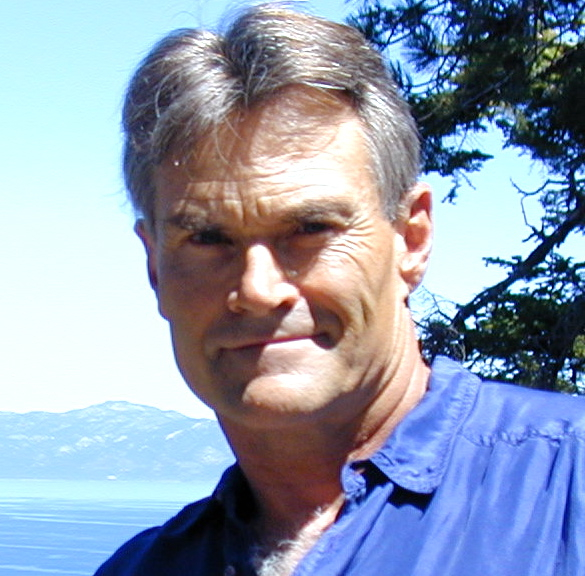
 

Tom Wendell

Tom Wendell

By Kathryn Reed

Tom Wendell left an indelible mark when it came to cycling on the South Shore.

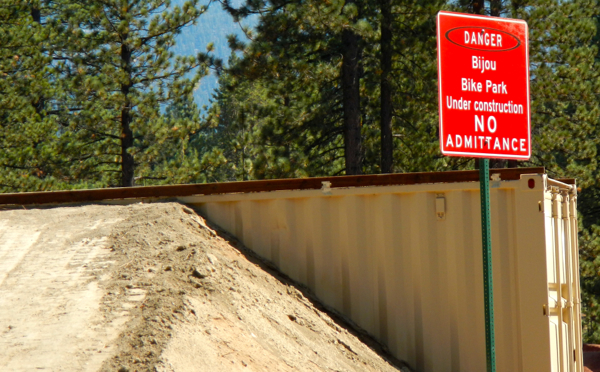
To honor this man who died two years ago at the age of 62 the city of South Lake Tahoe is dedicating the Bijou Bike Park in his name. A sign will be unveiled when the park opens Sept. 19. The top will say the park is dedicated to Wendell, followed by a tribute written by his brother, Ted.

In the middle will be a list of people who helped bring the park to fruition, with the donor list next to it.

Wendell promoted recreation when no one was listening. He was relentless with his passion and desire to get the powers that be to understand this area was an outdoor playground that needed to be promoted, developed – in the sense of trails, appreciated and maintained.
Sidebar: The following activities are planned: ·       10am        Parade starts at the Y ·       11:30am   Parade ends at Bijou Community Park ·       12:30pm   Ribbon cutting for bike park ·       1pm          Bijou bike course open to public ·       1:30pm     Bike rodeo for kids ·       2-3pm       Jump Jam on slopestyle line with world-class athletes ·       3:30pm     BMX race starts ·       All day      4th annual Deep Blue Derby Tournament hosted by the Sierra Regional Roller Derby.

The following activities are planned for Sept. 19:                 10am Parade starts at the Y; 11:30am Parade ends at Bijou Community Park; 12:30pm Ribbon cutting for bike park; 1pm Bijou bike course open to public; 1:30pm Bike rodeo for kids; 2-3pm Jump Jam on slopestyle line with world-class athletes; 3:30pm BMX race starts; All day 4th annual Deep Blue Derby Tournament hosted by the Sierra Regional Roller Derby.

“We know this would have been important to him. He talked about more bike parks all the time,” City Manager Nancy Kerry told Lake Tahoe News. “When you have people who are true advocates for a cause, they champion it. They make sure city officials are listening. Tom did that for biking.”

After Wendell died in August 2013 there was much talk by people of wanting to name something for him. The park dedication is the city’s way of recognizing Wendell’s contributions through the years to the cycling community.

In 2001 he helped form Tahoe Region Advocates for Cycling with Bob Kingman, Karen Fink, Pete Fink, Jeff Miner and Gary Bell. That was the predecessor to the Lake Tahoe Bicycle Coalition, of which Wendell was part.

Wendell was seldom seen in his car – even in the winter. His hybrid bike was like an extension of him. The trails around Cold Creek and Powerline were his regular stomping grounds when he was mountain biking.

Wendell has many people who are carrying his torch for him now. Ben Fish spent hours to make the bike park a reality. Then there is Ty Polastri, Curtis Fong, Pete Fink and Gary Bell – just to name a few – who walked alongside Wendell in his endeavors and today do more than their share to make road and mountain biking a reason to live at and visit Lake Tahoe.


USFS program encourages kids to get outdoors

Lake Tahoe Basin Management Unit, Eldorado National Forest and Tahoe National Forest are participating in the Every Kid in a Park program.

Fourth-graders nationwide can visit the new Every Kid in a Park website to obtain a pass that provides free access to students and their families to all federally-managed lands and waters – including national forests, grasslands, wildlife refuges and waters. The pass is valid for the 2015-16 school year and grants free entry for fourth-graders and three accompanying adults (or an entire car for drive-in parks) at more than 2,000 federally-managed sites.


President Obama launched the Every Kid in a Park initiative earlier this year as a call to action to get all children to experience America’s outdoors. Today, more than 80 percent of American families live in urban areas, and many lack easy access to safe outdoor spaces. At the same time, youth spend more hours than ever in front of screens instead of outside.

Fourth-graders may log onto the website to complete an educational activity in order to obtain and print their pass. Students can also trade in their paper pass for an official access card at participating federal sites. Passes are available at national forest offices.

Educators and community leaders may access educational activities, field trip options, and print passes for their classrooms. Parents visiting the website can find additional links for more information on planning trips to nearby public lands.


Mapping where Truckee River water goes

By Jeff DeLong, Reno Gazette-Journal

What percentage of the Truckee River’s water goes to agriculture in the Fallon area varies year to year and depends on how much water is available. On an average year, when plenty of water exists in the Carson River and Lahontan Reservoir to irrigate crops, the vast majority of the Truckee River’s water – 80 percent – flows to Pyramid Lake.

The Truckee-Carson Irrigation District gets 10 percent, diverted from the river at Derby Dam, for crop irrigation. The Truckee Meadows Water Authority gets 3 percent for municipal use in the Reno-Sparks area.

On an average year, about 734,000 acre-feet of water is diverted from the Truckee River.

Read the whole story


Problem Tahoe bears run in the family

By Scott Sonner, AP

RENO — Are some bears just born to be bad? Or do they learn from other bears that raid garbage cans, break into cars and homes and eventually have to be killed because they’ve lost their fear of humans?

Scientists have researched this classic debate over “nature” and “nurture” among black bears for decades, from Yosemite National Park in the Sierra to central Florida and the Adirondacks in upstate New York.

Now, a notorious 19-year-old female bear at Lake Tahoe with a rap sheet a mile long has become a poster child of sorts for the kind of generational cycle that experts say her young will be hard pressed to break as long as humans continue to leave garbage in their reach.

Last week, Nevada wildlife officials were forced to euthanize a young problem bear at the lake — the third offspring killed from the same litter born to the mama bear known by her tag number, Green 108.

“She’s just kind of a chronic, nuisance-type bear,” said Carl Lackey, a wildlife biologist for the Nevada Department of Wildlife. “She’s always been getting into trash, always been in the same area. We’ve captured several litters of hers. We’ve captured her several times.”
Lackey co-authored a 2008 study published in the Journal of Mammalogy about the role of genetics in bear conflict behavior.

“We sort of concluded that genetics alone could not explain a nuisance behavior in black bears,” Lackey said about the research led by S.W. Breck and C.L. Williams at the USDA’s National Wildlife Research Center in Fort Collins, Colorado.

A study led by National Park Service researchers first suggested in 1989 that problems with Yellowstone’s grizzly bears were a function of behavior passed from mother to offspring and successive generations, but it didn’t determine whether it was learned or inherited.

Another 2008 study by Rachel Mazur and Victoria Seher, researchers at Yosemite’s Division of Resources Management, documented bears “actively tutoring” their cubs to find food in human environments. They concluded that food-conditioned foraging is a skill passed from older bears to the young.

“We have observed sows pushing cubs into buildings and vehicles to retrieve food rewards,” they wrote.

Lackey said several bears that have been caught at Tahoe multiple times and released back into the wild “won’t go into a trap anymore.”

“They send their cubs into the trap or cubs into homes to get food,” he said.

Nevada Department of Wildlife spokesman Chris Healy witnessed something similar last summer at a trap set in Reno.

“Cubs showed up curious about the trap, and the sow we caught a year before would sit there and growl at the cubs to scare them away,” Healy said.

“We’re dealing with really smart animals that become habituated to food,” he said. “If you want to solve the problem, you have to change the way you deal with garbage.”

National parks across the West long have utilized bear-proof trash containers. Several communities in the Canadian Rockies started requiring bear-proof garbage cans as early as 1999. A few U.S. towns have made them mandatory, including parts of Boulder, Colorado, last year. But others — including Lake Tahoe — have rejected attempts because of costs and opposition to government regulation.

Mazur and Seher examined in 2008 whether the bears simply were adapting to their environment, or whether “previously adaptive behavior” became counter-productive, putting the animals in the way of harm by increasing contact with humans. While the garbage provides high-energy food, those bears were 5.6 times more likely than cubs of wild sows to be hit by cars, hunted or killed for safety reasons, they found.

In the end, the bears fall into an ecological trap, they wrote.

In 2004, Green 108 was first captured in Tahoe, tagged and released. Since then, she’s been trapped four times, most recently in July 2012.

“We don’t euthanize bears just for getting in trash when that’s all they’re doing,” Lackey said. “But that conflict behavior escalates from tipping over trash cans to breaking into homes, and that’s when we have to euthanize them.”

So is society ultimately to blame for problem bears like Green 108 and her cubs? Lackey thinks so.

“If we could have waved a magic wand and bear-proofed Tahoe years ago, you wouldn’t see the number of bears getting into these conflict situations,” he said.

Healy said Tahoe never had a serious bear problem until the early 1990s when food sources dwindled in the mountains during extended drought.

“That drought drove bears out of the back country, and a lot of them never left,” he said.


Downsides to doing a different workout every day

By Amanda MacMillan, Outside

When it comes to working out, most of us have no shortage of options. Most cities now have countless boutique fitness studios with services like ClassPass to let you sample as many workouts as you can squeeze into a month.

Group-training gyms like CrossFit introduce new workouts daily, with very little repetition in routine. And if you happen to do most of your exercising outside, the options are unlimited.

But like all good things, it is possible to have too much exercise, or at least too many options. Though it’s true, having variety in your training can help prevent injuries and provide your body with what’s known as “muscle confusion,” which keeps you from hitting an eventual plateau as your body adapts to the same physical stresses day after day.

But according to exercise physiologist and personal trainer Tom Holland, constantly changing your workouts may not actually be the smartest way to train because without consistency, it’s harder to make daily exercise a habit—and harder to make measurable progress in strength or skill.

Read the whole story


World has many more trees than previously thought

By Mark Armao, Wall Street Journal

There are slightly more than three trillion trees in the world, a figure that dwarfs previous estimates, according to the most comprehensive census yet of global forestation.

Using satellite imagery as well as ground-based measurements from around the world, a team led by researchers at Yale University created the first globally comprehensive map of tree density. Their findings were published in the journal Nature on Wednesday.

A previous study that drew on satellite imagery estimated that the total number of trees was about 400 billion. The new estimate of 3.04 trillion is multiple times that number, bringing the ratio of trees per person to 422 to 1.

Read the whole story


Kingsbury trail being improved for variety of users

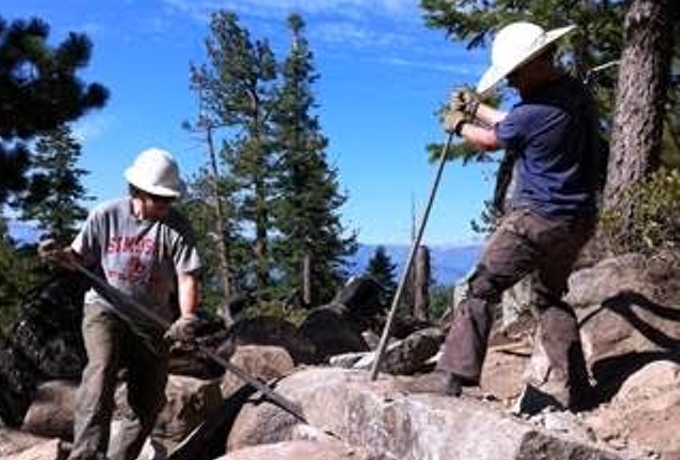
Crews work on a multi-use trail in Stateline. Photo/Provided

Crews work on a multi-use trail in Stateline. Photo/Provided

A six-member U.S. Forest Service trail crew has been busy reconstructing the Kingsbury Stinger Trail on lower Kingsbury Grade.

The upgraded trail will remain open to off-highway vehicles 50-inches wide (or less) including all-terrain vehicles and motorcycles, and non-motorized recreation use such as mountain bikes, hikers and equestrians.

The existing route is located in a sensitive drainage area that has many steep, eroded trails, which affects water quality and degrades the natural habitat. Nearly 3-miles long, the trail descends 1,300 feet and is very difficult for OHV and mountain bike users due to the exceptionally steep grades and deeply rutted surface. The realigned trail runs approximately 4.5 miles, with the same 1,300-foot elevation change. It will twist through stands of large trees and boulders and provide views of Lake Tahoe.

The upgraded trail is expected to be completed by the summer 2016.

The proposed action and a map of the project area are available online.


Golf tourney benefits Boys & Girls Club

The Boys & Girls Club of Lake Tahoe is hosting its 22nd annual golf tournament at Edgewood Tahoe on Oct. 12.

The event annually raises more than $40,000 to support the work of the club, which assists more than 600 local kids throughout the year.

For $225, golfers receive a round of golf, gourmet buffet breakfast, beverages throughout the day, $10,000 hole in one and closest to the pin competitions on all four par 3s, dinner, raffle prizes, a silent auction and a grand prize drawing.

For non-golfers or folks whose schedule is tight but who want to come join the fun and support local youth programs, an exclusive post-round dinner ticket is available for $25.

For more information or to register,  go online or call 530.542.0838.


SLT parade to end with opening of bike park

South Lake Tahoe’s 50th anniversary parade route has changed so it will end at the new bike park at Bijou Community Park.

The Sept. 19 10am parade will begin at the Y and end at the park.

The city has received more than 85 entries and expects more than 300 walkers in the parade.

The following activities are planned:

  • 10am               Parade starts at the Y
  • 11:30am          Parade ends at Bijou Community Park
  • 12:30pm         Ribbon cutting for bike park
  • 1pm                 Bijou bike course open to public
  • 1:30pm           Bike rodeo for kids
  • 2-3pm             Jump Jam on slopestyle line with world-class athletes
  • 3:30pm           BMX race starts
  • All day             4th annual Deep Blue Derby Tournament hosted by the Sierra Regional Roller Derby.


Crews take ax to invasive weeds in Tahoe marsh

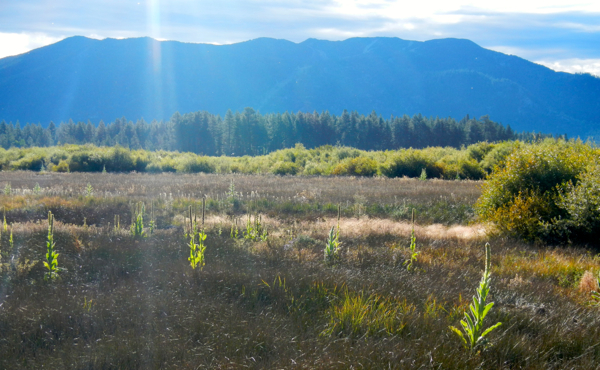
The invasive mullein weed is scattered about the Upper Truckee Marsh. Photo/Kathryn Reed

The invasive mullein weed is scattered about the Upper Truckee Marsh. Photo/Kathryn Reed

By Kathryn Reed

Long stalks lay lifeless on the ground; others are being carted away to be disposed off-site.

Mullein looks pretty, with stalks that can grow to 10 feet, and yellow flowers blooming every other year.

The problem is mullein is a weed – and an invasive one.

“They take resources away from plants that are indigenous,” Sarah Werick, land steward with the California Tahoe Conservancy, told Lake Tahoe News.

She was out at the Upper Truckee Marsh last month leading a crew that was removing the weed.

Where the plant is in its lifecycle determines how the agency handles it. What are left behind are portions of the plant that don’t have seeds. Just a little moisture and the mullein will reproduce. That is why the sections with seeds are removed from the area.

Mullein is scattered about this more than 400-acre section of the South Shore. Werick said the plant could take over a location – another reason to get rid of it.

Mullein can be allergenic, so some of the crewmembers have donned surgical masks to keep from inhaling anything that might make them ill.

As part of Werick’s job, she is always keeping an eye out for invasive plants.

“When we see a growth spurt, we come out and do a big weed removal,” she explained.

Also being removed on this particular day were thistles that are not native to the basin. However, there is indigenous thistle that remains untouched.

It takes a trained eye to know what is “good” vs. what is “bad,” which is why Werick discourages the public from pulling plants.