Time to help clean up Truckee River

The 20th annual Truckee River Day is Oct. 18.

Volunteers have their choice of half or full day restoration projects with different levels of difficulty. There will be 10-12 projects, including restoration at Dry Creek in Russel Valley, seeding and mulching at Johnson Canyon, milfoil surveys in Martis Valley, and revegetating near Boca Townsite. Work starts at 9am or 11am and ends at 2pm or 3pm.

The River Fair will be from 1-4pm at Granite Flat Campground.

This community event is presented in partnership with Sierra Watershed Education Partnerships. The fair features environmental activities for kids and adults. Food will be provided free of charge by Northstar.

To participate, register online by Oct. 15.


Star Lake — a stellar hike in the Sierra

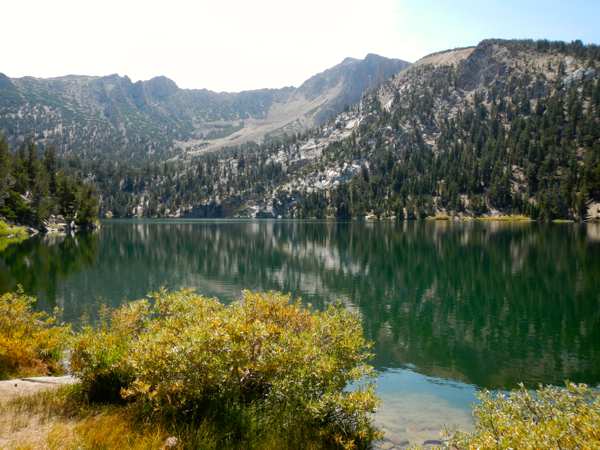
Star Lake is at an elevation of more than 9,000 feet. Photos/Kathryn Reed

Star Lake is at an elevation of more than 9,000 feet. Photos/Kathryn Reed

By Kathryn Reed

“Are we there yet?” is never a good question because inevitably the answer is “no” and the destination is still a ways off.

Such was the case with the hike to Star Lake a week ago. High Meadow trailhead is up, straight up, no switchbacks, on an old pitted road that is more suitable for a four-wheel drive vehicle than legs.

Enduring this stretch of trail, though, was well worth it. Star Lake is a jewel in the Sierra. As Rosemary said, it must have gotten it’s name from being so high it’s like the stars would be within reach if it had been nightfall.

The lake is at 9,100 feet.

Carolyn, who was wearing her FitBit, recorded 35,375 steps for the entire hike (which included walking around her house that morning) – as well as having logged 14.53 miles.
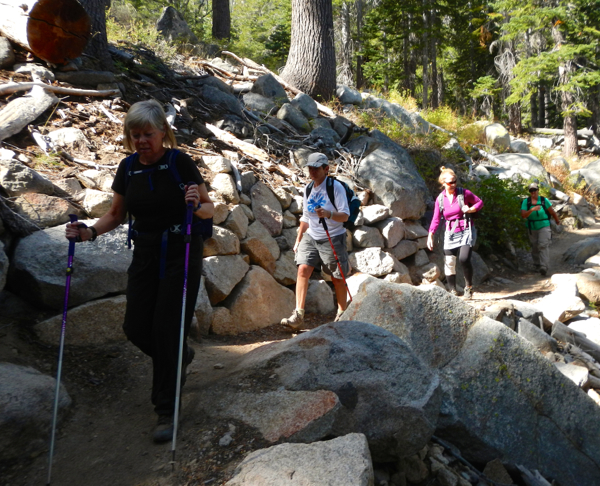
Carolyn, Rosemary, Brenda and Sue on their way to Star Lake.

Carolyn, Rosemary, Brenda and Sue on their way to Star Lake.

Before reaching High Meadow we turned off to the right toward Star Lake. (There’s now a sign there.) The trail became single-track, more gradual – even level at times, with the lodgepole and Jeffrey pines being interspersed with some juniper trees higher up. At one point the five of us walked through a quartz field; not a common sight in Tahoe.

Intermittently views of Lake Tahoe and the entire South Shore unfolded below us.

Water flows in a couple spots, which AJ was appreciative of.

Our destination – Star Lake – was too cold for our gang to swim in, but that didn’t stop others from cooling off. A couple tents were in the area, with openings to views of the jagged mountains surrounding the lake. Plenty of beach-like areas surround the water – perfect for a lunch break.
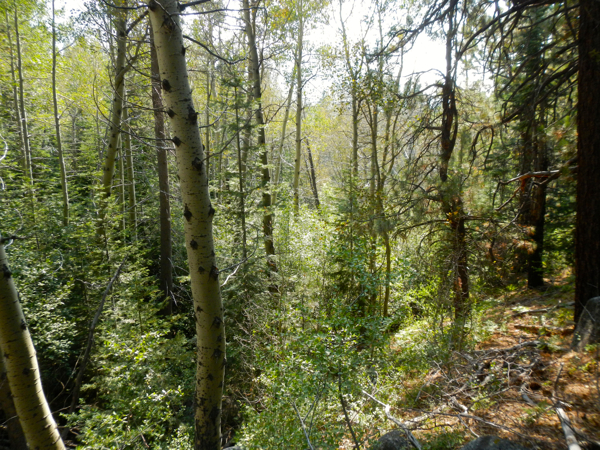
A fertile environment, including numerous ferns, along Cold Creek.

A fertile environment, including numerous ferns, along Cold Creek.

We were able to make a loop to avoid the road on the way back. We turned right toward the meadow on our way out.

The U.S. Forest service in 2012 completed a three-year, $2 million restoration of the meadow that realigned Cold Creek to more of its natural meander.

A slew of trails are in the area – including the Tahoe Rim Trail. It’s popular with mountain bikers. But one needs to be in good shape and able to navigate challenging terrain.

“After three seasons of work, the Monument Pass trail was completed in 2014. The trail connects from High Meadows to the Tahoe Rim Trail at Monument Pass with interesting rock formations, aspen groves, and views of Lake Tahoe.  The Star Lake Trail was completed in 2012 and was rerouted from the original road, which was overly steep with a fall line alignment. The trail gently climbs for approximately 3.8 miles to Star Lake and the Tahoe Rim Trail,” Garrett Villanueva, trails expert with the USFS, told Lake Tahoe News.

Monument Peak – which is the backside of Heavenly Mountain Resort – is on one side of the meadow at 10,067 feet. The meadow is at an elevation of 7,834 feet. Across the other side of the meadow are Freel, Jobs and Jobs Sister.
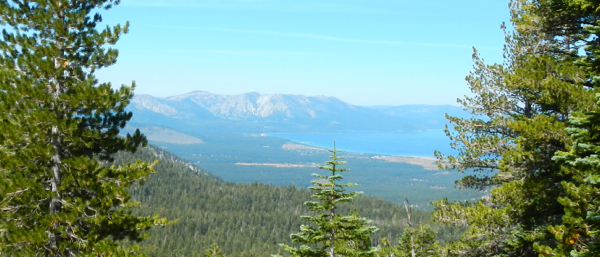
Lake Tahoe from the trail.

Lake Tahoe from the trail.

The foliage is more dense and lush along the Cold Creek trail. Near the top the aspens look healthy, whereas closer to the bottom the leaves have black splotches, with many branches barren. Still, this is so much prettier than the road we went up on in the morning. It’s also longer, but well worth it.

There were more “Are we there yets?” on the way down, but no one was complaining about having spent another glorious day hiking in Lake Tahoe.

—–

Getting there:

From South Lake Tahoe – get onto Pioneer Trail. Turn onto High Meadow Drive. This is the corner where Sierra House Elementary is. Drive as far as you can. Take the main trail that looks like a road.


Tahoe City training young mountain bike riders

The Tahoe XC Junior Mountain Riders Program provides children ages 7-11 an opportunity to experience and grow in the sport of mountain biking.

The weekly club rides focus on developing strong, responsible riders through instruction, practice, and fun in a healthy, supportive environment.

The six-week program costs $45 per child or $10 for drop-ins. It runs from Sept. 14-Oct. 19, 4-5:30pm. Meet at the Tahoe XC trailhead.

RSVP with child’s name, age and biking ability to andrews@tahoexc.org.


LTUSD-SLT restructuring fields agreement

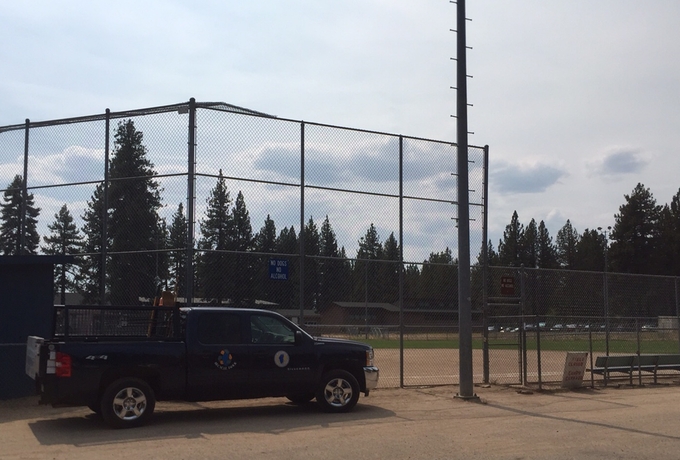
Soon South Lake Tahoe vehicles will not be seen at Lake Tahoe Unified School District owned fields. Photo/LTN

Soon South Lake Tahoe vehicles will not be seen at Lake Tahoe Unified School District owned fields. Photo/LTN

By Kathryn Reed

Players won’t notice anything different, but those who schedule and pay for the use of fields and tennis courts in South Lake Tahoe are likely to encounter fewer headaches going forward.

This is because this month city and Lake Tahoe Unified School District electeds are expected to ratify agreements that put LTUSD in control of these public entities. This means setting the fees, maintaining the facilities, paying for water-sewer-electric, and all of the scheduling. The latter has been under the district’s purview for a couple years.

The big change is oversight will be handled by one agency. The school board heard a presentation about this on Sept. 8 (no member of the public spoke), but won’t take action until Sept. 22. The agreement is on the Sept. 15 City Council agenda.

In putting together the recreation master plan it was evident a streamlined approach was needed to eliminate confusion for the public. This included a one-stop shop for booking facilities, and a clearer understanding of what the costs are. The agreement speaks to those issues.

LTUSD Superintendent Jim Tarwater is looking to keep the same fees for locals and charge more for out-of-town groups. Tarwater said the current prices are comparable to other facilities, though they are a little on the low side.

“Tournaments are what I’m looking at. Once we have established people they’ll keep coming up,”  Tarwater told Lake Tahoe News.

The change means the city will no longer be maintaining property it doesn’t own, nor will it be paying utility bills at the various sites. The city for a number of years had been doing so at some of the school district sites.

“For some reason over the years as lights would be installed they just got left in the city’s name. The city is transferring utilities to the property owner,” City Manager Nancy Kerry told Lake Tahoe News.

In this first year of the agreement the city will pay the district a $100,000 stipend to offset its new expenses.

The two agencies will evaluate that subsidy on an annual basis.

“They will hire a reservation clerk, grounds superintendent and tournament coordinator. The city wants to help offset that because it helps support community recreation,” Kerry said.

Tarwater said the scheduling piece would change by hiring someone to work 20 hours a week, with flex hours to handle crunch time in the spring and early summer. More grounds crews will be hired, too.

Attracting tournaments could offset expenses as well as increase revenue. South Tahoe High School hosted three football camps this summer. Breakfast, lunch and dinner were served to the players, which netted the district a few thousand dollars.

“We are looking at a more full service approach and outreach,” Tarwater said.

Tarwater would also like to put a pot of money aside to fix the tennis courts at South Tahoe Middle School, as well as get more groups to use the high school courts. (He said the football players put tents on STHS courts this summer because they got scared when they saw a bear.)

The recreation center and ice rink are not part of the agreement. However, the ball field at Lake Tahoe Community College and the fields that will be built adjacent to the artificial turf one will come under a separate agreement among the three entities. Later this fall LTUSD, SLT and LTCC electeds are expected to create a joint powers agreement to handle the fields there.

—–

       Notes:

·      South Lake Tahoe City Council meeting is Sept. 15 at 9am at Lake Tahoe Airport.

·      Lake Tahoe Unified School District meeting is Sept. 22 at 6pm at the district office on Al Tahoe Boulevard.


Old Highway 40 to get nearly $10 mil. overhaul

A $9.9 million grant from the California Federal Lands Access Program will be used to improve 6.5 miles of Donner Pass Road (Old Highway 40) from Interstate 80 to the Truckee.

The grant was awarded to Nevada County, though part of the work will be done in Placer County.

Upgrades include Class II bicycle lanes, parking and pavement rehabilitation.


Work is slated to begin in 2016, with completion in 2019.


Learn to landscape with little water

The final workshop in the Tahoe Friendly Landscaping series is Sept. 12 at Lake Tahoe Community College in Room B103 from 9am-1pm.

Converting Lawn to a Water Wise Landscape the Easy Way will provide hands-on demonstrations on turf removal, sheet mulching, and converting to micro irrigation. There will also be a discussion on different landscape styles and techniques.


This workshop is free and open to the public.


Mountain biking roots traced to Bay Area

By Ann Killion, San Francisco Chronicle

When Joe Breeze did what thousands of Mill Valley kids had done before him — stood on Miller Avenue across the street from the 2am Club and stuck out his thumb to hitch a ride — he didn’t know he was changing history.

But he was. Because on that October day in 1973, Breeze had a bike with him. A stripped-down old Schwinn cruiser, with big balloon tires.

It took a couple of rides to get all the way up to the top of Mount Tamalpais, but Breeze got there. He was supposed to meet his cycling pals Otis Guy and Marc Vendetti, but they were nowhere to be found. So, in the East Peak parking lot, he jumped on his bike and rode down the old railroad grade fire road.

“Oh, my God,” he thought to himself, “this is so much fun.”

Read the whole story


Drought along the Pacific Crest Trail

By Mary Emerick, High Country News

We had barely covered the first 10 miles of trail, hiking north from the California-Mexico border, when my hiking partner, Flash, and I found the first Pacific Crest Trail casualty. A man in his 20s, face flushed red from heat, watched us approach with clear embarrassment.

He sat in a small patch of shade next to a pack bristling with a solar charger and the latest, most expensive gear. “You wouldn’t happen to have any water, would you?” he asked.

Flash and I eyed each other. We were each carrying six liters, enough to easily take us the first 20 waterless miles to the Lake Morena campground. We had planned our water carry days before.  One liter for every five miles, with a little extra to account for the early April heat.  It was before noon, and a big climb out of Hauser Canyon awaited us. How much could we spare?

It was impossible to walk away without helping. The hiker watched precious water trickle into his bottle and drained it. We gave him more.  That morning he had set off on a journey of more than 2,600 miles, determined to make it to Canada, but a few hours later he had called friends for a pick up at Lake Morena.  He was leaving the trail.

Read the whole story


Fall doesn’t mean gardening is over for the year

By Melinda Myers

Don’t pack away that shovel and trowel. Fall is a great time to plant a few new additions in the landscape. Here are just a few ideas for adding immediate and long term beauty to your garden.

Add cool season annuals like pansies, snapdragons, ornamental kale and stocks to brighten the fall garden. Those in milder regions will enjoy them throughout the winter. Consider adding cold hardy pansies. They provide color in the fall garden, survive most winters, and are back blooming in the spring just as the snow melts.

Plant daffodils and other spring flowering bulbs in the fall for extra color next spring. Photo/Melinda Myers LLC

Plant daffodils and other spring flowering bulbs in the fall for extra color next spring. Photo/Melinda Myers LLC

Fall is also a good time to plant perennials, trees and shrubs. The soil is warm and the air cooler, so the plants are less stressed and establish more quickly. Select plants suited to the growing conditions and be sure to give them plenty of room to reach their mature size.

Plant trees so the root flare, the place where the roots curve away from the trunk, is even with the soil surface. Dig a hole, the same depth as the rootball, and two to five times wider. Roughen the sides of the hole and backfill with the existing soil. Water thoroughly and spread a 2 to 3 inch layer of mulch over the soil surface, keeping the mulch away from the tree trunk.

Follow a similar planting procedure for shrubs.  Plant these so the crown, the place where the stems meet the roots, is even with the soil surface. And be sure to keep the mulch away from the stems.

Plant daffodils, tulips, hyacinths and other bulbs in fall for extra color next spring. Set the bulbs at a depth of 2 to 3 times their height deep.  Then cover them with soil and sprinkle on a low nitrogen slow release fertilizer. This organic nitrogen fertilizer promotes rooting without stimulating fall growth subject to winter kill.

Start planting spring flowering bulbs after the nighttime temperatures hover between 40 and 50 degrees.  Be patient – waiting until the soil cools reduces the risk of early sprouting that often occurs during a warm fall.

Those tired of battling the animals may want to plant resistant bulbs such as daffodils, hyacinths, Fritillaria, alliums, Camassia, glory-of-the snow, snow drops, squills, and grape hyacinths. You may find it is easier to avoid the problem than battle the animals with repellents and scare tactics.

Plant a few short season vegetables in your garden for fresh-from-the garden flavor this fall. Simply count the days from planting to the average first fall frost to determine how many growing days are left in your area. Select vegetables that will mature and can be harvested in that amount of time. Leaf lettuce, spinach, mustard greens, radishes and carrots are fast growing, cool weather tolerant vegetables that make great additions to the fall garden and your dinner plate.

Get these vegetables off to a good start with a side dressing of low nitrogen fertilizer. Incorporate it into the soil prior to planting or sprinkle a narrow band along the row of plants. This organic nitrogen will provide needed nutrients without damaging the tender seedlings.

Extend the harvest season with the help of floating row covers. These fabrics allow air, light and water through while trapping the heat around the plants. No construction is needed; just loosely cover the plants with the fabric, secure the edges with pipes, boards or landscape staples and let the plants provide the support.

So be sure to get a jump on next spring’s garden season with a bit of fall planting now.

Gardening expert, TV/radio host, author and columnist Melinda Myers has more than 30 years of horticulture experience and has written more than 20 gardening books.


Patrollers optimistic deal will be struck before ski season

By Bubba Brown, Park Record

When the Canyons Professional Ski Patrol Association sat down with Vail Resorts to negotiate this spring, Pete Earle, president of the association, was hopeful a deal would be struck before the ski season ended.

But, for a number of reasons, the two sides were not able to come to an agreement. And since several of the negotiators for the association — which is a member of the union chapter United Professional Ski Patrols of America and has long patrolled the ski area that is now known as Canyons Village at Park City — were out of town over the summer, the parties agreed to table discussions and reconvene this fall.

This summer’s merging of Canyons Resort and Park City Mountain Resort was one factor that muddied the negotiations, as the sides were uncertain how that would affect the association, Earle said.

Read the whole story