Kids go outdoors to learn about plants, animals

By Kathryn Reed

A lagoon that looks more like a mudflat became a wealth of scientific discovery for Tahoe Valley Elementary School students.

“I learned how to keep water clean,” third-grader Sabrieo Parker said. She also learned that certain weeds could be bad for native fish.

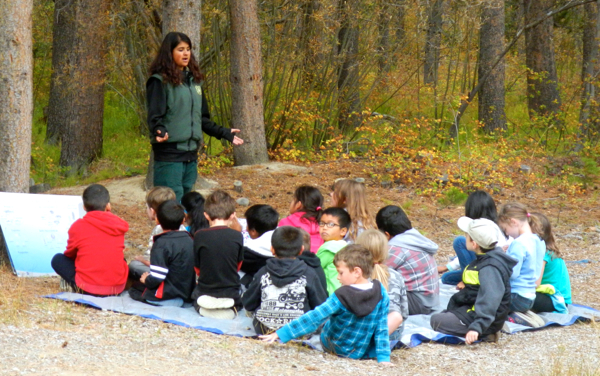
Students throughout Lake Tahoe Unified School District spent last week and will spend part of this week getting out of the classroom to learn about their environment.

“The biggest message was when you have invasive species it hurts native species,” Adilene Negrete with the U.S. Forest Service said.

This is true of plants and animals.

Adilene Negrete with the U.S. Forest Service teaches students about aquatic invasive species. Photo/Kathryn Reed

Adilene Negrete with the USFS teaches students about aquatic invasive species. Photo/Kathryn Reed

Savannah Rudroff with the League to Save Lake Tahoe was imparting information about plants in the area – primarily Eurasian milfoil and curlyleaf pondweed – that are not native.

A magnifying glass allowed the students to see the plants in greater detail. Then they got to color them – a step in reinforcing what they look like, with the idea they will be able to identify them outside the classroom experience.

Besides learning about specific fish and plants, the youngsters also broadened their vocabulary – learning what native, non-native and invasive mean.

Instruction is geared toward the appropriate grade level, with K-5 part of the outdoor classroom.

Also helping educate kids, though not necessarily each day, are representatives from the Tahoe Regional Planning Agency, South Tahoe Public Utility District, Lake Tahoe Humane Society, Tahoe Institute for Natural Science, Sugar Pine Foundation and community volunteers.

Each outing was as close as possible to the actual school site. This was designed to allow teachers to go to the location to further the learning experience.

For TVES kids it mean walking outside the back gate to the area near the Tahoe Keys lagoon.

This is the fourth year Beth Quandt, science outreach coordinator for the district, has put together this program.

“All the activities get kids to see what is going on in their environment,” Quandt told Lake Tahoe News.

Each lesson is age appropriate, with the curriculum growing from one level to the next.


Lesser known football injuries can be a killer

By CBS News

Player safety has football’s spotlight, from the NFL to Pop Warner football for little kids.

While the focus has been on concussions and discouraging helmet-to-helmet hits, tackling is often lower on the body, from the shoulders to the knees — and that opens up a different, potentially fatal worry.

Brian and Kathy Haugen, who lost their 15-year-old son Taylor seven years ago from a hit on the football field, are educating coaches, parents and players about those abdominal risks.

As receiver Taylor reached for a pass in 2008, two tacklers hit him, one from the front, another from the back. He staggered off the Florida field.

Read the whole story


Tahoe man hits hole in one in Meyers

Victor Uriz celebrates his hole in one on Oct. 2. Photo/

Victor Uriz celebrates his hole in one on Oct. 2 at Lake Tahoe Golf Course. Photo/Terry Darrough

“Sometime it’s better to be lucky than to be good” is how Victor Uriz summed up sinking a hole in one at Lake Tahoe Golf Course in Meyers.

The South Shore resident who has being playing golf for about eight years hit the shot Oct. 2 on hole 17.

Uriz’s sister, Cathy Darrough, and her husband, Terry Darrough, witnessed the event.

Uriz, who lives in the Angora burn area, told Lake Tahoe News he is not a very good golfer – “I’m out there hacking away a lot.”

The regular playing time and classes through Lake Tahoe Community College must have taught him something since his shot is something the pros rarely accomplish.

— Lake Tahoe News staff report


Marathon founder not ready to hand off baton

This marks the 20th year of the Lake Tahoe Marathon. Photo/Provided

This marks the 20th year of the Lake Tahoe Marathon. Photo/Provided

By Susan Wood

It may take as much dedication, stamina and love for the sport to run marathon operations as it does to compete in one.

When athlete extraordinaire Julie Moss finished the marathon of the Ironman in Hawaii in 1982 by crawling, six-time champion Mark Allen was so moved, he married her. It was one of the most unforgettable moments in sports.

And those endorphins can be just as important in the joint venture of a business deal, the hallmark of American society.

Locally, just ask Lake Tahoe Marathon founder and race director Les Wright – or even runner, adventure-sport guru Sean Sweeney. Sweeney, 48, and his business partner Jason Collin wanted to last year follow in the footsteps of Wright, now 73, and manage the high altitude marathon known for its stunning views and multitude of auxiliary running events. (It starts Oct. 8.)

But after an enduring more than a year of negotiations and rewrites beginning in March 2014, the deal fell apart.

Wright declined to comment on what happened. Sweeney, however, provided a bit of the high-road account.

Sweeney expressed interest in stepping in to take it over years ago. Wright, according to Sweeney, seemed interested enough to put together a contract involving an exit strategy and 15 concessions including one in which Wright would remain the race director and get paid.

“We spent a lot of time and a lot of energy, and we had an influx of new ideas,” said Sweeney, who also works in the Sierra-at-Tahoe marketing department.

Sweeney believes having 26 events “diluted” the weekend’s main event for the marathon purist.

“He has a lot going on,” Sweeney said. “We wanted to learn from him. But it was going on 14 months, and (he and his wife Cara) were going on vacation. We told him: ‘Vacation or not, if you don’t sign, we’re not interested.’”

Wright declined to sign, and the offer was pulled off the table.

“I’m probably never going to retire,” Wright admitted to Lake Tahoe News. This year is the 20th anniversary of the marathon.

Wright started the Lake Tahoe Marathon upon retiring from Lake Tahoe Unified School District as a physical education teacher at age 53.

“I did all those things I wanted to do when I retired – golf, fished, scuba and running. Then, I said: ‘I’m bored. I’m going to start a marathon,’” he recalled saying to himself in 1995.

Where to place the route was the big question.

He always noticed the captivating stretch along Lake Tahoe’s West Shore from Tahoe City to South Lake Tahoe.

“The beauty of that road gives me chills,” Wright said.

He put out fliers for the September event, and “it just took off from there,” he reflected back on the early beginnings. The first year brought out 250 runners. The next year, 1,300 people signed up. The high mark was 2,800 entries set a few years ago.

Collectively, the event rakes in about $20,000 in proceeds that are earmarked to groups such as Tahoe Arts Project, Valhalla and Tahoe-area schools. Volunteers work the 18 aid stations on the 26-mile route starting at a not-for-the-faint-of-heart 6,227 feet with a 2,000-foot elevation gain. It now ends at Lakeside Beach after two decades of ending at Pope Beach.

Along the way for the Thursday through Sunday extravaganza, Wright has added events – to the point the collage may seem overwhelming to the average participant. There’s the Tahoe Triple (three marathons in three days), Trifecta (three half marathons and a full marathon involving the East Shore.) Tack on a 10K, a swim-run duathlon, standup paddleboarding and kayak races as well as two pumpkin fun runs. In addition, a four-person marathon relay has been added to entice those not wanting to tackle a 26-miler or even half the distance.

“A lot of people will like to do that,” he said.

Overall, about 2,000 people have signed up this year for the multitude of events.

Race director Les Wright fires the start gun. Photo/Provided

Race director Les Wright fires the start gun. Photo/Provided

“No matter when I do it, there’s a conflict,” Wright said, illustrating the focus of events at Lake Tahoe in recent years. The events have been in September and October.

And under the guise of “there’s a reason for everything,” Sweeney and Collin have excelled in their own right by launching Epic Tahoe Adventures, a company that specializes in events to cultivate athletic prowess.

One successful event is the Rock Tahoe Half Marathon scheduled on June 18. With 2016 being its second year, the event has already signed up 500 participants and may take up to 3,000. The first year brought out 2,000 runners. Its slogan “run-rock-recover” goes well with Tahoe’s work-hard, play-hard mantra.

Add in a little techno benefit such as participant access to a recorded clip of themselves on the course, and the half marathon set on the East Shore has an appeal all its own. For starters, the website received more than 800,000 hits – 30,000 in the first two hours, according to Sweeney.

And more is in store from Sweeney’s athletic company.

This could be all good news to a runner like Brenda Knox, a Tahoe Mountain Miler.

“The race is well done. When I finished (this) year’s, I signed up immediately after,” said Knox, who has also competed in the Lake Tahoe Marathon. She’s “not a fan” of shuttles, so seeks out ways to avoid them. This year’s Rock Tahoe Half Marathon fit the bill.

And according to Lake Tahoe Visitors Authority Executive Director Carol Chaplin, there’s room around the lake for both events.

“In some ways, the two events are not comparable,” she said.

Chaplin pointed out how Rock Tahoe is a half and Lake Tahoe Marathon is a half, as well as a full version, along with other events.

Also, one is scheduled in June, while the other is slated in October.

Better yet, both events go hand in hand with Tahoe tourism stakeholders’ quest to make “outdoor recreation pretty much the focus,” Chaplin said.

“Whether there’s growth potential, we can’t answer that now. But I do think this area can support these two events. They don’t compete. We support more than one music event – as long as it’s not on the same weekend,” she said.


Basinwide control burns to begin soon

The Tahoe Fire and Fuels Team, which includes numerous fire and land management agencies in the Lake Tahoe Basin, will begin fall prescribed fire operations as soon as weather conditions are favorable.

Each prescribed fire operation follows a burn plan that considers temperature, humidity, wind, moisture of the vegetation, and conditions for the dispersal of smoke. This information is used to decide when and where to burn.

Smoke from prescribed fire operations is normal and may continue for several days after an ignition depending on the project size and environmental conditions.

To receive prescribed fire notifications, send an email topa_ltbmu@fs.fed.us.


Skiers, resorts cast hopeful eye toward El Niño

By Hugo Martin, Los Angeles Times
 
Forecasts of an approaching El Niño winter have ski resort operators dreaming of the kind of snowy peaks that were a common sight in California before a four-year drought dried up the state’s $3-billion ski industry.

But optimistic talk of powder-covered slopes may not be enough to persuade skiers to buy expensive resort passes, especially after being disappointed by limited runs and broad swaths of exposed dirt the last several seasons.

So this year resorts are trying something new: offering incentives if this year’s predicted El Niño turns out to be a dud. They range from simple discounts to guarantees that give pass holders credit toward skiing next winter.

Some annual passes even can be used at affiliated resorts where snow is more consistent, including one Colorado-based operator that has expanded amid industry consolidation to extend its Lake Tahoe passes to resorts it owns in other states.

Read the whole story


Tahoe National Forest to start pile burning

With the onset of cooler, wetter weather, the Tahoe National Forest is beginning preparations for prescribed burns that will occur throughout the fall, winter and spring, as conditions allow.

Planned projects include burning piles of stacked vegetation and low to moderate intensity understory burns of vegetation on the forest floor. The primary goals of these projects are to reduce the severity of future wildfires and provide protection for communities in the wildland urban interface. In addition, the prescribed burns will promote a diverse and more resilient forest, as well as improve wildlife habitat.

All four ranger districts on the Tahoe National Forest are planning prescribed burning operations. While detailed information on prescribed burning projects is available from the districts, some of the planned projects include:

  • The American River Ranger District will conduct understory and pile burning at Big Trees picnic area, Humbug Ridge, and the American Fire burn area.
  • The Sierraville Ranger District will conduct understory burning at Lewis Mill and west of Highway 89 (south of Little Truckee Summit), as well as pile burning in the areas of Loyalton Pines, Sierraville, Calpine, and Sagehen Summit.
  • The Truckee Ranger District will conduct understory burning east of Stampede Reservoir and on the west side of Highway 89 north of Tahoe Donner and Prosser Lakeview/Prosser Heights.
  • The Yuba River Ranger District will conduct understory burning three miles east of Camptonville and along Highway 20 just east of White Cloud Campground, as well as pile burning along Madrone Springs Road east of Nevada City.


Colo. court weighs avalanche risk in ski-area wrongful-death case

By Jason Blevins, Denver Post

Colorado’s Supreme Court on Tuesday heard oral arguments in a wrongful-death case that could shake the foundation of the law that shields ski areas from liability for on-slope injuries and deaths.

Lawyers were grilled by the justices weighing this question: Are avalanches an inherent risk of skiing or should resorts be liable for injuries caused by sliding snow within their boundaries.

It depends, they said, on how you interpret dangers listed in the Colorado Ski Safety Act — which doesn’t specifically name avalanches, but does include the conditions that create them.

The Ski Safety Act, created in 1979 and amended in 1990 and 2004, was created to protect Colorado ski areas from excessive litigation, allowing them to operate without onerous liability insurance premiums. It cites changing weather, nine different types of snow conditions, terrain variations and more than two dozen other dangers that are inherent risks of skiing. A skier injured under those risks cannot sue the ski area.

Read the whole story


USFS gearing up for seasonal burns

Eldorado National Forest will begin controlled burns as soon as weather conditions are favorable. Approximately 4,660 acres of National Forest land are slated to be burned this fall, winter and spring.

The prescribed burns that are planned will occur in the following Eldorado National Forest locations over the fall, winter and spring:

  • Amador Ranger District:
  • Lost Horse Prescribed Burn (Units 3-6) – 423 acres located on the north side of Hwy 88 across from Bear River road.
  • Mokey Bear – 360 acres just east of Lumberyard on Highway 88.
  • Oski Bear – 373 acres south of Bear River Reservoir.
  • Amador District Pile Burn – 100 acres district wide.
  • Placerville Ranger District:
  • Iron Trap Prescribed Understory (Unit 27, 17, and 1) – 1,445 acres located near the intersection of Mormon Emigrant Trail and Silver Fork Road
  • Marshall Mine Prescribed Understory – 142 acres located near Happy Valley and 880 acres near Baltic Ridge
  • Grizzly Flat Prescribed Burn – 7 acres near Grizzly Flat
  • Silver Saddle (Units G, I, J) – 276 acres near Silver Fork road.
  • Placerville District Pile Burn – approximately 111 acres of pile burning on Silver Fork road, the Baltic Ridge area, at the Institute of Forest Genetics, at Sly Park Station and at Grizzly Flat Station.
  • Pacific Ranger District:
  • Understory Burn – 350 acres. Pacific District Pile Burn – 100 acres district wide.
  • Georgetown Ranger District:
  • Georgetown District Pile Burn – 100 acres district wide.

Smoke from prescribed fire operations is normal and may continue for several days after an ignition depending on the project size. Project managers coordinate with state and local county air pollution control districts and monitor weather conditions closely prior to and during prescribed fire projects. Crews also conduct test burns before igniting a larger area, to verify how effectively fuels are consumed and where smoke is expected to travel.


Festival centers on all things fish

The Fall Fish Festival is Oct. 3-4 at the Taylor Creek Visitor Center on the South Shore.

Hosted by the U.S. Forest Service and the Tahoe Heritage Foundation, the festival is an opportunity to learn about the variety of fish species that live in Lake Tahoe and its streams including the federally threatened Lahontan cutthroat trout.

Festival events feature children’s activities, food vendors and event T-shirt sales, educational booths, streamside information and Kokanee Trail Runs on Sunday sponsored by the Tahoe Mountain Milers. For information on the trail runs, go online.

The festival is from 10am-4pm each day.  The U.S. Fish and Wildlife Service’s giant inflatable fish will serve as the gateway to fun activity stations for kids and festival mascots, Lulu the Lahontan Cutthroat Trout and Sandy and Rocky Salmon will make appearances. There will also be a special appearance by Smokey Bear.

The Fall Fish Festival and Oktoberfest at Historic Camp Richardson Resort occur the same weekend, so the parking lot at the visitor center fills quickly. The Forest Service encourages attendees to bike, walk or take public transportation to the event.