Tahoe boat inspection fees set; could change in future

By Kathryn Reed

Fees will stay the same for boaters getting inspections before they launch at Lake Tahoe this year.

The cost of the program is split 50-50 by the boater and the states. Tahoe Regional Planning Agency oversees the program.

At the Governing Board meeting last month Austin Sass, who represents South Lake Tahoe on the board, brought up the idea of making the program self-sustaining. This wasn’t the first time he has done so. This time, though, a few more board members expressed some interest in exploring the idea.

“Boating is a luxury. Why are we underwriting boaters?” Sass asked.

He said it could be a gradual easing of subsidies.

Matt Driscoll, TRPA staff member making the presentation, explained how the inspection program is part of the environmental improvement program. The EIP by nature is a public-private partnership.

Board member Shelley Aldean wondered if there would be less compliance if the fees were dramatically increased.

Clem Shute, another board member, pointed out how the governorships in California and Nevada will be changing this year, and wondered if support for the states would be continuing.

“There is no guarantee the $375,000 will be there. We may not get that money. We need to anticipate the possibility of not getting that money,” Schute said.

Executive Director Joanne Marchetta said a logical time to discuss the fees will be when the draft environmental impact statement for the shoreline is released later this year.


Potential danger for start of rafting season

By Tom Stienstra, San Francisco Chronicle

“Stay out and stay alive.”

That’s the message a state ranger has for anyone planning a little fun in the sun at Northern California rivers this weekend.

Warming temperatures in the 70s together with a late-season snow can make for a deadly mix in the upper reaches of the American River — a popular destination for white water rafters — as swift rapids, unseen undertows and frigid temperatures in the 50s can overwhelm even the most experienced swimmers.

Read the whole story


Sierra-at-Tahoe to honor its champion athletes

Sierra-at-Tahoe will honor its local winter sports athletes with a celebration at their home mountain on April 7. 

Jamie Anderson, Maddie Bowman, Hannah Teter and Kyle Smaine had success in the competitive year including bringing home Olympic gold and silver medals, world championship titles and X Games gold. The celebration will take place on the Solstice Plaza at Sierra’s base area and will include autograph signing, speeches by local dignitaries, a silent auction with proceeds going to Protect Our Winters and Jamie Anderson Foundation.

Autographs will be available on the Solstice Plaza from 11:30am-noon; bring items have signed by the Olympians.. Speeches will take place at 12:30pm and a silent auction with Olympic memorabilia and donations will be in the Solstice Eatery from 1-3p.m.

This is a free celebration and includes athlete appearances by Anderson and Hannah Teter. All athletes will be honored.


Tahoe aquatic invasive species program takes hold

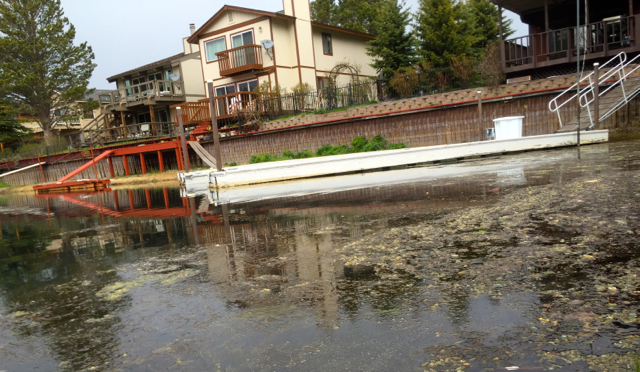
Milfoil was first discovered in the Tahoe Keys in the 1980s and curly pondweed in 2003. Photo/LTN

By Kathryn Reed

No one foresees the threat of aquatic invasive species going away, so permanent inspection stations for boats are probably going to become the norm in the Lake Tahoe Basin.

The first one is likely to be built in the Spooner Summit area. Nevada and U.S. Forest Service officials are studying it as part of the Highway 28 upgrades.

This is the 10th year the AIS program has been in existence under the purview of the Tahoe Regional Planning Agency. It’s a multi-faceted program that involves several agencies.

The goals include keeping out new invasive species and trying to reduce or eradicate the ones that exist.

Inspecting boats before they launch at Lake Tahoe is one way to keep AIS out of the water. In 2017 no new invasives were detected. However, there were 38 boats that were intercepted that had known AIS, with seven of those being mussels that can be devastating to a water body.

Of the 8,870 inspections conducted last year, 67 percent of the boats arrived here clean, drained and dry.

This season a new decontamination trailer will be used that should speed up the process and mean fewer trips around the lake by the service technician. Truckee will be getting new equipment so it can handle more complex boats.

While it’s not mandatory yet, TRPA is lobbying state and federal officials for inspections when boats leave a body known for having invasives – especially mussels. Lake Mead is one of those areas local officials would like to see have more stringent rules because it has the destructive mussels.

“Education is key so the public understands what we are doing and why,” Dennis Zabaglo, TRPA aquatic resources program manager, told the TRPA board at its meeting March 28 in Kings Beach.

Besides inspecting boats, the agency with partners are using a variety of techniques to curb infestations already in the lake. Some are more successful than others.

The UV light pilot project at Lakeside Marina to get rid of invasive weeds has been positive, with monitoring continuing.

Mats used on a 6-acre plot at Sand Harbor to stamp out the clam problem didn’t work as planned, with the infestation spreading to 20 acres. TRPA is working with Nevada agencies to chart another course. A clam harvester could be the next tool that is used.

Tahoe Keys and Ski Run Marina are two of the problem areas. The Keys has submitted an application to regulatory agencies to use herbicides in the canals of the South Lake Tahoe neighborhood. A decision has not been made to grant that request.

Officials continue to look at all available resources including LiDAR, aeration system and working with the boating industry to develop engine components that would keep out AIS.

The rapid response plan in case there is a serious threat detected will be revised this year, which will include a practice scenario.

TRPA is also finding that lab results are taking longer because more agencies are testing for AIS. A secondary lab has been secured if needed.


If Colo. makes Winter Olympic bid, it could be game-changer

By Jason Blevins, Denver Post

STEAMBOAT SPRINGS, Colo. — Could we? Should we? And just how would the Winter Olympics in Colorado look?

The committee tasked with weighing support for a possible Colorado Olympic bid visited the state’s Olympic breeding ground last week. Beneath almost 100 athlete-tagged flags draped throughout Steamboat Springs’ fabled Olympian Hall, exploratory committee member Steve McConahey shared a vision with what he called the community’s “thought leaders,” a collection of business owners and representatives from the local government, chamber, ski area and Forest Service.

“We are creating a new paradigm about how you can do the Olympics,” said McConahey, a former Denver Metro Sports Commission chaiman and Vail Valley local who served on a committee that proposed Colorado as a host for the 1998 Winter Games.

While the committee is officially only exploring the possibility of hosting the 2030 — or maybe even the 2026 — Olympics, when McConahey talks, it sounds like a pitch.

If Colorado can host a privately financed Olympics without government subsidies and guarantees, McConahey said, more cities around the world could see a new path toward hosting a Winter Games.

Read the whole story


S. Lake Tahoe pool to open to kayakers

The South Lake Tahoe Recreation & Swim Complex is offering times to practice kayak rolling skills .

The pool will be open Saturdays from April 21-May 26 (except May 5) from 3:30-4:30pm. There is no instruction available and people must bring your own kayak. Helmets and personal flotation devices are recommended. 

For additional information, call 530.542.6056.

Cost is $6 ages 18-54, $5 55 and older, $4 for 17 and younger.


North Shore teen wins national ski title

By Megan Harrod, U.S. Ski Team

The Toyota U.S. Alpine Championships wrapped up on Monday with women’s giant slalom with A.J. Hurt (Carnelian Bay) grabbing her second national title of the series.

Hurt, who skis for the National Training Group, won the alpine combined – her first career national title – last Wednesday. Hurt, who grew up skiing at Squaw Valley, made quite the impression this season with two NorAm victories and three FIS Ski World Cup starts.

“It’s always difficult [winning a national title],” reflected Hurt. “I knew I was capable if I skied my best, and that second run was definitely some of my best skiing all year, so that felt really good – not only for the result but just to finish the season off like that.”

Hurt was able to make up a significant amount of time from the mid-section to the finish line of both courses and won by a margin of 1.51 seconds over the University of Denver’s Andrea Komsic and Dartmouth College’s Foreste Peterson – who tied for second.

At a mere 17 years old, Hurt was also the fastest junior on the day, followed by an impressive showing from Ski & Snowboard Club Vail’s Allie Resnick, who finished fourth overall and second among juniors.

The Tom Garner Regions Cup was awarded to the Western Region, who amassed 2,171 points over the Eastern Region’s 1,789 points, followed by Rocky Central with 1,347 points.


Burner event at Sierra-at-Tahoe

Burners will be on skis at the fifth annual Burner Ski Day on March 31 at Sierra-at-Tahoe.

The event is family friendly and for all ages.

Slopeside activities on the main plaza are free, and include a playa finest fashion show, art, theme camps, and live music. Mountain activities for all levels will include Burner Mass Descents and Human Slaloms in full Burner style attire.
 
For more info, go online.


Tahoe receives Calif. Wildlife Conservation grant money

The Wildlife Conservation board this week approved approximately $33.1 million in grants for 22 projects to enhance stream flows to benefit fish and wildlife habitat throughout California.

The Legislature appropriated funding for these projects as authorized by the Water Quality, Supply and Infrastructure Improvement Act of 2014 (Proposition 1). A total of $200 million was allocated to the WCB for projects that enhance stream flow.

Projects were chosen through a competitive grant process, judged by the WCB, California Department of Fish and Wildlife (CDFW) and the State Water Resources Control Board.

Funded projects include:

  • A $609,970 grant to the University of California Regents for a cooperative project with UNR and the Desert Research Institute, to expand monitoring, scientific studies and modeling in the Tahoe-Truckee Basin. The results will guide watershed-scale forest thinning strategies that enhance stream flow within an area that provides critical habitat for threatened species. The project is located primarily on National Forest lands in the Lake Tahoe Basin and Tahoe National Forest.
  • A $4.8 million grant to The Wildlands Conservancy.
  • A $693,408 grant to the Humboldt Bay Municipal Water District.
  • A $726,374 grant to Mendocino County Resource Conservation District
  • A $5 million grant to the Sutter Butte Flood Control Agency.
  • A $851,806 grant to the Sonoma Resource Conservation District.
  • A $5.3 million grant to the Alameda County Water District.
  • A $3.9 million grant to The Nature Conservancy.


Tahoe resorts rejoice after week of storms

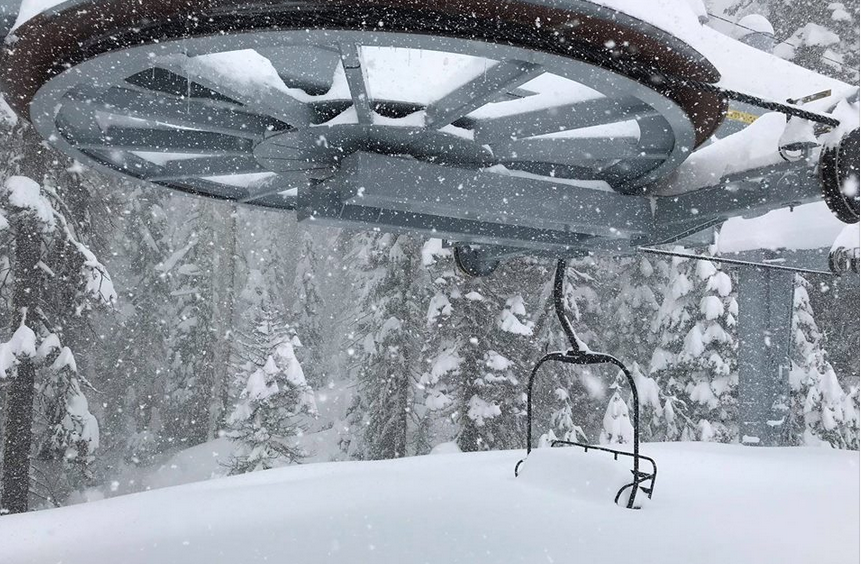
Tahoe area resorts would prefer snow dumps early in the season rather than late. Photo/Sierra-at-Tahoe

By Ed Fletcher, Sacramento Bee

Just in time for spring break, the late-season “atmospheric river” that dumped snow across the Sierra this week has ski resorts going from “waa” to “whoa!”

After below-average precipitation to start the season, the “miracle” storm may result in one of the snowiest Marches on record.

While ski resorts with deep pockets can buffer the impact of a weak winter with a sophisticated snow-making operation, none can escape the financial impact.

Read the whole story