Snowmaking won’t save Lake Tahoe ski resorts if the overnight temperatures keep rising
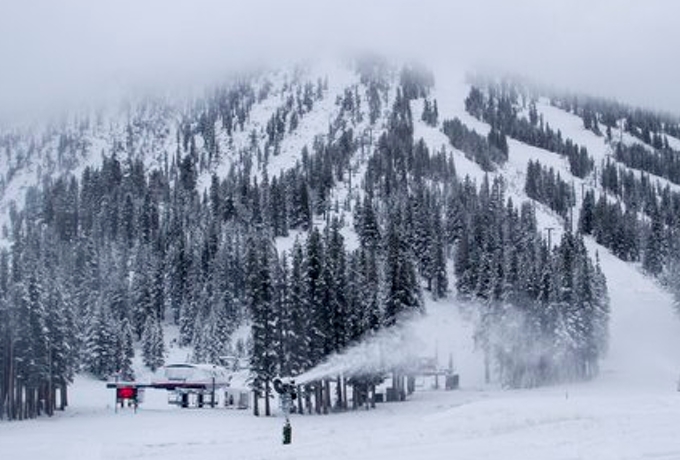
Snowmaking and Mother Nature are allowing Mt. Rose to be the first resort in the greater Lake Tahoe area to open this season. Photo/Provided

Snowmaking and Mother Nature are allowing Mt. Rose to be the first resort in the greater Lake Tahoe area to open this season. Photo/Provided

By Anne Knowles

Mt. Rose Ski Tahoe kicks off the ski season today, optimistic this season will be a return to normal after a foot of snow fell Monday.

“El Niño typically bodes well for Mt. Rose. This is shaping up to be like ’97, a warm October followed by a successful snow year,” said Mike Pierce, head of marketing at the Nevada resort, referring to 1997 when the Truckee River overflowed and Reno was flooded. “We’re due to break the cycle.”

Pierce isn’t alone in thinking this way.

OpenSnow, a group of local weather forecasters, says there is a 60 to 70 percent chance of above average snowfall in California and Nevada this winter.

“I’m hopeful with El Niño. We got almost 12 inches (Tuesday), heavy base type snow that’s good to have this time of year,” Barrett Burghard, senior manager of snow services at Heavenly Mountain Resort, told Lake Tahoe News. “Last year was the toughest season. But we’ve seen these cycles. Hopefully we’ll have three to four years of good moisture.”

Still, no one knows for sure. The National Weather Service’s Climate Prediction Center currently projects a 33 percent chance Lake Tahoe will have above average precipitation this winter, but it’s hard to know if most of it will be in the form rain or snow only at the highest elevations, 8,000 to 9,000 feet.

“There is little to suggest that a big El Niño causes more snow,” said Kelly Redmond, regional climatologist for the Western United States with the Desert Research Institute, at a recent Incline Village talk. “We tend to get more extreme events.”

At the same time, NWS says there is an even greater chance — 40 percent — temperatures in the basin will be above average. That creates problems not only for precipitation, but also for snowmaking, which the resorts have depended on to make it through the last few seasons.

Snowmaking is most productive and energy efficient, and costs less and consumes less water, the lower the temperature.

No one can control the temperature, which is key, but resorts have invested millions of dollars on more advanced snowmaking equipment in the last few years.
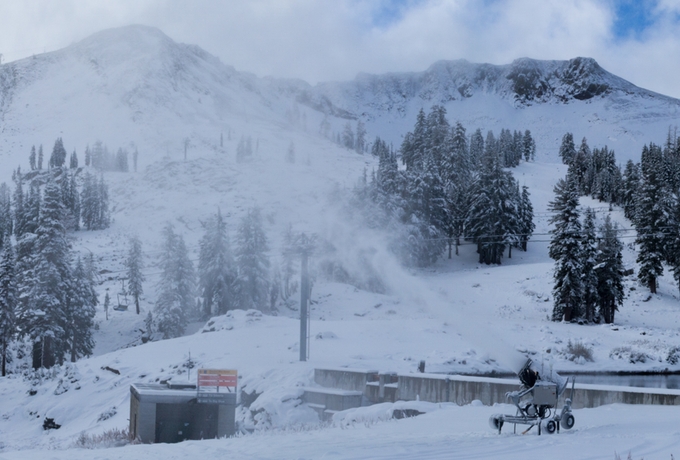
Squaw Valley has spent millions of dollars to ensure its slopes are covered in white. Photo/Provided

Squaw Valley’s attention to snowmaking dramatically changed when KSL took over ownership. Photo/Provided

Squaw Valley, for example, has spent $8 million in the past five years to upgrade its equipment. The resort says it can operate up to 20 new snowmaking guns with the same amount of compressed air required by a single old gun and make nine times as much snow as it could 10 years ago.

On Tuesday, Squaw spent the day making snow, thanks to a big drop in the temperature. Plans are to open Nov. 25.

Mt. Rose operates 25 SMI Snowmakers’ PoleCat snow guns, Pierce said, which can cover up to 25 percent of its trails. A dozen are fixed; 13 are mobile and hook into hydrants throughout the resort, which tap into an onsite well.

“We’ve been buying water rights for the last 20 years,” Pierce told Lake Tahoe News.

The snowmaking allowed the resort to operate from Nov. 8 to April 19 last season when it received just 167 inches of snow, about half the average.

Heavenly, owned by Vail Resorts, has invested heavily in an elaborate snowmaking operation that allows it to cover more than two-thirds of its 97 trails.

“The biggest change we’ve seen is energy efficiency,” said Heavenly’s Burghard, including more efficient guns and advanced compressor controllers.

This season Heavenly is testing a GPS-based depth sensor attached to PistenBully snowcat that may more precisely measure the snow.

“But as far as the temperatures go, there’s not a lot we can do,” Burghard said.

He said there are additives to aid snowmaking at higher temperatures, but Heavenly doesn’t use them.

“They’re not costly, but we’re in the Lake Tahoe watershed and we’re reluctant to use them,” Burghard said.

Heavenly buys its water for snowmaking from South Tahoe Public Utility District and Kingsbury Grade Improvement District.

Andrew Strain, vice president of planning and government affairs for Heavenly, suggested Nevada look at allowing the use of effluent for snowmaking at mountain resorts not on the lake. He said this during testimony at a state-sponsored drought summit in Carson City in September.

Snowbowl, a ski resort in Arizona, began making snow using effluent in 2013.

The Nevada Department of Environmental Protection has a standing committee on water reuse which is in the early stages of looking at that possibility, according to JoAnn Kittrell, public information manager for the Department of Conservation and Natural Resources.

“It’s tricky for Tahoe. Even as a base, it may have too many nutrients,” Kittrell said. “It might have to be treated to drinking water levels. Then it becomes a question of being cost prohibitive.”
LTUSD superintendent backs out of recreation deal with LTCC, SLT; board never voted on it

  By Kathryn Reed

Lake Tahoe Unified School District’s board has never had the opportunity to vote on whether it wants to be part of a consortium with Lake Tahoe Community College and the city of South Lake Tahoe that would manage and maintain ball fields.

Instead, Superintendent Jim Tarwater made the decision to back out of the deal that has been talked about since at least last spring.

“I don’t know that it is really a policy decision,” LTUSD board President Barbara Bannar told Lake Tahoe News. “It doesn’t involve the education of our children. When you look at what benefit the children in the school district get from being part of the JPA it was minimal at that point if any.” Plus, she cited the growing attorney costs for a reason to put an end to the discussions.

The college board and City Council both voted on and for the creation of the JPA – believing the decision to enter the joint powers agreement is a matter for electeds to decide, not the hired leaders of the organizations.

The college and city are going forward with the JPA without LTUSD. They were the original creators of the JPA, with LTUSD being a late addition – and now a recent subtraction. Separate agreements will need to be written to incorporate the K-12 district into the equation, though, because it is still a player without being JPA member.

The reason all three entities were initially creating the JPA was to consolidate the management and operation of ball fields. The recreation master plan calls for a blended approach instead of individual entities; ultimately making it easier on the user.

Less than two months ago LTUSD Superintendent Jim Tarwater was set to take the JPA to the board. He told Lake Tahoe News this week that the reason to forego the JPA is that the district could not afford all the maintenance that was proposed.

“They need more maintenance than what I can do,” Tarwater said.

“The board doesn’t need to vote on it,” he said of the JPA.

An agreement from earlier this year has LTUSD being required to maintain the fields on its property instead of the city doing so. In turn, the city is subsidizing this operation by $100,000 to be a community partner and recognizing adult leagues also use these fields.

Had LTUSD joined the JPA, it would have gotten the $50,000 for maintenance that comes from Measures S/R for the community play field at the college. That full amount has never been used and is carried over each year. It’s anticipated the new fields to be built adjacent to that field will use up the balance of the $50,000. This is allowable based on the original recreation measure calling for multiple fields at that location.

LTCC will now be responsible for the maintenance of the current and future fields in that area.

The current field and proposed fields are in part owned by all three public agencies. The JPA was to have managed all of them. Now easement agreements with LTUSD must be devised.

The JPA was a discussion item at last week’s LTUSD board meeting. The board at the time seemed open to the JPA idea. But it wasn’t an action item.

A day later Tarwater sent an email to City Manager Nancy Kerry and LTCC President Kindred Murillo saying the district would not be part of the JPA. This came after the three had a conference call that morning that Tarwater referenced. The email cites the lack of a guarantee of the baseball field immediately being built as the reason to not enter the JPA.

“There is no guarantee that a new baseball field will be built. For these and other reasons, the LTUSD has decided, after careful thought and consideration, to decline the offer to be a member of the JPA,” Tarwater wrote. While he makes it seem like this was a district decision, it was in fact his decision alone. “One [stet] behalf of LTUSD Board of Education, I hope that the Community Play Consortium is successful.”

There is no guarantee which field will be built when because this is something the City Council must vote on. That will take place in January when it is better known what the coffers look like. The city has about $1.2 million – it may turn out to be more – to build the fields. Cost estimates are being worked on now. The goal is at a minimum one field will break ground next year.

The college is investing $1.6 million to renovate the current field, with Measure R contributing $300,000 to that cause. That, too, will occur in 2016.

LTUSD, even without being a party to the JPA, will continue to do all the scheduling for the community ball fields. It is possible the district and other entities would become JPA board members down the road.


Ski resorts saying no to drones

By Anna Callaghan, Outside

Helmet-mounted GoPros have become a common sight at ski areas. The next step: ski-run footage shot from drones. As UAVs get more accessible and affordable (the Federal Aviation Administration predicts 1 million drones will be sold during the holidays this year), some organizations fear they could become just as ubiquitous as—but more dangerous than—action cams.

That’s why the National Ski Area Association (NSAA), the trade association for 330 ski areas in the United States and Canada, released a sample policy that bans drones without prior authorization. An overwhelming majority of the organization’s resorts, from Aspen to Jackson Hole, have already put that ban in place, or soon will.

“Drone technology is relatively new, and given that ski areas tend to be at high altitude and in cold climates, which affects the battery life of drones, their reliability remains untested,” says Dave Byrd, director of risk and regulatory affairs at the NSAA. “We’re also concerned that they may crash into chairlift towers, fall onto people, or startle people because of their noise and cause collisions. Also, having noisy drones flying all over the place goes against the grain of the sort of skiing-in-nature experience.”

Read the whole story


Expect prescribed fires throughout basin

North Lake Tahoe and Tahoe Douglas fire protection districts and the U.S. Forest Service will continue prescribed fire operations over the next few weeks in various locations around the Lake Tahoe Basin. Operations may take place near Incline Village, Meyers and Zephyr Cove Park.

Operations will  continue as conditions allow.

Smoke from prescribed fire operations is normal and may continue for several days after an ignition depending on the project size and environmental conditions. Agencies coordinate with state and local county air pollution control districts and monitor weather conditions closely prior to prescribed fire ignition.

Before prescribed fire operations are conducted, agencies post road signs around areas affected by prescribed fire, send email notifications and update the local fire information line at 530.543.2816.


Coyote hunt critics try again for Nev. ban

By Jeff DeLong, Reno Gazette-Journal

Opponents of coyote-hunting contests are trying once again to ban the practice in Nevada.

Four critics of what they describe as “gratuitous slaughter” have petitioned the Nevada Wildlife Commission to outlaw a controversial practice that gives cash or other awards to hunters who kill the most coyotes during so-called “coyote call” events.

After a lengthy hearing last March, the commission voted overwhelmingly to deny a similar petition. Critics have prepared a second document they hope will bring success.

Read the whole story


Turkey Trot registration under way

The Turkey Trot Fun Run will be Nov. 21 at Bijou Community Park in South Lake Tahoe.

It will begin at 10am.

Participants are encouraged to dress in Thanksgiving attire. Prizes will be given for best costume and most ridiculous costume.

For more information or to register, go online.


Finding inspiration on a Tahoe mountaintop

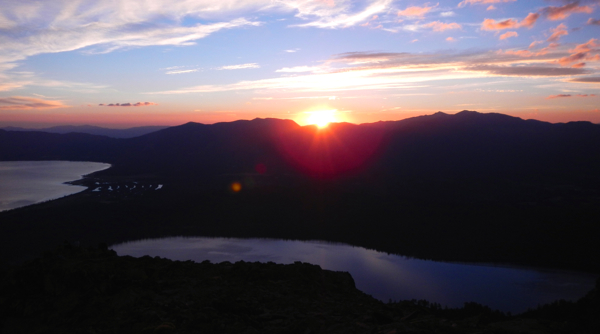
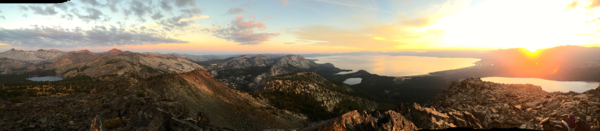
Sunrise on Mount Tallac is worth the climb no matter the hour. Photo/Kathryn Reed

Sunrise on Mount Tallac is worth the climb no matter the hour one has to start. Photo/Kathryn Reed

By Kathryn Reed

As the sky was getting light we could see our destination just a few steps away. We had made it in time to meet our goal.

It was the best sunrise I have ever seen.

Sitting atop Mount Tallac at 9,735 as the sun comes over the mountains and shines all her glory onto Lake Tahoe is something to behold. Pictures don’t adequately capture all the hues Mother Nature paints across the sky.

The wispy clouds seemed liked jewels – necklaces and bracelets to accessorize the spectacle that was unfolding before us.

What a birthday gift.

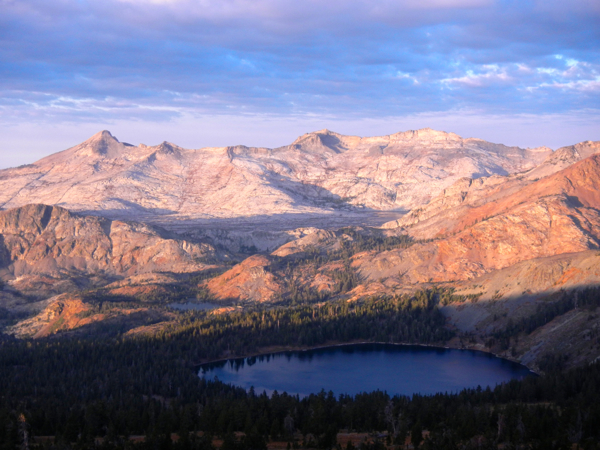
Gilmore Lake from the top of Mount Tallac. Photo/Kathryn Reed

Gilmore Lake from the top of Mount Tallac. Photo/Kathryn Reed

I wanted to do something memorable for my 50th birthday this year – in addition to my gift to myself of a three-day tennis camp last spring with my great friend Carolyn. It was important my actual birthday weekend be Tahoe-centric.

Climbing Mount Tallac under a full moon and being at the peak for sunrise are two things I’ve thought about doing for some time. Why not do both in one hike? My birthday weekend in September happened to be a full moon. Perfect.

I invited a few friends to make the trek with me. Two took me up on the adventure. Darla – who I’ve known since third grade – came up from the Bay Area, and Kele – a friend since we were in our 20s when we worked in Tahoe the first time I lived here – came down from Oregon. We left the house about 1am that Saturday and we were hiking 30 minutes later.

It was a good thing we all had headlamps because the full moon was not of much assistance. The trees were in the way of that natural light. Then it eventually set and we were left in total darkness.

At times we shut off our lights to be dazzled by the Milky Way. This was a show unto itself. Most people only see something like this in a planetarium. It might be the only reason I would ever consider another attempt at backpacking.

Desolation Wilderness lives up to its name.

Desolation Wilderness lives up to its name. Photo/Kathryn Reed

I don’t take the stars I see for granted from my backyard, but this truly was more magical with zero ambient light.

Big spiders – and several of them – were the main wildlife out at this hour. And for whatever reason they were right on the trail. (They didn’t look like friends of Charlotte’s, but we still let them be.)

To say everything looks different in the dark is stating the obvious. Thank goodness for trail markers, otherwise who knows where we would have ended up. It was only near Gilmore Lake that we were unsure of the route. We figured it out on the second attempt.

We had started at the Glen Alpine Springs trailhead because this is the least steep of the routes. It is, however, the longest at about 12 miles round trip.  We thought it wiser to go the easier route in the dark.

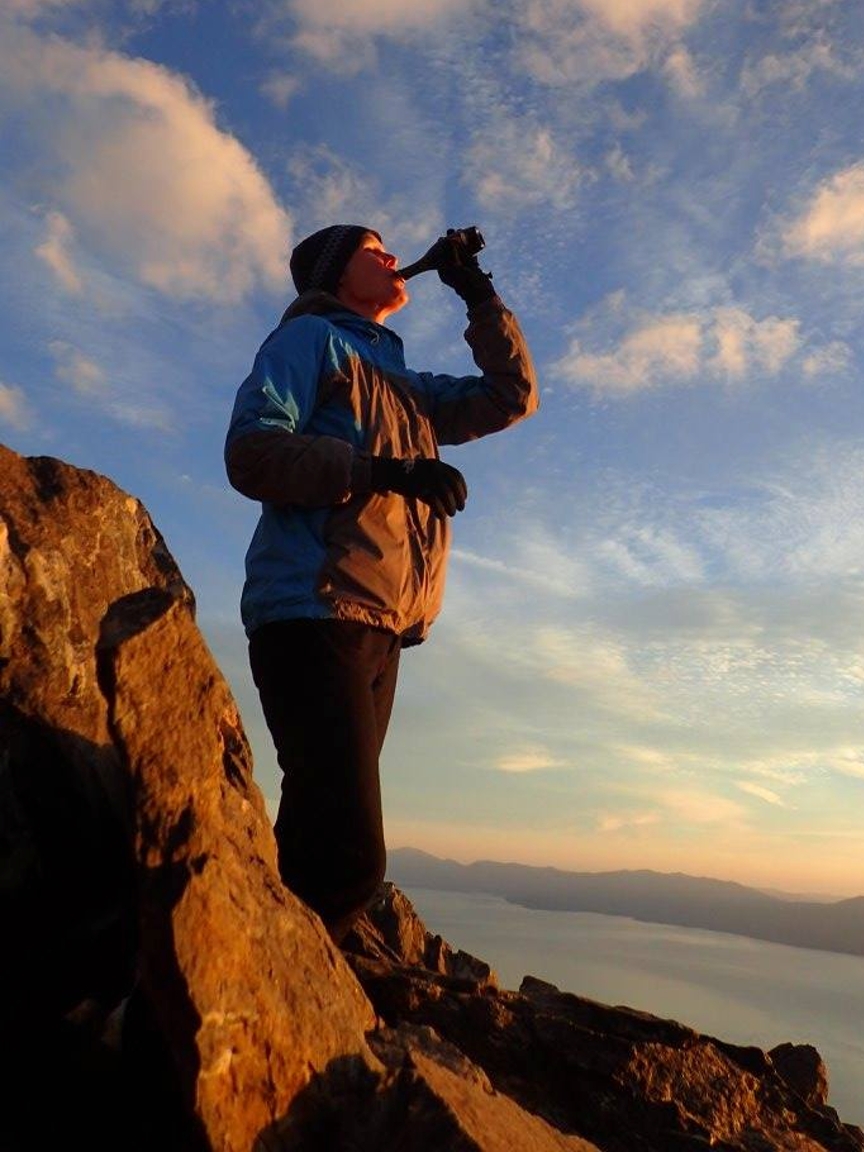
Drinking to the accomplishment and to being 50. Photo/Darla Sadler

Drinking to the accomplishment and to being 50. Photo/Darla Sadler

The summit, well, it’s one of those special places that can touch one’s soul. For many reasons it was more magical this time. It was so wonderful that there were only four other people up there. (Other times it has been so congested with people yakking on their cell phones that it was hard to know this was wilderness.) They were celebrating a 25th birthday and thought it was cool 50-year-olds were doing the same thing.

And while they briefly made me feel my age, we proved age has a thing on youth. We gave them all of our hand warmers because we had gloves (they weren’t prepared for the cold) and we were the ones with Prosecco to toast the occasion (they didn’t have anything to celebrate with).

It was a toast to Tahoe, friendship, a great 50 years and a future of unknown possibilities.

—–

Getting there:

From South Lake Tahoe take Highway 89 north. Turn left on Fallen Leaf Lake Road. Weave around to where it dead-ends at the trailhead.

Fill out a permit and start hiking.


Lifting weights may aid the brain

By Gretchen Reynolds, New York Times

Exercise is good for the brain. We know that. But most studies of exercise and brain health have focused on the effects of running, walking or other aerobic activities.

Now a new experiment suggests that light resistance training may also slow the age-related shrinking of some parts of our brains.

Our brains are, of course, dynamic organs, adding and shedding neurons and connections throughout our lifetimes. They remodel and repair themselves constantly, in fact, in response to our lifestyles, including whether and how we exercise.

Read the whole story


WHS football team wins league, headed to playoffs

Whittell High School’s football team will enter postseason play with an undefeated regular season record.

The Warriors for the first time in the school’s history won all of its games, compiling a 9-0 record in Division IV West League. The league champs are hoping to vie for the state title.

Next up is Carlin on Nov. 6 at 6pm at home. Carlin High School comes to Zephyr Cove having lost only one game.

— Lake Tahoe News staff report


Snowpack tests could lead to better decisions

By Chris Lundy, Backcountry

Early in my avalanche career I was in the field one day with a local forecaster. Based on the snowpack tests we performed at the edge of an avalanche path, we agreed that conditions on that slope were borderline, but we didn’t think it would slide. Stepping into my skis, I triggered a large collapse and watched in horror as a three-foot crown shattered the slope inches from our pit.

That event went down in my memory as a powerful lesson on the limitations of snowpack tests.

Backcountry skiers and riders have been taught to dig pits for years, but the elephant in the avalanche education room has always been what role they play in your decision making. All too frequently we use them to judge whether or not a slope is safe to ski—what do you expect when they’re often called “stability tests?” These tests, however, have serious limitations—both in the accuracy of their results and their interpretation—and, when applied incorrectly, can cause more harm than good.

Read the whole story