Lake Tahoe once was a mecca for fishermen

Fishing at Lake Tahoe remains popular. Photo/LTN file

Fishing at Lake Tahoe remains popular. Photo/LTN file

By Kathryn Reed

CAMP RICHARDSON – Despite people continually messing with the ecosystem, fishing remains a vibrant part of Lake Tahoe’s allure.

In the 1800s the area was known for the abundance of fish and their size.

Native Americans knew this well before the white man came to the basin. The Indians tended to fish the streams and tributaries more than the main lake.

They used spears and other methods to catch fish. It was common to fish during spawning season. That practice ended when the white man chased them away, saying this was the worst time to fish. It was white fish and Lahontan cutthroat trout that were the main catches. Some of it was dried and traded with other tribes.

David Long, an environmental consultant, discussed the history of fishing at Lake Tahoe on Nov. 10 at the Camp Richardson Lodge as a guest speaker for the Lake Tahoe Historical Society.

There are reports of a trio of brothers catching 165 fish in one day that was then sold to a Truckee hotel. In 1894, 40 tons of trout were caught in the first month of fishing season. During spawning season it was impossible to cross a stream without killing some fish.

William Pomin holds the record for largest cutthroat trout caught at Lake Tahoe – 31½ pounds in 1911. Robert Aronsen on June 21, 1974, caught the record lake trout – 31 pounds, 6 ounces; Kokanee salmon record was set by William Bush on July 20, 2013 – 5 pounds, 2 ounces.

Mining and timber severely impacted the fishing at Lake Tahoe. Streams were degraded as trout nests were disturbed by the lumber practices at the time. Temporary dams changed the flow of water. Fish ladders were not always built. Saw dust was thrown into the Truckee River.

Long said the introduction of most of the nonnative species was to help grow bigger fish, to enhance the food web. For the most part the opposite happened.

The crayfish are one of many creatures in Lake Tahoe that are not native. They were introduced in the 1800s.

“The unintended consequence is the crayfish ate the fish eggs more efficiently than the fish ate the crayfish,” Long said.

In 1916 Lahontan cutthroat trout were still the predominant fish. But the nonnatives eventually won out and the cutthroat was eliminated by the late 1930s. There are multiple agencies working to reintroduce the cutthroat to Lake Tahoe and its tributaries, which has not been welcome by all.

California introduced rainbow trout in 1877, with Nevada doing so in 1893.

Brook trout came in 1877 or 1878.

Lake trout, or mackinaw, were introduced by Nevada in 1888. California planted them at Fallen Leaf Lake in 1894.

“It was a controversial planting,” Long explained. “California didn’t want fish eating fish. Nevada said so what.”

In 1896 Brown trout were introduced.

It was in 1917 that commercial fishing was banned at Lake Tahoe. That order was lifted a couple years ago to allow crayfish to be harvested. Sport fishing is still allowed, but the size and quantity of what’s caught has been declining.



What happens to your body during an ultramarathon

By Bonnie Berkowitz, Washington Post

Sometime in the past couple of decades, the idea of running a marathon became less crazy.

Since Oprah Winfrey finished the Marine Corps Marathon in 1994, millions of average Joes and Janes have tackled the distance, and now “26.2” shows up routinely on bumper stickers and bucket lists.

But for some people, a 26.2-mile marathon just isn’t long enough. These athletes are turning to ultrarunning, a sport that not long ago was considered the reclusive, funky-smelling cousin of traditional road racing.

No one is saying that a marathon is short or easy, but there are some huge differences — physiological, logistical and psychological — between running far and running really, really far.

Read the whole story


Sugar pine tallest pine in world

The sugar pine is back as the largest and tallest pine in the world.

Recent discoveries of giant pines put sugar pine back in the lead after the five biggest sugar pines from Robert Van Pelt’s book “Forest Giants” all died from storms and disease, according to the Sugar Pine Foundation.

Mike Taylor discovered the the Tioga Tower in Yosemite National Park. It is now the tallest sugar pine at 273.79-feet tall and 7.7 feet at breast height.

Carl Casey discovered the largest pine in the world, the Calaveras King, in Calaveras Big Trees State Park. It has a diameter of 9.1 feet at breast height, stands 241-feet tall and contains about 5,400 cubic feet of wood.

American Forests takes nominations, verifies and records the size of trees.


Gaming association will search for ‘rational alternative’ to sports betting law

By J.D. Morris, Las Vegas Sun

Calling it a “major shift” in the casino industry’s approach to gambling on sports, the American Gaming Association today revealed plans to assemble a group focused on carving out a potential new path for the legal sports betting industry.

The Washington, D.C.-based casino lobbying group said it will create a “broad coalition” charged with figuring out whether there is a “rational alternative” to existing sports betting law.

The association was vague about what that alternative could be but said it may include regulation, strong protections for consumers and “robust tools for law enforcement” to put an end to illegal sports betting.

Read the whole story


Decorated ski racer to join broadcast booth

By David Wharton, Los Angeles Times

Things could get a little more interesting for NBC’s ski broadcasts, with Bode Miller set to make his debut as an on-air analyst.

One of the most successful alpine racers in American history, Miller has a history of speaking his mind and clashing with officials in his sport. He once admitted to competing while still drunk from the night before.

Miller’s first telecast is scheduled for early December at a World Cup event in Beaver Creek.

Read the whole story


Ski industry hopeful riders return to slopes

By Kathryn Reed

TRUCKEE – A sense of enthusiasm is in the air when people start talking skiing in the Sierra. At least for this season.

Mother Nature is cooperating with ski executives’ desire to have plenty of white stuff available pre-Thanksgiving. Natural snow combined with freezing overnight temps that are ideal for snowmaking are allowing many resorts to open this week – with all three of Vail Resorts’ Tahoe properties opening Saturday.

“There’s so much optimism for the season,” Mike Reitzell, president of the California Ski Industry Association, told Lake Tahoe News.

Reitzell on Tuesday completed a 36-day tour of 23 California resorts. It was a 3,500-mile journey that ended that day at Shasta Ski Resort.

The morning of Nov. 10 was spent talking to the Truckee Donner Chamber of Commerce and hearing from North Shore industry folks.

Reitzell is new to the job, having taken over for Bob Roberts earlier this year. Reitzell’s roots are with the legal side of the ski industry. He worked for Duane Morris LLP’s Truckee office. The firm specializes in sports and recreation law.

He acknowledges membership in the association has dropped in recent years. It’s something he is paying attention to. The association is made up of a mix of downhill and cross country resorts. The board is considering expanding membership to other ski related entities like visitors authorities, though they would not be voting members.

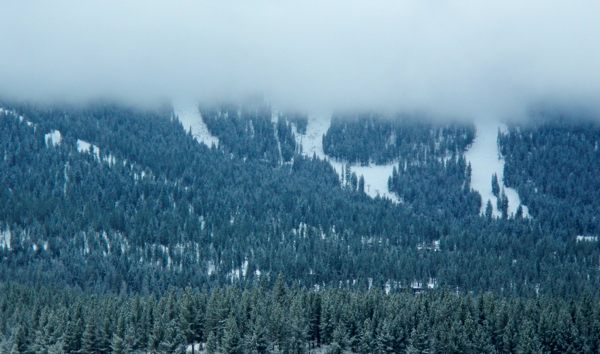
Northstar on Nov. 10 is shrouded in clouds, though its slopes are covered with snow. Photo/Kathryn Reed

Northstar on Nov. 10 is shrouded in clouds, while its slopes are covered with snow. Photo/Kathryn Reed

While this season is starting out well, the industry – especially in California-Nevada — has taken a beating because of the lack of snow. For the last four-drought years snowfall is 75 percent of average. Most resorts last year were never able to open all of their terrain. Many lifts stopped running well before their normal mid-April closing.

Lack of snow and terrain has in turn led to a decline in skier visits the last four years. Stats from the California Ski Industry Association show 7.7 million skier visits in 2010-11, 5.9 million in 2011-12, 5.8 million in 2012-13, 5.4 million in 2013-14, and 4.6 million in 2014-15. That is a 40 percent drop.

“Smaller resorts have had a difficult time, but they are all still here,” Reitzell said. “They recognize the need for a fiscally sound business.”

He said there is a resiliency among resort operators, noting they’ve weathered droughts and other economic downturns besides the current situation.

Still, the lack of visitors has many resorts turning to other activities besides skiing and snowboarding – like ropes courses, music, and indoor fun.

One of the more than 100 people at the Tuesday meeting asked what could be done to attract millennials and families.

For Reitzell, he said it’s about packaging lessons and equipment at a good price point. It’s also just about getting them to the mountains. Playing in the snow is a start, then perhaps they will want to graduate to the slopes.

Greg Dallas, CEO of Sugar Bowl-Royal Gorge, isn’t convinced the Tahoe market as a destination is overpriced for families. He pointed to how Disneyland is $120 a day and families are still going there.

He and Reitzell said how the smaller, feeder resorts can attract the newbies, get them to fall in love with the sport and create lifelong riders.

For Beth Howard, vice president and general manager of Northstar, what keeps people returning is the brand promise – from snow surface to culinary excellence to traditions.

“There’s a tremendous variety offered by all resorts in California,” Reitzell said. “Whatever experience people want they can find it in California.”


USFS to offer Christmas tree permits

The U.S. Forest Service Lake Tahoe Basin Management Unit will begin the sale of Christmas tree permits on Nov. 16 and end Dec. 24 at noon.

Permits cost $10 each (cash or check are preferred on the South Shore, cash or check only, no credit cards on the North Shore), with a limit of two permits per family. Permits must be purchased in person, are not transferable and are sold on a first-come, first-served basis.

Permit holders may choose from a variety of pine, fir or cedar in designated cutting areas.

In support of Every Kid in a Park, established under presidential proclamation, the Forest Service will offer one free Christmas tree permit to fourth-grade students who present a valid paper voucher or durable Every Kid in a Park pass. To obtain the paper voucher, go online.

Cutting a Christmas tree offers a traditional holiday experience, while helping to thin the forest of excessive smaller diameter trees, which creates a healthier forest over time.


Maps to designated cutting areas are provided at the time of purchase.


STHS grad paying for college players’ school

By Jeff Goodman, ESPN Insider

After UAB could not cover the full cost of attendance for its student-athletes this year, coach Jerod Haase decided to pay the bulk of players’ stipends — for both the men’s and women’s basketball teams — out of his own pocket.

Haase is a graduate of South Tahoe High School.

Sources said Haase’s donation was $46,000, or $23,000 to each program. He did not initially want to speak to ESPN for the story but did confirm that he and his wife made a donation to the school that was earmarked for the players on both teams.

“We are extremely excited about doing the full cost of attendance,” said Haase, who makes $1 million annually. “For the vision that the administration has for the program, it’s important we do the full cost of attendance.”

Read the whole story


LTCC soccer coach relieved of all duties

Lake Tahoe Community College’s board of education on Nov. 10 voted to terminate Ben Wade as the student outreach and equity director effective Nov. 30.

Wade has had the position since the start of the calendar year. He was on probation for one year.

Ben Wade

Ben Wade

He was also the men’s soccer coach. He was put on paid administrative leave starting Nov. 5 for the rest of the month. Reasons for his dismissal have not been released.

Neither LTCC President Kindred Murillo nor board President Kerry David would comment Tuesday night about the action taken.

Wade was not at the meeting and could not be reached for comment.

College officials have been meeting with players, especially sophomores who will be seeking four-year institutions to transfer to next fall, to ensure their needs are met.

— Lake Tahoe News staff report


Forest Service sequencing 1,000 fungal genomes

By Jane Hodgins

A 79-year-old collection of fungal cultures and the U.S. Forest Service’s Northern Research Stationare part of a team that will sequence 1,000 fungal genomes in the next five years.

Dan Lindner, a research plant pathologist with the Northern Research Station’s Center for Forest Mycology Research (CFMR), is one of 13 scientists participating in the 1000 Fungal Genomes project, which in collaboration with the Department of Energy’s Joint Genome Institute will sequence two species from every known fungal family. The project is a first step in creating an encyclopedia of all fungi, which will one day help researchers understand not only what they do, but how fungi operate.

The 1000 Fungal Genomes project was one of 41 research projects awarded funding through the Department of Energy’s 2012 Community Sequencing Program.

The CFMR will provide approximately 200 of the 1,000 species that will be sequenced, with the remaining 800 species provided by four other major culture collections from around the world. Established in 1932, the CFMR’s culture collection includes 20,000 cultures from 1,600 species of fungi.

“It’s an incredible resource,” Lindner said. “As far as we know, it’s the world’s largest collection of wood-inhabiting fungi.”

The CFMR culture collection is comprised mainly of Basidiomycetes, or club fungi, which includes the types of fungi that form mushrooms. These fungi play many critical roles in forests, from species that protect tree roots to species that decompose wood to destructive forest pathogens that actively kill trees. Researchers at the CFMR will grow the fungi and isolate the DNA for sequencing by the DOE’s Joint Genome Institute.

Fungi are prevalent, hard working, and largely unknown despite their importance to everything from carbon cycling to production of life-saving drugs, including “old-fashioned” wonder drugs such as penicillin as well as best sellers such as the cholesterol lowering statins and the immunosuppresant ciclosporins, which made organ transplants possible. Fungi are also needed for the production of quality of life products like chocolate, beer and specialty cheeses, such as brie and gorgonzola. There are an estimated 1 million to 1.5 million species of fungi; only about 100,000 species have a name.

“They are so important in so many ways, and we have so much to learn about them,” Lindner said. “We know the tip of the iceberg.”

The 1000 Fungal Genomes project involves an international team of researchers lead by Oregon State University scientist Joseph Spatafora. Team members include Lindner, scientists with the U.S. Department of Agriculture’s Agricultural Research Service, and scientists from universities in the United States, the Netherlands, and France.

Supported by the Office of Biological and Environmental Research in the DOE Office of Science, the DOE Joint Genome Institute’s Community Sequencing Program enables scientists from universities and national laboratories around the world to probe the hidden world of microbes and plants for innovative solutions to the nation’s major challenges in energy, climate, and environment.

Jane Hodgins works for the U.S. Forest Service.