Proper layers key to staying warm outdoors

By Joe Jackson, Outside

When layering for snowy adventures, think about quality as well as quantity. Start with the three-layer principle: up top, you’ll want a form-fitting baselayer, a warm-breathable midlayer, and waterproof outerwear.

The logic is simple. If you’re active, sweat is the enemy. Soak yourself and you’re going to get cold no matter how puffy your down jacket is. Layering gives you the flexibility to react to changing temperatures and exertion levels (chairlift versus a mogul run). The three-layer system wicks sweat, provides insulation, and keeps out the elements more effectively than a single layer or too many layers.

Note: If you already have a layering system that works, stick with it.

Read the whole story


Invasive clams a threat to Sand Harbor

By Anne Knowles

CARSON CITY — Nevada officials are worried about the arrival of Asian clams at Sand Harbor.

Charles Donohue, administrator and state land registrar for the Nevada Division of State Lands, said a small population of the invasive species has been detected at the popular Lake Tahoe beach. On Nov. 30he was addressing the Nevada Legislature’s interim committee that oversees the Tahoe Regional Planning Agency and Marlette Lake water system.

He told Lake Tahoe News two age classes of the clam were recently discovered by a graduate student at UC Davis after an initial review cleared the area.

Donohue said there was some speculation that the clams ended up there via discharge from the ballast of a boat that had traveled somewhere where the clams are commonly found. They have been in Lake Tahoe since 2002.

They are about 2 to 3 centimeters, with some 1-2 millimeters – like a grain of sand. They produce calcium – which Lake Tahoe doesn’t naturally have much of. Calcium is needed for quagga mussels to survive and thrive; that is one species that has yet to be detected in Lake Tahoe.

Donohue said an assessment will soon be made and, if necessary, a quick mitigation before the clams can do any near shore damage.

“Sand Harbor is a treasure,” Donohue said.

Amy Berry, chief executive officer of the Tahoe Fund, after hearing Donohue’s presentation, said the Asian clam mitigation could become one of the group’s projects for 2016.

She said two projects the nonprofit may do next year are acquisition of Johnson Meadows in the upper Truckee River and adding lookouts to Taylor Creek.

For 2017, the group is considering work on the Incline Flume Trail.

The Legislative Committee for the Review and Oversight of the Tahoe Regional Planning Agency and the Marlette Lake Water System meets six times during the interim. The remaining meetings will be at Lake Tahoe.

After its work, the committee can submit 10 bill draft requests to the 2017 Legislature.


Daily dose of ecotherapy eases stress in kids

By Katie Arnold, Outside

Every few months my daughter’s public elementary school, like schools all around the country, practices emergency lockdown measures. “If there’s a bear outside, we go into our closet and turn off the lights,” my daughter, who’s 7, explained to me after the most recent drill. “We lie on the floor and put backpacks on our heads, all squished together. We’re not allowed to talk because bears are much stronger than people and can crash through the windows and get us. We have to stay in the closet for an hour until it’s safe.”

As a second-grader, my daughter and her classmates are still too young to know exactly what–or who—they’re defending against. Bears, of course, aren’t nearly as grave a danger facing school children as gun violence, as this fall’s deadly school shooting at Umpqua Community College in Oregon reminded us. The tragedy was the 295th mass shooting in the U.S. this year, on the 274th day of the year.

Even when school violence happens across the country to children and people we don’t know, the trauma affects us all, to varying degrees.

What we can do is help them cope and try to ensure that the recent spate of violence—and attacks that may occur in the future—don’t leave them with lasting emotional trauma. Among the common-sense strategies the Department of Interior recommends in the aftermath of a national tragedy: talking to your children about their fears, limiting their exposure to television and online news coverage, creating a safe environment at home, and resuming normal physical activities.

There’s another proven way to ease concerns and treat trauma: ecotherapy. That’s the term coined in the mid-1990s for using nature to promote psychological healing. “Nature therapies are being used very successfully to ease both emotional and physical trauma, and stress is one more form of this,” says Linda Buzzell, co-editor of the book “Ecotherapy: and a psychotherapist at Pacifica Graduate Institute in Santa Barbara.

Read the whole story


Drought squeezes duck hunters – could be bad news for fowl

By Ryan Sabalow, Sacramento Bee

RICHVALE — At 5am on a recent Tuesday in Northern California’s rice country, headlamps and pickup lights illuminated a flurry of movement off a turnout along a rural Butte County highway.

A half dozen men tugged on camouflage chest waders, coats and caps, and loaded shotguns and equipment onto waiting ATVs. Around them, a couple of Labrador retrievers bounded around the group with excitement.

Greg Galli, the owner of River Valley Outfitters, directed the flow, readying his clients for a windy morning of duck and goose hunting. Galli would lead the men into rice fields that have been flooded post-harvest, in part to serve as resting ground for the mass migration of birds making their annual winter trek south along the Pacific Flyway. Galli, who leases hunting blinds from Sacramento Valley farmers, has had a busy fall.

“Our day-shoot blinds are doing triple what they normally do,” Galli said, “because most people don’t have water in their duck clubs.”

Largely lost in the statewide discussion about fallowed crops, depleted reservoirs and brown lawns, is the impact of California’s drought on hunting. The succession of four dry years has dried up many of the natural marshes and rice fields used by the estimated 55,000 people who hunt waterfowl in California. While the number of duck hunters has stayed relatively steady overall in recent years, some of the state’s larger refuges have seen a marked decline in hunter usage.

As land available to hunters shrinks, there’s more at stake than increased competition for access to remaining wetlands. State officials point to implications for the state’s rural economy – and ultimately for waterfowl.

Read the whole story


Coyote men to play in state semifinals

Lake Tahoe Community College’s men’s soccer team is heading to the state’s final four after beating Feather River in overtime on Saturday.

The California Community College Athletic Association semifinals take place Dec. 4 at De Anza College in Cupertino. Northern California’s No. 5 seeded Coyotes will face Southern California’s No. 6 seed Oxnard College, at 10am.

If the Coyotes beat Oxnard on Friday, they will advance to the state finals on Dec. 6 at 1:30pm at De Anza.


Ganong barely misses podium in super G

By USSA

LAKE LOUISE, Alberta – Travis Ganong (Squaw Valley) barely missed another podium on Sunday in Lake Louise, but took his best-ever super G finish in fourth place. The King of Lake Louise, Aksel Lund Svindal of Norway, took the win, trailed by Matthias Mayer of Austria and Peter Fill of Italy.

The day felt similar to Saturday’s downhill race in more ways than one. Pleasant temperatures, a nearly cloudless sky, and Fill laying down a fast time within the top of the order contributed to a sense that the magic of Bill Murray’s “Groundhog Day” could be in the air. Then Ganong, whose previous best super G result was sixth in Kitzbuehel in 2014, cracked in right behind Fill at 0.06 seconds slower. When Svindal made a costly error once again but still managed to come down in the lead, almost a half-second ahead of Fill, the potential podium looked nearly identical to Saturday’s with the addition of Austrian Max Franz tying Ganong for the final spot. But, Svindal took the win again, his ninth podium and eighth victory at the Canadian speed venue.

Ganong was still stoked on the day, even though his was just 0.06 seconds off the podium. “It was good skiing today and solid, no big mistakes. I’m really happy,” said Ganong. “I think I lost like two-tenths in the first eight seconds, so that cost me the podium. I have bad shoulders and my thumb’s hurt so I can’t really push that hard. That’s kind of frustrating, but the skiing after that was good.”

The Truckee native, who had surgery on his thumb last week, leaves Lake Louise with a podium and a career-best super G result, indicating that he could be a serious threat in two disciplines on the tour this winter.

“I’ve always been really fast in training in super G, I just haven’t had a breakthrough like this yet in my super G career. So it’s really awesome to start chipping away at super G as well,” said Ganong. “In training I do it all the time with Svindal and these guys, we train with them and are right in there with them. It’s good to get one on race day.”

Steven Nyman (Sundance, Utah), finishing 21, and Andrew Weibrecht (Lake Placid, N.Y.) in 26 were the only other scoring athletes from the U.S. Ski Team. Weibrecht was lucky to emerge unscathed from the race after he launched off the final air on course and his tips drifted toward the sky.

“I thought I was not going to pull that together, actually, and I just did. So I’m happy about that. That’s my one takeaway from the day,” admitted Weibrecht.

Wrapping up the Americans, Tim Jitloff (Reno) was 40. Bryce Bennett (Squaw Valley), Marco Sullivan (Squaw Valley) and Wiley Maple (Aspen, Colo.) were 46, 47 and 48, respectively. Drew Duffy (Warren, Vt.) had a wild ride, but finished his first World Cup in 55th.


Maine resort focuses on lift safety after accidents

By David Sharp, AP

CARRABASSETT VALLEY, Maine — A Maine ski resort that’s responsible two of three chairlift mechanical failures that led to injuries in the past five years is working to make sure it doesn’t happen again.

Sugarloaf is spending $1.5 million to make improvements after a chairlift malfunction allowed it to move in reverse last March, injuring seven skiers.

Workers are replacing the drivetrain on the King Pine chairlift that malfunctioned and have replaced the gear box on a sister lift of a similar design, Timberline. They’ve also upgraded the brakes on seven other lifts to ensure no rollbacks. Another aging lift was removed altogether.

“We’re making these lifts as safe as possible with the most modern standards and components,” said Rich “Crusher” Wilkinson, vice president of mountain operations. “We don’t want to have any more lift incidents here.”

Nationwide, such incidents are rare. Skiers are far more likely to be hurt driving to the resort or skiing down the slopes than riding on lifts, according to the National Ski Areas Association.

There have been only six mechanical failures resulting in injuries in the past 15 years in the U.S., and the last fatality linked to a mechanical problem was in 1993 in California, officials say.

At Sugarloaf, investigators determined the mechanical failure on the 27-year-old King Pine quad was caused by a broken drive shaft in a gearbox that allowed the lift to begin moving backward. A faulty switch prevented an anti-rollback system from locking the lift in place, and then the emergency braking system failed to automatically activate.

The Borvig-manufactured lift traveled about 400 feet in reverse, prompting some skiers to bail out, before it stopped three to five seconds later. Three of the seven injured skiers were taken to a hospital.

Five years earlier, high wind contributed to another lift accident in which some chairs on Sugarloaf’s Spillway East plummeted 25 to 30 feet onto the snowy surface below, injuring eight skiers and trapping others in the air for more than an hour. That 35-year-old lift was replaced entirely with a new model.

All claims from the 2010 accident have been settled, and there have been no new claims from the March incident, said Noelle Tuttle, a Sugarloaf spokeswoman.

Both of Sugarloaf’s accidents involved older lifts that are part of an aging infrastructure at many resorts. Nationwide, most lifts were installed during the 1970s, ’80s and ’90s, and hundreds of old lifts remain in service, industry officials say.

Skier Ron Jacques said he has confidence in Sugarloaf to make needed repairs, but he acknowledged the resort’s track record hasn’t been good in recent years.

“Their number has come up too often in the past few years,” said Jacques, owner of the Ski Depot store in Jay. But, he added, no machinery is 100 percent foolproof.

After the March accident, Partek Ski Lifts, which provides technical support for Borvig lifts like the one that failed, warned operators of about 170 similar Borvig and Partek lifts to replace switches. Sugarloaf also shut down a similar lift, Timberline, which served the mountain’s summit.

Over the summer, workers undertook additional work to provide confidence to skiers.

In addition to regular maintenance, workers drained the oil from the gear boxes on all of the lifts and used a scope to examine components for excessive wear. That led to the overhaul of the gearbox on one lift, Wilkinson said.

“We’re trying to be proactive here, to get out in front of it,” Wilkinson said. “We’ve done all we can. We’ve been very aggressive at upgrading these lifts and we have the utmost confidence in them.”

Each state regulates the maintenance and safety aspects of ski lift operations.

The Maine Board of Elevator and Tramway Safety has not released its final report on its investigation, but it issued a series of recommendations over the summer to ski resorts with similar lifts, said spokesman Doug Dunbar.

Maine ski resorts have a good track record, and there’s never been a chairlift fatality caused by a mechanical problem in Maine. “While any accident is too many, chairlift travel remains very safe in Maine and throughout the U.S.,” he said.


Full moon snowshoes set for West Shore

Ed Z’berg-Sugar Pine Point State Park will have full moon snowshoes on Jan. 23, Feb. 20 and March 19. Beginners’ clinic starts at 6:30pm, tour starts at 7pm.

Adults are $25, and children 12 and under $10. Space is limited, and tickets may be purchased online under “events calendar”. Price includes parking, snowshoes and guided tour. The program lasts approximately 90 minutes.

Wear warm, layered clothing and winter boots.


Ganong on podium in Alberta downhill

By USSA

LAKE LOUISE, Alberta – After a solid three days of training, Travis Ganong (Squaw Valley) threw down a fast run on Saturday to grab third place at the Lake Louise downhill.

The downhill track at Lake Louise was yet again the creator of a comeback fairytale as Aksel Lund Svindal of Norway claimed victory by the narrowest possible margin, just 0.01 seconds, in his first World Cup speed race since an Achilles injury kept him off tour all of last season. He edged out Italian Peter Fill, who held the lead from his bib 4 start all the way until Svindal came down 16 skiers later.

In the final spot on stage, Ganong rounded out the podium at an unlikely venue for the 27 year old. He was the first U.S. Ski Team athlete on course, and his time held up for third place despite numerous attacks from the top seven skiers.

“I’ve really struggled here at Lake Louise in the past. I really didn’t do well here when I was at the NorAm level, kind of figuring it out. This year the snow is just so perfect that I was able to push hard and ski like I want to ski and be competitive. So I’m really happy with how it worked out,” said Ganong, whose best finish at Lake Louise prior to Saturday was a 10th place. “On a day like today it’s the best day to be a racer – it’s perfect conditions, perfect weather, sunny. It’s a good start to the winter.”

Pre-race favorite Kjetil Jansrud was going for broke on the hill, and his aggressive movements and direct line cost him the tenths that Svindal managed to hold. Jansrud ultimately finished ninth, 0.77 seconds off his teammate, after a rough and ragged run.

“On race day people get really over-amped sometimes. You saw that today, like Jansrud had some mistakes and some of the other favorites had mistakes because they were pushing really hard,” remarked Ganong. “For me it’s all about staying relaxed and skiing within myself and having fun and trusting in my ability.”

Ganong holds onto the American Downhillers’ denim vest this week after Steven Nyman (Sundance, Utah) finished tied for 16th with Patrick Kueng and Andrew Weibrecht (Lake Placid, N.Y.), who had to take a rerun after being flagged off course, finished tied for 24 with Bostjan Kline. Vermont native Drew Duffy (Warren, Vt.) made his World Cup debut but lost his outside ski on the bumpy terrain. He slid toward the fences but was able to get up and ski down without injury. Bryce Bennett (Squaw Valley) finished 38, Marco Sullivan (Squaw Valley) was 41 and Wiley Maple (Aspen, Colo.) was 49.

“Hopefully next week my teammates are knocking at the door with me. I’d be proud to hand (the vest) off to the next guy or hold onto it for another week,” said Ganong.


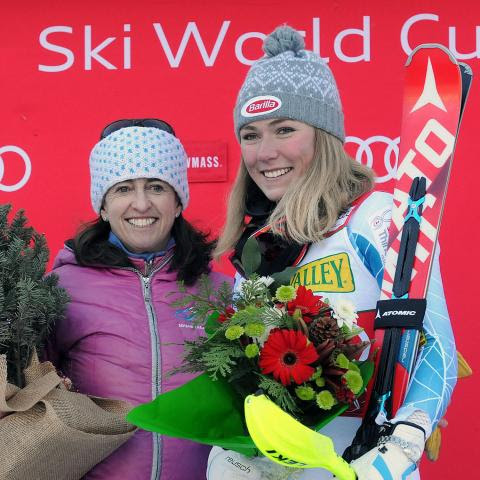
Shiffrin first U.S. athlete to win Aspen since McKinney

Tamara McKinney came to the race and cheered on Shiffrin from the finish. She posed with Shiffrin on the podium after the race. (USSA-Tom Kelly)

Tamara McKinney came to the race and cheered on Shiffrin from the finish. Photo/Tom Kelly/USSA

By USSA

ASPEN, Colo. — It was a historic day Saturday at the Nature Valley Aspen Winternational, as Mikaela Shiffrin (Eagle-Vail, Colo.) dominated her competitors by over three seconds to take the first American women’s win at Aspen since 1981.

It had been a high and dry 34 years, with no American standing on top of the Audi FIS Ski World Cup podium at Aspen since Tamara McKinney of Squaw Valley won in 1981. And Shiffrin didn’t just break the record; she annihilated it, winning the race by 3.07 seconds. That margin broke yet another record—it was the largest women’s slalom win margin since 1968.

“It’s a special day. I was a little bit nervous, but I handled it well,” said Shiffrin. “My skis were great. Everything set up perfectly. I don’t know if the stars will ever align like that again.”

Shiffrin finished ahead of Veronika Velez Zuzulova of Slovakia and Frida Hansdotter of Sweden. “I really charged! I fought hard in the second run,” said Shiffrin, who crashed two gates from the finish in Friday’s GS. “[Friday] was a big disappointment, so I had some anger. I took that into [Saturday].”

Resi Stiegler (Jackson, Wyo.) was the only other American to make the flip, taking 15th place. It was her first race back after her knee injury.

Lila Lapanja (Incline Village)—who was racing her first World Cup—and Paula Moltzan (Lakeville, Minn.) did not finish first run.