Controlled burns scheduled for Tahoe basin

North Lake Tahoe and Tahoe Douglas fire protection districts, the Nevada Division of Forestry and the U.S. Forest Service expect to continue widespread prescribed fire operations this week.

Operations on the North Shore may take place on the west side of Incline Village and in Carnelian Bay; on the West Shore, off Elizabeth Drive north of Tahoma; on the South Shore, northwest of Fallen Leaf Lake, off Lake Tahoe Boulevard near Twin Peaks, off South Upper Truckee Road near Meyers and on Kingsbury Grade; on the East Shore, off Logan Creek Drive, north and south of Glenbrook, north of Spooner Lake and near Thunderbird Lodge.

Operations may continue over the next several weeks as weather and conditions allow.

To view a map with project locations and details, go online.


Mountain bikers want access to wilderness

By Vernon Felton, Outside

Since 1984, mountain bikes have been banned from all Wilderness areas. That, however, might change soon.

The Human-Powered Wildlands Travel Management Act of 2015, a potential piece of legislation seeking to reverse that prohibition, has begun its journey on Capitol Hill, and, although the draft has yet to gain an official sponsor, it’s already sparking controversy over who should and shouldn’t be allowed in America’s most pristine places.

Mountain biking was in its infancy, back in 1984, when the U.S. Forest Service revised its regulations, banning not only motorized transportation in Wilderness areas, but also “mechanical transport,” a move that has since made mountain bikers persona non grata on nearly 110 million acres of Wilderness.

Opponents of the ban point out that no studies of mountain biking’s environmental impact were conducted at the time and that several independent studies since then have shown that mountain bikers have about the same impact on trails as hikers and less than equestrians—a group that enjoys largely unfettered access to wilderness.

Read the whole story


Donner Summit climbing area accessible to public

The historic 400-foot Black Wall that stands guard on the eastern flanks of Donner Summit, as well as the Peanut Gallery and Road Cut climbing areas are open to the public again.

The Truckee Donner Land Trust and the Access Fund bought the land, which also protects the access trails to the popular Space Wall and Stealth Wall.

Truckee Donner Land Trust will hold the 11.9-acre property, adding it via a boundary line adjustment to the neighboring 65 acres of land they already hold in fee. Access Fund will maintain a permanent conservation easement on the Black Wall property to back up the Land Trust’s long-term commitment and ensure climbing access in perpetuity.

The world-class climbing at Donner Summit features finely textured granite with deep chimneys, low-angle slabs, overhanging test pieces, and splitter cracks.

Climbers have been scaling the walls on Donner Summit for 50 years. But in 2013, the private landowners expressed concerns about liability, putting access to the historic climbing area at risk. After nearly a year of negotiations, they agreed to sell the property.

The climbing community and partners in just seven months raised more than $300,000 to purchase the property.


Christmas tree sales on the rise in EDC

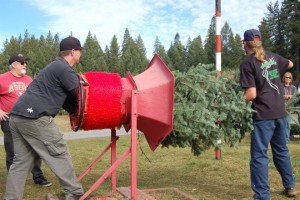
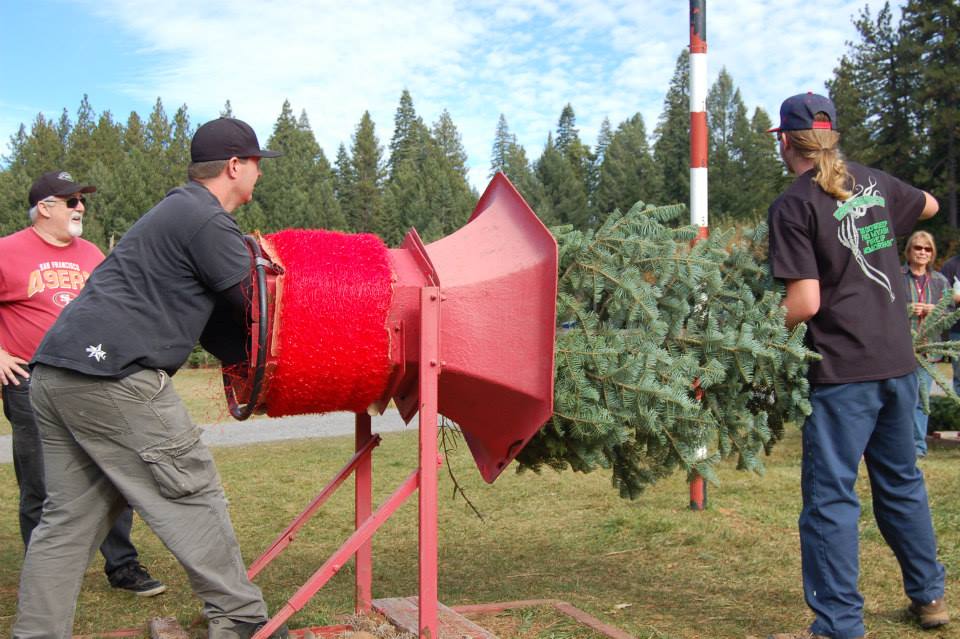
A tree gets wrapped at Harris Tree Farm in Pollock Pines. Photo/Harris Tree Farm

A tree gets wrapped at Harris Tree Farm in Pollock Pines. Photo/Harris Tree Farm

By Kathryn Reed

Christmas trees are big business in El Dorado County and the drought is not drying out the money train.

While the number of trees harvested in El Dorado County is going up, that is not true of the whole state. According to the National Christmas Tree Association, California harvested 383,940 trees in 2002, 119,855 in 2007 and 109,045 in 2012.

(Nevada did not record any trees for any of those years.)

In El Dorado County, the 36,100 trees sold in 2014 had a value of $2.166 million, while in 2013 the 35,808 trees sold were worth $2.148 million, according to the county’s 2014 Agriculture Crop & Livestock Report.

Dee Kobervig, president of the El Dorado County Christmas Tree Growers Association, said cutting down a tree at a farm is a growing business for her 32 members. (There’s about another 30 growers in the county who aren’t part of the organization.)
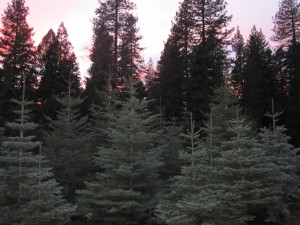
Photo/Harris Tree Farm Christmas tree tidbits: •Between 25 million and 30 million live Christmas trees are sold in the U.S. every year. •	There are nearly 350 million Christmas trees growing on farms in the U.S. •	For every harvested Christmas tree, one to three seedlings are planted the following spring. •	There are about 350,000 acres in production for growing Christmas trees in the U.S. •	There are close to 15,000 farms growing Christmas trees in the U.S. •	The top Christmas tree producing states are Oregon, North Carolina, Michigan, Pennsylvania, Wisconsin and Washington. •	The most common Christmas tree species are: balsam fir, Douglas fir, Fraser fir, noble fir, Scotch pine, Virginia pine and white pine. Source: USDA National Agricultural Statistics Service, National Christmas Tree Association

Photo/Harris Tree Farm
Christmas tree tidbits:
• Between 25 million and 30 million live Christmas trees are sold in the U.S. every year.
• There are nearly 350 million Christmas trees growing on farms in the U.S.
• For every harvested Christmas tree, one to three seedlings are planted the following spring.
• There are about 350,000 acres in production for growing Christmas trees in the U.S.
• There are close to 15,000 farms growing Christmas trees in the U.S.
• The top Christmas tree producing states are Oregon, North Carolina, Michigan, Pennsylvania, Wisconsin and Washington.
• The most common Christmas tree species are: balsam fir, Douglas fir, Fraser fir, noble fir, Scotch pine, Virginia pine and white pine.
Source: USDA National Agricultural Statistics Service, National Christmas Tree Association

“The demand is probably going to outweigh the amount of trees (in the county),” Kobervig told Lake Tahoe News. “A lot of people are getting rid of fake trees.”

Plus, people like to know where their tree came from and to be part of the process.

Those in the industry call it “farm to floor”, a take off from the “farm to fork” food movement.

Many of the smaller farms are already sold-out for this season.

The trees native to the area are red fir, Douglas fir, white fir, and cedar. But most of the farms grow other trees to accommodate consumers. These include noble, Colorado blue spruce, Swiss silver, Grant fir, and Fraser fir.

“The Nordman out of Norway is the No. 1 Christmas tree in Europe. It seems to be growing really well here,” Kobervig said.

The drought has had some impact on the farmers. Trees are not growing as fast without as much water as normal. Usually it’s the seedlings that require irrigation. Farmers have seen a higher mortality rate with the young trees. Spring rain is important to growth and that just hasn’t happened for the last few years.

“I will admit that some of my noble firs probably had more needle drop because of the heat,” Kobervig said. “Those are trees that normally grow in the Pacific Northwest.”

For Jane Harris of Harris Tree Farm she was watering her seedlings earlier than normal.

With trees taking between 10 and 15 years to reach a sellable size, losing a crop can be devastating.

“A few trees died, but at 4,000 foot elevation it is not as warm as some other farms,” Harris said of her Pollock Pines farm.

What helped this fall was having cold temperatures. This meant the needles were set, which is safer once the tree is cut – it won’t dry out as fast and be a fire hazard.

One thing tree farmers do to help sustain their business is employ “stump culture”.

Customers are asked to leave 12 to 18 inches of stump in the ground.

“That stump will grow a new Christmas tree, so when you cut a tree you are not really killing it,” Kobervig explained.

Plus, this method means less soil disturbance and trees growing faster than if it had started as a seedling.


Niche sports and the doping you don’t hear about

By Warren Cornwall, Outside

Last January, at the center of a Las Vegas arena, Anderson Silva secured his legacy as one of the best mixed-martial artists in history. The 40-year-old Brazilian fighter battered his opponent in five rounds of hooks, jabs, and kicks in a fight put on by the Ultimate Fighting Championship.

But four days later, the Nevada Athletic Commission announced that the fighter had tested positive for the steroid drostanolone in the run-up to the fight. It was a body blow to a sport long troubled by rumors of doping. Not only that, but Silva’s opponent in that fight, Nick Diaz, also allegedly tested positive for marijuana in a post-fight test.

As drug scandals buffet marquee sports like pro cycling, track, and Major League Baseball, relatively low-profile, low-budget niche sports are trying to navigate the same treacherous waters. While cage fighting shares few things in common with ultramarathon running, obstacle course racing, CrossFit or mountaineering, there is one important common denominator: each sport is wrestling with the potential for doping—and the public-relations damage that comes with it. It’s also becoming more apparent that it doesn’t take the lure of Olympic gold or a seven-figure contract to make athletes cross the line.

Read the whole story


U.S. names snowboarding team

The 2016 U.S. Snowboarding halfpipe, slopestyle, big air and snowboardcross teams, led by Olympians Lindsey Jacobellis (Stratton, Vt.), Kelly Clark (West Dover, Vt.), Taylor Gold (Steamboat Springs, Colo.) and Chas Guldemond (Truckee) have been officially announced.

The pro team features a roster of 33 internationally-ranked snowboarders, including 19 Olympians and three Olympic gold medalists.

2016 U.S. Snowboarding Team

2016 U.S Snowboarding Halfpipe Team

Men
Greg Bretz (Mammoth Lakes)
Ben Ferguson (Bend, Ore.)
Taylor Gold (Steamboat Springs, Colo.)
Chase Josey (Sun Valley, Idaho)
Matt Ladley (Steamboat Springs, Colo.)
Gabe Ferguson (Bend, Ore.)

Women
Kelly Clark (West Dover, Vt.)
Arielle Gold (Steamboat Springs, Colo.)
Chloe Kim (Mammoth)
Elena Hight (Incline Village)
Hannah Teter (Meyers)

2016 U.S. Snowboarding Slopestyle Team

Men
Nik Baden (Steamboat Springs, Colo.)
Eric Beauchemin (Lake Winola, Pa.)
Brandon Davis (Mammoth)
Chas Guldemond (Truckee)
Kyle Mack (Bloomfield, Mich.)
Ryan Stassel (Anchorage)
Eric Willett (Breckenridge, Colo.)

Women
Jessika Jenson (Rigby, Idaho)
Ty Walker (Stowe, Vt.)
Karly Shorr (Milford, Mich.)
Hailey Langland (San Clemente)

2016 U.S. Snowboarding Snowboardcross A Team

Men
Nick Baumgartner (Iron River, Mich.)
Alex Deibold (Manchester Center, Vt.)
Nate Holland (Squaw Valley)
Trevor Jacob (Golden City)
Seth Wescott (Sugarloaf, Maine)

Women
Faye Gulini (Salt Lake City)
Lindsey Jacobellis (Stratton Mountain, Vt.).


Reno-to-Tahoe bike trail takes 2 million steps forward

By Benjamin Spillman, Reno Gazette-Journal

The dream of biking from Reno to the shores of Lake Tahoe just got about 2 million steps closer to reality.

That’s thanks to more than $2 million in funding from the Federal Highway Administration is being directed to complete a segment of the Tahoe-Pyramid Bikeway between Reno and Truckee.

The segment between Floriston and Boca is only about three miles long but it’s significant because once it’s complete cyclists will be able to ride from trails and paths in Reno, through Truckee and on to Tahoe City without using roads.

It also means they’ll be able to connect even more off-highway riding on U.S. Forest Service roads in the Truckee area and the Tahoe Rim Trail.

Read the whole story


Winter storm warning issued for Tahoe

Crowds were minimal first thing Saturday morning at Heavenly. Photo/Carolyn E. Wright

Crowds were minimal first thing Saturday at Heavenly. Photo Copyright 2015 Carolyn E. Wright

The National Weather Service in Reno has placed the Lake Tahoe Basin under a winter storm warning from 4am to 7pm on Sunday.

The heaviest snow is expected to be between 10am and 4pm, with 6 to 10 inches at lake level and 10 to 18 inches above 7,000 feet.

Winds will be the strongest in the morning.

There is a chance of snow into Monday.

Highs through Wednesday will be in 30s, with lows being in the teens or less starting Sunday.

— Lake Tahoe News staff report


Free backcountry demo event at Alpine

The Lake Tahoe Backcountry Demo Event, North America’s largest venue for all things alpine touring, telemark and splitboard, returns Jan. 2

Alpenglow Sports has partnered with Alpine Meadows Ski Resort for the 10th year. The event is from 9am to 3pm.

Participating vendors will include DPS, Dynafit, G3, Scarpa, NTN, Salomon, Scott, Marker, Volkl, Twenty-Two Designs, La Sportiva, Voile, Moment, Julbo, Fly Low, Jones Snowboards and more.

In addition to the opportunity to try more than100 styles of skis, Alpenglow and Richard Bothwell of the Bay Area Adventure Club will also provide a free, informal avalanche companion rescue class. This clinic will include beacon searches, strategic shoveling, and probing and will begin at 1pm at the registration tent.

The event is free, but participants must possess a valid lift ticket or season pass purchased from Alpine Meadows or Squaw Valley, along with a driver’s license and credit card for deposit.


Young U.S. freeskiers dominated Rev Tour

By USSA

COPPER MOUNTAIN, Colo. – U.S. rookie halfpipe team member Abigale Hansen (June Lake) dominated the first stop of the U.S. Revolution Tour at Copper Mountain on Thursday and Friday, winning both halfpipe events. Hansen led a strong contingency of up-and-coming U.S. freeskiers to kick off what looks to be a promising season for U.S. athletes

The first stop of the Rev Tour featured back-to-back halfpipe competitions under mostly sunny, Colorado skies. In addition to Hansen’s wins, the American women scored a couple of podium finishes: Carly Margulies (Mammoth Lakes) finished third on Thursday and Zyre Austin (Glenwood Springs, Colo.) took second on Friday (she also took fourth on Thursday).

The American men also fared well, with Hunter Hess (Bend, Ore.) snagging a podium spot with a third-place finish on Friday.

The rest of the Americans in the field showed well, with strong showings in the final on both days: Paula Cooper (Vail), fifth on Thursday and sixth on Friday; Jeanee Crane-Mauzy (Park City), fifth on Friday; Joey Lang (Aspen), sixth on Thursday; Cameron Brodrick (Mammoth Lakes), sixth on Friday.

Next up for the Revolution Tour is the Mammoth Mountain stop Jan. 26-31.