Study: Teenagers aren’t getting enough exercise

By Roni Caryn Rabin, New York Times

Teenagers can be a notoriously sedentary group. Now a study showed that school may be a big part of the problem.

The study, which used GPS devices to track when and where teenagers were getting physical activity, found that, on average, they were physically active only 23 minutes a day while at school. Meager as that figure is, it made up over half the 39.4 minutes of physical activity the average teenager got every day.

Teenagers are “one of the tougher groups to get active,” said Jordan A. Carlson, a research assistant professor at Children’s Mercy Hospital in Kansas City, Mo., and one of the authors of the new study, which was published in Pediatrics. By some estimates, fewer than one in 10 adolescents get the 60 minutes of physical activity a day recommended by the Centers for Disease Control and Prevention.

Read the whole story


Killing of calf highlights tension with wolves in Calif.

By John King, San Francisco Chronicle

A calf was likely killed and eaten by wolves in Siskiyou County last month, state wildlife officials said — the first reported case of the endangered predators dining on ranchers’ livestock and an incident that may raise tensions over wolves’ reappearance in California.

The killing of the calf prompted the first “livestock depredation investigation” since a wolf crossed into California from Oregon in 2011, marking the first evidence of a wild wolf in the state since 1924. The apparent attack involved the “Shasta pack,” which consists of two adult wolves and five pups.

The 48-page investigation report — which includes color photos of the two rear legs that were all that remained of the carcass — was released Friday. It comes as the state takes public comments on a comprehensive draft plan for how wolves, which were classified as endangered in California in 2014, might be managed as they multiply.

Read the whole story


Prescribed fires planned on North Shore

The North Lake Tahoe Fire Protection District may continue prescribed fire operations on the west side of Incline Village the week of Dec. 21.

Residual smoke may be seen in locations where operations have taken place over the last several weeks. To view a map with project locations and details, go online. Smoke from prescribed fire operations is normal and may continue for several days after an ignition depending on the project size and environmental conditions.

To receive prescribed fire notifications, send an email to pa_ltbmu@fs.fed.us.


U.S. women solid in downhill

By USSA

VAL D’ISERE, France – Laurenne Ross (Bend, Ore.) cracked the top 10 as Lindsey Vonn’s (Vail) bid for a record-tying downhill victory hit a bump in the road Saturday.

Vonn, the current overall World Cup leader, was 0.13 faster than Switzerland’s Lara Gut at the first split time when she hit a bump midway down the Audi FIS Alpine World Cup downhill course and briefly became airborne. She eventually landed and skied safely off the course for a DNF. That ended her bid for a record-extending 72 World Cup win and record-tying 36 downhill victory.

Gut moved to within two points of Vonn in the overall World Cup standings after winning for the second-straight day at Val d’Isere. Her countrywomen Fabienne Suter finished second, followed by Canadian Larisa Yurkiw in third. Ross led a solid showing by the U.S. women in 10, followed by Alice McKennis (Glenwood Springs, Colo.) in 12, Stacey Cook (Mammoth Mountain) in 16 and Jackie Wiles (Aurora, Ore.) in 17.


Wiles, the youngest member of the women’s speed team, scored her third career World Cup top-20 downhill result, and continues to gain confidence from her skiing and teammates in her third World Cup season.

“I’m really lucky to be with the group of girls that I’m with,” Wiles said “They’re all amazing skiers. I think we have the best speed ski team in the world right now. So for me to be a teammate of theirs and learn from everything little thing they do and keep growing and learning from them, I’m in a great position right now.”


U.S. men miss podium in super G in Italy

By USSA

VAL GARDENA, Italy – Coming off a career-best super G result at Beaver Creek, Andrew Weibrecht (Lake Placid, N.Y.) was once again the top American, finishing fifth, at the Audi FIS Alpine World Cup super G Friday.

The winning ways of Norway’s Aksel Lund Svindal continued as the Attacking Viking captured the Val Gardena super G for the fourth time in his career and fourth victory this season. Following Svindal in second and third, respectively, were two of his countrymen, Kjetil Jansrud and Aleksander Aamodt Kilde, marking the third ever Norwegian World Cup podium sweep and first ever in super G. Austria’s Matthias Meyer was fourth.

Carrying serious speed from the top of the course, Weibrecht caught air over a blind roll, pushing him well wide of his intended line on the critical steep-to-flat section of the trail. However, by pushing it on the rest of the course he managed to claw back much of his lost time, leaving those watching to wonder what might have been.

Three other Americans scored World Cup points with Travis Ganong (Squaw Valley) in 19, Jared Goldberg (Holladay, Utah) in 21, and Steven Nyman (Sundance, Utah) in 28. Marco Sullivan (Squaw Valley) was 46 and Tommy Biesemeyer (Keene, N.Y.) was 50.


Study: Cleared ski runs recover the best

By Kat Kerlin, Davis Enterprise

What happens to the land when a ski run is abandoned? Not much, if the run was previously graded, according to a study from UC Davis.

The study, published online Wednesday in the Journal of Applied Ecology, evaluated six abandoned ski areas in the Northern Sierra region of California and Nevada. It found that runs that were graded showed no predictable recovery even 40 years after abandonment.

The sites ranged from 10 to 43 years since abandonment and, like many ski areas in the Western United States, most had operated under a special-use permit on U.S. Forest Service lands. The study included the Lake Tahoe area sites of Powder Bowl, Plavada, Tannenbaum, Edelweiss, Iron Mountain and Echo Summit.

With graded runs, heavy machinery is used to remove vegetation, boulders and, consequently, much of the topsoil and seed bank during construction.

In contrast, “cleared” runs, in which trees and shrubs were cut with their roots left in the ground, consistently recovered to blend in with the surrounding forest, the study found. Trees and other vegetation grew back over time, and bare ground and visible soil erosion decreased, protecting water quality.

Read the whole story


Amateur athletes using hypoxic tools to train

By Erin Beresini, Outside

Altitude training—it’s not just for elite athletes anymore. What with the rise of altitude chambers and hypoxic workout rooms in your local gym, oxygen-deprivation hypoxicator masks, and even hypoxic bed chambers (Michael Phelps slept in one in his run-up to the 2012 London Olympics), amateur athletes are now using these tools to try and train just as well as their professional idols.

“The ‘us and them’ division is slowly being eroded away,” says Richard Pullan, founder of London’s hypoxic gym, The Altitude Centre, which works with Hypoxico (the leading manufacturer of all things hypoxic) and has about 60 members who train daily in its 2,700 meters and 14.9 percent oxygen environment. “Increasingly, amateur athletes are styling their training around that of elite athletes. And many want to see how good they can be if they have access to the same tools that elites and professionals do.”

Yet despite the availability of new hypoxic toys, most recreational athletes have yet to really transcend the level of elite times that altitude training would seem to suggest is possible. And much of the reason for this has to do with how hypoxia is used at the amateur and professional levels.

Read the whole story


Tahoe firm making gear for women who shred

By Benjamin Spillman, Reno Gazette-Journal

TAHOE CITY — To people who dedicate their lives to mountains and snow the statement from Jen Gurecki might have sounded blasphemous.

“I’m at a point in my life where I’ve had so many powder days I can’t even keep track of them,” Gurecki said before getting to the really shocking stuff. “There are bigger things to do in life than powder days.”

It was especially surprising coming from Gurecki, 39, who moved from Arizona to Lake Tahoe 15 years ago to spend more time on the snow. And last year she and Danielle Rees, 38, co-founded Coalition Snow, a startup that makes skis and snowboards.

But slowly, as Gurecki explained the idea behind Coalition, it became clear how her drive to build company could surpass even her passion for powder.

That’s because the mission behind Coalition — described as the only ski and snowboard maker founded by women and dedicated to having women design products for advanced female skiers and riders — is to do more than sell equipment to surging numbers of millennial-age female skiers and riders. It seeks to open doors for those same women in the male dominated snow sports industry, on the slopes and in the boardrooms.

Read the whole story


LTCC Nordic trails open

The Nordic Ski Center at Lake Tahoe Community College is open.

Passes (day and season) and lessons (cross country and skate) are available through the college’s Connect Community Education program.

The center offers 5 to 7 kilometers of diverse trails that are maintained and groomed two to three times per week by volunteers. The trails wind all around LTCC’s 164-acre campus, offering views of Freel Peak, Trout Creek, and the forest surrounding the college.

The grooming schedule is online.

Local businesses may get two transferrable full-season business passes for up to 10 employees for $100. The couples season pass is $39, while an individual season pass is $29. The family season pass is $49 for an individual family with up to six members. Currently enrolled LTCC and LTUSD students may get a student season pass for $10 with a valid school ID. A single day use pass is $5.

Season pass revenues help to support the continuation and growth of the Nordic Ski Center at LTCC, making it possible for the Center to continue operation in the years to come.

Purchasing a season pass offers skiers dawn-to-dusk access to the groomed trail system seven days a week, until the snow is gone. To purchase a season or day pass online.


SLT trail talks stall; eminent domain likely

By Kathryn Reed

By mid-January South Lake Tahoe is expected to initiate eminent domain proceedings in order to build the El Dorado Beach to Ski Run bike trail.

The city doesn’t want to take the property, but instead is seeking the right-of-way to build the multi-use path.

Based on some of the funding coming with strings per the federal government there is a time line for the money to be spent. If the project is not finished by June 2018, the city could lose about $2.5 million in state and federal funding. The city might also be on the hook for refunding nearly $1 million in grants that have been spent on design and planning if the trail were not to be built.

Heidi's in South Lake Tahoe believes losing a couple parking spaces and any change to the sign would hurt business. Photo/LTN

Heidi’s in South Lake Tahoe believes losing a couple parking spaces and any change to the sign would hurt business. Photo/LTN

The bidding process cannot begin until the acquisitions are completed per federal stipulations. The city wants bid documents to be ready this spring.

City staff repeatedly said the clock is ticking and time is of the essence.

While the City Council this month gave the affected properties 45 days to resolve the issue without going down this path, at least two of the properties don’t appear to be willing to negotiate. This comes after the city began the dialogue more than a year ago.

Mary McCall, who owns a tiny slice of the needed property, told the electeds last week she feels pushed and coerced. She is a descendant of the pioneer Johnson family and said her family has given enough already.

A wedding chapel sits on the land. The city needs 126-square-feet of right-of-way. It has a value of $7,500.

She is worried about relocating the sign, wonders why businesses on the other side of the street aren’t affected, and said cyclists can ride in the street.

Don Rosenthal, who operates Heidi’s restaurant, was speaking on behalf of the property owner. However, with a 40-year lease, Rosenthal has a huge stake in what occurs on this parcel at the Bijou Center.
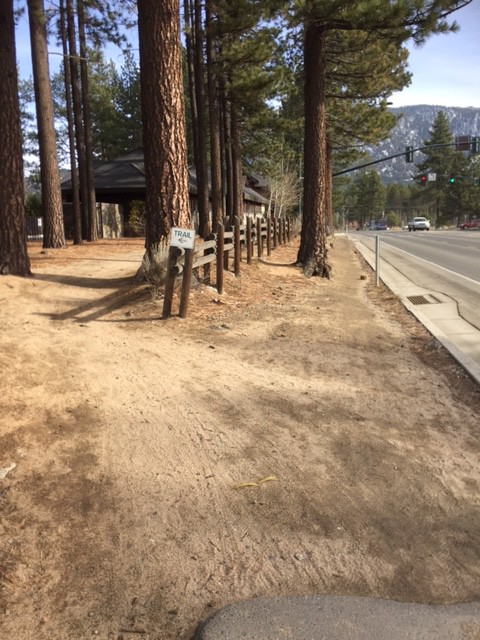
The current trail is dirt and tree roots in places. Photo/LTN

The current trail is dirt and tree roots in places. Photo/LTN

The city wants 966-square-feet of right-of-way; offering $15,000 for it. Safety, loss of parking and sign relocation are Rosenthal’s biggest worries.

The engineering consultant on the project said concessions have been made, such as moving the trail as close to Highway 50 as possible for these people.

McCall and Rosenthal told the council they would try to work things out. Outside the meeting room and out of earshot of the electeds they said the opposite.

The city also needs 1,300 square feet ($48,000) from Urbana Tahoe and 2,700 square feet ($10,250) from Tahoe Beach and Ski Club. The latter is not contentious, but requires eminent domain to satisfy the homeowners’ policy.

The city must offer fair market value, but cannot legally offer more. Property owners can take the city to court once eminent domain filings occur.