Peregrine falcons on the rise in Tahoe

Publisher’s note: This article first appeared in Tahoe In Depth and is reprinted with permission.

By Will Richardson

It’s August at Lake Tahoe, the peak of shorebird migration, and the low water level means ample beach and mudflat habitat at the delta formed by the Upper Truckee River and Trout Creek.

Sandpipers and plovers of a dozen species are spread out along the beach, feverishly fueling up for the next leg of their southbound journey, when suddenly — panic. The birds alight, coalescing into a swirling aerial ball, fragmenting and reorganizing. The swarm stretches and splits into two groups as a peregrine falcon slices straight through the middle of the flock, plucking an indecisive straggler along the way. It’s a thrilling spectacle, but less common at Tahoe until recent years.

The peregrine’s name means “wandering falcon” and it has the most extensive natural range of any bird species on the planet. Prior to the Comstock era, it is likely that peregrine falcons were regular breeders in, and certainly would have been regular migrants though, the Lake Tahoe region. An 1877 report by the U.S. Geological Survey describes the species as “met with frequently in early fall.”

As recently as the early 1940s, peregrines were known to nest at Echo Summit and Cave Rock, but over the course of the next several decades, the species experienced precipitous population declines around the world due to the use of organochlorine insecticides like DDT, aldrin, and dieldrin.
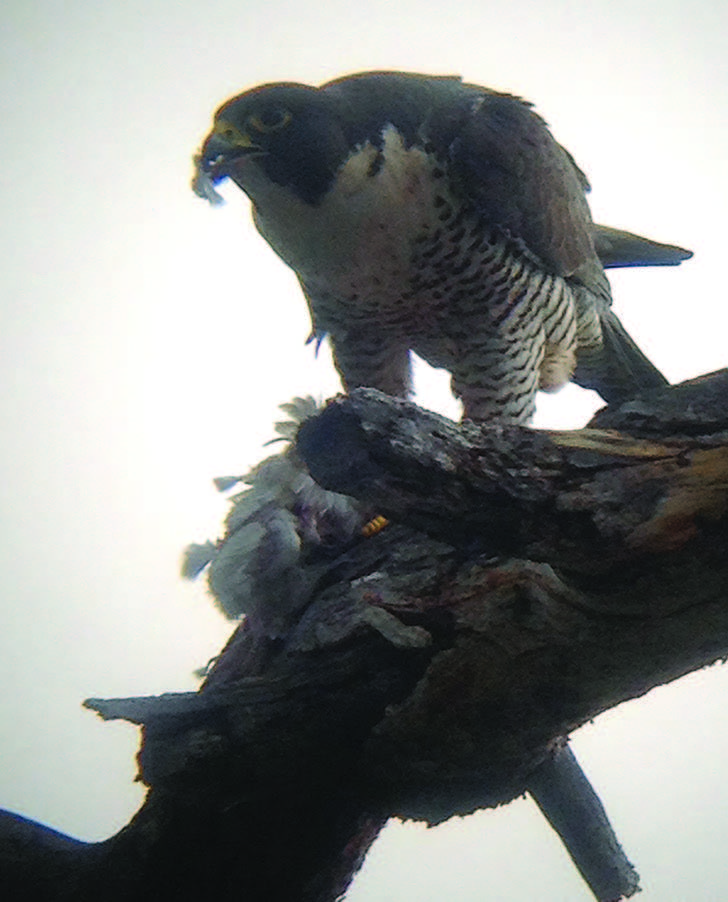
A peregrine falcon eats a band-tailed pigeon near Sand Harbor. Photo/Will Richardson

A peregrine falcon eats a band-tailed pigeon near Sand Harbor. Photo/Will Richardson

The approximately 3,875 breeding pairs of peregrines in North America prior to the 1940s declined to 324 breeding pairs at their lowest point in 1975. DDT use was banned in the U.S., Canada, and most of Western Europe by the early 1970s, but it took many years to bring the species back from the brink.

One method used to promote rapid population growth and expansion was captive breeding and hacking. Nestling birds hatched from captive breeding programs (often involving falconry birds in the case of peregrine falcons) were reared in a wooden box to help protect them from predators and weather, and these boxes were placed at unoccupied but otherwise suitable nesting sites, typically a high cliff, a couple of weeks prior to fledging. Once the birds had been at the site for five to 10 days, the box was opened, giving these birds the freedom to move around the site, flap their wings, and build strength.

Biologists provided the birds food throughout the hacking process, but there was minimal contact and biologists often used hand puppets to simulate feeding behavior of adult birds. From 1985 through 1991, 18 juveniles were released at two hack sites in Tahoe, one at Luther Rock and one at Eagle Falls. All 18 birds successfully fledged and dispersed, and the program was considered a success, though where these birds ultimately dispersed to is anybody’s guess. Migrants and presumed transients would steadily increase during the 1990s and 2000s, but it was 22 years since the last hacking effort at Luther Rock before peregrines were confirmed to be breeding again at Lake Tahoe.

In 2007, peregrine falcons were observed in late summer near both South Maggies Peak and Angora Peak. Further investigations revealed that a rock-climbing biologist had observed a peregrine at Luther Rock in 2006. In 2008, the wildlife crew of the U.S. Forest Service Lake Tahoe Basin Management Unit began monitoring potential nesting sites based on a 1980 nesting survey, and the following year a nest was found at Luther Rock.

What’s more, the pair at that nest successfully fledged two young. By 2011, a second nest was discovered at Castle Rock. In 2014, a third nesting pair was confirmed at Cave Rock, and this summer a fourth nest was found at Eagle Lake. Thanks to heroic efforts on a shoestring budget, the wildlife crew at LTBMU has managed to confirm that each of these locations has remained active since they were first found, typical of the species, and a minimum of 20 juveniles has fledged at Lake Tahoe over the last seven years. This is truly an impressive rebound for the peregrine.

Birders and biologists rejoice at the return of the peregrine to Tahoe. Their great speed and hunting skill can be exhilarating to observe. As Forest Service biologist Shay Zanetti points out, “they add an exciting element to the basin ecology.” But perhaps more importantly, they belong here.

Now we need to make sure we can sustain all of these breeding predators, and foraging habitat may prove limiting. Peregrines prefer to hunt water birds and were once known as “Duck Hawks” in this country.

Prior to the construction of the first dam at Tahoe City in the 1860s, there was far more shorebird and wetland habitat distributed around the lake’s shoreline. Extensive beaches and mudflats were perhaps more consistently available from year to year. Now the best waterfowl and shorebird habitat has been reduced and concentrated into a few small pockets, especially when the lake is full.

Thus, we need to consider the peregrine falcon, perhaps nesting miles away on some craggy cliff side, when setting policy that can affect the bird population at a given location. That’s why it’s important for dog owners to keep their pets on a leash at the Upper Truckee Marsh or many of Tahoe’s beaches. But it also applies to forest management practices that might affect band-tailed pigeons, Steller’s jays, Northern flickers, or other birds the peregrine relies on for food. To support a healthy population of peregrine falcons at Lake Tahoe, we need healthy populations of the other bird species as well. Based on the recent trajectory of peregrine recovery at Tahoe, it appears things are looking up.

Will Richardson is co-founder and co-executive director and director of applied science at the Tahoe Institute for Natural Science.

Lake Tahoe and snow base keep rising

lake level chart

Motorists are now able to get over most mountain passes in the Lake Tahoe area.

Earlier this morning a slide closed Highway 50 over Echo Summit. Caltrans has cleared it. Highways were a mess last night, with most of them closed at times. It was taking motorists double their normal drive time and then some to get to their destinations.

Highway 89 around Emerald Bay is closed.

Crews were out doing avalanche control, as the booms resonated through neighborhoods. This was to make the roads safe.

The Sierra Avalanche Center is saying the danger level for Dec. 22 is “considerable”. This is for below, at and above tree line.

The National Weather Service in Reno has issued a flood warning until 4pm Tuesday for the burn areas including the King Fire that scarred the forest near Pollock Pines. The warning also includes the Rim, Butte and American fire locations.

The good news about the rain at lower elevations is that Lake Tahoe has risen 1.92 inches in the last storm, according to the National Weather Service. The agency said 4.3 billion gallons of water fell in to the lake in a 30-hour period.

Most of the ski resorts are reporting 10 inches or more of snow. Sierra-at-Tahoe and Tahoe City Cross Country closed on Tuesday to dig out.

More snow is in the forecast for the rest of the week, with 100 percent chance on Thursday.

For current road conditions, click on the state icons on the home page of Lake Tahoe News.

— Lake Tahoe News staff report


Are bicycle helmet laws dangerous?

By Reid Singer, Outside

There’s no question that helmets make cycling safer. A recent study by researchers at the University of Arizona found that wearing one makes you 59 percent more likely to survive a collision.

But according to many bike advocacy groups, laws requiring that adults wear helmets actually lead to more injuries. How’s that?

Studies show that the laws deter people from riding, and the fewer riders there are on roads, the more car-bike accidents occur.

Read the whole story


Bikepacking the backcountry

By Brad Branan, Sacramento Bee

Earlier this year, I was having a perfectly good time backpacking the Tahoe Rim Trail when I became unnerved by all the people passing me on mountain bikes. The reason for my frustration: They were clearly having more fun than me.

So I did what any self-respecting outdoor enthusiast would. I bought a full-suspension Marin mountain bike the next week.

My interest in backpacking didn’t wane, though, with the purchase of the bike. I began to see mountain biking as an extension of the same love for exploration driving my backpacking. So I asked myself: How could I take overnight trips into remote areas like I did backpacking, except on my mountain bike?

Enter bikepacking.

It’s backpacking crossed with mountain biking, except most or all of the gear is stowed in bike bags, not backpacks.

Read the whole story


Parallel giant slalom tricky for racers

By USSA

VAL GARDENA, Italy – Tim Jitloff (Reno), fresh off a seventh-place finish in Sunday’s traditional giant slalom, finished ninth to led the way for the U.S. Ski Team in Monday night’s new Audi FIS Alpine World Cup parallel giant slalom. Ted Ligety (Park City) and Andrew Weibrecht (Lake Placid, N.Y.) were both knocked out in the first round, finishing 24 and 29, respectively.

The first of its kind on the World Cup, the PGS was full of surprises, with many pre-race favorites making early exits and a dark horse or two providing thrilling action in the new format.

Two very familiar faces, though not from recent GS races, were left standing in the final heat. Norwegians Kjetil Jansrud and Aksel Lund Svindal had spent the last hour methodically picking off opponent after opponent on the modified two-jump Gran Risa slope. When the snow dust finally settled, it was Jansrud who took his first victory of the season, just edging out his compatriot in the simple, cross-the-finish-first-and-win format.

Third-place finisher Andre Myhrer of Sweden took the victory in the small final by a sizable margin over German surprise contender Dominik Schwaiger, whose best World Cup result before the night was 19 in the previous day’s GS. This result marks Myhrer’s first trip to the podium since his runner-up finish in the 2014 Adelboden slalom.

Surprisingly, many of the World Cup’s top GS skiers looked uncharacteristically sluggish on the relatively flat course, perhaps flustered by having a racer next to them or by two sizable mid-course jumps that quite literally threw almost every racer off line at one point in the night.

Ligety, Marcel Hirscher of Austria, Felix Neureuther of Germany and Henrik Kristoffersen of Norway were all knocked out in the first round. In fact, six of the top seven finishers were seeded outside of the top 15, perhaps indicating that success in traditional GS is not indicative of success in the parallel format.

The night began with the opening round of 32 competitors skiing head-to-head in a two-run format, giving each racer a chance to ski both the red and blue courses. The 16 round was two runs, but through the rest of the rounds to the final, it was a one run knockout with one very clear rule: Win, or go home.

The entire event took less than 90 minutes to complete, providing intense, spectator-friendly action in a reasonable amount of time compared to a traditional daylong ski race.


Early snow a confidence booster for resorts

By Benjamin Spillman, Reno Gazette-Journal

Compared to last year’s dry winter it seems like Sierra Nevada skiers and snowboarders are practically swimming in snow, at least in the opening days of the winter of 2015-16.

But it’s still too early to tell if a snowier winter will help California and Nevada winter resorts bounce back from their worst performance since 2001-02 in terms of skier visits.

The 2015-16 snow season is off to a good start. But it will take a lot to offset the low total of skier visits to west coast winter resorts during the drought winter of 2014-15.

Read the whole story


K2 skis changing ownership

By Matthew Townsend, BloombergBusiness

Newell Rubbermaid Inc. agreed to buy Jarden Corp., parent company of K2 skis, for about $15.4 billion, creating a consumer-products giant with a sprawling portfolio that will use its increased size to cut costs and bolster investment in its most-promising businesses.

The new company, called Newell Brands, will have $16 billion in sales, according to a statement. Jarden investors will receive cash and stock valued at about $60 a share — 24 percent higher than the closing price on Dec. 4, the last trading day before media reports said merger talks had begun. Newell will issue $5 billion of debt to complete the transaction and expects to keep its investment-grade debt.

The move is a bet that Newell can gain efficiency and clout with large vendors such as Wal-Mart Stores Inc. from Jarden’s more than 100 far-flung brands, including everything from Oster appliances and K2 skis to Yankee Candle. Newell Rubbermaid Chief Executive Officer Michael Polk, who will run the combined entity, is aiming to squeeze $500 million in costs out of the business within four years.

Read the whole story


U.S. men regroup to put in respectful runs

By USSA

ALTA BADIA, Italy – Ted Ligety (Park City) led a recharged men’s tech team, just missing the podium, as the Americans rebounded from a disappointing first run performance. Ligety led the way, finishing fourth, followed by Tim Jitloff (Reno) in seventh, and Tommy Ford (Bend, Ore.) in 12.

Austria’s Marcel Hirscher won his third-straight Audi FIS Alpine World Cup giant slalom, and became the only racer in history to win three times at Alta Badia. Henrik Kristoffersen of Norway was second, followed by Victor Muffat-Jeandet of France in third.

Following a disappointing first run for the Americans, the athletes and coaching staff made a few changes to re-charge for the second run. Ford was first to start the second run and posted the fastest second run of the day.

“I finally let it go second run and skied really well … skied clean,” Ford said.

Ligety and Jitloff sat 1-2 on the leaderboard midway through the second run after nailing the middle section and carrying speed into a pair of rollers (that will be used for Monday’s parallel giant slalom) into the finish. They watched as racer after racer failed to knock them off the leaderboard.

France’s Mathieu Faivre and Alexis Pinturault finally split the U.S. leaders, knocking Jitloff to fourth as Ligety remaining atop the leaderboard with three racers remaining. However, the victory wasn’t meant to be for Ligety as Muffat-Jeandet moved into the lead, followed by the 21-year-old Kristoffersen, and finally Hirscher, whose victory solidified his lead atop the World Cup giant slalom standings.

“I knew going into the second run that I needed to throw down a great run, because my performance to this point has just been OK and not up to my capabilities,” Jitloff said. “I was very nervous for sure, but that nervousness helped push me.”


4 U.S. men in top 20 at Val Gardena

By USSA

VAL GARDENA, Italy – Bryce Bennett electrified the crowd with an attack from the back to lead the U.S. men and score a career-best sixth-place finish at Saturday’s Audi FIS Alpine Ski World Cup downhill.

Long after Norway’s Aksel Lund Svindal won yet another downhill this season, Bennett, wearing bid 57, stepped into the starting gate and looked Svindal-esque as he capitalized on his large six-foot-seven-inch frame to keep his skis on the snow and carry speed through key sections where other skiers were thrown off line and forced to make recoveries.

Crossing the finish line 1.04 seconds back in sixth place, the once hush crowd erupted in cheers as Bennett lifted his goggles in sheer disbelief before letting a well-deserved fist pump fly.

“I’m still surprised. I crossed the finish and saw sixth and I was like, what? No chance! The timer is broken!” an exhilarated Bennett said in the finish. “I just got in the zone somehow. I’ve been working on it, and it clicked a little bit. I just laser beamed the whole course, just focused every section and it was fast.”

Bryce Bennett skis from bib 57 to sixth place.

The victory for Svindal was his fifth in seven World Cup starts this season. Guillermo Fayed of France was second, followed by Norway’s Kjetil Jansrud in third.

For Bennett, finding the maturity to shake off a bad performance in yesterday’s super G was the key to how he was able to channel his inner self and come away with a stunning result.

In addition to Bennett’s stellar performance, Steven Nyman (Sundance, Utah), who was gunning for his fourth career win in Val Gardena, finished ninth, Travis Ganong (Squaw Valley) was 13, and Andrew Weibrecht (Lake Placid, N.Y.) was 17, giving the Americans an impressive four skiers in the top 20. Marco Sullivan (Squaw Valley) was 35.


Northstar gondola makes ride to slopes faster

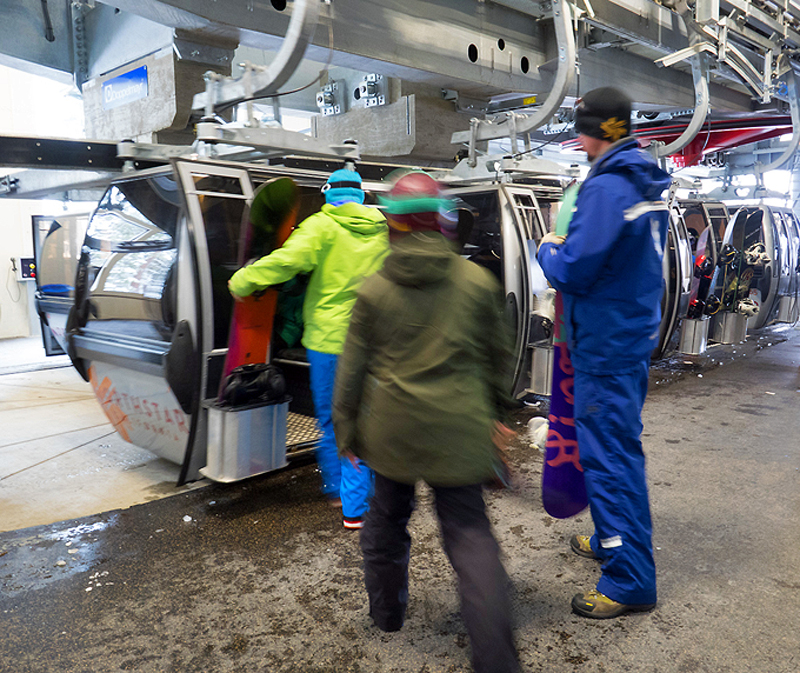
Skiers and riders board Northstar's gondola to get to mid-mountain. Photo/Carolyn E. Wright/Copyright

Skiers and riders board Northstar’s gondola to get to mid-mountain. Photo Copyright 2015 Carolyn E. Wright

By Kathryn Reed

TRUCKEE – Speed – it’s what most riders want. Waiting in lines and slow lifts don’t add to a memorable ski day, at least not in a positive way.

Comfort is another biggie.

Northstar has been listening. While skiers and snowboarders might not notice the changes at first, the Big Springs Gondola has been overhauled in the last two years. The latest upgrade for this season is making the 30-year-old transport faster. In five minutes people are whisked from the village to mid-mountain.

The change allows for an increase of 10 percent more of the six-seater cars being able to get from the bottom to the top compared to years past.

During the summer engineers worked to make the whole apparatus quieter and smoother.

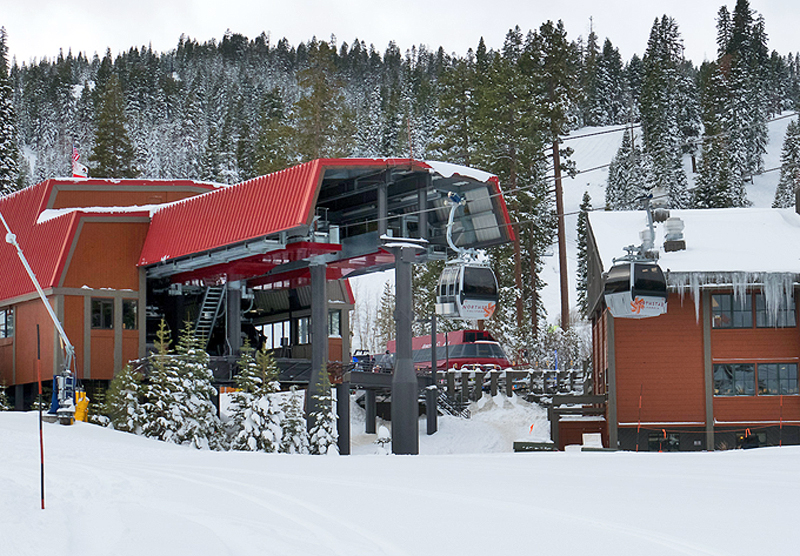
The gondola ends at mid-mountain.

It’s a quick ride for passengers on the gondola to get to mid-mountain. Photo Copyright 2015 Carolyn E. Wright

“The infrastructure was upgraded with the most recent technology available, keeping terminals from being too loud for guests waiting to onboard,” Cass Walker, the resort’s spokeswoman, told Lake Tahoe News.

In the previous offseason the doors and windows were replaced, as were the seats – which came with more cushioning. Most of the work was done in house.

The outside equipment holder now accommodates the fatter skis, with it being able to hold six pairs of skis and four snowboards.

Prior to the gondola’s opening in 1985 people had to rely on the Village Express Chairlift. The starting point is close to the gondola. But seldom does the lift run. It’s just not as efficient. Plus, it drops people off right on a run.

The gondola drops people off within walking distance to three main chairlifts that go farther up the mountain. Plus, this is mid-mountain, where there is a day lodge. And for those who are not skiing and just want a ride up the mountain, the gondola is the E ticket ride to get there.

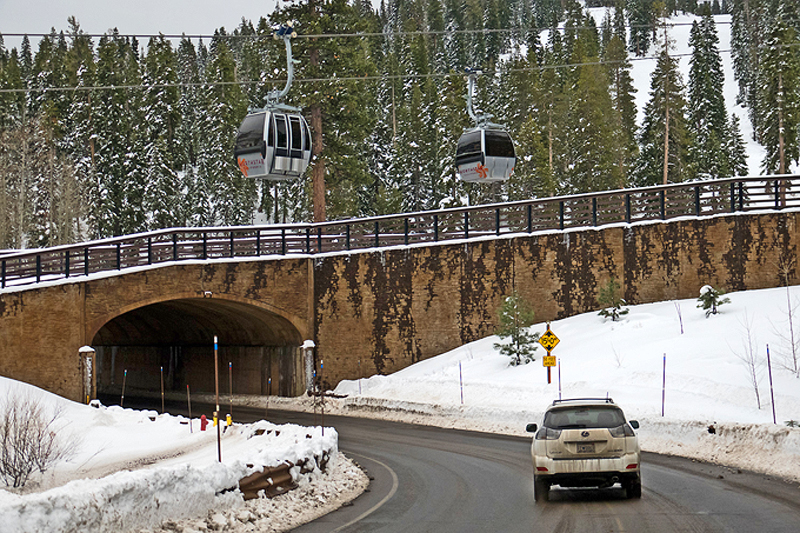
The gondola crosses the road leading to the Ritz-Carlton. Photo/Carolyn E. Wright/Copyright

The gondola crosses the road leading to the Ritz-Carlton. Photo Copyright 2015 Carolyn E. Wright

“The entire terminal has also been renovated – featuring lovely scenic and village shots and some great accolades. We will also be including new furnishings within the terminal,” Walker said.

Per company policy Walker would not release how much it cost to improve the gondola. All she would say is parent company Vail Resorts has infused $30 million into Northstar in the last five years since it acquired the property.

For now, this is the end of the planned upgrades to the gondola. This means it will be a while before Northstar has what Vail ski resort has – a heated eight-seater gondola.