U.S. men challenged in downhill in Italy

By USSA

SANTA CATERINA, Italy – Travis Ganong (Squaw Valley) and his U.S. teammates tackled one of the most challenging downhill tracks on the Audi FIS Alpine World Cup circuit Tuesday, where just making it to the finish line was a victory.

“There’s been lots of action, lots of crashes, lots of crazy stuff,” Ganong said after leading the U.S. Ski Team in 17 place. “I would say this is one of the toughest hills we ski. It’s really hard. It’s like Sochi on the top and Bormio on the bottom – super dark, bumpy, super fast speeds. It’s a real deal downhill. It’s a gnarly, gnarly hill – the after-Christmas wake-up call.”

Adrien Theaux of France won his third career World Cup downhill Dec. 29 on the dark, bumpy track. Hannes Reichelt of Austria was second, followed by David Poisson of France in third. World Cup downhill leader Aksel Lund Svindal of Norway finished seventh and moved into the overall World Cup leaded by 15 points over Marcel Hirscher of Austria, who did not race Tuesday’s downhill.

For the Americans, it was a challenging day. Steven Nyman (Sundance, Utah) was 26; Jared Goldberg (Holladay, Utah) was 33; Bryce Bennett (Squaw Valley) 37; Marco Sullivan (Squaw Valley) 42.


2 snowmobilers rescued near Ebbetts Pass

By Cathy Locke, Sacramento Bee

Two El Dorado County men spent a night stranded outdoors in the Ebbetts Pass area of Alpine County after their snowmobiles became stuck in the snow late Saturday afternoon.

Joshua Seidel and Zachary Bradgon, both 24 and residents of Diamond Springs, were rescued by searchers on the ground after they were located Sunday morning by a California Highway Patrol helicopter crew. Both men were in good physical condition after spending the night in a tree well created by the snow, according to a CHP news release.

Bradgon, Seidel and another friend had gone to the Ebbetts Pass area about 1:30pm Saturday to ride their snowmobiles, CHP officials said. Being unfamiliar with the area, they rode around the main area, near the parking lot, until about 4pm, then decided to explore down the canyon. Bradgon and Seidel left the friend behind and told him they would return soon.

Read the whole story


Tahoe Donner to try to help set Guinness record

Tahoe Donner Downhill Ski Area aims to help set a Guinness Book of World Record on Jan. 8.

As part of the National Learn to Ski and Snowboard Month initiative to gain new lifetime skiers and snowboarders, 160 resorts across the country, including Tahoe Donner, have teamed up in hopes of breaking a record for the largest, one-time ski and snowboard group lesson in the world.

At 10am that day, 50 beginner skiers and 50 beginner snowboarders will have the chance to participate in this learn to ski and snowboard lesson at Tahoe Donner. The current world’s largest ski lesson (multiple venue) world record is 594 participants. Tahoe Donner will have a max of 100 ski and snowboard participants and a minimum of 25 represented in this challenge, along with two independent witnesses and two stewards. Participants in the world record challenge are exclusively for beginner students, new to the sport.

Registration is $10 per person, available on a first-come, first-served basis and subject to sellout.

To be counted toward the Guinness World Record, participants and instructors must complete the one hour, 30 minute lesson.

To sign up, go online.


Going to the beach Tahoe style — with skis

Lots of snow this year makes it to ski on Tahoe's beaches. Photos/Kathryn Reed

Lots of snow this year makes it easy to ski on Tahoe’s beaches. Photos/Kathryn Reed

By Kathryn Reed

ROUND HILL – Flat and scenic – the perfect combo for a cross country ski trek for those who are not super proficient at this sport.

While gliding is a large component of getting anywhere on these skis, many of us were having trouble on this particular Saturday. The snow at times was sticky, other times slick. We persevered. The beauty surrounding us was too beautiful to let our speed or lack thereof dampen the outing.

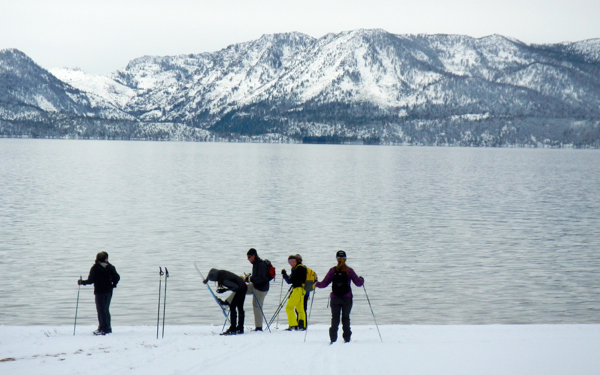
With the abundance of snow this year there is little reason to have to travel far to ski. The beaches in the basin offer miles of scenic bliss. Being next to the water allowed for views to the West Shore and of Mount Tallac.

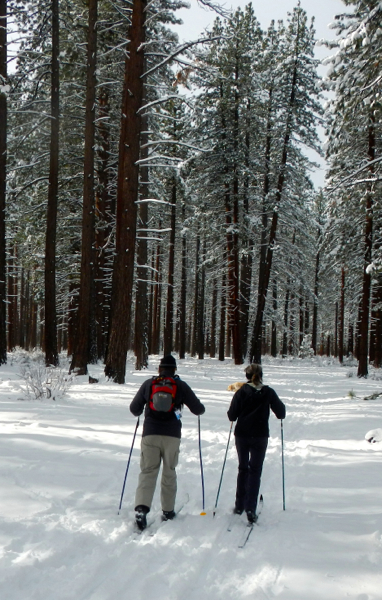
Starting out the trek is through the woods.

Starting out the trek is through the woods.

Going out the lake was tranquil; looking like it could have been a good day for a paddle, as well. Heading home, though, the water was rougher – making the choice to be on land the smart decision for that day.

Eleven people and three dogs earlier this month went from Nevada Beach, through Edgewood Tahoe Golf Course to Lakeside Beach and back – about four miles round trip.

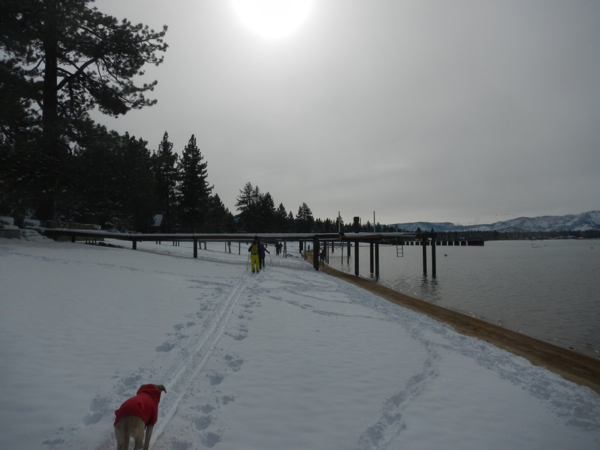
The lake is so low that at times we were gliding under piers. It certainly made it easier than contending with water or being close to private dwellings. Nevada and California have different rules about what is considered public property in regards to the water lines.

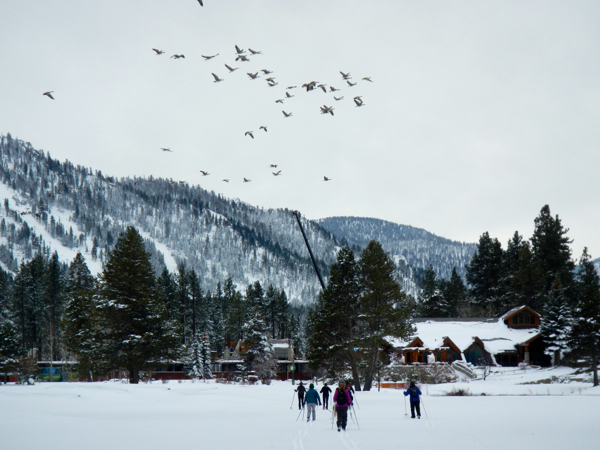
Edgewood Tahoe goes from golf course to cross country trail.

Edgewood Tahoe goes from golf course to cross country trail.

With snow, the clubhouse at Edgewood looks regal, yet inviting. Unfortunately it wasn’t open the day we scooted by.

In fact, nothing was open on this stretch of sand. With the number of people who were out at Lakeside, it would seem like a perfect place for a hot chocolate and food concessionaire. They have the facilities in the summer, so why not now?

No ducking required to ski under the docks.

No ducking required to ski under the docks.

—–

Getting there:

From South Lake Tahoe, go east on Highway 50. Drive past the casinos. Turn left on Elks Point Road. Turn left on Dorla Court. Park and ski toward the lake.


Aging rock climbing equipment a safety threat

By Steven K. Paulson, AP

DENVER — They have popular names like Dome Rock, Yosemite, Rocky Mountain National Park and Joshua Tree, and they all have one problem in common that seasoned rock climbers call a “ticking time-bomb” — aging climbing anchors.

The anchors, drilled and pounded into the sides of mountains, are rusting and starting to fail, and some climbers and parks are trying to replace them. Funds, however, are sparse.

Some of the anchors are made of iron and were installed in the 1960s. Others hide dangerous secrets — they are bolted in rocks that have loosened because of freezing and thawing, and there are bolts that look new on the outside, but have rotten cores.

Some bolts are so bad climbers can pull them out with their fingers.

Experienced climbers often keep logs of dangerous or failing equipment and share them with other climbers, but the information is often not available to other climbers.

Bernadette Regan, a seasoned climbing ranger at Joshua Tree National Park, about 140 miles east of Los Angeles, fell last year when a bolt broke off while she was rappelling down a popular route called “Solid Gold,” one of the park’s more popular routes.

Her life was saved because she didn’t trust the bolt and had a backup rope that kept her from plunging 150 feet to the ground.

“I was testing it, and jumped on a bolt and it broke,” she said. The bolt was replaced a week later.

Park officials held a “bolting blitz” last month that brought in master bolters from around the U.S. to do some concentrated re-bolting on ancient anchors. They replaced 62 bolts, some of them more than 30 years old.

Regan said experienced climbers are worried because the sport has drawn more interest in recent years.

She said interest soared this year after Kevin Jorgeson and Tommy Caldwell spent 19 days scaling the 3,000-foot sheer granite face of the Dawn Wall of El Capitan wall in Yosemite National Park, long considered one of the world’s most difficult climbs.

Chris Weidner, who is on the board of the Boulder Climbing Community in Colorado, said the anchors are “ticking time-bombs.”

He said it has taken years for the climbing community to band together to fix the problems because experienced climbers are a close-knit community and they don’t rely on old equipment to keep them safe.

He said thousands of climbing routes from the East Coast to the West Coast need to be fixed for new enthusiasts.

“It’s scary when you look at bolts that are corroded,” he said.

Weidner said one of his favorite routes in Rocky National Park, called “the Diamond” because of its massive diamond shape, requires climbers to climb nearly 1,000 feet vertically on ropes.

He said the mountain is dotted with rotting equipment left behind by other climbers.

He said most climbers can’t stop and spend hours drilling into granite to replace the bad equipment they find, and they climb other routes or use equipment that can be easily hammered or stuffed into a crag and removed as the climbers scale their way up.

Weidner said it will take a concerted effort to make the sport safer, and the group is asking for donations to buy the equipment.

“So far, deaths are few and far between,” said Brady Robinson, who now leads a campaign called the Access Fund dedicated to replacing the equipment.

He said every climber, no matter how experienced, falls once in a while and people are putting their lives on the line when they hook their ropes to the equipment.
Plans released for Squaw-Alpine gondola

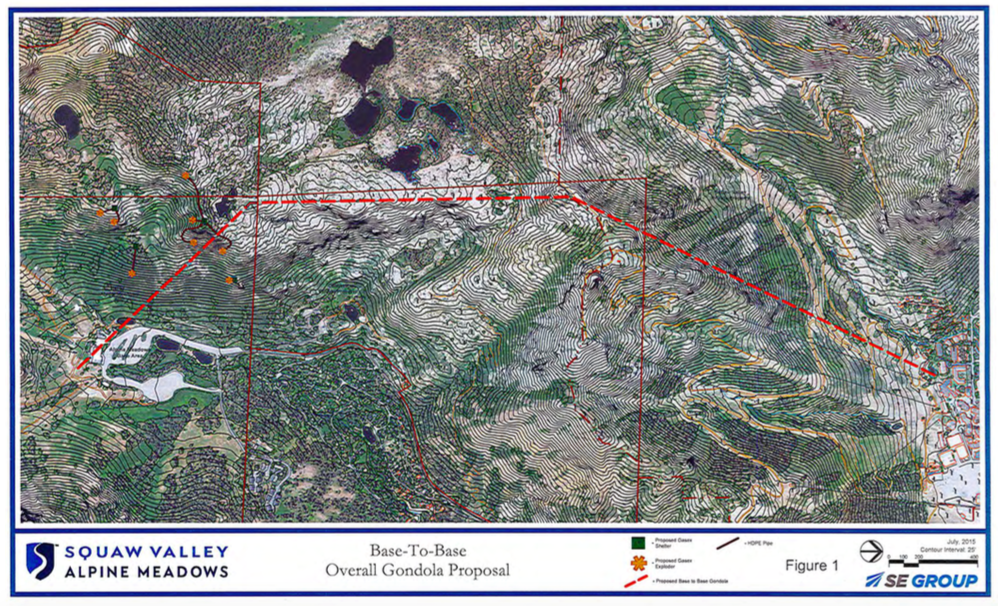
squaw-alpine gondolaPlacer County this month released the application and a description of the gondola that would link Squaw Valley and Alpine Meadows.

While the cars, with a capacity to hold eight people, would not travel into Granite Chief Wilderness, they will come awfully close. That is one of the controversial aspects of the project.

Combining the terrain of the two resorts was talked about long before Squaw Valley Ski Holding came into being. KSL Capital Partners bought Squaw in November 2010. JMA Ventures bought Alpine in 2007. Squaw Valley Ski Holdings Inc. was created in September 2011 to operate both resorts.

In April it was announced that an agreement had been reached with Troy Caldwell who owns the private land known as White Wolf. This acreage sits between Squaw and Alpine. It won’t be open to skiing, but is needed to erect the gondola.

The application says there will be two base areas, plus two midpoint stations, as well as eight Gasex exploders for avalanche control. It would be 13,000 feet long, with 37 towers.

The plan is the gondola would only operate during the ski season.

— Lake Tahoe News staff report


Sledding — uncontrollable fun in the snow

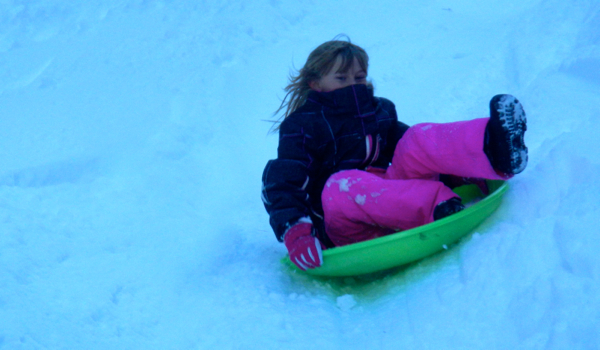
Scarlett Hart hangs on tight Dec. 25 as she sleds near South Tahoe High School. Photos/Kathryn Reed

Scarlett Hart hangs on tight Dec. 25 as she sleds near South Tahoe High School. Photos/Kathryn Reed

By Kathryn Reed

Sledding – it’s one of those winter activities that transcends generations, has little to do with athletic ability (though hiking uphill can be a workout), and brings out the inner child in those who let themselves careen down a slick surface with no brakes or any steering mechanism.

Laughter fills the woods of Tahoe this time of year with adults and kids finding inclines steep and tame, long and short, straight and with jumps – all in the pursuit of seeing how fast one can go downhill on a piece of plastic.

Stop trying to be in control and remember what it was like to be a carefree kid. That was the overwhelming sentiment of a group of adults (and one 9-year-old) who spent part of Christmas afternoon sledding behind South Tahoe High School where the old ski lift used to be. (One of the stanchions remains at the bottom of the hill.)

Some safety tips: •Sled in a snow park or allocated sledding area. Injuries are less common in designated sledding areas. We see more injuries when people sled in the woods near their house or in informal sledding areas where groups of people congregate.   •Sled in an open area, away from trees. The worst injuries I have seen come from collisions with trees resulting in head injuries, lacerations, broken bones, contusions, and abrasions.  •Avoid hard packed snow. Adults who end up going airborne often land harder. In hard packed snow conditions, it’s fairly common to see fractures in the vertebrae. •Sled in an area free from obstacles. If someone else is using the same path, wait for it to clear. Injuries are also sustained when people are hit by a sled coming from behind and they can’t get out of the way in time. Source: Lance Orr, director of Barton Memorial Hospital’s emergency department

Some safety tips:
• Sled in a snow park or allocated sledding area. Injuries are less common in designated sledding areas. We see more injuries when people sled in the woods near their house or in informal sledding areas where groups of people congregate.
• Sled in an open area, away from trees. The worst injuries I have seen come from collisions with trees resulting in head injuries, lacerations, broken bones, contusions, and abrasions.
• Avoid hard packed snow. Adults who end up going airborne often land harder. In hard packed snow conditions, it’s fairly common to see fractures in the vertebrae.
• Sled in an area free from obstacles. If someone else is using the same path, wait for it to clear. Injuries are also sustained when people are hit by a sled coming from behind and they can’t get out of the way in time.
Source: Lance Orr, director of Barton Memorial Hospital’s emergency department

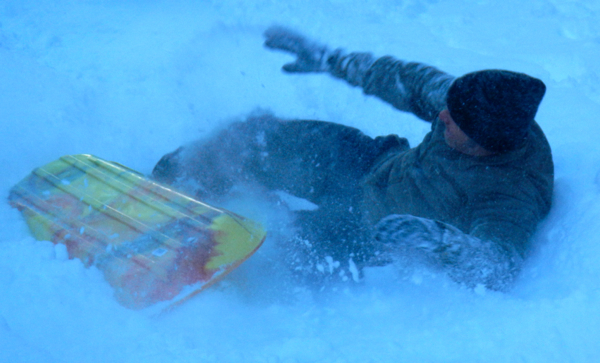
So many winter activities – skiing, snowboarding, skating – are all about control. Sledding is the opposite. And once you give in, it’s a whole lot more fun – even if it means careening off the main path or an unintended gymnastic maneuver becomes part of the dismount.

One of the problems with people sledding wherever there is an incline is the parking.

“We will tow just as many local cars as we will out of town cars. Locals are just as bad,” California Highway Patrol Officer Ruth Loehr told Lake Tahoe News. “If any part of the vehicle is in the road, we are going to tow it.”

It’s especially bad near Emerald Bay. Lake Tahoe Airport and Echo Summit areas are also notorious for people either ignoring no parking signs or having part of the vehicle in the highway.

Parking tickets are $94.

Loehr says officers try to get people to move their vehicles, but after a while tickets and towing are the only way to solve the problem and make it safe for everyone.

And while sledding is fun, it can also result in a trip to the hospital.

“From my perspective in the emergency department, sledding can be one of the more dangerous outdoor activities. It is difficult to have good control of where a sled goes,” Lance Orr, physician and director of the emergency department at Barton Memorial Hospital, told Lake Tahoe News.

Locally, the number of injuries related to sledding have been holding steady through the years, though exact numbers were not available.

“Kids are more likely to sled than adults and, as a result, we see more kids injured than adults. Though adults land harder than kids, and can suffer more severe injuries,” Orr said.


Nevada offering several First Day hikes

Nevada State Parks is offering a series of guided hikes led by park rangers and/or local volunteers as part of the nationwide First Day Hikes Program.

The Jan. 1 hikes are free and the park entrance fees will be waived.

Hikes in Northern Nevada include:

  • Rock Point Mill Hike

Take a short walk through the remains of the Rock Point Mill and learn some of Nevada’s early history, from the California Gold Rush to the development of Dayton State Park. Dogs are not permitted on this walk. This walk is less than one mile round trip, but it includes some short, rocky hills and stairs. Participants should wear sturdy hiking boots, bring water, and dress in layers for the weather. This walk should last approximately one hour. We will discuss the purpose of the mill along with some of Nevada’s early history, including the California Gold Rush, and the gold and silver discoveries at Virginia City.Difficulty: Moderate

Meet at 10am. The Rock Point Mill is located across the highway from Dayton State Park. Participants should park in the northeastern corner of the Gold Ranch Casino parking lot.

For more info, contact Kim Zuch at 775.687.4319 or washoelake@hdiss.net.

  • Fort Churchill State Park

This will be a three-mile, round-trip hike along the Nature Trail at Fort Churchill State Historic Park. Hikers of all ages are invited to be immersed in the beauty of Fort Churchill in winter and learn about the area’s rich history and abundant natural resources.

Dress for the weather (hats, gloves, and waterproof boots recommended), and be sure to bring water. In the event of severe weather, the hike may be canceled.

Difficulty: Easy. It will be from 1-4pm.

Meet at the John C. Fremont Picnic Area at Fort Churchill State Historic Park.

For more info, contact Kristin Sanderson at 775.577.4880 or bucklandstation@hotmail.com.

  • Washoe Lake State Park

Hike through the sand dunes at Washoe Lake starting at 1pm. Difficulty: Easy.

Meet at the Washoe Lake State Park Equestrian Area.

For more info, contact Kim Zuch at 775.687.4319 or washoelake@hdiss.net.


Guided snowshoe trek at Van Sickle park

Celebrate National Winter Trails Day by participating in a free guided snowshoe hike in Van Sickle Bi State Park on Jan. 9 from 10am-1pm.

Participants will learn about Lake Tahoe’s pristine environment while snowshoeing.

There is no cost to participate.  This event is open to first 20 people. Register in advance by calling 530.541.6059 or email: kedwards@cityofslt.us.

Meet at Explore Tahoe An Urban Trailhead Visitor Center located at 4114 Lake Tahoe Blvd.

Bring your own snowshoes, dress in layers, wear hat and gloves, and bring plenty of water. There will be hot cocoa and snacks following the hike at the visitor center.


Sierra’s cat on the prowl to perfect riders’ experience — especially in terrain parks

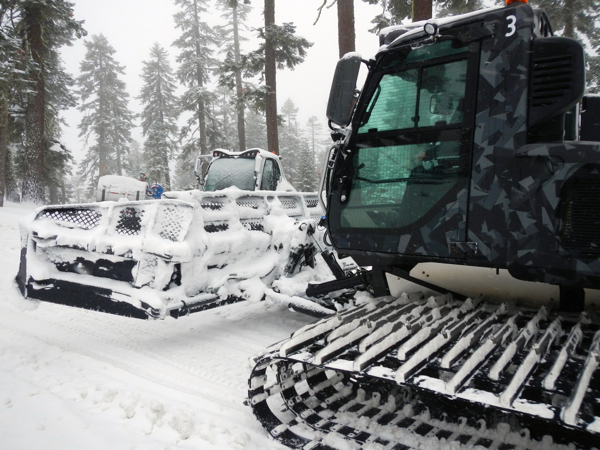
Sierra has a four-year lease on its snowcats so the fleet doesn't get too old. Photos/Kathryn Reed

Sierra has a four-year lease on its snowcats so the fleet doesn’t get too old. Photos/Kathryn Reed

By Susan Wood

TWIN BRIDGES – It’s not your grandfather’s Bombardier.

That’s the impression of Sierra-at-Tahoe’s new addition to its terrain park grooming fleet – the Prinoth Tier 4 Bison X. The workhorse of a machine runs smoothly like a Cadillac, but acts like it has the conscience of a Tesla electric car when it comes to protecting the environment, an underlying goal the ski resort 12 miles west of Meyers has focused on for years.

Benny McGinnis, Sierra’s terrain park manager, has welcomed the new member of the family of 12 grooming machines – some of which like this Bison are geared for the terrain parks. The $200,000 machine comes equipped with more torque, more features and more fuel efficiency – while throwing out fewer emissions. As numbers go, it emits 90 percent less in noxious fine particles compared to past generations, according to McGinnis’ fact sheet.

The output is right in line with Lake Tahoe’s environmental movement.

And if wondering why else this machine is important, one need only look at what in recent winters had not been falling from the sky in Tahoe to understand. California is coming off four years of unprecedented drought. If not for reliable and capable grooming machines and their operators, the ski seasons would not have lasted as long as they did. They can save a season. Think of it this way, in drought, there’s only so much snow that can go around.

Benny McGinnis is a veteran snowcat driver, specializing in terrain park work.

Benny McGinnis is a veteran snowcat driver at Sierra specializing in terrain park work.

“In the wake of the drought, efficiency is key. That means efficiency in on-mountain operations — the way we move and preserve snow and also efficiency in environmental practices. This cat gives us the chance to accomplish all of those while continuing to create progressive terrain parks,” spokeswoman Thea Hardy told Lake Tahoe News.

Progressive terrain parks are breeding grounds for Olympians.

In 2014 Sierra was celebrating the cultivation of three Olympic gold medalists — Maddie Bowman, Jamie Anderson and Hannah Teter. There’s a reason they ski and board here.

“The terrain park has definitely influenced Jamie Anderson in becoming the huge athlete she is today,” said McGinnis, a 14-year veteran terrain park builder who operates heavy machinery for the U.S. Forest Service in the summer months. In winter though, it’s all about Sierra – and all its users.

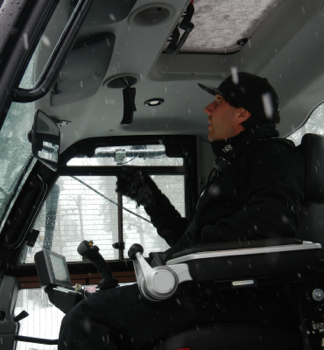
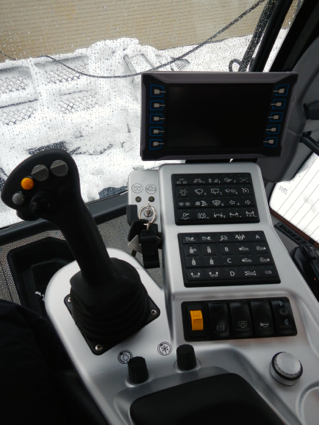
Drivers sit in the middle of the cab with a slew of controls at their fingertips.

Drivers sit in the middle of the cab with a slew of controls at their fingertips.

The Prinoth machine has a smaller cab than older models while maintaining the track size. That helps it maneuver more easily – especially at the “take offs” and “landings” associated with terrain parks.

“I like that this job gives me the opportunity to create something and to let a normal person come up and feel like an Olympic athlete. Tourists want to come up and get out of their lifestyle – to speed up or to slow down, and be an athlete,” McGinnis told Lake Tahoe News.

The Prinoth groomer, clad on the outside with a camouflage design, has more than 30 possibilities to manipulate the tiller and blade through a joystick attached to a panel that resembles an airplane. The blade can even pick up terrain park features.

This machine also provides more visibility with heated wipers and larger windows as well as more comfort for the operator with a Bluetooth sound system and heated seats. McGinnis admitted operators might get work fatigue just like a plane pilot or even someone who operates a computer for eight hours. His crew of six machine operators works two shifts encompassing between eight to 10 hours, the latter if the ski area gets dumped on. The job requires 80 hours of training.

Some are set in their ways and like to stick to the older machinery. But the handful of terrain park builders like the challenge of the new toy. All like to create a culture that embodies play.

“These cats are expensive to run. If we’re not managing the business responsibly, then we as a culture we love can’t exist,” he added as if a poet.

Call them poets of the night, writing the fate of the mountain slopes the next day.

—–

Notes:

What else is new at Sierra-at-Tahoe this year?

·       The Learn-to-Ride program is enhanced for all ages wanting to try their hands and feet on the Burton Backhill snowboard design.

·       The addition of a safety program called Helmets are Cool has come on board.

·       The WiFi has been beefed up in the base area, so guests will be able to connect with family members and friends more easily.