Snowshoe on top of the Sierra Mountains
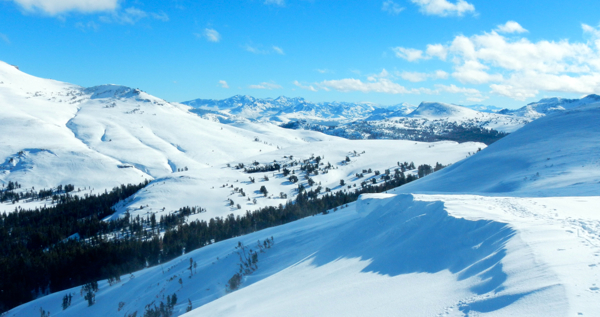
Snowy mountains for as far as the eye can see. Photo/Kathryn Reed

Snowy mountains for as far as the eye can see. Photo/Kathryn Reed

By Kathryn Reed

KIRKWOOD – Temperatures hovering closer to zero than above freezing couldn’t put a chill on the views that spilled forth.

For 360 degrees it was a winter wonderland. It was like being in the middle of the Sierra with mountains as far as the eye could see.
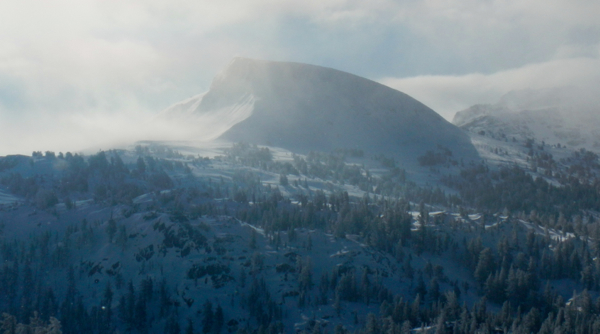
Elephants Back stands out across the other side of Highway 88.

Elephants Back stands out across the other side of Highway 88.

Distinguishable landmarks dotted the landscape – Elephants Back, the runs at Kirkwood, Little Round Top, Round Top, Hawkins Peak and others.

Meiss Meadow didn’t look much different than Caples Lake, which was covered in ice and snow.

The view to the sapphire colored Lake Tahoe may have been similar to what Gen. John Fremont saw when he first laid eyes on this alpine wonder.
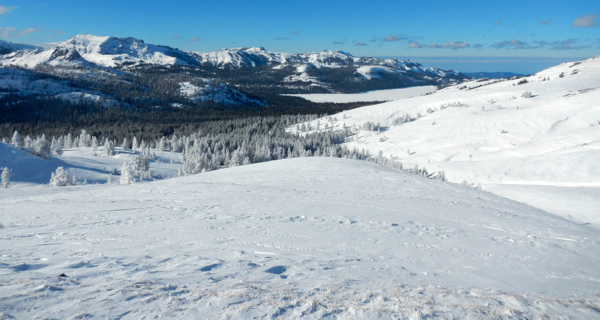
Caples Lake in the distance is popular with ice fishermen this time of year. Photo/Kathryn Reed

Caples Lake in the distance is popular with ice fishermen this time of year. Photo/Kathryn Reed

What a glorious way to welcome 2016.

Five of us spent the morning of Jan. 1 on an incredible snowshoe in the Carson Pass-Kirkwood cross country ski area. Plenty of tracks could be seen, presumably mostly from backcountry skiers. For the most part we were breaking trail. We knew where we wanted to go, but there was no set path to get us there. That just added to the fun.

At the bug station in Meyers it was minus 7 degrees as we drove through. At the starting point it was 10 degrees and had warmed to 22 by the time we were done. What a thermometer would have read on the ridge with the wind howling to the point it seemed to take our breath away, well, it’s probably better we didn’t know.
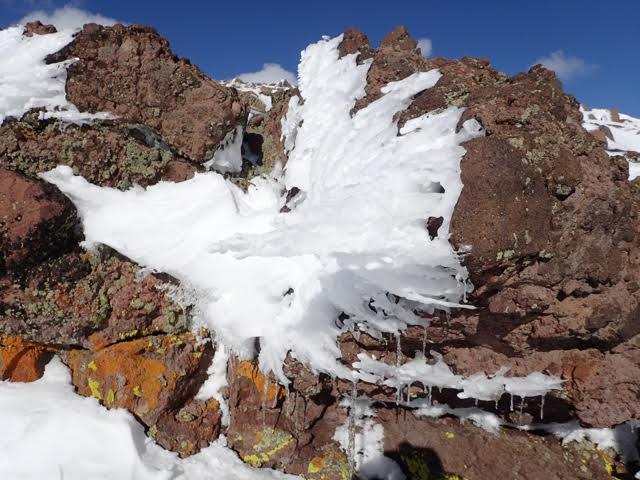
Ice formations on rocks along the ridgeline. Photo/Donna Rockwood

Ice formations on rocks along the ridgeline. Photo/Donna Rockwood

That wind whipped ice formations onto rocks in what looked like works of art, especially with the orange lichen nearby.

At times the snow was so hard our snowshoes made no indentation, while other times it was like floating on idyllic powder, and in other spots it was a crusty layer we punched through.
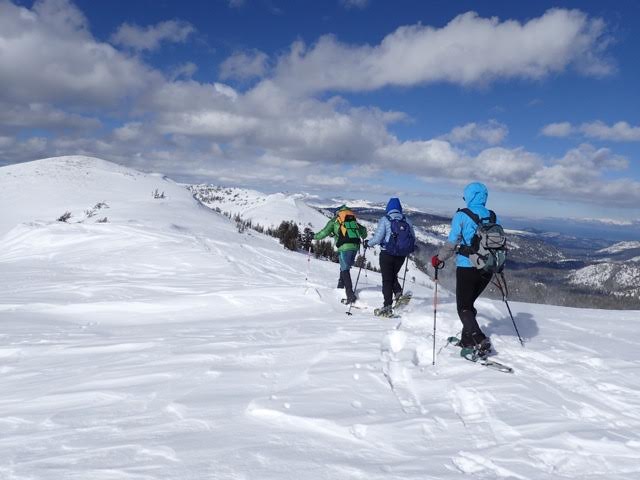
Craig, Carolyn and Kae make their way through what much of the way was a powdery oasis. Photo/Donna Rockwood

Craig, Carolyn and Kae make their way through what much of the way was a powdery oasis. Photo/Donna Rockwood

From the trailhead we headed nearly straight up and then to the left toward the ridge we knew we wanted to trek along. Had we continued, Little Round Top would have added at least another three miles to our journey. We opted to drop down into a bowl.

At the bottom we hooked up with the groomed trails of Kirkwood cross country before we made our way to the maintenance station where we had left a vehicle.

In all, we went 6.55 miles. We started at 8,573 feet and reached 9,444 feet. We gained 1,654 feet in elevation, and descended 2,267 feet.
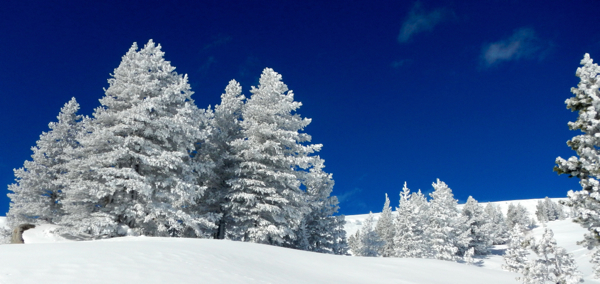
Frosty trees dot the landscape. Photo/Kathryn Reed

Frosty trees dot the landscape. Photo/Kathryn Reed

—–

Getting there:

From South Lake Tahoe take Highway 50 west through Meyers. Turn left onto Highway 89. At Pickett’s Junction, turn right onto Highway 88. Go past the parking area atop Carson Pass. We started at Meiss Trailhead, which is on the right. We left a car at the Caltrans maintenance station farther down Highway 88.

Tahoe Donner hosting Winter Festival

Tahoe Donner Cross Country Ski Area will host its inaugural Winter Festival on Jan. 24.

The Tahoe Donner team will introduce participants to the world of Nordic sports and snowshoeing, complete with demonstrations, free equipment demos, discount skiing and live entertainment.

All festival-goers will be treated to:

·         Discounted trail passes to explore up to 100 kilometers of terrain for just $10—regularly $30.

·         Discounted ski or snowshoe rental equipment at $15—regularly $25.

·         Free lessons and tours.

·         Free demo day – cross country ski, snowshoe and fat bike equipment.

Winter Festival is from 11am-3pm at Tahoe Donner Cross Country Ski Area, located at the Alder Creek Adventure Center at 15275 Alder Creek Road, Truckee. To accommodate parking needs, in addition to offering free parking on site, complimentary shuttle service will be provided from The Lodge Restaurant & Pub. For more info, go online.


Dogs face danger in the backcountry

By Benjamin Spillman, Reno Gazette-Journal

For people who love dogs and the Sierra Nevada backcountry it’s tough to imagine a better day than what Don and Polly Triplat planned for one Sunday.

The Truckee couple, two friends and their dog, Scarlet, would spend the day skiing, relaxing and enjoying solitude and views of Lake Tahoe in the Third Creek area near Incline Village.

For the Triplats, both 45-years-old and avid backcountry skiers trained in avalanche safety and wilderness first aid, ski outings with Scarlet and their other dog, Brodie, were rewarding for the whole family.

“It is absolutely a blast to watch your dog slide down a hill in front of you,” said Don Triplat, who is also the executive director of the Sierra Avalanche Center, a non-profit partner with the U.S. Forest Service that provides education on avalanche safety and information on snow conditions in the backcountry.

Read the whole story


Pioneering boat inspections benefit Tahoe

By Christopher Kilian

After nine years and 51,000 inspections, Lake Tahoe’s boat inspection program has become a national model for preventing aquatic invasive species (AIS) from sneaking into the lake and wreaking environmental havoc.

The program by the Tahoe Resource Conservation District (Tahoe RCD) and the Tahoe Regional Planning Agency (TRPA) has used research to pioneer innovative ways to decontaminate boats quickly and thoroughly. Program officials have consulted with boat mechanics to develop the best procedures and resources, and they are working with one manufacturer on engine designs that will facilitate decontamination in the future.

Stopping invaders

TRPA and Tahoe RCD launched the Watercraft Inspection Program in 2008 to minimize the risk of aquatic invasive species becoming established at Lake Tahoe. Understanding that watercraft play a significant role in spreading AIS, and notably the quagga and zebra mussel, the purpose of the program was to intercept these risks before they entered Lake Tahoe.

The 100th Meridian Initiative and Pacific States Marine Fisheries Commission provided the official training for Tahoe’s original inspection team leaders. Inspections were introduced to the boating public at launch ramps around Lake Tahoe. Any vessel found to be harboring AIS had few options at the time. Other lakes might turn away potential risks, but the goal of the Tahoe program was to grant access to all watercraft.

From bleach to heat

The solution was decontaminations, a process that would allow access to all vessels that failed the inspection and were at high risk of infesting Lake Tahoe. At the time, science showed that adult mussels could be eradicated by exposure to high concentrations of bleach. And so the advent of Tahoe’s decontamination program was born.

Spray bottles of bleach were used on areas of a watercraft deemed by the inspection process to be at high risk of transporting or harboring mussel larvae, called veligers, that are invisible to the naked eye. This process, although proven, had its drawbacks. Bleach could not be used everywhere, and in this concentration is harmful to carpeting, upholstery, and aluminum.

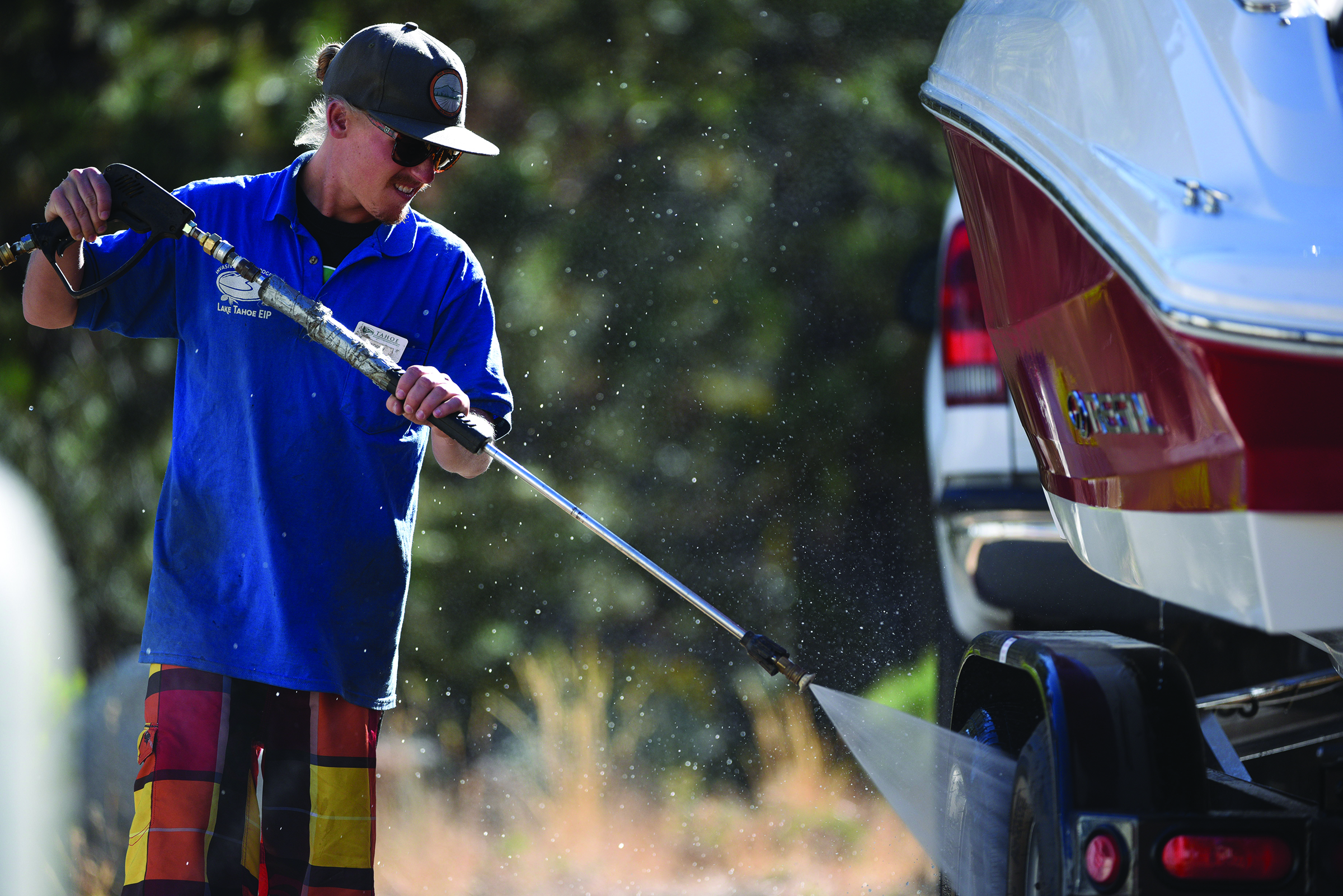
An inspector uses a pressure washer to decontaminate a boat before it is launched in Tahoe. Photo/Corey Rich

An inspector uses a pressure washer to decontaminate a boat before it is launched in Tahoe. Photo/Corey Rich

New techniques discovered

Other drawbacks were difficulties in achieving exposure times, removing bleach after application so it would not enter the lake, and an inability to be used in raw-water siphoning systems.

In 2009, scientists discovered that hot water was a suitable method for exterminating mussel veligers and other species. With an exposure time of just 10 seconds, adult quagga mussels will die when exposed to 140-degree water.

The Tahoe program purchased portable pressure washer units to improve the effectiveness of high-risk decontaminations and eliminate chemicals from the process. A small crew of Tahoe RCD and TRPA staff were responsible for performing every decontamination. Machines, equipment, and containment mats were transported to Tahoe marinas to perform these decontaminations, and took anywhere from one to four hours to complete. It was at this point that our knowledge of the complexity of watercraft began to blossom.

The Watercraft Inspection Program harnessed the knowledge of local boat mechanics, industry professionals, and marina operators and wrote what became known as “The Boat Book.”

This was a resource meant to expound upon the limited information previously understood about watercraft. Manufacturers of pumps, impellers, engines, and other marine parts were contacted to ensure that the process of flushing these components with hot water would be safe for vessels.

During the research and consulting process, it became obvious that the risks posed by watercraft lay much deeper than the outer hull and engine compartment. Watercraft have an intricate network of areas for discretely transporting potentially threatening AIS, explaining why they are one of the top carriers of AIS. 

Process continually improved

Over the years, continuous research led to many more decontaminations. The program looked to science, statistics, and data analysis, as well as an ever-growing knowledge of the mechanics of watercraft, to eliminate some risk factors and absorb others. Decontamination procedures were vetted through local boat mechanics, including those that specialize in pleasure boats, race boats, and wooden boats.

Rigorous protocols were designed to effectively inspect and decontaminate, preventing the spread of AIS without having to decontaminate every vessel entering Lake Tahoe.

Through an outreach campaign, boaters were encouraged to arrive “Clean, Drain, and Dry” in order to pass the inspection.

Inspection sites were moved to improve boater convenience as they entered the basin and alleviate congestion at the launch ramps.

The decontamination equipment was heavily modified and evolved from a simple pressure washer to a unique and purpose-built machine that was quicker, safer, more effective, and capable of accommodating even the most obscure vessel. Through these processes, decontaminations became much quicker and less frequent. And Tahoe’s inspection program is now one of the nation’s most protective.

Chris Kilian is the operations coordinator for the watercraft inspection program for the Tahoe Resource Conservation District. This article first appeared in Tahoe In Depth.


Close call with avalanche a scary lesson

By Benjamin Spillman, Reno Gazette-Journal

There are a lot of reasons Jason Layh shouldn’t have been caught in a Sierra Nevada avalanche late last year.

For starters the range is known for it’s heavy, stable snowpack even in big years, let alone during the fourth consecutive year of drought and meager snow.

And Layh is an experienced, knowledgeable skier who understands the danger of avalanche terrain and skis accordingly.

But none of that mattered in December 2014 when he and three friends headed to Castle Peak north of Truckee to make turns following a few days of fresh snowfall.


But the rewards of backcountry skiing come with risk, as Layh and his group were about to be reminded.

Read the whole story


Largest national parks hit visitation records

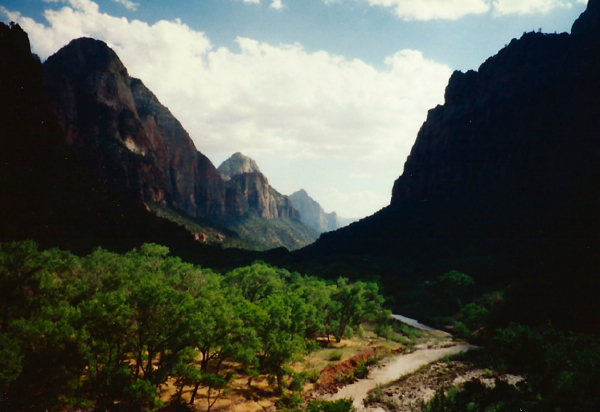
Virgin River in National Park in Utah. Photo/LTN file

Virgin River in National Park in Utah. Photo/LTN file

By Felicia Fonseca, AP

FLAGSTAFF, Ariz. — Many of the country’s most prominent national parks, including Grand Canyon, Yellowstone and Zion, set new visitation records in 2015 and are bracing for what could be an even busier new year.

The National Park Service celebrates its 100th birthday in 2016 and has been urging Americans to rediscover the country’s scenic wonders or find new parks to visit through marketing campaigns that include giving free passes to every fourth-grader and their families.

So the attendance records could be shot lived, with even bigger crowds expected next year.

“Everybody’s getting psyched and ready for it,” said Yellowstone spokeswoman Sandra Snell-Dobert. “We want people to have a good experience when it comes to our national parks. We’re trying to keep that wonderful experience while managing large numbers of people.”

Overall visitation to national parks is on track to hit 300 million in 2015, besting last year’s all-time high of nearly 293 million. Absent December totals, Grand Canyon in northern Arizona hit almost 5.3 million visits. Zion in Utah is over 3.5 million. Yellowstone, which stretches into Wyoming, Montana and Idaho, is nearing 4.1 million. Yosemite in California is about 220,000 visits shy of the 1996 record_4.2 million — with November and December still left to count.

The past year has meant some adjusting for parks as they manage the crowds. Yosemite lowered the entrance fees during the late fall and winter partly to encourage visitors to consider times other than the busy summer. Zion extended its shuttle bus service when the parking lots became too full for people to access the canyon. It also brought in interns to help study peak times.

The Grand Canyon opened up its residential and employee entrance at the South Rim to those who already had passes over holiday weekends and plans to do the same in 2016. It’s also ramped up hiring for entrance gate employees but will move them around jobs so they don’t get burned out, said Grand Canyon revenue and fee business manager Marlon Avantyr.

“We survived this year pretty much unscathed, just tired, but in a good way,” he said. “We have a good plan and a good idea of what to expect, so we’re hoping to stay ahead of the curve.”

More signs around national parks will help direct traffic and officials plan to use social media to help visitors better plan their trips. Park officials say they’ll rely more on seasonal workers, interns and volunteers who might suggest less-busy areas to visit or alternate times. The Park Service’s fiscal year 2016 budget includes $8 million for seasonal employees during the centennial, the agency said.

Some decisions on crowd-management will be made on the fly, said Zion spokeswoman Aly Baltrus.

“We’re constantly looking for what’s needed,” she said. “But at this point we don’t have an influx of funds, so we’re rearranging things as best as we can.”

At nearly 2,000 square miles, the Grand Canyon has plenty of room for visitors to branch out for river trips, backcountry hikes and to dozens of lookout points. However, the South Rim remains the most popular tourist spot. Just this year, the park proposed charging at least $5 for day hikes beyond 5 miles on major trails from the north and south rims to ease congestion.

The upcoming year will bring dark skies programs, a Theodore Roosevelt impersonator and historical steam engines to the Grand Canyon. But it won’t be all about the Grand Canyon. Workers will be talking up other Arizona parks that don’t get as much attention.

“Grand Canyon promotes itself,” said Vanessa Ceja-Cervantes, the park’s centennial community outreach assistant. “We have to do very little to get people to come out to the park.”


Warning to stay off ice at Tahoe

During this time of year in Lake Tahoe, ice may appear thick enough to walk on, but the thickness is unreliable.

At local areas such as Lakeview Commons and Ski Run Marina, several individuals have ventured out onto the ice. This can dangerous and deadly if someone breaks through.

South Lake Tahoe firefighters warn that lake ice is most fragile in frozen areas around an open patch and along the shore; and urge people to avoid rivers and lake shorelines, where even ice that looks solid is weak.

Safety tips:

·        Ice is never 100 percent safe: the best advice is to stay off of it.

If you do venture onto the ice, remember:

·        Check the weather and avoid ice-related activities on warm or stormy days.

·        Check ice conditions with knowledgeable local individuals and obey all ice warning signs.

·        Keep away from unfamiliar paths or unknown ice, and avoid traveling on ice at night.

·        Never go onto the ice alone. A buddy may be able to rescue you or go for help if you get into difficulty.

·        Before you leave shore, inform someone of your destination and expected time of return.

·        A thermal protection buoyant suit will increase your chances of survival if you do go through the ice. If you do not have one, wear a lifejacket/personal flotation device (PFD) over an ordinary snowmobile suit or layered winter clothing.

·        Assemble a small personal safety kit, no larger than the size of a man’s wallet, to carry on your person. The kit should include a lighter, waterproof matches, or magnesium fire starter, pocketknife, compass and whistle.

·        In addition to the above safety equipment, you should also carry ice picks, an ice staff and rope. A cellular phone could also help save your life.

·        Insist that children, if they do play on ice, are always under adult supervision. Children not within arm’s reach have ventured too far.


Ski rental business booming

By Sharokina Shams, KCRA-TV

Just in case you needed another sign that things are looking up in the Sierra this winter, you might need to visit some ski shops – and not just the mountain stores near the resorts, but the ones in Sacramento.

The stores are serving thousands of customers, renting and selling ski equipment at a feverish pace and working to repair and tune gear almost constantly.

If you are a customer, that means you may have to plan ahead to get the gear you need before your ski trip or be willing to wait, especially for rentals.

Read the whole story


Early snow boosts Lake Tahoe, Truckee River water forecast

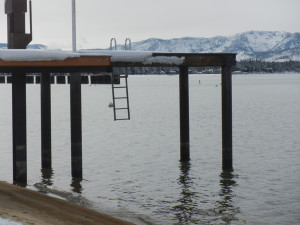
Lake Tahoe still has a ways to go before it hits natural rim. Photo/LTN

Lake Tahoe still has a ways to go before it hits natural rim. Photo/LTN

By Benjamin Spillman, Reno Gazette-Journal

It’s looking increasingly likely water levels in Lake Tahoe will climb above the natural rim at some point in the coming year.

That’s according to the Natural Resources Conservation Service streamflow forecast published Monday.

How high above the rim the water level will rise, however, remains a question because there are still too many variables to play out between now and the end of the April-through-July period covered by the forecast.

Read the whole story


Study: Drought threatens 58 mil. trees in Calif.

By Kurtis Alexander, San Francisco Chronicle

Beneath the canopy of snow that recently blanketed California’s mountainsides are vast swaths of forest struggling to survive the drought.

A study released Monday by the Carnegie Institution for Science counts as many as 58 million trees statewide experiencing severe water loss, whose ruin would not only turn massive stands of pristine green to ugly brown but upset vital watersheds and wildlife.

The research, published in the Proceedings of the National Academy of Sciences, follows a U.S. Forest Service report last spring that identified 12 million trees killed by drought but left questions about how many more might wither.

“Our maps reveal much wider, much larger-scale impacts on our forest than the dead trees would tell in themselves,” saidGreg Asner, an ecologist at Stanford University who led the new study. “What we found are large sections of forest at high risk of mortality if drought persists after the El Niño.”

Read the whole story