Super Bowl will elicit $4.2 bil. in mostly illegal bets

By J.D. Morris, Las Vegas Sun

Americans are poised to wager $4.2 billion on the upcoming Super Bowl 50, with the vast majority of those bets expected to be placed illegally, according to a projection released Wednesday by the casino industry’s main lobbying and trade group.

The American Gaming Association said its sports betting projection for the Feb. 7 championship football game between the Denver Broncos and the Carolina Panthers represents an 8 percent increase from last year.

About 97 percent of the anticipated bets — $4.1 billion — will be wagered illegally, according to the gaming association.

Read the whole story


Amgen bike race route to include Hope Valley

Cyclists competing in the Amgen Tour of California in May will ride around Lake Tahoe and through Hope Valley.

The men’s elite race Stage 5 will begin in Lodi and finish 132.4 miles later at Heavenly Mountain Resort’s California Lodge on May 19. The women’s 72.7-mile Stage 1 will start and finish at the Cal Lodge that same day.

This will be the first day of the four-day women’s event. The approximately 160 female athletes will begin between 10 and 11am, riding clockwise around Lake Tahoe. In a slight variation from last year’s women’s race, cyclists will go from Highway 50 to Pioneer Trail then to Ski Run Boulevard, Needle Peak, Wildwood and finish at Heavenly. The athletes should finish between 1 and 2pm.

The men’s races features approximately 200 athletes. From Lodi they will travel on Highway 88, going over the Carson Pass into Hope Valley, then over Highway 89’s Luther Pass, to Pioneer Trail off of Cornelian, Cheyenne, Apache, Mandan, then to Ski Run Boulevard, and through Needle Peak, Wildwood and finishing about 3:45pm at Heavenly. This stage will reach the highest elevation ever mounted by the race at 8,600 feet.


Nev. company revolutionized ski, snowboard tricks

By Benjamin Spillman, Reno Gazette-Journal

Most of skiing and snowboarding fans have never heard of Frank Wells.

But if they’ve ever watched their halfpipe heroes crush a freestyle competition during the X-Games, Burton Rail Tour, Burton Peace Park, Dew Tour or other major events they’re familiar with the quality of his work.

“A really good halfpipe, basically, there’s no resistance,” said Wells, a former professional snowboarder who has been designing and building terrain features since 1999. “There are no curbs, or kinks, it is just very, very smooth.”

Wells is a senior project manager and snowcat operator for Snow Park Technologies, a Verdi, Nev.,-based company that’s come of age with the Gen X and millennial age skiers and snowboarders who transformed snow sports in the past 20 years.

Read the whole story


Sierra avalanche risk subsides

By Benjamin Spillman, Reno Gazette-Journal

Avalanche danger in the Sierra Nevada around Lake Tahoe is low on all aspects for the first time since New Year’s weekend.

The apparent stabilization of the snowpack is good news for skiers, snowboarders, snowshoers and snowmobile riders following more than three full weeks of delicate conditions in the backcountry. Although some risk remains, the likelihood of slides is low.

The unstable period saw myriad avalanches throughout the region, including one that buried professional skier JT Holmes and another at Sugar Bowl Resort that resulted in accusations of trespassing and reckless behavior against the snowboarder said to have triggered it.

Read the whole story


Avi safety message targeted at younger crowds

By Phuong Le, AP

MOUNT BAKER, Wash. — Walker Smith has been skiing in-bounds at resorts since he was young, but lately the Seattle teen has become more interested “in getting tracks where no one else has really gone.”

He knows backcountry travel comes with avalanche risks, he said. So under a brilliant blue sky one Saturday, he and a dozen teens hiked out into the snowy landscape outside the boundaries of Mount Baker ski resort to learn how to identify avalanche terrain and spot warning signs.

“It’s not 100 percent safe in the backcountry so you have to know about all the dangers,” said Smith, 17, a member of the Mountaineers Adventure Club, a Seattle-based teen program that partnered with Northwest Avalanche Center to organize the avalanche awareness field trip.

As more young adults head out of bounds to ski, snowboard or hike in the winter, experts are targeting their message about avalanche safety to an even younger audience. They’re trying to reach kids early — in middle or high school, sometimes even in elementary school — to build their knowledge about snow and avalanches.

“They’re young, they’re impressionable. They don’t have a pattern of bad behavior yet. By spending more time on youth, we feel like we can make a difference in changing behavior,” said Scott Schell, program director of the Northwest Avalanche Center, a Seattle-based non-profit and federal government partnership.

The center, which issues weather forecasts and avalanche warnings, also offers about 200 free or low-cost education classes each winter to church groups, schools, shops and other organizations. About one-third are now geared toward teens or young adults.

“We feel that working with younger people is the way to affect behavior down the line,” since they’re likely to be lifelong users of the outdoors, Schell said. “We tell them that most of the time it’s safe and sometimes it’s not. Learning when it’s safe and when it’s dangerous is one of the key takeaways.”

At least 14 people have been killed in slides so far this season; the three most recent deaths happened Sunday in Washington and Wyoming. This month has been the deadliest January for slides in nearly 20 years, according to the Colorado Avalanche Information Center, the central archive for avalanche accidents in the country. On an average, 27 people die in avalanches across the U.S. each year. The center doesn’t track age of all fatalities, but avalanche deaths typically involve men between 20 and 45, the center said.

After a 2003 avalanche killed three young men in Utah, the Utah Avalanche Center created a free avalanche awareness program for middle and high school students. The hour-long program includes a high-energy video that helps them understand how to have fun in the mountains while avoiding avalanches.

Better gear, more media coverage and rising lift tickets at resorts have made the backcountry more accessible and appealing to a wider range of people.

A lot of the kids may not go into the backcountry, but the idea is that “when someone talks them into getting into the backcountry 15 years from now, they’ll have this knowledge that they’ve stored away,” said Paul Diegel, executive director of the Utah Avalanche Center.

More than 200,000 students in Utah have been exposed to the “Know Before You Go” program over the last decade. And the program has spread to other states.

In Jackson, Wyoming, the American Avalanche Institute, which targeted high schoolers, has expanded its program to middle schools as well. It runs several free avalanche programs for kids 10 to 18, which is funding by the Steve Romeo Memorial Fund.

Lessons are shorter with more hands-on activities; the goal is repetition and learning progresses through the age groups. “We try and send our younger, hipper instructors who are easier to relate to,” said Sarah Carpenter, co-owner and teacher at the American Avalanche Institute.

The message to younger age groups is to stay in bounds and avoid the backcountry, Carpenter said. But with older teens, “our goal is not to preach abstinence. As the kids get older, they’re going to go into the backcountry.”

The goal is to give them good habits and skills to build a foundation, she said. The message: if they duck under a rope or venture out-of-bounds, the conditions are going to be very different.

For the teens, ages 14 to 18, with the Mountaineers Adventure Club, the day began with a review of the avalanche forecast, which said conditions were moderate.

Eric Gullickson, an avalanche instructor with the Northwest Avalanche Center, lead the group as they set off, snow crunching under foot, toward Artist Point on Mount Baker, about 130 miles northeast of Seattle.

As they hiked, Gullickson pointed roller balls on slopes, cornices and other avalanche dangers. He asked the group what the difference is between snow inside ski resorts and out of bounds. The teens chimed in that ski resorts control the snow by grooming it and skiers and boarders are packing down the snow.

“The snow is always changing so you always have to be assessing,” he said. “As you’re walking around, keep an eye on the slopes. In your mind, think: ‘Do I want to go there? What’s a good place to go?'”

Gullickson then used a shovel to dig a snow pit, carving a 6-foot vertical face in the snow to reveal the layers of snowpack. The teens moved closer as Gullickson pointed out the hard layer of snow between two soft layers.

“It’s good to know,” said Rowan Forsythe, 15, of Seattle, afterward. “The more knowledge you can have, it’s another tool.”


Squaw to dedicate day to MS empowerment

Vertical Express for Can Do Multiple Sclerosis, the only national event series that combines skiing and fundraising to empower people with MS, will hit the slopes of Squaw Valley on Feb. 27.

Vertical Express for Can Do MS features on-mountain and après activities for people of all ages and ability levels. Individuals may register for $25 online. While fundraising is not required to participate in the event, attendees are encouraged to raise funds to earn VIP status, as well as a variety of prizes.

In addition to the on-mountain activities, an adaptive ski experience at the Squaw Valley event will enable 10 people with MS and their support partners to build self-esteem and confidence, improve their fitness levels and join their family and friends on the slopes.

Can Do MS honors the legacy and beliefs of founder and Olympic ski racing medalist Jimmie Heuga, a pioneer in the MS care management field, who was diagnosed with MS at the height of his skiing career and later went on to revolutionize the way MS is managed today.

Go online for list of that day’s events.


Drought blamed for Nev. reservoir’s dead fish

By Associated Press

LOVELOCK — A drought-fueled algae explosion may have killed off all the fish at Rye Patch Reservoir and state wildlife officials say it could take years to rebuild the popular northern Nevada fishery known for its trophy-sized walleye and giant catfish.

Nevada Department of Wildlife biologist Brad Bauman says he won’t know for sure until spring whether any of the fish are still alive in frozen lake about 100 miles northeast of Reno.

He told the Lovelock Review-Miner the area’s first known golden algae bloom apparently occurred primarily because the reservoir between Lovelock and Winnemucca has been largely stagnant for three years with no fresh water flowing in from the Humboldt River.

He says the lack of inflow combined with elevated minerals, low nutrients and cold temperatures apparently trigged the bloom.


Wild, natural beauty abounds in national parks

Publisher’s note: This is one in a series of stories about the National Park Service, which is celebrating its 100th anniversary in 2016.

Battling Male elk engage in ritualized mating behavior during the rut - antler wrestling or sparring. Photo Copyright 2016 Carolyn E. Wright

Male elk engage in ritualized annual mating behavior during the rut in Colorado’s  Rocky Mountain National Park. Photo Copyright 2016 Carolyn E. Wright

By Carolyn E. Wright

I had visited Rocky Mountain National Park many times to hike, bike, and photograph the beautiful landscape. This time was different. With my new husband in tow, we were in search of the elk rut, also known as the mating season, when the males fight for a harem of cows and their calves. The bull elk also will bugle during this time to attract the females and to intimidate other bulls.

Carolyn E. Wright photographs elk in Denali National Park. Photo Copyright 2016 Carolyn E. Wright

Carolyn E. Wright photographs elk in Denali National Park. Photo Copyright 2016 Carolyn E. Wright

We started our afternoon drive from Estes Park where we were staying in the famous Stanley Hotel, which was the inspiration for the movie “The Shining.” We followed the main road through the park, stopping to enjoy several overlooks, as this was my husband’s first visit to the park. It was getting late and I knew we had to get to the Poudre Lake area where the land is flat and water abundant. There, we should find our goal.

The layers of Canyonlands National Park in Utah. Photo Copyright 2015 Carolyn E. Wright

The layers of Canyonlands National Park in Utah. Photo Copyright 2015 Carolyn E. Wright

We rounded the corner and saw herds of elk. I couldn’t gather my camera equipment fast enough. Fortunately, we were rewarded with several young bulls fighting and other interactions. It’s an incredible opportunity to witness nature at work.

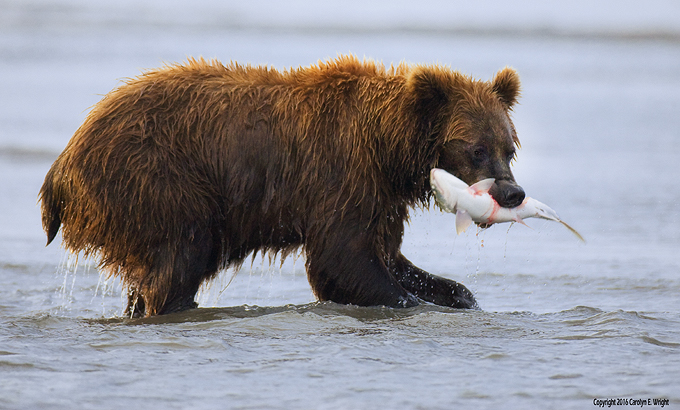
A grizzly finds its salmon dinner in Alaska's Denali National Park. Photo Copyright 2016 Carolyn E. Wright

A grizzly finds its salmon dinner in Alaska’s Lake Clark National Park and Preserve. Photo Copyright 2016 Carolyn E. Wright

This is one of my many wonderful experiences at our national parks. These memories started as a youngster growing up in Tennessee, where my family and friends made several trips to nearby Smoky Mountain National Park. My family enjoyed the outdoors and camping, so I soon started to document the beauty with my camera.

Harbor seals chill on glacier ice in Kenai Fjords National Park in Alaska. Photo Copyright 2016 Carolyn E. Wright

I later added the goal of visiting every national park to my bucket list. While I could spend lots of time and money traveling all over the world, it is much easier and cheaper to enjoy the incredible diversity and beauty of our park system. I don’t have to worry about language barriers, passports, or currency exchanges. I also had to travel for work, so it was easy to add a weekend visiting a nearby park to my business trip.

Smoky Mountains Creek flows through the Great Smoky Mountains National Park in Tennessee. Photo Copyright 2016 Carolyn E. Wright

Smoky Mountains Creek flows through Great Smoky Mountains National Park in Tennessee. Photo Copyright 2016 Carolyn E. Wright

We have 59 national parks, plus many more national monuments and recreation areas. I’ve been to 33 national parks (some of them several times), from the Everglades in Florida, to Denali in Alaska, Acadia in Maine, and Sequoia in California. Each park has unique and varied features. Rocky Mountain National Park is my overall favorite because of its combination of extreme mountains and wildlife. Kenai Fjords (sea life, including whales, otters, and sea lions) and Lake Clark (coastal brown bears, aka grizzlies) offer the closest access to animals. Great Sand Dunes provided the most fun, running and rolling down the dunes. Yellowstone presents the most diversity of landscape and animals.

Great Sand Dunes National Park and Preserve in Colorado if full of contrasting terrain. Photo Copyright 2016 Carolyn E. Wright

My experiences during my visits have ranged from elation to fear. During a backpacking trip in the Smoky Mountains, a wasp stung me, we had to cross a fast running creek seven times, and we got lost for several hours. I’ve watched a mother bear nurse her cub within feet of me in Lake Clark. I’ve seen the rare blossoming of fields of wildflowers in Death Valley. The Denali mountain provided the most spectacular view, but it is one of the most difficult areas to hike because there are no trails in the park. I fought hypothermia during a backpack trip there. An alligator approached us in the Everglades. I hiked to the bottom and back up the steep Grand Canyon. Deer ate berries next to me in Olympic.

A sow nurses her cub. Photo Copyright 2016 Carolyn E. Wright

A sow nurses her cub at Lake Clark National Park and Preserve. Photo Copyright 2016 Carolyn E. Wright

All of our national parks bestow a plethora of scenic opportunities and a sense of grounding at a low price. Great thanks to President Theodore Roosevelt who started the National Park Service and to those who continue to preserve these national gems.


Why gear costs so much

By Graham Averill, Outside

I’m a sucker for thumbholes. Those little empty spaces on the cuffs of hoodies and base layers that showed up maybe a dozen years ago—those things make me swoon. And I’m not the only one.

According to a recent Nike investor meeting, Nike’s customers are willing to pay a premium for clothing with seemingly benign features like thumbholes. During the past several years, Nike has performed analyses that looks at the value customers attribute to specific features on technical clothing in hopes of getting more “scientific” about its pricing.

“[We] had them tell us, what do you think this one’s worth versus this one? What details on the shorts make it worth more?” explained Jeanne Jackson, president of product and merchandising at Nike, to investors during the meeting. “We discovered in tops that if a top has a thumbhole in it, the consumer perceives it as a premium top. So we’re getting a little bit more scientific about what those features and benefits are that the consumer will perceive as worth more money.”


We reached out to Nike and a handful of large outdoor brands, all of which refused to comment about their pricing strategies or any internal consumer analysis.

Read the whole story


U.S. dominates Mammoth Grand Prix halfpipe

By USSA

MAMMOTH MOUNTAIN – It was a highly successful day for the American halfpipe riders at the first stop of the U.S. Grand Prix in Mammoth on Sunday.

American women swept the podium with Kelly Clark (West Dover, Vt.) taking the win, Chloe Kim (La Palma) finishing second and rookie team member Maddie Mastro (Wrightwood) earning her first pro-level podium with third. The U.S. men took four of the top-five positions including a pair of podium finishes: Chase Josey (Hailey, Idaho) grabbed second and Gabe Ferguson (Bend, Ore.) finished third; Ryo Aono of Japan topped the field for the win.

Mammoth Mountain has seen snowy, stormy conditions since the Grand Prix began on Thursday, which affected several competitions, including the cancellation of qualifications for the snowboard halfpipe.

“I’m glad that we were able to get the contest off today,” Clark said. “It’s been a challenging week of weather.”

The four-time Olympian used her veteran knowledge to approach the competition, landing a “safety” run on her first pass and then bumping it up by adding her signature 1080 on the second pass, which earned her the win. “We had an early start,” she said. “I just tried to make the most of my practice because we didn’t really have any this week.”

Fifteen-year-old Kim, who broke Clark’s five-year winning streak at X Games Aspen in 2015, also landed what she called her “back-up plan” to land in second. “I’m just happy that I had a back-up plan,” said Kim, who wanted to throw a relatively new tailgrab 1080 she first landed at the U.S. Open in 2015. “I was really excited to maybe throw one today, but unfortunately that wasn’t able to go down.”

Mastro, a member of the U.S. Snowboarding rookie halfpipe team and Mammoth Mountain team, was thrilled to earn her first pro podium in front of family and friends. The 15-year-old will hopefully use the momentum rolling into her first X Games appearance in Aspen this week.

Idaho native Josey earned his first Grand Prix podium with a similar mindset to that of the ladies.

“There was definitely strategy going into the first runs, just wanting to land a run and then kind of see where you can go from there,” he said. “The weather got better and the second run I just stepped it up and went for two more double corks, and that’s what got me my score. It’s my first Grand Prix podium and it really means a lot to U.S. Snowboarding and USSA, so I’m stoked.”

Young Gabe Ferguson not only topped most of the field to earn his first Grand Prix podium, he also topped his fellow U.S. Snowboarding teammate and older brother, Ben Ferguson, who finished 24th. “This is my first Grand Prix podium and I’m super excited,” Gabe said. “It’s been tough with all the weather that’s come through the last couple days so I’m just happy we’re out here having fun today.”

Rounding out the men, Jake Pates (Eagle, Colo.) was fourth, Ryan Wachendorfer (Edwards, Colo.) fifth, Toby Miller (Truckee) ninth, Joshua Bowman (Mammoth Lakes) 12th, Nathan Jacobson (Bend, Ore.) 17th, Robert Pettit (Aspen, Colo.) 20th, Chase Blackwell (Longmont, Colo.) 22nd, Dru Brownrigg (Bend, Ore.) 23rd and Ben Ferguson (Bend, Ore.) 24th.

For the women, Elena Hight (South Lake Tahoe) was fifth, Hannah Teter (Meyers) sixth, Zoe Kalapos (Vail) seventh, Jenna Dramise (South Lake Tahoe) 12th, Hannah Merson (Stowe) 16th, McKinzie Johnson (Park City) 19th, Autumn Inouye (Hood River, Ore.) 20th and Madison Taylor Barrett (West Chesterfield, N.H.) 22nd.