
Lahontan cutthroat trout rediscovered in Utah creek

Fisheries biologist Corene Luton measures a Lahontan cutthroat trout as it moves through the fish passage facility at Marble Bluff Dam, Nevada. Photo/Jeannie Stafford/U.S. Fish and Wildlife Service

By Lauren Bain, Nevada Today

The Lahontan cutthroat trout was rediscovered in a “dinky” stream near the Nevada-Utah border. Genetic testing by Associate Professor of Biology Mary Peacock led to the rediscovery of an iconic Nevada fish.

“Even though they were in that tiny, dinky stream on the edge of Utah for close to 100 years, they had maintained that capacity to grow into this big fish,” Peacock said. “People just went completely wild; it’s like the big boys are back.”

Peacock became involved with the research and recovery of the Lahontan cutthroat trout in the early 2000s. She began working on ways to perform genetic testing to determine if the small trout discovered in the Pilot Peak streams were the original species of the Truckee River watershed.

Read the whole story


Comments sought on USFS over-snow program

The U.S. Forest Service has released the draft environmental impact statement for the Tahoe National Forest over-snow vehicle use designation project.

The USFS is proposing to designate snow trails and areas for public OSV use on the Tahoe National Forest. The Forest Service will also identify snow trails where grooming for public OSV use would occur within the Tahoe National Forest.

The notice of availability will initiate a 45-day public comment period on April 13 on the DEIS.

The DEIS is available online.

In addition, the Tahoe National Forest will be answering at open houses on April 24 and May 2. The April meeting is from 3-7pm at the Sierraville Ranger Station and the May event is from3-7pm at the Holiday Inn in Auburn.


Resorts place greater emphasis on snowmaking

By Danny King, Travel Weekly
 
For most of the history of snowmaking technology, the ski industry has viewed it as a plan B effort: filling in bare spots on an occasional warm, dry day in the mountains, especially late in the season. But global warming has changed that view. Increasingly, snowmaking is becoming a ubiquitous component of the ski experience at U.S. resorts large and small.

In announcing its first capital improvement budget since its founding last year, Alterra Mountain Co. made sure to earmark a sizeable part of that budget for snowmaking equipment designed to pick up where Mother Nature leaves off — or has already left off.

Alterra, which owns Squaw Valley and Alpine Meadows, declined to say exactly how much of the $555 million it has budgeted for its dozen North American resorts within the next five years will be dedicated to upgrading the snowmaking systems.

As of today, snowmaking machines can cover about 22 percent of the acreage at U.S. ski resorts, according to the 2016-17 Kottke National End of Season Survey released by the National Ski Areas Association (NSAA).

Read the whole story


Controlled burns to resume in Tahoe basin

The Tahoe Fire and Fuels Team, which includes local, state and federal agencies, will continue prescribed fire operations this week around the Lake Tahoe Basin. 

Weather and conditions permitting, the Tahoe Douglas Fire Protection District, California State Parks, California Tahoe Conservancy and the U.S. Forest Service will continue prescribed fire operations in Sugar Pine Point and Burton Creek state parks on the West Shore, Carnelian Bay and Kings Beach on the North Shore, Logan Shoals on the East Shore and on Kingsbury Grade and off Ski Run Boulevard on the South Shore. Smoke may be present. 

Each prescribed fire operation follows a specialized prescribed fire burn plan that considers temperature, humidity, wind, moisture of the vegetation, and conditions for the dispersal of smoke.  This information is used to decide when and where to burn.


Calif. wants input on trout management

The California Department of Fish and Wildlife will be soliciting public comment and ideas on the statewide management of trout at a series of public meetings.

The three key areas for which CDFW are seeking input are:

  • The revision of CDFW’s Strategic Plan for Trout Management, last published in 2003
  • The creation of a new Strategic Plan for Trout Hatcheries
  • Simplification of inland trout angling regulations

Each meeting will include a brief presentation covering each area. CDFW personnel will be available at information stations to answer questions and listen to stakeholder interests, needs and ideas.

All stakeholder input will be taken into consideration as draft plans and a regulation simplification package are developed for formal public review.

The closest meeting to the Tahoe basin is April 18 at the Truckee-Tahoe Airport Community Room from 6-7:30pm.


Tahoe basin USFS sites to open for season

The U.S. Forest Service Lake Tahoe Basin Management Unit  will soon begin the process of opening recreational facilities in the Lake Tahoe Basin.

Weather and snow conditions permitting, Inspiration Point will be the first site to open on  April 14. Baldwin and Nevada beaches open April 28. The Taylor Creek Visitor Center opens May 25. The Tallac Historic Site parking area opens May 15, and will be staffed beginning May 26.  
 
The following is a list of opening/service dates, weather and snow conditions permitting:

Campgrounds

·         Round Hill Pines Resort – May 10

·         Meeks Bay Resort, William Kent, Kaspian, Meeks Bay, Bayview, Fallen Leaf, and Nevada Beach campgrounds – May 11

·         Camp Richardson RV Park, Luther Pass Campground and Angora Resort – May 25

·         Blackwood Canyon and Watson Lake campgrounds – June 1

·         Camp Richardson’s Eagles Nest and Badgers Den campgrounds – June 11 

Day-use areas

·         Baldwin and Nevada beaches – April 28

·         Chimney Beach and Secret Harbor – May 1

·         Sandpit Off-Highway Vehicle (OHV) Area – May 10

·         Eagle Falls restrooms, Kiva Picnic Area, McKinney Rubicon Trailhead restrooms, Sawmill Pond and Tallac Point – May 15

·         Big Meadow Trailhead – May 25

·         Pope Beach – May 26.

Keep in mind, recreation area grounds are open year-round, but until sites officially open, there is no parking, trash removal or restroom facilities available. Be sure to pack out all trash and where pets are allowed, always clean up after your animal. Until parking lots open, park your vehicle off the roadway, avoid parking on vegetation, and do not block access gates. 


LimeBikes expanding program in S. Lake Tahoe

By Kathryn Reed

LimeBikes are coming back to South Lake Tahoe – and for a longer period.

They are expected to start showing up in mid-May to be ready for the Memorial Day surge and will be scattered about until mid-October.

These bikes were introduced here last summer on a pilot basis backed by the League to Save Lake Tahoe. The goals were to give cyclists an inexpensive way to get on a bike, get people out of their cars and reduce pollutants.

What hasn’t been disclosed is how much driving is done by the company to redistribute the bikes, or pick ones up that need servicing.

From the get-go these bikes were a bit controversial. People complained they were garish, looked like trash as they were left in random locations, and competed with established bike shops. (Sensors have been added to the bikes to monitor when they’ve been tipped over.)

As for the company, they believed last year was a success. Thus the reason to bring the bikes back for a longer duration, and the possibility of adding motorized scooters and bikes. The scooters would cost $1 to unlock and then 15 cents per minute. In cities  where scooters have been introduced they are used eight times more often than bikes, officials said.

Sam Dreiman, director of strategic development for LimeBikes, told the South Lake Tahoe City Council last week that tourists and locals were on the bikes. He said a substantial number of casino workers used them as their main mode of transportation to get to and from work.

The state line area is where ridership was the heaviest. Participation grew through the summer, with spikes on the weekends.

The bikes have GPS in them, allowing for the company to track the whereabouts of the bikes, but also know the locations people visited.

Expanding business partnerships is a goal as a way to encourage taking bikes to LimeBike-friendly establishments. That concept is still in the works.

As for competing with brick and mortar bike outlets, Dreiman said, “In other cities they don’t see this as competition. It is a different use.”

In part this conclusion is based on the duration people tend to use a Lime Bike – 10 minutes on average in South Lake Tahoe. Tourists renting a bike want it for an hour or all day.

With there being no docking locations for the bikes, they can be left almost anywhere.

While the South Shore likes to consider itself one community, each jurisdiction has its own laws and rules.

LimeBikes wound up in Douglas County, Camp Richardson and on U.S. Forest Service property. The Bay Area-based company does not have agreements with those entities.

“We have discussed the LimeBikes program and feel that a bike share program does add value to the community. However, greater engagement with local bike rental and bike shop businesses would be desired. We believe there is room for improvement,” Melissa Blosser with Douglas County told Lake Tahoe News. However, she added, “We are not in a position to regulate or ban them.”

The USFS has strict rules about making money on federal lands. If someone were to pick up a LimeBike on USFS land could be construed as making money, compared to if someone were to ride to a Forest Service beach, stay a bit and then leave with the bike.

“We have not issued a competitive permit for the commercial use of LimeBikes as of yet, as we are working with the community to explore the idea of their utilization, a test program. There were some issues last year as to where the bikes were left, however it did not cause any substantial problems,” Heather Noel with the Lake Tahoe Basin Management Unit told Lake Tahoe News. “LimeBikes could be confiscated if found abandoned on National Forest System lands and impounded five days after a notice has been mailed.”


OMG fun run registration open

Registration is open for the June 3 OMG Fun Run.

For a few hours, leopards, butterflies, world-class athletes and Tahoe style entertainment will take over Old Meyers Grade. Costumes are encouraged and the best costume in each division (12 and under, women, and men) will receive a prize. Additional prizes will be awarded for the first to reach the top and most laps in each division. Winners in each category and participants who complete at least three laps will have their names posted on the OMG website after the event.

Old Meyers Grade is located 0.1 miles up South Upper Truckee Road. The course gate-to-gate round trip is 2.6 miles. The event will be held rain or shine. Refreshments will be provided.

Proceeds will go to fund, support and promote creative and sustainable projects community-enhancing events in Meyers.

The 10am-noon event will at to be on Old Meyers Grade in Meyers. Advanced registration is $15 for adults and $5 for 12 and under, free for 5 and younger. It includes an OMG T-shirt.  Registration the day of the event is $20 for adults and $10 for children and will be onsite at Old Meyers Grade from 8:30-9:30am.


Sierra-at-Tahoe athletes bring Olympics home

Jamie Anderson and Hannah Teter celebrate their accomplishments at Sierra-at-Tahoe on April 7. Photo/Kathryn Reed

By Susan Wood

TWIN BRIDGES – Sharing their Olympic experience in full circle, medalists Jamie Anderson and Hannah Teter came home to Sierra-at-Tahoe Saturday to celebrate with about 500 friends, families and fans.

The Winter Games in South Korea are but a distant memory, but etched in the hearts and minds of those of all ages who turned out was the community spirit that spawned these extraordinary athletes.
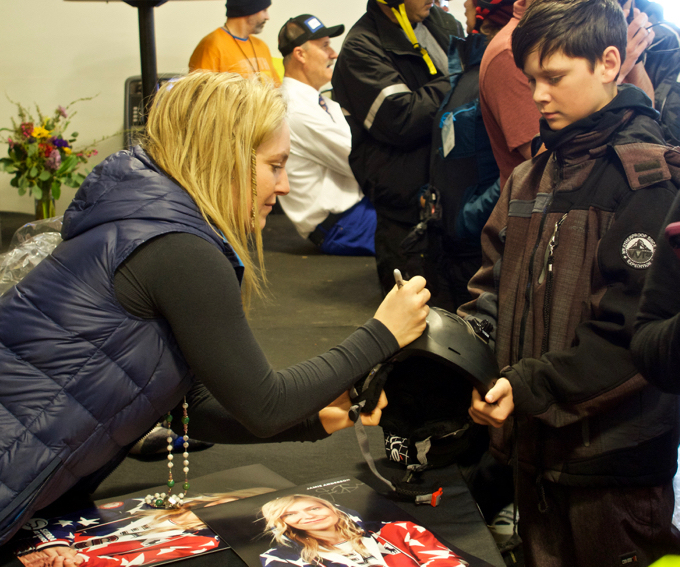
Jamie Anderson signs a helmet, one of many personal items people brought to be autographed. Photo/Kathryn Reed

Anderson and Teter have won gold medals in different Winter Games, celebrating in grand style four years ago when they arrived at the Sierra plaza in a vintage fire truck with a parade of dignitaries. This year’s event was smaller in blustery weather, but no less enthusiastic.

In viewing the autograph line set up at the Solstice, it was hard to know who was more excited about meeting these women who call Sierra their home resort – the kids or the adults.

 

Sierra-at-Tahoe General  Manager John Rice’s philosophy of making the resort a family helps foster the development of Olympic-caliber athletes.


Mercedes Rodrigues of San Mateo could hardly contain herself.

“I was shaking,” she said, describing the moment she walked up to Anderson and Teter to have them sign posters. She was smiling from ear to ear as her 10-year-old son, Cameron, was quite relaxed. The family watches Olympic sports as diligently as they bring their season passes to ski at Sierra.

“I want to try to win everything,” she said, peering over the signed memorabilia in the silent auction.

Nolan and Maia Vo are fans of Hannah Teter’s. Photo/Kathryn Reed

Before and after Anderson and Teter appeared before a swarm of cameras, South Lake Tahoe Mayor Wendy David and Sierra-at-Tahoe General Manager John Rice gave personal accounts of what the experience means to them.

Nods were given to other Sierra homespun athletes, Maddie Bowman and Kyle Smaine, who couldn’t make it since they’re in Mammoth and Russia, respectively. On occasion, fans, Teter and Anderson would hold up giant “fathead” cutouts of them to remind all just how large the Sierra family is.

David told the crowd how proud she is of these homegrown athletes, characterizing the experience as a “unique and treasured opportunity.”

Then, she proceeded to mention her humbling experience at Sierra-at-Tahoe years ago.

“Like many of you, many of my memories center around Sierra-at-Tahoe. My first time on skis was here on this mountain. I was terrible and had to be guided off the mountain by the ski patrol down Sugar and Spice before darkness hit,” she said of the green run that winds around from the summit to the base lodge. “It is here that I blew out my ACL (knee ligament), came down off the mountain on a sled, only to be greeted by a ski school class of preschoolers, most of whom I was teaching.”

South Lake Tahoe Mayor Wendy David and Sierra General Manager John Rice celebrate the athletes’ success. Photo/Kathryn Reed

David taught Bowman, who seized the opportunity to get in on the 4.0 GPA program Sierra established years ago. The program awards a Sierra season pass to Lake Tahoe Unified School District students who receive straight A’s. Hundreds of South Shore youth have taken advantage of the program. As a former LTUSD trustee, David told Lake Tahoe News she credits that program with providing students like Bowman valuable time on the slopes honing their craft.

Rice was no less personal in addressing his pride directed at these athletes who train on his turf.

“I’m very humbled and honored to be here,” Rice told the attentive crowd. He attributes much of the resort’s success in cultivating these winners to not only the programs but the parents, coaches, community and the sheer fun of the mountain’s culture.

Cut outs of Maddie Bowman and Kyle Smaine are reminders of Sierra’s depth in high-level competitors. Photo/Kathryn Reed

The Sierra Olympic quest all started with Travis Cabral, now a South Lake Tahoe police officer serving his community in other ways.

Rice recalled how Cabral – in pure, no-frills Sierra style – said all he needed to succeed were a season pass, shovel and locker, and he was set.

When Bowman, Anderson and Teter entered the scene, Rice thought: “These girls are crushing it.”

With a few giggles from the crowd, Rice talked about how a younger Anderson was motivated by Starburst candy she knew he often had in his office. She also knew to go to him with her French fry craving and for a ride.

“Jamie, she’s in a different class, a different league now,” he said, having cultivated “this small town girl” with a unique talent into a renowned sensation worthy of celebrity status.

A younger Teter showed up from Vermont and also humbly asked Rice for a pass in order to train to make the U.S. Olympic Ski Team. Then she won a gold medal in Italy over a decade ago.

“I asked her if she wanted two passes (after that),” Rice said to audience laughter. “We’ve kept her on because she’s so much a part of our brand.”

Indeed, she is. Teter took a moment to tell Lake Tahoe News she plans to split her snowboarding time next season between a few competitions and a lot of “soul riding” – illustrating just how mentally spiritual the sport can be. She calls moving to Tahoe “one of the best decisions she’s ever made in her life.” Teter’s eyes lit up when she declared she’d like to compete in Beijing for the next Winter Games in 2022.

“I feel like I still have the gusto. I just have to mix it up,” she said about trying new things. In the meantime, her charitable work and maple syrup operation get her attention still.

Her comrade, Anderson, was no less genuine – proudly wearing the honor of being a Meyers resident where she was home-schooled and “Sierra was my day care.”

The crowd whooped it up.

Anderson, the first female snowboarder to win more than one Olympic gold medal, later told Lake Tahoe News this most recent gold medal performance was “even sweeter” than the first in Russia because it was won “under enormous pressure.”

Jamie Anderson’s medals from the 2018 Winter Games. Photo/Kathryn Reed

The 28-year-old snowboarder won gold in the inaugural women’s slopestyle event in 2014 in Sochi, then made a repeat performance at the 2018 Winter Olympics in PyeongChang a few months ago. She also took home silver this year in the first big air competition – an event with a launching ramp of 160 feet.

Teter, 31, won the gold medal in halfpipe at the 2006 Winter Olympics in Torino and silver at the 2010 Games in Vancouver. She placed fourth in Sochi. She missed making the 2018 team by one spot.

Both women were handed a special basket provided by the Lake Tahoe Visitors Authority and a bouquet of flowers to go with the adoration.

“I think these athletes have really turned the world’s eyes on us (in Tahoe). It just shows what kind of athlete we produce in this environment,” LTVA Executive Director Carol Chaplin told LTN.

Who’s next? Perhaps it will be 7-year-old Nolan Vo or 10-year-old Maia Vo of Orinda – who drove up to stand in line at their home resort to meet Anderson and Teter with their parents, Long and Mimi.

Or could it be a very shy but intense-looking Taylor Sheldon, 6, of El Dorado Hills?

“She’s been so excited about this all week,” her mother, Melissa Sheldon, said.

Anderson had a special message for all the kids: “Just find something you really love, look out for each other and never give up on your dream.”


Study: Science lacking in rules governing hunting

By Jason Daley, Sierra

Hunting in the United States and Canada is very different than in other parts of the world. Over the last 150 years, the hunting community and managers have developed a system called the North American Model of Wildlife Conservation. In short, in other places, like Europe, wild game is considered the property of private landowners. In North America, things are more democratic—wildlife is considered a public trust, one that needs to be managed as a sustainable public resource for the benefit of everyone. And to make sure that happens, the model dictates that decisions for how to keep herds of elk, deer, bear, and other animals healthy be based on the best available science. 

But in a new paper in the journal Science Advances, researcher Kyle Artelle, formerly of Simon Fraser University in British Columbia, and his colleagues take a look at whether hunt management systems in the United States and Canada hew to some basic scientific standards. What they found is that a majority fail to meet the four hallmarks they map out, which they say act as a litmus test for science-based claims. 

Read the whole story