Being green at a ski resort isn’t a simple process

By Patrick Doyle, Mountain

When Squaw Valley installed electric vehicle charging stations back in 2013, the resort ran into an immediate problem: The electricity it received from its provider, Liberty Utilities, was dirty, generated in part by the burning of Rocky Mountain coal at the North Valmy Generation Station, a hulking power plant in Northern Nevada. North Valmy, according to the Sierra Club, spews the equivalent of 2.5 million metric tons of carbon dioxide into the atmosphere each year, a figure equal to the annual emissions of nearly half a million cars. It is the single largest greenhouse-gas emitter in the state of Nevada. Although well meaning, by choosing to power electric cars off that soiled wattage, Squaw would only be perpetuating climate change.*

Around this time, Chris Steinkamp, executive director of Protect Our Winters, reached out to Squaw CEO Andy Wirth. A California-based nonprofit started by pro snowboarder Jeremy Jones, POW has built powerful allies in the snowsports community by combating climate change, an enormous threat to the ski industry. After a handful of conversations on the best way to tackle the energy problem, POW and the Squaw executive team approached Liberty Utilities with a simple, yet powerful argument: We are some of your largest customers—running ski lifts and resort operations, after all, takes a good chunk of power—but coal and climate change are killing our industry. Can you find a cleaner source of energy to use instead?

Liberty Utilities was surprisingly open to the conversation. Nudged along by the ski industry partners as well as the Sierra Club of California and Nevada, Liberty announced in April 2015 that it was ending its contract with North Valmy. What’s more, Liberty proposed to build two solar plants near Hawthorne, Nevada, to boost its renewable portfolio.

Read the whole story


Avalanche fatalities most common in Jan., Feb.

By Megan Michelson, Outside

January and February are typically peak months for avalanches—more skiers, snowmobilers, and other winter enthusiasts die in slides during those months than any other time of the season. This year, we’re already off to a chart-topping high with one of the most deadly Januaries on record.

Thirteen people died in avalanches in January across the western United States, the highest number for that month since 2008, when 19 people were killed during what was one of the deadliest winters in the past 65 years, according to a report issued by the Colorado Avalanche Information Center, which records avalanches across the country. There have been two fatal avalanches in February so far, including one that buried someone on a snowbike, or a dirt bike that’s been outfitted with a ski up front and a snowmobile-like track in the back.

A big part of the problem has to do with lots of new El Niño snow sitting on top of what’s called a “weak layer,” or a type of buried snow that can collapse and trigger an avalanche. “A lot of our areas have two persistent weak layers that we’re really concerned about,” says Spencer Logan, a forecaster with the Colorado Avalanche Information Center.

Read the whole story


Western States ultrarun keeps Armstrong out

By Blair Anthony Robertson, Sacramento Bee 

With news that disgraced cyclist Lance Armstrong may have designs on competing in the grueling 100-mile Western States Endurance Run, the race’s board of trustees met Saturday to draft a new policy that makes clear how welcome Armstrong is to enter the race.

Not now. Not ever.

That policy, Performance Rule 18, also could be called the Armstrong Amendment. It essentially bans the ex-cyclist and others like him who have been caught using performance-enhancing drugs from competing in Western States. That race travels over mountainous, heavily wooded terrain from Squaw Valley to Auburn and is considered the most prestigious event in the niche sport of ultrarunning.

Read the whole story


Climate change making mountaineering more dangerous

By Devon O’Neil, Outside

In July 2011, Arnaud Temme and three friends were climbing the Rottalgrat, a tough route on the west side of the Jungfrau in Switzerland’s Bernese Oberland, when rocks began to rain down from above. Temme, an experienced alpine climber, took a rock to the shoulder and a handful more hit his helmet, but the team eventually completed the route unharmed.

That night, the climbers evaluated their experience in the warm comfort of the Mönchsjoch Hut. Their guidebook, which was a decade old, described the route as relatively safe with only minor rockfall danger. “But the more recent guidebook, which we didn’t have, said to stay away from this route because of very high rockfall danger,” Temme says.

The disparity struck Temme, a 37-year-old assistant professor at the Netherlands’ Wageningen University who is also an affiliate of the Institute for Arctic and Alpine Research (INSTAAR) at the University of Colorado at Boulder. How could two guidebooks describe the same route in such different ways when they were written less than a decade apart? That question served as the impetus for Temme’s three-year study into the effects of climate change on alpine climbing danger, the results of which were recently published in the international scientific journal Geografiska Annaler. Temme says the two are “very probably related.”

Read the whole story


Record $132.5M bet on Super Bowl in Nevada

By Scott Sonner, AP

So you thought the Panthers and Broncos would put up a lot more points in Super Bowl 50, that Carolina quarterback Cam Newton would score at least once and probably be named the game’s most valuable player?

So did a lot of people, and that had Nevada sportsbooks smiling a day after they took in a record $132.5 million in wagers on the big game.

“It was a very good day,” Johnny Avello, executive director of the sports book at Wynn Las Vegas, said Monday.

“A defensive battle was something we were rooting for and fortunately, that’s exactly what it was,” added Jay Kornegay, the odds maker at the Westgate Las Vegas Superbook.

A 5.5-point underdog at the casinos, Denver upset Carolina 24-10 — a total well below the over-under projection of between 44 and 45. Newton was the overwhelming favorite to win this year’s MVP, but he failed to score and watched Denver linebacker Vonn Miller take the honor at 12-1 odds.

Odds makers said gamblers bet heavily on the Panthers in the weeks ahead of the game.

“But over the last few days, the pendulum swung in Denver’s favor and really balanced a lot of things out,” Kornegay said. “Our best case scenario was for the Panthers to win the game, but not cover. So it wasn’t a best-case, but as long as we stayed under the total, we were in good shape.”

The Nevada Gaming Control Board said in its preliminary estimate Monday that Nevada’s 194 sports books kept about 10.1 percent of the $132.5 million in Super Bowl wagers, for a total win of $13.3 million.

The previous record of $119.4 million was set two years ago when Seattle beat Denver 43-8. The total win that year was the best recorded over the past 10 years, about 16.5 percent or $19.7 million. Wagers totaled just under $116 million last year, with a casino win of 2.8 percent.

The last time Nevada books lost money on the Super Bowl was 2008 when they paid out about $2.6 million more than they took in as the New York Giants beat New England, 17-14.

This year marked the first time Nevada sportsbooks could accept bets on the MVP. Traditionally, bets can be made only on things that happen during the game. But the Nevada Gaming Commission made the change after allowing bets on the Heisman Trophy for the first time last year.

“We were blown away by the wagering on the MVP,” said Michael Grodsky, director of marketing at the William Hill Race & Sports Book. “It was a very healthy handle on that, and Von Miller winning the MVP was a big winner for the public. Ten percent of all the tickets we wrote were on Von Miller.”

The odds makers said a low scoring Super Bowl usually translates into success for the house when it comes to the so-called prop bets — things like will so-and-so score more than so-many touchdowns, or will there be a safety, a 2-point conversion, or an overtime?

The betting public tends to bet “more overs and more yes than no” on those questions, Kornegay said.

“Cam not scoring a touchdown was a very good result for us so was Greg Olsen’s performance overall,” he said about the Panther tight end who was held to four catches for 41 yards. “(Carolina receiver) Ted Ginn not getting a rushing attempt was another one that went our way.”

Nevada sports books avoided the controversy that plagued some off-shore betting sites that had accepted bets on such things as how long it would take Lady Gaga to sing the national anthem. The actual ending point wasn’t clear when she repeated the final word of the phrase, “home of the brave.”

“That’s exactly why we don’t take wagers on that.” Kornegay said. “There’s no official result in a box score.”


Being avalanche aware with kids in the backcountry

By Katie Arnold, Outside

Just after the New Year, my husband and I skied in with our daughters and family friends to High Camp Hut, a rustic four-bedroom cabin without running water or electricity at 11,000 feet elevation in the San Juan Mountains of Colorado. This was our fourth backcountry ski trip in as many years, and we’ve become addicted to the silence and stillness that you only get when go off the grid for a few days.

To get to the hut, our group skied three miles, up 1,000 feet of vertical gain, and through a snowstorm. We had three kids on nordic skis and a fourth being pulled in a sled, and the meadow surrounding the log cabin was blanketed in pristine powder. All this is to say, our pace was anything but electric. But when we arrived, it felt as though we were the first people in the world to set foot in that gorgeous alpine basin rimmed by spiky 13,000-foot peaks.

The U.S. Forest Service’s National Avalanche Center reports that, in the past decade, an average of 27 people died annually in avalanches in the U.S.—and not just in the big mountains out West. New York, Maine, New Hampshire, and Vermont all have recorded fatalities. The problem is happening overseas as well. For instance, last winter more than 100 people died in avalanches in the Alps.

Read the whole story


Record heat expected in Lake Tahoe Basin


Mount Tallac at Fallen Leaf Lake will be a great place to bake in the sun. Photo/LTN

Fallen Leaf Lake will be a great place to bake in the sun. Photo/LTN

By Lake Tahoe News

Put away the fleece this week, a bit of a heat wave is going to hit the Lake Tahoe Basin.

Forecasters at the National Weather Service in Reno are predicting record highs may be broken, with Tuesday the mostly likely day for this to happen.

The record high for South Lake Tahoe on Feb. 9 is 55 degrees. It was set in 2012. The forecast is for the thermometer to hit 59.

Shane Snyder, meteorologist with the Weather Service, said his agency is likely to revise the forecasted highs for Wednesday and Thursday. As of Monday morning they were 56 and 55, respectively. He expects the actual numbers to be higher once the easterly flows move out on Tuesday.

The records for Feb. 10 and Feb. 11 for South Lake are 58 set in 1996 and 54 set in 2015.

“We should have not have a problem tomorrow beating the record,” Snyder told Lake Tahoe News.

He said the high pressure is just to the west of the basin, but will soon be directly overhead. This will mean warm temps and no moisture for the week.

Snyder added there is a minimal chance of precipitation on Saturday, but said the system is weak. Looking toward next week it also looks more like spring than winter.


Invasive species a constant threat in the West

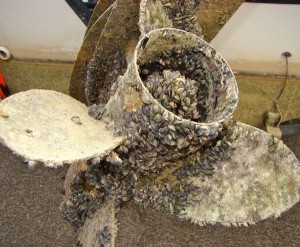
Quagga mussels like these on a boat prop leaving Lake Mead are what officials want to keep out of uncontaminated lakes. Photo/TRPA

Quagga mussels like these on a boat prop leaving Lake Mead are what officials want to keep out of uncontaminated lakes. Photo/TRPA

By Anne Knowles

Invasive species cost the country $3 billion every year and none more so than the fast-growing quagga mussel.

“The quagga mussel is the most costly invasive in U.S. history,” said Matt Morrison, chief executive officer of the Pacific Northwest Economic Region, during a webinar last week titled Critical Habitat and Invasive Species hosted by the Western Governors’ Association.

Morrison said the tiny, fingernail-sized mussels, which can reproduce up to a million offspring annually, are in everywhere except the Pacific Northwest.

They latch onto any hard surface and not only affect fish such as salmon, but agriculture and water infrastructure as well, including hydropower operations like the 60 located throughout the Pacific Northwest.

And once the mussels enter a system, they are there to stay.

“They’ve never been eradicated,” said Morrison. “That’s just not an option.”

That’s why agencies in Lake Tahoe do all they can to prevent the tiny mussels from ever entering its waterways.

Every boat entering Lake Tahoe is required to be inspected, unless it bears a Tahoe-only tag that certifies the lake is the only water the boat enters, said Chris Crookshanks, native aquatics staff specialist with the Nevada Department of Wildlife.

“As soon as the mussels were discovered in the lower Colorado (in Lake Mead) the Lake Tahoe basin spent a lot of money to implement measures to prevent them,” said Crookshanks.

Research done last year by UNR and the Desert Research Institute found that quagga mussels could thrive in Lake Tahoe despite the lake’s low calcium levels.

Crookshanks spends time on recovery of Lahontan cutthroat trout, which are threatened by nonnative fish species, including rainbow, brown and brook trout that were introduced into water bodies throughout the west, including Lake Tahoe.

Crookshanks said other threats to the native trout in Nevada are water diversions, feral horses, cattle, fire and drought.

He said the key to success in the trout’s recovery are cooperation between various entities such as the Bureau of Land Management, U.S. Forest Service, area Native America tribes and non-governmental organizations such as Trout Unlimited as well as private landowners through safe harbor agreements.

Those successes don’t include Lake Tahoe.

“It is so big we’ll never see recovery of Lahontan cutthroats there,” said Crookshanks. That has not stopped agencies on the California side, though, from trying to bring back the native species.

Technically, a useful method has been to start at the top of a water system, install temporary barriers, work to control nonnative fish populations, then remove the barriers and work on the next stretch of the system, said Crookshanks.

“That’s a great strategy, but there are some systems where the temporary barrier has to stay because the next piece can’t be done,” said David Sweet, Yellowstone Lake special project manager with Wyoming Trout Unlimited.

Sweet has worked for years on the effort to restore Yellowstone cutthroat trout, which are preyed upon by nonnative lake trout.

The U.S. Park Service, Yellowstone Park Foundation and NGOs spend about $2.3 million annually on the work, and in the last four years have been able to half the lake trout population and triple the number of Yellowstone cutthroat.

He said the primary methods are netting operations and telemetry to identify lake trout spawning areas and then do alternative suppression.

“Eradication is a term we rarely use, we use suppression,” said Sweet. “Eradication is impossible in a system like a lake or with something like mussels. We reduce the populations and give the cutthroat a chance to survive. … In the future we may be able to talk about eradication through genetic engineering.”


Bettors make late run on underdog Broncos

By Matt Youmans, Las Vegas Review-Journal

A dominant defensive performance by the Denver Broncos helped send Peyton Manning into the sunset as a winner, if indeed it was the final game of the legendary quarterback’s NFL career.

The Panthers, who received overwhelming wagering support early, closed as 5-point favorites at most Las Vegas sports books.

But bettors made a late run on the underdog Broncos, who cashed at around plus-180 on the money line.

Read the whole story


Sales of life-saving backcountry gear lag

By Shay Castle, Denver Post

Get the gear. Get the training. Get the forecast.

That’s the mantra of the industry that’s built up around the rising popularity of back country sports — skiing, snowboarding, snowmobiling — undertaken outside the groomed boundaries of ski resorts.

But while more and more people are venturing out into the backcountry, sales of life-saving avalanche gear are not keeping pace.

National sales of all backcountry equipment (skis, boots, bindings, etc.) are down 12 percent over the past three seasons, despite an 18 percent increase in back country participation. Sales of avalanche safety equipment (probes, beacons and shovels) are down 16 percent over the same time.

Read the whole story