Squaw teen 15th in GS at Youth Games

By USSA

HAFJELL, Norway – Sixteen-year-old Keely Cashman (Squaw Valley) grabbed 15th place Tuesday in the giant slalom at the Youth Olympic Winter Games.

The giant slalom podium featured Switzerland’s Melanie Meillard finishing first, with Germany’s Katrin Hirtl-Stanggassinger finishing second and Switzerland’s Aline Danioth rounding out the podium in third.

“Snow was bullet proof and it was an excellent race,” said women’s NTG head coach Thomas Erhard. “Great learning experience for her at a major Championship.”

One of the top skiers in the world in her age group, Cashman also finished 10th in the super G on Saturday. Onward and upward, Cashman will now look ahead to Thursday’s slalom.

On Monday, the athletes of the Youth Olympic Games received a visit from a very special guest, Youth Olympic Games Ambassador Lindsey Vonn (Vail). When the all-time winningest female alpine ski racer is not busy winning Audi FIS Ski World Cups – her win tally is now 76 – she enjoys spending time off the mountain helping to inspire and encourage the next generation of champions.

Vonn’s advice for athletes included everything from encouraging athletes to enjoy the entire Games experience to finding a hero to inspire them. Of course, she also advised athletes to get a dog, as Vonn just purchased her third puppy, a King Charles Cavalier named Lucy.

Modeled after the Olympic Games, the Youth Olympic Games debuted its winter event in 2012 at Innsbruck, Austria. Held every four years, the Youth Olympic Winter Games feature more than 1,100 athletes aged 15 to 18, from around the world.


Shiffrin back in top form after knee injury

By USSA

CRANS-MONTANA, Switzerland  – Mikaela Shiffrin (Eagle-Vail, Colo.) returned from injury to dominate the Audi FIS Ski World Cup slalom Monday, taking her 18th World Cup victory.

“That was a pretty incredible race,” said Shiffrin, who suffered a knee injury warming up for a race in December. “I’m glad it’s over, but I enjoyed skiing that last run, it was really rough and a challenge at every single gate. It was just bumpy and a wild ride – tough, but a good fight, and that’s the way it should be.”

Proving that her rehab and training over the past couple of weeks had prepared her to return to top form, Shiffrin soaked up the first run sunshine and support from an enthusiastic crowd cheering her to the finish. She cruised into the first-run lead by 0.27 seconds.

“I was really nervous for the first run,” she said. “So nervous that I thought I left my legs at the start. But the second run was better, I felt like I was back in the groove.”

And indeed she was. Starting as the final racer in the second run, Shiffrin watched as racer after racer battled deteriorating course conditions and visibility issues as clouds shrouded the upper portion of the course. In dominating fashion though, she extended her first-run advantage through the rutted course and cruised to victory by 0.45 over France’s Nastasia Noens. Marie-Michele Gagnon of Canada finished third.

“There were some scrappy turns … none of the girls skied their best, and I didn’t ski my best,” Shiffrin said of the challenging course conditions. “It was just one of those things where you had to be really mentally tough, and I’m glad my mental side is there, because that component is tough to get back.”

Resi Stiegler (Jackson Hole, Wyo.) skied to her best slalom result of the season in eighth.

“I feel awesome,” Stiegler said. “But I’m still hungry for more. I wasn’t totally satisfied with today, but I’m very, very happy. Starting the second run with a better position for getting toward the podium is huge for me.”

Lila Lapanja (Incline Village) showed significant promise starting 43rd in the first run, skiing to a 17th place first run finish. However, she got caught in a rut on the top section of the course, straddled, and failed to finish.

“I didn’t want to ski to finish for just points,” Lapanja said. “I just wanted to go, and go and go. I went a little too direct tactically where I needed to give a little bit. So, it didn’t work out, but the mental approach is getting pretty strong and I definitely can’t wait until Jasna (Slovakia, March 5-6).”


Anderson wins Snowjamboree in Canada

By USSA

QUEBEC CITY, Canada – Jamie Anderson (Meyers) won the ladies’ event at the Snowjamboree, presented by Videotron Mobile, FIS World Cup big air, battling arctic temperatures in downtown Quebec City. Ryan Stassel (Anchorage) was third for the men, scoring his first World Cup big air podium.

For the second time in three days, the big air athletes competed on a man-made scaffolding jump – heading north from Boston’s Fenway Park to Quebec City. This time Anderson won the competition in dominant fashion, beating second-place Katie Ormerod of Great Britain by more than 50 points. Spain’s Queralt Castellet rounded out the podium in third.

“I think the event tonight was awesome,” Anderson said after the competition. “It was really, really cold with our arctic front, but we are winter athletes so we got to perform in crazy weather and I’m just stoked.”

Julia Marino (Westport, Conn.), who won the Big Air at Fenway, was seventh.

For the men, Max Parrot of Canada took home his second big air World Cup win in three days on the jump he helped to design. His fellow countryman Tyler Nicholson was second and Stassel, who competed for the U.S. in slopestyle at the 2014 Sochi Olympics, finished a respectable third.

Brett Moody (Anchorage) took seventh while Brandon Davis (Mammoth Lakes) was 25th.


An epic ski experience at Park City

Park City is now the country's largest ski resort. Photo/Kathryn Reed

Park City is now the country’s largest ski resort. Photo/Kathryn Reed

Publisher’s note: This is one in a series of stories about Park City, Utah.

By Susan Wood

PARK CITY, Utah – It’s a new PC world where “The Greatest Snow on Earth” meets the largest ski company in the United States.

Vail Resorts, which owns Northstar, Heavenly and Kirkwood mountain resorts, expanded its reach and portfolio by opening Park City with the advertising tagline: “There is only one.” The marketing reference signifies the Broomfield, Colo.-based ski company’s purchase of the Park City Mountain Resort in 2014 for $182.5 million upon Powdr Corp.’s miscalculation and coerced selling of the Wasatch Mountain flagship ski area next door to Vail’s formerly-named Canyons resort.

What was Powdr Corp.’s misfortune may turn out to represent a fortune for Vail.

Orange Bubble Express is a unique experience the cover. Photo/Kathryn Reed

Orange Bubble Express is a unique experience with the cover. Photo/Kathryn Reed

Vail being Vail – the ski company didn’t waste any time investing in the combined Park City-Canyons resort. A little less than half of Vail’s $50 million commitment went into the eight-person Quicksilver gondola at mid-mountain that combines the two ski areas. The linking lift, which opened in December, provides skiers with 300 trails served by 41 lifts on 7,300 skiable acres. The connection makes Park City the largest resort in the United States.

Take it from this reporter who through the years has spent five weeks skiing Utah – this is massive, exciting and full of potential.

Park City and Canyons have historically been different worlds. Now Vail has the best of both. Park City has runs like Widowmaker, which a skier and boarder can eye from the extremely convenient town lift, and Jupiter Bowl with Volkswagen-sized moguls that can humble an experienced skier. A few decades ago, tourists flocked to Park City because it was the “in” thing and the groomers had their way on powder days. The Canyons ski area has been known as Wolf Mountain and Park City West – where a relatively inexpensive ski experience awaited. If one wanted untouched powder on many runs, this is where you graced the slopes.

Then came a 180-degree turn. The atmosphere evolved under Vail’s wing when Canyons was bought in 2013. In a few years, Canyons became the swank skier experience, with a mini upscale village anchored by Grand Summit timeshare units at the base.

Aspects of Park City's mining history is scattered about the mountain. Photo/Kathryn Reed

Aspects of Park City’s mining history is scattered about the mountain. Photo/Kathryn Reed

While Canyons has catered to snow bunnies and Sundance types in recent years, Park City Mountain Resort managed to keep its just-here-to-ski-and-bask-in-Olympic-glory feel. The giant slalom and snowboard halfpipe events were staged there during the 2002 Salt Lake City Winter Olympics.

Now Vail hopes to extend its touch to the Park City side after Powdr Corp. forgot to renew its bargain-basement 20-year lease at $150,000 annually with Talisker Land Holdings, the Canadian corporation that owns the land upon which Park City operates. To illustrate the small world of the ski industry, Talisker bought the old Canyons resort from the New England-based American Skiing Company and brought on Powdr Corp. to manage it. ASC once owned Heavenly before its stock was delisted from the New York Stock Exchange.

The high finance, chess-type negotiations have some die-hard Park City old-time skiers either whole-heartedly enthusiastic or cautiously optimistic about the infrastructure possibilities and transformation.

Jim Hadden – a 44-year Park City resident – remains in a wait-and-see mode.

Miners Camp design is a replica of the lodges at Heavenly and Northstar in California. Photo/Kathryn Reed

Miners Camp’s design is a replica of the lodges at Heavenly and Northstar in California. Photo/Kathryn Reed

“I didn’t want Vail to come in (at first). I wanted to leave the mountain the way it was,” Hadden told Lake Tahoe News while riding the Crescent Express chairlift. The lift offers access to some sweeping views from the Wasatch looking toward town and on a weekday, wide-open black runs.

Now retired, Hadden showed up straight out of college as an authentic ski bum. He fondly remembers the days when “really good skiers” would cover the mountain.

“Now I’ve noticed more beginners with Epic,” Hadden said of Vail’s multi-resort pass. “The ski schools should be full,” mocking the inability of those who now ski at Park City.

He’s open to having more runs and lifts with Vail’s reputation of investing in its ski areas. But like old-timers in other ski areas, he’s concerned Park City will lose its unique character. What’s more, he’s adamant about not paying for parking.

To that, Chief Operating Officer Bill Rock – who ran Tahoe’s Northstar before being tapped by Vail corporate for this large assignment – told Lake Tahoe News no plans are in place to expand paid parking beyond its two paid lots at the Sundial resort at Canyons and the underground lot in Park City. Most of Vail’s resorts have some sort of exclusive paid parking for those who opt into it.

Hadden is not alone in the parking demand.

“They better keep it free,” Josh Salberg of Salt Lake City, who has been coming to the Canyons side for 20 years, said while buckling up his board at the top of the Saddleback Express chairlift. The high-speed quad is tucked away behind the front ridge and represents a best-kept secret on the Canyons side with the ever-lasting long Snow Dancer run off the high ground.

The mid-mountain gondola links Park City to what was Canyons. Photo/Kathryn Reed

The mid-mountain gondola links Park City to what was Canyons. Photo/Kathryn Reed

There are other best-kept secrets. Salberg takes the Cabriolet lift from the Canyons side lower parking lot to the mountain base. The unique, stand-up, flatbed lift is open at the top, offering 360-degree views.

To accommodate a perceived influx of skiers and boarders at the combined resort, Rock pointed to the efficient Park City transit system that with Vail encourages “people to not get in their vehicles, to park and take the shuttle from the (Salt Lake City) airport.”

“One thing as a local that bothers me with Vail is they’ve taken away the local discounts,” Salberg said. He used to enjoy getting free buddy tickets with a pass.

“Now they’re half off, which isn’t bad,” he said.

He also has a 5-year-old child and therefore wants Vail to bring back the kids’ ski free program.

To that, Rock told LTN that the Epic pass combining both resorts represents “a huge deal” with no need to now buy two passes at Park City and Canyons. Also in Utah, there’s a kindergarten-to-fifth-grade pass that provides five days of free skiing, one lesson and rental equipment.

“I love that they combined the mountain and upgraded,” Salberg said. But in the same breath, he admitted the jury is still out on how good Vail taking over the dual resort is if it means everything goes upscale, prices go up, tourists rule and many of the ski area workers he knows can’t afford to live in Park City.

The old Canyons side is much more developed than the Park City base. Photo/Kathryn Reed

The old Canyons side is much more developed than the Park City base. Photo/Kathryn Reed

The Cairns family from Australia offered a different perspective from the top of Tombstone Express. The high-speed six-pack offers an ideal middle ground for skiers and boarders wanting a connection between the steeps at Super Condor Express where an extreme rider may walk up Murdock Peak and the blue-run land near the new gondola.

Lisa Cairns said she likes being able to have family members use the Epic pass since Vail just bought the Perisher resort, which is within driving distance from their home in the Blue Mountains. And the Cairns feel at home in Park City. Father Hayden used to be a ski instructor at Deer Valley, and with that, 17-year-old Zac declared he was born in PC and agreed with mom that he likes “the Vail influence” despite initial reluctance.

“That means we can ski the Australian winter,” the family matriarch said of the opposite seasons from the States to the land Down Under. It’s summer there now.

“I can’t believe how many Australians are here,” she said.

Within minutes of the clan skiing off, another Aussie family skied by.

Jeff Throm of New Orleans got out of the Orange Bubble Express lift on the Canyons side ecstatic about the possibilities of where to go, insisting he had just scratched the surface one recent sunny Park City morning. The Orange Bubble high-speed quad comes equipped with an orange cover that shields riders from the elements.

“I like that they combined the resort, but I’d like to see more lifts for more connections,” he said.

Chairlifts cost a lot of money and can turn even the most tucked away ski area into a hot spot where overpriced food and lodging as well as paid parking may bring in more out-of-towners, but can scare away those who call the region home.

And once again, there lies the delicate balance between appeasing locals and increasing visitation.
With the vast amount terrain, it would be hard to ski everything at Park City in one day. Photo/Kathryn Reed

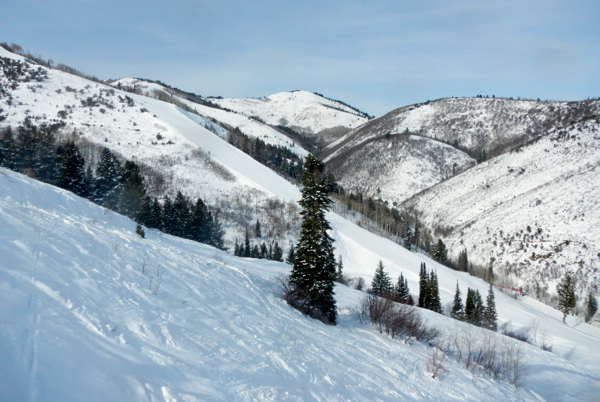
With the vast amount terrain, it would be hard to ski everything at Park City in one day. Photo/Kathryn Reed

Ski areas are like people

How does a ski industry corporation raise or raze a resort that adapts to its ideals while embracing its unique fingerprint and footprint?

That appears to be the challenge. A Tahoe resident need only look at Vail’s Kirkwood and Heavenly to see the genuine differences.

A skier or boarder might ponder this as they visit Vail day-use lodges. Take Northstar’s Zephyr Lodge and Heavenly’s Tamarack Lodge. Both look strikingly similar to Park City’s brand-new Miners Camp. Miners Camp replaced a funky ski hut amid old mining shafts and aspen trees that dot the resort. Plus, the PC food offerings are vast with unique items such as vegetarian Moroccan stew and three-cheese potatoes, but one can still get a $7 beer there. Despite the homogenous architecture, Vail embraced the lodge’s past by mounting miner axes on the wall at the bar.

While Canyons has grown up on the newer side of the Park City region, the PC old-town side has the feel of an old ski town. Many of the historic landmarks exist, and the ski area has embraced the history with a tour designed to share it.

“I always like to learn,” skier and retired college Professor Jeanne Pankanin said while on the historic tour with guide Chic Carlucci. She enjoyed hearing about the history of the Olympics at the top of the Eagle lift where the giant slalom race was staged.

At the top of McConkey’s Express, the snow is as light as a feather and the bowls as treacherous as the waves at Mavericks. The tour group peered down on Soldier’s Hollow, the setting for the Games’ cross country ski events.

For the most part, Carlucci provided a wealth of background information on the history of Park City mining. More than 1,200 miles of tunnels with up to 1,700-foot drops connected to 70 mines represented a $450 million industry sparked in the 1800s. The resort has even maintained its ore bins for historic reasons, Carlucci said. In some cases, workers have had to prop up dilapidated buildings.

One 1,300 tunnel built to transport water was constructed so well a miner “could see the end of it,” Carlucci declared.

“They built the railroad in four months on just human labor. Normally that would take three years,” the New York guide said at the top of the Crescent chairlift.

Many who ski and board the Wasatch ski area seem hopeful Vail will make infrastructure improvements — especially when it comes to putting in connecting runs and lifts. Some who worked there have already seen the potential. At the top of the Bonanza Express six-pack, one can ski the long ridgetop Jonesy’s run and forget about the everyday working world.

Even Heavenly’s former COO, Blaise Carrig, – who ran Vail mountain resort operations before retiring – has a run named after him. Blaise’s Way runs adjacent to the new gondola at the mid-point stop, smack dab between the old Park City resort and the Canyons side, the ski area Carrig ran before he worked for Vail.

“It looks like the only way,” one skier said of Blaise’s Run, before heading down to the lower mountain from the gondola.

Perhaps the only way for Vail Resorts is progression and innovation. The challenge at Park City may involve harnessing that new growth and creativity without forgetting the ski area’s colorful past.


Squaw skier 10th at Youth Olympic Winter Games

By USSA

HAFJELL, Norway — River Radamus (Edwards, Colo.) took the biggest victory of his young career, winning the men’s super G at the Youth Olympic Winter Games Saturday.

“The course was pretty technical today,” said Radamus. “There were a couple of really key spots that I think I nailed. I didn’t really go in with any sort of expectations. I knew that if I executed my lines and skied the way I wanted to, I would have a chance, but this is definitely a welcome surprise.”

Competing on the Hafjell, Olympic Slope, Radamus edged out Italy’s Pietro Canzio for the gold by 0.03 seconds. Austria’s Manuel Traninger won the bronze. Radamus, who just turned 18 on Friday, is the current U.S Junior National slalom champion.

“The entire experience here has been really awe-inspiring and something I think I’ll always remember,” said Radamus. “The fact that I got to go out and win a medal is something that I don’t think I’ll ever forget and something that I’ll be very proud of for a long time.”

Radamus grew up in ski racing, with his father Aldo a former U.S. Ski Team coach and longtime head of Ski & Snowboard Club Vail. Radamus moved up through the alpine development pipeline in the Vail club and into the USSA’s National Training Group program. He also attended the USSA TEAM Academy, the U.S. Ski Team’s program for high school aged athletes. He graduated from the academy last year at the same time he was named to the U.S. Ski Team’s D team.

“This is a great result by River on a big stage against an international field of the best athletes his age,” said USSA Alpine Development Director Chip Knight. “It’s shows our next generation is on track against the best in the world.”

In the women’s super G, 16-year-old Keely Cashman (Squaw Valley) finished 10th. Austria won the gold and silver with Nadine Fest and Julia Scheib going 1-2. Switzerland’s Aline Danioth won the bronze.

Modeled after the Olympic Games, the Youth Olympic Games debuted its winter event in 2012 at Innsbruck, Austria. Held every four years, the Youth Olympic Winter Games feature more than 1,100 athletes aged 15 to 18, from around the world. Alpine events will include slalom, giant slalom, super G, downhill and alpine combined. The Games continue through Feb. 21.


Ski helmets evolve, become common equipment

By Kathryn Reed

For athletes, equipment matters in terms of performance and safety.

While helmet use has increased from 25 percent of skiers-snowboarders wearing one in 2002-03 to 78 percent in 2014-15, according to the National Ski Area Association, consumers don’t always pay attention to the quality.

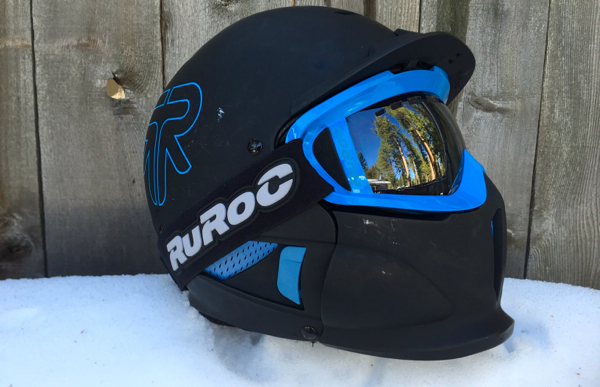
RUROC, which was formed 10 years ago in the United Kingdom, is the first company to create a fully integrated helmet, facemask and anti-fog goggle. For five years their helmets have been on the market, with the hopes of being in stores in the United States for next season. Right now they are available online.

Trevor Jacob of Mammoth Lakes wears the RUROC helmet. He finished fifth in the men’s snowboarder cross at the X Games in Colorado last month.

It’s a solid fitting helmet that is similar and snug like a motorcycle helmet. However, it’s not rated for motorized sports. Departments of transportation regulate helmets for snowmobiling and motorcycling. This is a direction the company wants to evolve into, as well as helmets for downhill mountain biking.

RUROC officials said their helmets pass two European and one United States standards for alpine sports safety.

RUROC helmets are about safety and function with the goggles and facemask components. Photo/LTN

RUROC helmets are about safety and function with the integrated goggles and facemask. Photo/LTN

“The person just starting out doesn’t need a RUROC helmet instantly,” Dan Rees, managing director and CEO for RUROC, told Lake Tahoe News. “It is more for the extreme rider who is pushing themselves.” He noted how Jacob can hit 100 mph on his board.

But even this non-extreme skier feels more secure in it than other helmets. A good whack on the head on a recent Saturday unintentionally tested its protection – with positive results. The company also sees backcountry skiers gravitating toward their product.

The U.S. Ski and Snowboard Association has regulations about what type of helmets are allowed for juniors and adult competitors. Different entities have regulatory standards. There is the American Society for Testing and Materials; CE indicates a helmet meets the requirements of the European Economic Community Directive; and RS-98 is a certification mark of the Snell Memorial Foundation.

According to Snell Memorial Foundation’s website, the nonprofit has been dedicated exclusively to head protection since 1957 through scientific and medical research, standards development, helmet testing, and public education.

The foundation lists these elements as critical protective properties:

·      Impact management — how well the helmet protects against collisions with large objects.

·      Helmet positional stability — whether the helmet will be in place, on the head, when it’s needed.

·      Retention system strength — whether the chinstraps are sufficiently strong to hold the helmet throughout an incident involving head impact.

·      Extent of protection — the area of the head protected by the helmet.

In addition to the safety aspects, what makes the RUROC different is that the system integrates the goggles and the facemask. The mask, while an ideal added safety tool for those in terrain parks, serves as a great addition in cold, snowy conditions. The mask pops out fairly easily, so it doesn’t have to be worn the entire day.

The lenses are made in Italy and have an anti-fog coating.

“We wanted a complete closed system,” Rees explained. “With the goggles, it is seamless to the roof of the helmet. It creates a constant vacuum of air and prevents fog.”

Ski resorts are all over the board when it comes to rules about helmet use.

“We were among the first companies to require helmets on all employees and all children in ski school. If parents don’t want a helmet on their children, they have to proactively alert us and sign a waiver,” Russ Pecoraro with Vail Resorts told Lake Tahoe News. “I’m not aware of a preference in terms of helmets. Anecdotally, it’s hard to find people these days not wearing a helmet.”

The Broomfield-Colo.-based ski company owns Heavenly, Northstar and Kirkwood ski resorts in the Tahoe area.

Helmets are not mandatory for anyone at Sierra-at-Tahoe, though the resort offers employees a 30 percent discount on helmets to encourage them to buy and wear one.

“Lessons do not require a helmet, but are available for rental with all lessons,” Steve Hemphill with Sierra told Lake Tahoe News.

The resort also goes into schools in Lake Tahoe Unified School District to educate students on helmet and snow safety.

At Squaw Valley and Alpine ski resorts Giro is the official helmet.

“This program includes a generous allotment of complimentary helmets to our ski team coaches and members of our ski patrol as well as a 50-75 percent off purchase program for all resort employees,” Michael Radlick with Squaw-Alpine told Lake Tahoe News.

Helmets are no guarantee a person won’t be hurt, but for many impacts on the slopes they will lessen or curtail a severe injury.

“Helmets can help prevent injuries and, in many cases, an injury would have been worse without a helmet. I would also speculate that we do not see some patients because they fall and hit their head while wearing a helmet and the injury was not enough to require a trip to the hospital,” Lance Orr, medical director of Barton Memorial Hospital’s emergency department, told Lake Tahoe News. “If the person had not been wearing a helmet, it may have been a different scenario. An example of where a helmet may not help is if someone lands in a manner that puts direct force onto the spine.


Excursion benefits Snowshoe Thompson legacy

The 17th annual Snowshoe Thompson Celebration Cross Country Ski and Snowshoe Tour is March 5 from 9am-1pm.

This is a benefit for the Friends of Snowshoe Thompson to promote awareness of Snowshoe Thompson and maintain his statue in Genoa.

Registration is from 8:30-9am off Highway 89 in Hope Valley, north of the river. Parking will be on Highway 89; look for the flags and “Snowshoe” banner.

Cost is $15, children younger than 12 are free. To RSVP or for more information, contact Nina at 530.573.8940 or Sue at 775.315.7777.


Controlled burns on East and South shores

Tahoe Douglas Fire Protection District, California Tahoe Conservancy and the U.S Forest Service may continue prescribed fire operations beginning Feb. 16.

On the East Shore, operations may take place near the Logan Shoals Vista Point, Camp Galilee, south of Glenbrook and between Round Hill and Zephyr Cove. On the South Shore, operations may take place near Spring Creek, Panther Road, and Mountain Drive near North Upper Truckee Road.  To view a map with project locations and details, go online.

Residual smoke may be seen in locations where operations have taken place over the last several weeks.

Before conducting prescribed fire operations, agencies post road signs around areas affected by prescribed fire, send email notifications and update the local fire information line at 530.543.2816.


Full moon snowshoe on West Shore

There will be a guided full moon snowshoe at Sugar Pine Point State Park on Feb. 20.

Explore the natural and cultural history around the Hellman-Ehrman estate and walk along the Lake Tahoe shore.

For those new to snowshoeing, there will be a beginner’s clinic at 6:30pm. The hike starts promptly at 7 pm near the restrooms in the day use side of the park (lake side entrance, east side of Highway 89). The program lasts approximately 1½ hours and costs $25 per person for adults. Children 12 and under are $10. The cost includes tour, event parking, and snowshoe rentals.

Wear warm, layered clothing and winter boots.

Space is limited. Purchase tickets online.


Reno’s Guldemond on podium at Fenway

By USSA

BOSTON – U.S. Snowboarding rookie Julia Marino (Westport, Conn.) topped the women’s field at the Polartec Big Air at Fenway on Thursday night in front of a stellar Boston crowd in one of America’s most iconic sports venues. Marino, a New England native, wasn’t originally even scheduled to compete. She snuck in off the alternate list when her teammate Ty Walker (Stowe, Vt,) was forced to drop after being injured in practice.

It was a groundbreaking event for the U.S. Grand Prix and the FIS Snowboard World Cup – a 140-foot-tall scaffolding big air event situated in the center of Boston’s Fenway Park. Never before has the U.S. Grand Prix featured a big air-only event, and never before has snowboarding been presented in such a historic American venue.

Marino, who hadn’t competed on a scaffolding jump or in front of such an enormous crowd before, said that she was feeling the vibe of the Fenway spectators. “I’ve never snowboarded at a contest with a crowd this big – it’s amazing!” she said. “I thought it would make me more nervous but it actually made it way more fun. Every time I landed a trick it was so cool to hear the whole crowd going wild. There were so many people here – I didn’t think that this many people would show up for a snowboarding event; it’s amazing to see all these awesome fans out here supporting what we do.”

The Canadian women rounded out the podium with top qualifier Jenna Blasman in second and Brooke Voigt in third.

Chas Guldemond (Reno) led the U.S. men with a third-place podium finish. He was also pumped on the energy of the crowd, hyping everyone up with his best imitation of Babe Ruth.

“Fenway totally went off like we expected it to,” Guldemond said. “The crowd was really behind me which made my experience amazing and to land three runs and call my shot on the last one and send it to the bottom, that topped off my night.”

The men’s event was won by Max Parrot of Canada, who was the only athlete to throw a triple cork. Fellow Canadian Michael Ciccarelli was second.

Rounding up the American women, Jessika Jenson (Rigby, Idaho) was fifth and Karly Shorr (Milford, Mich.) was sixth. For the men, Eric Beauchemin (Grand Blanc, Mich.) seventh. Lyon Farrell (Haiku, Hawaii) eighth.