Vonn crashes, carried down hill in sled

By Nick Zaccardi, NBC Sports

Lindsey Vonn crashed and was carried on a sled down the mountain at a World Cup race in Andorra on Saturday.

Vonn was leading under snowfall, about 10 seconds from the finish of the super-G course, when she fell while shifting pressure onto her left leg for a turn.

She slid for six seconds and came to a stop, not running into safety fencing.

Read the whole story


U.S. women sweep X Games halfpipe

By USSA

OSLO, Norway – Chloe Kim (La Palma) led a huge U.S. podium sweep for the halfpipe women at X Games Oslo, with Kelly Clark (West Dover, Vt.) earning silver and Arielle Gold (Steamboat Springs, Colo.) taking bronze. Chase Josey (Hailey, Idaho) had a stellar showing for the men, earning bronze.

It was another historic performance for Kim, the 15 year old who has been breaking records as fast as they can be counted. She became the first athlete in X Games history to win two gold before the age of 16 when she won at Aspen less than a month ago. She extended that record to three gold medals in Oslo, also becoming the youngest athlete to win three consecutive golds. She had a groundbreaking run that featured jaw-dropping amplitude and back-to-back 1080s, earning the highest score ever awarded to a female halfpipe rider at X Games – 98.00.

“I was really excited on how tonight went,” Kim said with another X Games gold medal hung around her neck. “It’s really crazy to win three X games medals in a row. It’s just an unbelievable experience.”

Clark, the veteran in the field in her 19th consecutive X Games appearance, powered through an injury to earn her 14th overall medal, the most by a female in X Games history. Clark pulled her groin on the first night of practice and was struggling with obvious pain going into the final. She rode with focus, however, pushing through to land a frontside 1080 on her third and final run and a spot on the podium in the silver-medal position.

Behind the podium sweep, Maddie Mastro (Wrightville) finished fourth and Hannah Teter (Meyers) eighth.

It was a highly-competitive men’s competition as well, and Josey’s bronze-medal performance was an excellent showing at his second X Games appearance (he placed 11th at Aspen in January in a contest that was abbreviated to one run due to inclement weather). He finished behind Ayumu Hirano of Japan in first and Iouri Podladtchikov of Switzerland in second.


Environmentalists sue to better protect sage grouse

By Associated Press

BILLINGS, Mont. — Environmental groups sued Thursday to force the Obama administration to impose more restrictions on oil and gas drilling, grazing and other activities blamed for the decline of greater sage grouse across the American West.

A sweeping sage grouse conservation effort that the government announced last September is riddled with loopholes and will not be enough to protect the bird from extinction, according to the lawsuit filed in U.S. District Court in Idaho.

It follows several legal challenges against the same rules from the opposite end of the political spectrum. Mining companies, ranchers and officials in Utah, Idaho and Nevada argue that the administration’s actions will impede economic development.

The ground-dwelling sage grouse, known for their elaborate mating ritual, range across a 257,000-square-mile region spanning 11 states.

The new rules and land use policies for federal lands in the region were meant to keep the popular game bird off the endangered species list. They are backed by more than $750 million in commitments from the government and outside groups to conserve land and restore the bird’s range.

But the lawsuit from the Western Watersheds Project, Center for Biological Diversity and two other groups said the rules have too many exceptions favorable to industry at the expense of the bird.

“Each state had its own specific loophole,” said Erik Molvar with WildEarth Guardians, another plaintiff in the case. “For Wyoming, there are huge loopholes for oil and gas. Nevada has loopholes for geothermal power. In southeastern Oregon, there were loopholes for wind farms. And everywhere there are loopholes for transmission projects.”

Interior Department spokeswoman Jessica Kershaw declined to comment directly on the lawsuit, but she said the government’s conservation plans follow the best science and were crafted in partnership with state and local officials.

“The plans are both balanced and effective, protecting key sage-grouse habitat and providing for sustainable development,” Kershaw said in an emailed statement.

The grouse population once was estimated at 16 million birds across North America. It’s lost roughly half its habitat to development, livestock grazing and an invasive grass that encourages wildfires in the Great Basin of Nevada and adjoining states. There are now an estimated 200,000 to 500,000 greater sage grouse.

The Prairie Hills Audubon Society of South Dakota was another plaintiff in Thursday’s suit.

Notably absent was its parent organization, the National Audubon Society. The influential, New York-based advocacy group supports the administration’s plans and wants them to be given time to work, spokesman Nicholas Gonzalez said.


Disabled veterans snowmobile through Tahoe

By Paul Nelson, KTVN-TV

Snowmobiling is just one of many outdoor winter sports in the Sierra, but for some veterans, this is more than just a 15-mile tour.

The veterans have physical disabilities. Some are confined to wheelchairs while others need canes to get around. But none of that matters when they’re out here.

About 85 veterans are a part of the group. They get to ride the snowmobiles through the Tahoe wilderness and enjoy some of the best views in the area.

Read the whole story


Battlefields a hallowed reminder of the past

Publisher’s note: This is one in a series of stories about the National Park Service, which is celebrating its 100th anniversary in 2016.
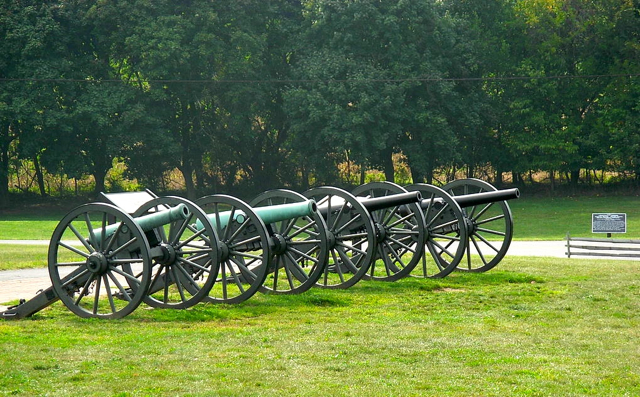
The single bloodiest day in U.S. history was the Battle of Antietam on Sept. 17, 1862.

The single bloodiest day in U.S. history was the Battle of Antietam on Sept. 17, 1862.

By Linda Fine Conaboy

Little did I know on that pleasant and tranquil day in the fall of 2003 I was headed for a moving and intense experience—an event more weighty than I had bargained for. That was the day my friends and I visited Antietam National Battlefield, the site of the bloodiest single day of the Civil War—some say the bloodiest day in all of American history.

At that time in my life, I knew little about the Civil War, had only vaguely heard of this battlefield called Antietam and really didn’t think it made much of a difference in my life.

As my friend drove, I quickly scanned the brochures we received from the man at the entry, and making a decision to drive instead of walk the route because of a time constriction, we headed off, our real anticipation being the Appalachian Trail where we were to hook up with other friends for a few days of hiking.

However, the brochures (which I still have) were absorbing. We learned that Antietam, in Sharpsburg, Md., on bright and sunny Sept. 17, 1862—maybe somewhat like the day we were there—provided the setting for the destruction of nearly 25,000 souls—they were either killed, wounded, captured or simply ended up missing.

Mostly young men and maybe a few women, died on the slopes of Sharpsburg ridge, an area consisting then of mainly farms, fruit trees and bridges.

As we drove, our anticipation of the place heightened. Out our car windows, we marveled at the farm buildings, still there after all these years—oh, that these structures could talk, think of the story they would tell. Surprisingly, one of these buildings is still privately owned and occupied.

Imagine, living in a building that was privy to so much death. I’ve always wondered if this has an effect on the current residents of that building. As a journalist, I would very much like to interview them and ask if their day-to-day lives are in any way tinged by the killing and all the spilled blood. Blood that has since vanished, but nevertheless is still there somewhere, maybe in some way fertilizing the healthy trees that mark this battlefield today.

Burnside's Bridge at Antietam National Battlefield in Maryland

Burnside’s Bridge at Antietam National Battlefield in Maryland.

A review of the history of this battle states that Gen. Robert E. Lee’s Confederate forces stretched across the angle formed by the junction of the Potomac River and Antietam Creek. Gen. George McClellan, the Union leader, intended to attack both of the Confederate flanks and then assault the middle of Lee’s line.

According to the brochure, “There was no cohesion, no unified command, no definite objective, and at the climax of the battle Gen. George McClellan, leader of the Union forces, was unwilling to commit his reserves in the center. Antietam was in fact, a soldier’s battle, waged by separate units with little direction from above.”

History tells us that this gory battle was fought for nothing and it was determined to be a draw.

Forgetting for a while that the Appalachian Trail awaited, we pulled the car over to the side of the road and stood on a bridge crossing Antietam Creek, a beautiful and simple bridge that still stands just the way it did in 1862.

We walked up the dirt road away from the bridge called Bloody Lane. Viewing brochure pictures of all those people sprawled on the ground on Bloody Lane with their arms and legs akimbo, thoughts of death hit me like a hammer. Here we were, traipsing along in the warm sunshine, on sacred ground.

On this trip with my friends, my first since my husband died a few months earlier, death here and death at home seemed to be stalking.

It seemed unworldly that we could be walking along a road that was the scene of so much human destruction—and as a parallel to the thoughts Antietam evoked, it was amazing to me that I could be walking along this road without my husband of so many years. The poignant feelings evoked by this surreal event somehow served to bring to climax all of those despondent emotions I had about the passing of Tom. In some unimaginable way, they put it all into perspective in one simple moment of clarity.

This is why Antietam will forever be a place of beauty to me as well as a place of ultimate sadness.

I have the same feelings when I visit Valley Forge National Park. The feelings that are evoked thinking about all of those young, courageous and innocent people who fell for their cause, sometimes to no avail, are heartbreaking.

The headquarters of George Washington at the Valley Forge encampment. Photo/RevolutionaryPA.com

The headquarters of George Washington at the Valley Forge encampment. Photo/RevolutionaryPA.com

In summer, the rolling hills and lowlands of Valley Forge are grassy and beautiful, but on Dec. 19, 1777, when the Continental Army staggered in, weary from long marches, the prospect of wintering there was bleak.

Housing consisted of roughly built, drafty wooden huts—replicas of which are now strewn about the grounds, reconstructed as nearly as possible, on their original sites. The huts served as home to the troops as they froze and starved their way through that vicious winter, waiting for marching instructions from their commander, Gen. George Washington, although marching in the snow would be a difficult proposition as few of them had shoes.

Washington, however, did not live in the drafty huts with the men. His home, formerly the Isaac Potts house, still standing today, appears to be much more storm worthy and capable of warding off the cold. In fact, a recent tour of the Potts home indicates there were real beds, with perhaps down comforters for warmth, fireplaces and utilitarian but useful furniture.

Historians estimate that somewhere between 10,000 and 12,000 men bivouacked at Valley Forge a post about 20 miles from Philadelphia, with about 2,500 of them dying from disease and exposure, not once fighting a battle during that winter, except the battle for survival.

Fortunately, or unfortunately, depending on your outlook, with winter setting in, the prospect of confronting the enemy greatly diminished and never came to fruition. Washington’s army left Valley Forge on June 19, 1778.

Just as the battlefield at Antietam evokes wonder and heartache at the heroism people endure, display and confront during war, Valley Forge is a monument to the human condition, available in living color to anyone willing and able to make the trip to experience it.

I think it takes visits like these, to our national parks and other sites of extreme and natural beauty (although some are not beautiful, but just as interesting), to add the grounding so necessary to living our everyday lives. I think we all come away better people for allowing ourselves to be drawn into the history of what these places preserve.

I recommend you immerse yourself in as many of the national parks, national monuments, wilderness areas, ghost towns—anywhere you can experience our past, unfettered by the bounds of everyday life. They’re available and some are not too far home; you owe it to yourself.


Spooner resumes groomed cross country trails

For the first time in four years, cross country trails are being groomed at Spooner Lake State park.

The 6 mile trail system is free. It is made possible by a partnership between Nevada State Parks and Nevada Nordic, a nonprofit group based in the basin.

Nevada Nordic has spent hundreds of hours planning and grooming the system of trails at Spooner.

The trail system includes several teardrop loops, offers skate and classic skiing, and is intermediate with flat rolling terrain. The plan is to expand the trails in the future to increase distance and difficulty.

Ski trails will close when the snowpack gets thin enough that grooming would have a harmful impact.

Trail etiquette, according to State Parks:

·         Do not walk on the trail in shoes or boots.

·         Dogs should be on a leash of not more than 6 feet in length and off to the side of the groomed trails.

·         Snowshoers are welcome, but should stay to the far edge of the trail and be careful not to mar the center of the trail for skate skiing, or the tracks set for classic skiing.


Chairlifts can be luxurious

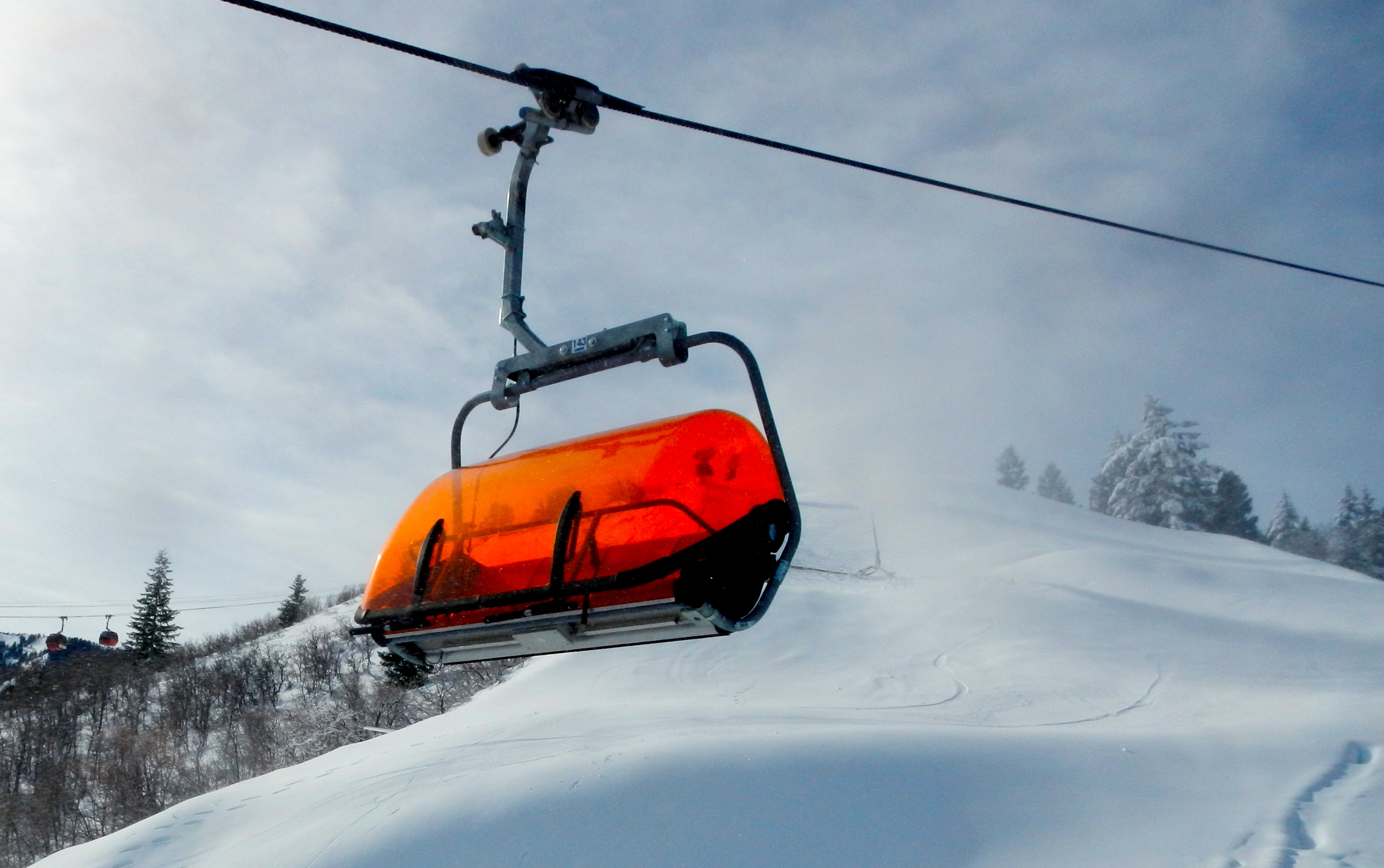
The Orange Bubble Express opened in 2010 at the Canyons, now part of Park City Mountain Resort, as the country’s first heated chairlift.

The Orange Bubble Express at Park City in Utah was the first heated chairlift in the United States. Photo/Kathryn Reed

By Megan Michelson, Outside

If you ski in Kitzbühel, Austria, this winter, you’ll be treated to a chairlift ride like no other. The new Brunn eight-seat lift, which opened in December in the Pengelstein region, offers heated seats that are slip-proof and ergonomically designed with high-end leather upholstery. Each chair also comes with a clear plastic storm-proof shield and a locking safety bar.

Austrian lift manufacturer Leitner Ropeways built the chair over a ten-month period and brought in engineers from the automobile industry for their expertise in seat design. The seats’ leather and foam also come from the automotive world.

“The goal was to combine high-quality materials, an ergonomic design, and cutting-edge technology,” Leitner spokesperson Daniela Innerhofer told Outside. “The impetus was to offer even more comfortable chairs combined with premium design and, of course, to create something innovative.”

Read the whole story


Lichen becomes California’s latest symbol

By Emily Benson, San Jose Mercury News

California’s newest state symbol adorns coastal oaks and conifers like a cloak. Birds pluck it from the branches to line their nests. Deer find it so delicious they’ve been known to fight over it. Scientists study it for clues about air pollution.

And now, California has turned it into the country’s first official state lichen.

This year, lace lichen joined the ranks of the Golden State’s 36 other official state symbols, which range from the California grizzly bear, the official state animal, to the saber-toothed cat — our official state fossil.

The California Lichen Society worked with Assemblyman Marc Levine, a Marin County Democrat, to sponsor the bill that gave lace lichen — a tangled, pale green organism named for the delicate nets growing from its tendrils’ tips — its new title. Gov. Jerry Brown signed it into law last summer, and it went into effect Jan. 1.

Read the whole story


Anderson grabs first at site of 2018 Olympics

By USSA

BOKWANG, South Korea – Americans dominated at the official Olympic snowboarding slopestyle test event for the 2018 PyeongChang Winter Games, where Brock Crouch (Mammoth Lakes) took the win for his first career World Cup podium and Jamie Anderson (Meyers) won for the women. Karly Shorr (Milford, Mich.) earned her third World Cup podium with second place.

Crouch is a 16-year-old member of the slopestyle rookie team. He battled windy conditions at the site of the 2018 Winter Olympics to top the competitive field.

“The last two competitors were Brandon (Davis) and Chris (Corning) and they’re both from the U.S.,” Crouch said. “That’s when I was in first and I didn’t even care – I was so excited that I was going to podium when they were about to drop, I just wanted them to land their runs so it could’ve been a U.S. sweep.”

Olympic champion Anderson didn’t land her first two runs, but finally put it down her third time.

“It was definitely a safety (run),” Anderson said of the run that secured the victory. “I was hoping to put that down on my first run so that I could try some different runs and (things) just didn’t go my way today.”

Shorr put her first run to her feet and sat in the top spot until Anderson pulled it out on the second-to-last run of the competition. She was happy to make the podium saying, “Anytime that you do well, especially in a place that’s so far away from where I’m from and knowing that the Olympics are here and this environment is kind of like the Olympics…it’s a huge confidence boost to know that I can hang with all the top girls and be able to put down a run that will get me on the podium.”

Top qualifier Brandon Davis (Mammoth Lakes) finished just off the podium in fourth, while points leader Chris Corning (Arvada, Colo.) was sixth and Ryan Stassel (Anchorage) was eighth.


Widespread controlled burns planned for Tahoe

California State Parks, Nevada Division of Forestry and U.S Forest Service may continue prescribed fire operations beginning Feb. 22.

On the East Shore, operations may take place near Logan Shoals Vista Point, Spooner Summit and Sand Harbor. On the South Shore, operations may take place near Eagle Point Campground, Spring Creek and Panther Road. On the West Shore, operations may take place near Sugar Pine Point and D.L. Bliss state parks and on the North Shore near Burton Creek State Park.

To view a map with project locations and details, go online. Residual smoke may be seen in locations where operations have taken place over the last several weeks.