TTD’s Incline bike path costs questioned

By Sean Whaley, Las Vegas Review-Journal

CARSON CITY — Visitors to Lake Tahoe’s East Shore could soon have a new bike path linking upscale Incline Village to Nevada’s Sand Harbor State Park, but the price tag might induce sticker shock: $12.5 million for the 3-mile project.

Yes, that is more than $4 million a mile in taxpayer dollars for a 10-foot-wide bike path traveling just about 16,000 feet along the picturesque mountain lake.

Not to mention another $7 million to $9 million that the Nevada Transportation Department plans to spend in state gas taxes in conjunction with the project on related environmental and safety needs.

Another $750,000 in private donations has also been raised for the path.

Read the whole story


Anderson claims crystal globe in 2 events

By USSA

SPINDLERUV MLYN, Czech Republic – The final snowboard FIS World Cup slopestyle event took place Sunday, where Chris Corning (Arvada, Colo.) hit the podium for the men with a second-place finish, and secured the overall World Cup slopestyle title.

The 16-year-old from Colorado scored two World Cup podiums this season, including a victory at the Cardrona, New Zealand, event in August. Fellow American Brandon Davis (Mammoth Lakes) was second behind Corning in the overall slopestyle standings.

Ryan Stassel (Anchorage) finished fifth at the Spindleruv Mlyn event and Eric Beauchemin (Grand Blanc, Mich.) was sixth.

Karly Shorr (Milford, Mich.) and Jessika Jenson (Rigby, Idaho) both made the final, finishing fifth and sixth, respectively. Jamie Anderson (Meyers) won the crystal globe award for women’s snowboard slopestyle despite skipping the final event of the season. Anderson also claimed the crystal globe for overall freestyle snowboarding.


Amid cycling boom, penalties for errant drivers remain light

By Scott McFetridge, AP

When Iowa’s largest city joined the boom in urban cycling, work crews painted more bike lanes, erected traffic signals especially for cyclists and installed rental bikes at self-service stands that catered to commuters and tourists alike.

In Des Moines and scores of other U.S. cities, the efforts drew bike riders onto busy streets that were once the sole province of cars and trucks. The changes also heightened the risk of serious collisions like the one that threw Ken Sherman from his bicycle with such force that his body tore off the vehicle’s side mirror.

Cyclists are frustrated that the growing support for two-wheeled transportation has only rarely led to tougher penalties for drivers who hit bikes, many of whom are never ticketed or receive only minor citations, even in accidents that permanently disable or kill cyclists. The motorist who hit Sherman was deemed to be at fault but was never charged with any wrongdoing.

“I was upset and outraged,” said Sherman, who suffered a punctured lung and broke his shoulder blade and collarbone. “I’ve wanted to get my arms around the laws we have and how they’re being enforced.”

After his 2009 crash, he joined a bicycling association and began lobbying the Iowa Legislature for changes.

Concerns about cycling safety have risen along with ridership. Bicycle commuting nationwide climbed 62 percent from 2000 to 2013, according to a census survey. In cities such as Chicago, San Francisco and Washington, it shot up by more than 300 percent.

Studies show that having more bicyclists on the road can actually improve overall safety by making motorists more aware of riders. But the increase in cycling has coincided with a 6.6 percent rise in injuries from car-bike crashes and a 1.5 percent increase in deaths between 2001 and 2013, according to the National Traffic Safety Administration. In 2013, 743 cyclists died in crashes with cars, and an estimated 48,000 cyclists were injured.

Nearly 40 states have laws requiring passing motorists to give bicycles at least 3 feet of space, and at least six offer special protections to cyclists and pedestrians. But few have backed up those laws with stiff fines for violators.

That means even though it’s illegal for passing motorists to get too close to bicyclists in most states, violators face only small penalties, such as California’s $35 fine, which can rise to $220 if the bicyclist is injured. The penalty is the same in Virginia. A first offense in Wisconsin can range from $20 to $200.

Minnesota last year became one of the few states to significantly stiffen the penalty for motorists who hit cyclists, with passage of a $3,000 fine, but prosecutors must prove the driver was acting carelessly when the cyclist was killed or seriously injured. For simply passing too close, the fine remains small.

Dorian Grilley, executive director of the Bicycle Alliance of Minnesota, said he’s heard of only one person being ticketed for the offense in the past 25 years.

A driver was cited for driving without insurance after he hit David Wuest in St. Paul, Minn., knocking him to the pavement and causing a brain injury that has left Wuest unable to work nearly two years after the April 2014 crash. An investigation determined that the motorist was at fault, but since he was not under the influence of drugs or alcohol, the driver only had a pay a small fine.

Wuest, of Minneapolis, said higher penalties could lead some motorists to be more careful around cyclists, but he thinks crashes will happen as long as bicycles travel so close to cars. He’s resumed riding but only on bike paths.

“I assume people don’t want to hit cyclists,” he said, “but it keeps happening.”

Dave Snyder, who leads the California Bicycle Coalition, said bicyclists are injured and killed so often that it seems normal. Although he said he’s appalled that motorists who hit cyclists usually don’t pay significant penalties, his group is more focused on creating separation between bikes and cars.

Gov. Jerry Brown has called for funding changes to roadways to protect cyclists, and Snyder said that could save far more lives than prosecuting motorists.

“Those cases of drivers not being charged are outrageous, but fixing that problem is not the most important problem,” he said.

Robin Stallings, executive director of the group Bike Texas, took a similar view, saying laws should be toughened and more motorists prosecuted for hitting bicycles, but that may never happen. It’s more likely, he said, that local and state governments will build protected lanes for cyclists so they’re less vulnerable.

Jeff Gray was severely injured and a friend killed on a sunny morning in 2014 when a van hit them on a rural road in western Iowa. The driver, who said he didn’t see the bikers, paid a $2,400 fine.

People need to be more aware of the number of cyclists injured and killed in such crash, Gray said.

“They don’t understand they’re racing past someone going 10 mph. They don’t understand it,” Gray said. “I don’t think people even think about it.”

Controlled burns planned for much of Tahoe

Weather permitting, California State Parks, the Nevada Division of Forestry and the U.S. Forest Service may continue prescribed fire operations beginning March 21.

On the North and West shores, operations may take place in Burton Creek and Sugar Pine Point state parks. On the East Shore, operations may take place near Sand Harbor, Spooner Summit and Camp Galilee. On the South Shore, operations may take place near Lake Tahoe Boulevard and Sawmill Road, Panther Lane near South Tahoe High School and off Highway 89 near Spring Creek. To view a map with project locations and details, go online.

Residual smoke may be seen in locations where operations have taken place over the last several weeks.


Winter to make brief return appearance

The calendar says spring so that means it is going to snow in Tahoe.

Winds are expected to increase today as the storm moves in. Rain will precede the white stuff, with snow levels starting today above 8,000 feet.

More rain and snow in the basin is expected Monday and into the night. According to the National Weather Service in Reno, the heaviest snow will be March 21 between 4 and 8pm. A chance of snow will linger into Tuesday

— Lake Tahoe News staff report


Mt. Shasta — small ski resort delivers big fun

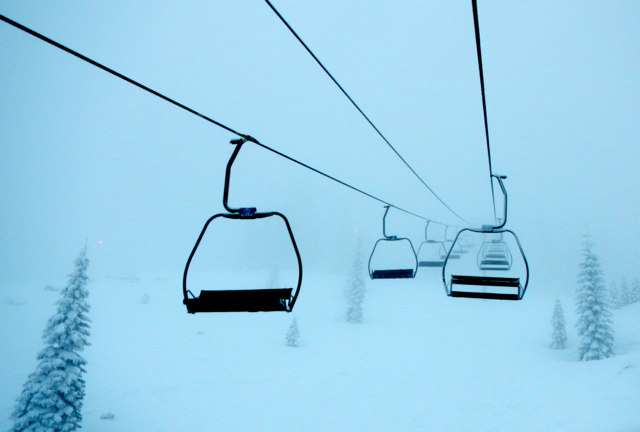
Mount Shasta Ski Park is California's newest resort, having opened in December 1985. Photo/Kathryn Reed

Mount Shasta Ski Park is California’s newest resort, having opened in December 1985. Photo/Kathryn Reed

By Kathryn Reed

MCCLOUD – Mount Shasta Ski Park received the best 30th birthday present it could – snow. So much white stuff has fallen this season that the original planned closing date of March 12 has been moved to April 17.

This North State resort has had a couple tough years. It was open for four days in 2013-14. And while the resort allowed 2013-14 pass holders to use their pass last season, by January 2015 the resort was closed because of lack of snow.

The resort has snowmaking, but there are variables that are beyond its control like drought, rain instead of snow and having a mountain that mostly faces south.

This season the privately-held ski resort has had three of its busiest days since it open in 1985.

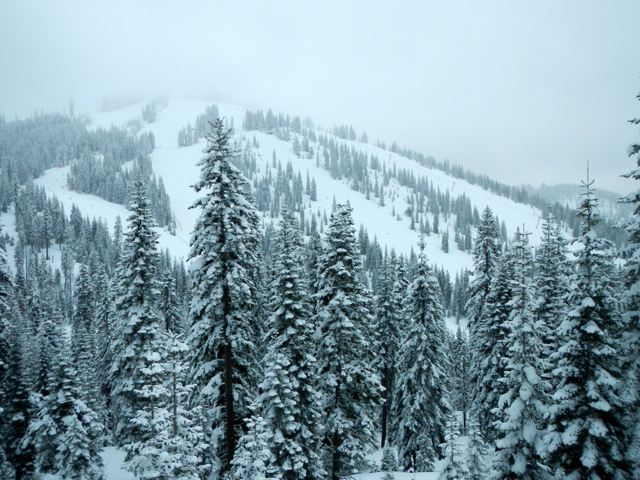
Fifty-five percent of the terrain is intermediate. Photo/Kathryn Reed

Fifty-five percent of the terrain is intermediate. Photo/Kathryn Reed

This is the second ski resort on the mountain. The first was known as Mt. Shasta Ski Bowl and was located at the end of Everitt Memorial Highway. It was open from 1959-78. Avalanches were a constant problem. The last year it was open an avalanche took out the main chairlift.

Most of the skiers who come here are from the Redding area. The resort doesn’t even market to Bay Area riders.

“This mountain is one of the best family mountains in the state,” Michael Smith, report spokesman, told Lake Tahoe News. “Because of the mix of skiing we have it caters to families much better.”

Looking at the resort from the parking lot it’s reminiscent of Homewood Mountain Resort where it doesn’t appear there is much terrain. Once on the mountain that myth is dispelled. It is also a bit like Sierra-at-Tahoe in that there aren’t many lifts. Again, once on the mountain one realizes the lifts are strategically located.

Shasta’s three chairlifts service 32 trails, 425 acres, with 1,435 vertical feet.

Earlier this month the resort hosted 30 high school teams that were competing in the California Nevada Interscholastic Ski and Snowboard Federation Championships.

Conditions were such that the lights for night skiing were on because visibility was sketchy. With the white stuff coming down, a thin layer of powder covered what had been groomed runs. It was light and fun to make fresh tracks even in mid-morning.

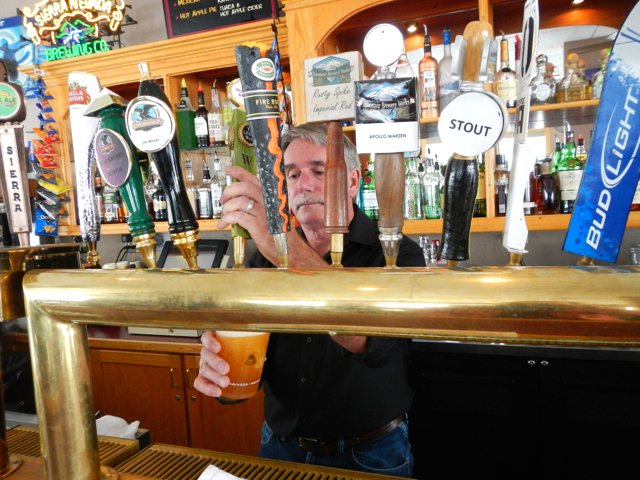
Mark the bartender pours one of the 13 beers that are on tap. Photo/Kathryn Reed

Mark the bartender pours one of the 13 beers that are on tap. Photo/Kathryn Reed

The lodge was full of people eating and drinking. The weather was too yucky to enjoy the deck, which was nearly doubled in size in 2013.

Thirteen beers are on tap – most from surrounding breweries. They are rotated, with the brewmaster sometimes on hand to share his expertise.

While there has been talk for 15 years of expanding the resort north into the Grey Butte area of the mountain, there is no publicized time line of when this might happen. Smith said with the resort not making money for three years, that type of capital investment isn’t in the works right now.

The price for skiers is reasonable — $39 for an adult mid-week ticket, $54 on Friday-Saturday-Sunday and holidays.


Husky takes overall honors at I-Did-A-Run

As part of North Lake Tahoe’s SnowFest 2016, the 12th annual I-Did-A-Run event took place on March 13 at Tahoe Donner Downhill Ski Area.

Dogs of all shapes and sizes pulled out all the stops to compete in this on-snow dog pull race with proceeds from raffle sales raising $1,671 for the Humane Society of Truckee-Tahoe. Dogs raced against the clock pulling covered wagon sleds over a snow-covered course. Prizes were awarded to the speediest finishers among four weight divisions.

In total, 38 dogs ranging in age from 5 months to 15 years old raced for the title:

·         Division 1 (0-25 pounds) winner: Raina, an American Cocker Spaniel, at 2.57 seconds, owner: Dean Eppley. Of interest, Raina was the second oldest dog that competed in this year’s event at approximately age 14.

·         Division 2 (26-50 pounds) winner: Sascha, a mixed breed adopted from the Humane Society, at 2.79 seconds, owner: Hannah Grey. Of interest, Sascha was the youngest race winner this year at age 1.

·         Division 3 (51-75 pounds) winner: Nikolai, a Siberian Husky, at 2.40 seconds, owner: Hannah Gray. Of interest, Nikolai was last year’s fastest dog and overall event winner.

·         Division 4 (76+ pounds) winner: Nellie, a Golden Retriever, at 3.11 seconds, owner: Melissa and PJ Madigan. Of interest, Nellie was one of three Golden Retrievers to race and the only winner for her breed.

The overall winner was the second consecutive year was Nikolai, owned by Hannah Grey of Dayton. In addition to being the fastest dog and overall winner for two years, Nikolai also competed as a puppy in 2014, taking first place in division 1.


Tahoe area climber to attempt Everest without oxygen

Benjamin Spillman, Reno Gazette-Journal

Even when he’s recalling a failed attempt to ski the Himalayan peak Makalu, Adrian Ballinger is quick with a joke or a smile.

But the mountaineer’s next big expedition is no laughing matter.

Ballinger, 40, of Olympic Valley plans to summit Mt. Everest without using supplemental oxygen.

For Ballinger the attempt is the culmination of two decades as a mountaineer and guide, including six previous Everest summits with oxygen.

Read the whole story


Feds giving Eldorado National Forest millions

The Eldorado National Forest has received $5.1 million in special supplemental funding this year to support efforts to reduce the threat of wildfire and the risk of insect and disease in the South Fork American River Watershed.

The 2016 supplemental funding will be used to accomplish work on five major multi-year, multi-phase projects:

  • Fire Adapted 50 Project – A series of fuel breaks using an all lands approach to treat fuel across multiple jurisdictions in the Highway 50 corridor for community protection, emergency access and egress. This year’s work will include reducing fuel on National Forest System lands to create a 300 foot buffer on the north side of Highway 50. It will also support work by partners in the Sly Park area.
  • Cleveland-Ice House Forest Health Project – Thinning of dense, overstocked plantations and neighboring natural stands which are at risk of loss to insect and disease and are highly susceptible to wildfire.
  • King Fire Restoration Project – This year’s work in the SOFAR watershed will focus on removal of fire killed trees in strategic fire management zones for the purpose of controlling future wildfires.
  • Wright’s Lake Recreation Area Fuels Reduction Project – Fuel reduction around developed areas and along roads to create safety corridors in an area that is heavily used for public recreation and includes 75 privately owned cabins.
  • Caples Ecological Restoration Project – Fire control lines will be completed in preparation for the use of prescribed fire in the Caples Creek drainage. This drainage has not had substantial wildland fire occurrence for more than a century which has decreased biodiversity and created a build-up of hazardous fuels.
  • The Pilliken Plantation Restoration Project, another major project in the watershed, will not require supplemental funding because it includes commercial timber sales that will generate revenue. This project also involves thinning dense stands which are at risk of loss to insect and disease and are highly susceptible to wildfire.


Time running out to train for Gunbarrel 25

The annual Gunbarrel 25 at Heavenly Mountain Resort is April 2.

The challenge to to take 25 laps on Heavenly’s famous mogul run. Competitors have from 10am to 4pm to try to finish.

Preregister by calling 530.542.5129 or emailing LKillebrew@vailresorts.com. Registration on the day of the event will be in the California Lodge from 7:30-9:30am.

The cost is $50 for pass holders and $115 for non-pass holders.