Fires create gaps in Pacific Crest Trail

By Associated Press

Vast wildfires have created lengthy gaps in Southern California sections of the famed Pacific Crest Trail, which hikers must bypass via shuttles or alternate routes to avoid dangerous conditions like unstable trees and loose rocks.

Long-distance backpackers must be shuttled by van around the closures or risk incurring $2,500 fines, the Riverside Press-Enterprise reported this week.

To get around a 15.5-mile gap caused by a wildfire last year in the San Bernardino National Forest, hikers are driven from the Whitewater Trail House in Cabazon to Onyx Summit on State Route 38, where the trail reopens.

About 14 miles of the trail approaching the mountain town of Idyllwild are closed three years after a blaze scorched more than 27,000 acres.

Each year, thousands trek sections of the 2,650-mile Pacific Crest Trail, which runs from Mexico to Canada.

Some of the adventurers — who often take on nicknames for their journeys — aren’t thrilled with the idea of getting into a van after retreating into the wilderness. Last week in Idyllwild, Bruce “Man in Black” Cornish of San Diego planned to research an alternate hiking route to bypass the closed section while waiting for friends.

At 59, he retired early from a job as an eighth-grade science teacher to hike the entire route after dreaming about the trip for 20 years.

“The philosophy of this trail is, ‘Hike your own hike’,” he told the newspaper. “If people want to hitch ahead, that’s cool. It’s just not for me.”

Danger in the unstable areas can come from falling branches dubbed “widow-makers,” dead giant trees with weak roots that can fall and crush hikers, the U.S. Forest Service said. Loose rocks, debris including rolling logs, flash floods, trailside stump holes and slippery ash can also pose a danger.

Crews are working to remove charred trees and fill in holes to make the trails passable again. While some hikers are impatient for the work to finish, others don’t mind catching an occasional ride.

“I know some other people who are what we call ‘purists’ — want to hike every inch of the trail,” said Robert “Bobcat” Donnellan, 38, of Asheville, N.C., sitting at a picnic table outside the Whitewater home where he was staying April 13. “I personally don’t care.”


Sizable bass reeled in at Lake Tahoe


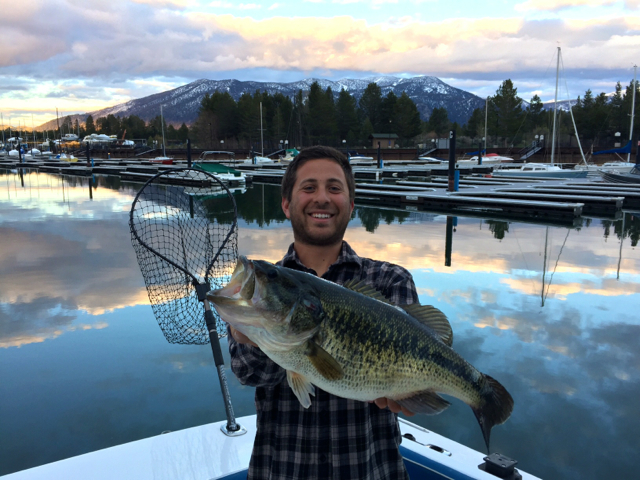
Andrew Lubrano of South Lake Tahoe with a 6 pound, 7 ounce bass caught April 29. Photo/Provided

Andrew Lubrano of South Lake Tahoe with a 6 pound, 7 ounce bass caught April 29. Photo/Provided

It took fishing captain Andrew Lubrano nearly 30 minutes to land a bass today in the Tahoe Keys.

It weighed 6 pounds, 7 ounces. The record for Lake Tahoe is just less than 8 pounds.

“I was just cleaning my boat and threw an extra piece of bait I had into the water,” the charter captain told Lake Tahoe News.

He let the fish back into the water to live another day.

Lubrano joked about all the efforts to eradicate the non-native fish from Tahoe clearly didn’t work.

The area Lubrano caught the fish in was right near where the oil spill occurred a couple weeks ago in the South Lake Tahoe canals.

— Lake Tahoe News staff report


OMG Fun Run registration open

OMG is part serious running, part casual walking and part crazy costume party.

The inaugural OMG (Old Meyers Grade) Fun Run will be May 22 from 10am-noon.

Register online for on of three categories – youth, costume-walking or competitive. Cost is $25 for adults and $10 for children under 12. Those who register before the race will receive an OMG T-shirt. Registration the day of the event is $30/$15; from 7:30-9:30am at the Grade.

Old Meyers Grade is located 0.1 miles up South Upper Truckee Road. The course gate-to-gate round trip is 2.6 miles

Prizes go to the first person to reach the top of the grade and for the most laps in each division. Participants who complete at least three laps will have their names posted online. There will be refreshments and music.

The OMG Fun Run is presented by the Meyers Community Foundation. Proceeds support and promote creative and sustainable projects, and community-enhancing events in Meyers.


Dog park a possibility in Truckee

A grass-roots effort is under way to bring a dog park to Truckee.

Tahoe Vista, Tahoe City and South Lake Tahoe have parks for canines.

People like the parks because it’s an opportunity for the animals to socialize, run without going on a long walk or hike, and it’s in a confined space.

Resident Nova Lance-Seghi is spearheading the idea, with the hopes Truckee-Donner Recreation & Park District will build the facility. Locations are being scouted and costs analyzed.

South Lake’s park opened in 2008 at a cost $35,000. The nearly 1 acre is in Bijou Community Park. It’s sectioned off for big and small dogs, with the big guys having a bit more space to run.

For those interested in a Truckee dog park, there is an online petition to generate support.

— Lake Tahoe News staff report


Residential burn permits available in EDC

Residential burn permits from CalFire’s Amador-El Dorado Unit will be required beginning May 1.

These permits are free, valid for three years from the date of issuance and allow for the burning of dry landscape vegetation (not household trash) that originates from the landowners property. Permits are available at most of the local staffed fire stations.

Use of burn barrels is no longer legal in Amador or El Dorado counties.
Quick tips about landscape debris burning:

  • Make sure pile is no larger than 4 feet by 4 feet
  • Scrape a 10-foot wide ring around pile down to bare dirt
  • Have a shovel and water supply (garden hose) close by
  • Make sure an adult is present at all times until pile is dead out
  • Be sure to call to ensure it is a permissive burn day.

For more info, call 530.621.5842.


Tahoe boat inspections keeping invasives out

By Kathryn Reed

STATELINE —  It’s working.

That was the message Dennis Zabaglo, Tahoe Regional Planning Agency’s aquatic resources program manager, delivered to the Governing Board on April 27 about the boat inspection program.

The program started eight years ago without everyone being on board. Since then, though, other lakes have started inspection programs, boaters have learned the importance of having a clean boat and invasive mussels have not reached Lake Tahoe.

In 2015, there were 6,800 local inspections, 2,300 decontaminations and 40 boats with invasives intercepted. These numbers are similar to 2014, but less than previous years. This is attributed to the low lake level keeping people away.

Zabaglo said the decrease in decontaminations is also attributable to boaters understanding the “clean, drain, dry” philosophy so invasives are not transported from one water body to another. Boats are the No. 1 way aquatic invasive species enter a lake.

Lake Tahoe is home to clams, weeds and fish that are invasive. To date, though, the more dangerous quagga and zebra mussels have been kept at bay. Last year investigators stopped one boat with an invasive mussel. In prior years about a dozen came through the inspection line. Most of those were from the Great Lakes area.

With Nevada officials implementing a screening of all boats leaving Lake Mead, that, too, is curtailing the spread of the mussels.

The mussels can ruin water supplies, filtration systems, the ecosystem, watercraft and potentially the economy.

TRPA is continuing to work with Truckee on inspections in waterways just outside the basin like Donner Lake.

Zabaglo said the five- and 10-year goals include creating more enhanced, permanent inspection facilities, which in turn would pay for themselves. Some could be like mini visitors centers. A grant is being applied for that would fund these.

The boat inspections resume May 1 from 8:30am-5:30pm.

They are located at:

• Meyers: The junction of highway 50 and 89, seven days.

• Spooner Summit: Junction of highways 50 and 28, seven days.

• Alpine Meadows: Highway 89, off Alpine Meadows Road north of Tahoe City, Thursday-Sunday.

• Truckee-Tahoe: Highway 267, off Truckee Airport Road, Thursday-Sunday, opens May 19.

Fees are staying the same. They have not changed since 2014. Boats only accessing Tahoe pay $30, while boats coming in and out of Tahoe pay based on the length of the vessel, with the most common price being $86.

Inspections also are necessary for Fallen Leaf and Echo lakes users. Boaters need to get inspected and decontaminated prior to going to those ramps, with Meyers being the closest loction. Neither of those lakes has any invasives.

The inspection program costs about $1.5 million a year. Half of that comes from the inspection fees, the other half is divided equally between California and Nevada. This is the first year the states have funded the inspections. Prior to that more than half came from the feds via the Southern Nevada Public Lands Management Act.

One board member asked if it’s possible for boaters to sneak in when inspectors are not on site.

“Boaters are compliant. They understand,” Zabaglo said.

TRPA also did a “secret shopper” scenario last year with an outside agency to test inspectors. They all passed. That type of oversight will continue.


Harbaugh on board for celeb golf tourney

Ex-San Francisco 49er coach Jim Harbaugh is returning to the American Century Championship in July.

The Michigan football coach last played in the celebrity golf tournament at Edgewood Tahoe in 1998 when he was a player in the NFL. Harbaugh also played in 1997.

The 27th annual tournament is July 19-24.

Returning notables include Charles Barkley, Justin Timberlake, Aaron Rodgers, John Elway, Jerry Rice, Dan Quayle and Steve Young.

Detroit Lions wide receiver Golden Tate is a newcomer to the list that usually includes about 80 stars from the world of sports, music, and Hollywood.

While Steve Kerr tries to lead the Warriors to another NBA championship, the coach has committed to play in the ACC. No word yet if his star player Steph Curry will join him. Curry played in the Stateline tournament two years ago, but skipped last year as his wife was expecting. He also has a knee injury and playoffs to contend with now. In 2014, he tied for 13th.

— Lake Tahoe News staff report


Upper Truckee River recreation to be impacted

Source: USFS

                                                  Source: USFS

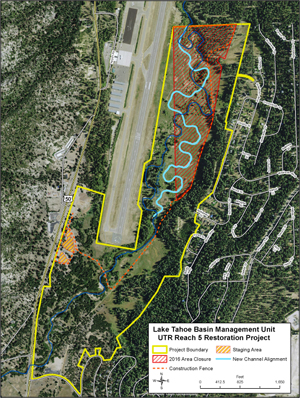
Start paddling now because a popular section of the Upper Truckee River is going to be off limits for most of the summer.

The U.S. Forest Service and California Tahoe Conservancy will resume work June 13 on what is now the fourth year of creating a new channel for the river. The river and meadow will not be open to the public.

The river in the work area will closed from June 27-Oct. 15. This will start at Elks Club and go past Lake Tahoe Airport.

The goal of the project is to have the river meander how it did prior to being straightened years ago when ranching was prevalent in the area. The eroding banks carry sediment to Lake Tahoe, thus making is less clear.

Part of the work includes building a bridge and relocating native mussels. The bridge will be built starting June 13. This will impact those re-creating on the water, too. They will have to portage their vessel until the ban takes effect two weeks later.

Next season kayakers and the like will be on the new channel.

— Lake Tahoe News staff report


Free tennis lessons available for kids at ZCTC

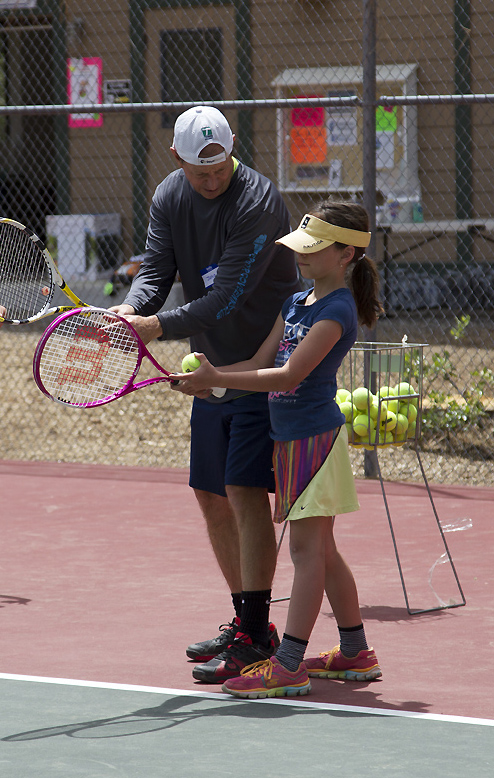
John Wlcek teaches Luna Remmel how to serve. Photo/Provided

John Wlcek teaches Luna Remmel how to serve. Photo/Provided

Youngsters in grades K-8 will have the opportunity to learn the fundamentals of tennis for free in May from a professional at Zephyr Cove Tennis Club.

Deanne Larsell, USPTA certified instructor, will lead the after school sessions with the assistance of players from the club. For those who have played before, more advanced instruction will be provided.

Each lesson is open to students throughout the Lake Tahoe Basin as well as the Carson Valley.

Dates are:

·      May 23, 3:20-4:05pm – grades K-2

·      May 24, 3:20-4:20pm – grades 3-5

·      May 25, 3:20-4:20pm – grades 6-8.

The three-day event is sponsored by ZCTC in conjunction with Douglas County Parks and Recreation Department.

Space is limited and preregistration is required by calling Kahle Community Center at 775.586.7271 or Douglas County Community Services at 775.782.9828.

A limited number of rackets will be available. Come dressed to play – which means athletic wear and non-marking shoes. Be sure to bring water and wear sunscreen. Arrive 15 minutes before the start time.

Zephyr Cove Tennis Club is on Warrior Way off Highway 50 in Zephyr Cove.


Grandeur of Denali doesn’t disappoint

Publisher’s note: This is one in a series of stories about the National Park Service, which is celebrating its 100th anniversary in 2016.

The road to Denali. Photo/Jacob W. Frank/NPS

The road to Denali leads to a world of outdoor wonder. Photo/Jacob W. Frank/NPS

By Kim Wyatt

DENALI NATIONAL PARK & PRESERVE – After almost four hours on the bus, the driver pulled to the side of the road and opened the door.

“Little Stony Creek.”

We heaved our backpacks over our shoulders and stepped off. The bus receded in the distance. We stood in a massive valley, surrounded by broad-shouldered peaks, rolling tundra and absolute silence.

All my problems rolled away with the bus. Across the valley floor, I saw two boulders tumbling down a green slope. I pulled out my binoculars: They weren’t boulders; they were baby grizzly bears, playing. In one swift motion mama bear stood, growing twice in size, nose in air.

S hit,” I said. “We’ve got to go.”

My hiking companion and I headed up a creek bed and were soon in a small canyon, out of any range I hoped the adult grizzly would find threatening. The hike itself was typical of my experience in Alaska: periods of tundra and rocky streambeds punctuated by river crossings and something I rarely encountered in Tahoe, fear. Of animals, wet feet, the elements. Even in mid-summer, the weather was ever-changing—it looked as if the turbulent sky might rupture any minute. And around seemingly every corner were enormous piles of what looked like regurgitated berry pie: grizzly scat. So we’d sing louder to keep them away, maybe every song I remember from the ’70s. By the time we reached camp I had just exhausted my Tony Orlando and Dawn repertoire.

I rarely thought about dying when backpacking in Yosemite or Desolation Wilderness. But I did in Alaska.

It’s the scope of Denali National Park & Preserve that gets you. At 6 million acres, it’s the third largest national park in the U.S. (the top two are also in Alaska). It contains the highest portion of the magnificent Alaska Range, glaciers and massive rivers spilling into grand valleys. Conservationist Charles Sheldon and dog musher Harry Karstens first wintered in Denali in 1907. Deeply moved by their experience, they lobbied Congress to establish Denali as a national park to conserve wildlife. In 1917, Mount McKinley National Park was created; the park name was changed in 1980 to include the native Athabaskan word “Denali,” meaning “the high one.” I wanted my whole life to see this massive peak, but clouds had obscured previous attempts. At 20,310 feet, Denali creates its own weather, and doesn’t show itself easily.
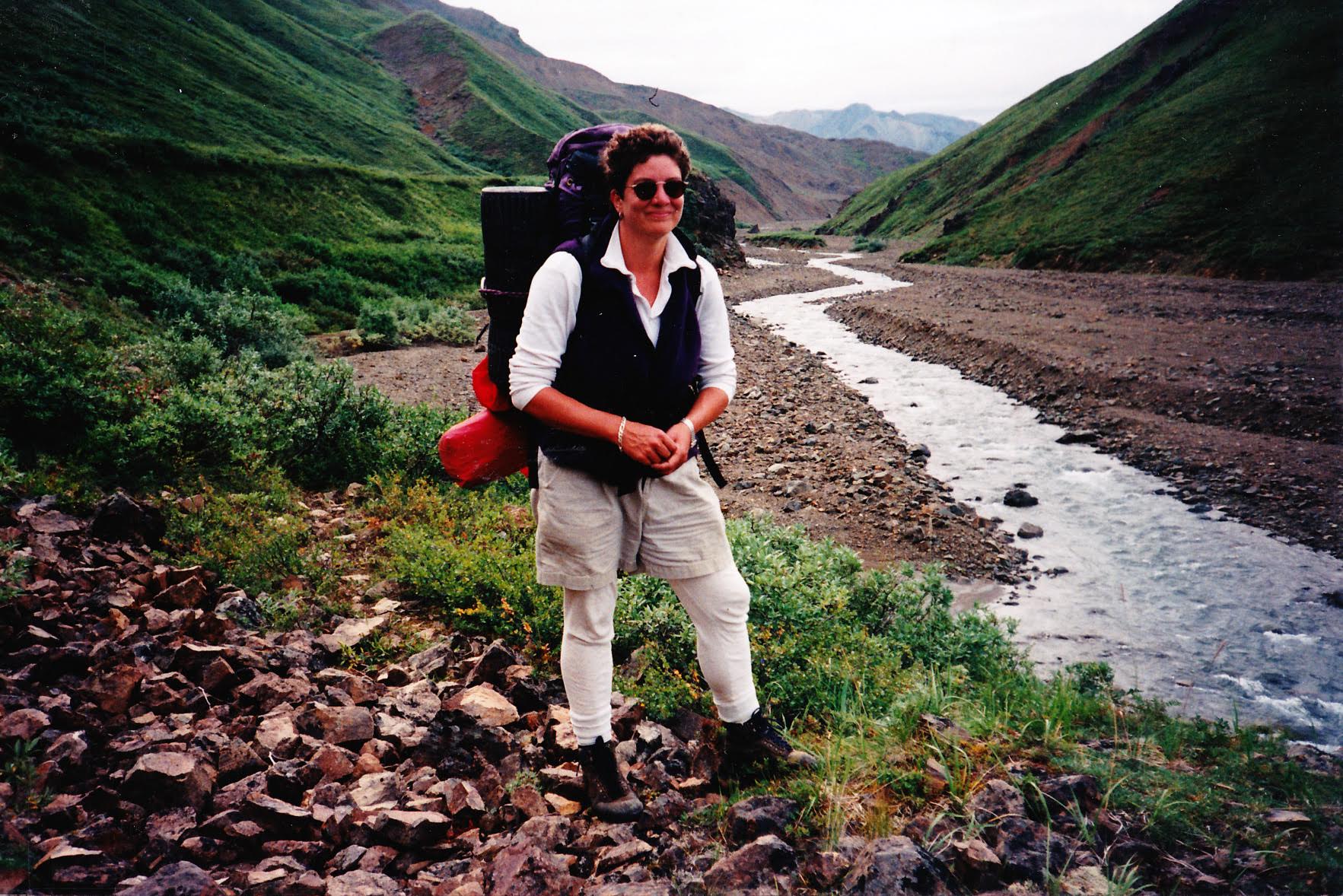
Kim Wyatt backpacks through the wilderness of Denali National Park & Preserve. Photo/Provided

Kim Wyatt backpacks through the wilderness of Denali National Park & Preserve. Photo/Provided

Except for a lottery held twice a year, cars are not allowed on the road inside the park. If you plan to backpack, before being issued a permit you must watch a video on Denali’s humbling weather, the Golden Triangle—your tent, cooking area and bear canister must be at least 100 yards from each other—how to cross a wide, braided river and, finally, advice on bear, wolf and moose encounters. (For example, never run from a grizzly or a wolf. But if charged by a moose in open terrain, run in a zigzag pattern. It’s a lot to remember, how to run/not run.)

Then you can apply for your permit. Denali National Park & Preserve is made up of 87 units, and you have to choose your unit before you apply. There are quotas and limits to the number of people allowed in each one to avoid the kind of scene you have at popular trails in other parks. And then you take a converted school bus to the trailhead. When you’re done hiking, you come out and wait for the bus.

Only four people were allowed in our unit. We never saw the other two.

You must apply for your permit in person. Because Denali is not exactly on the beaten path–it’s about a five-hour drive from Anchorage, where I lived—you should be ready to roll. We’d been warned to have three or four options, as the most popular hikes might already be at their limit. All of our choices were booked, so we took a ranger’s recommendation of Stony Creek, one of her favorites, a hike with varied scenery, and if we were lucky, a superlative view of Denali on a rare clear day. (Weather is something else you need to worry about in Denali. Cloud cover necessitates knowing how to use a map and compass.)

I’d lived and worked in Yosemite for a decade before I moved to Alaska and I felt confident about my trail skills. The problem—or the beauty—in Denali is once you get off the bus, there are no trails. There are no signs. The rivers are wider than highways and there are grizzly bears and wolves and moose that you should run/not run from. And walking on taiga and tundra, rather than granite, is not as easy as it sounds. Alpine tundra is low and scrubby, but brushy tundra is soft: two steps forward, one step back.

After dinner, the clouds hunkered down and we lost any view we might have had, so we retreated to the tent. A few hours later, I woke to the sound of footsteps in front of the tent. My heart seized: Would I stupidly die in grizzly country? But the steps were light, and multiplied until they sounded like castanets. Rain on rocks, perhaps. I peered out the tent’s avalanche chute to see caribou, one after another, walking single file past the tent in twilight. It turned out that we were sleeping on a caribou migration route. I opened the tent door and watched them pass until falling back to sleep.

In the morning, the tent glowed bright yellow. The sun was out! I jumped from my bag and hopped outside and there was Denali in all its glory. My jaw dropped.

An ecstatic current ran through me. While the world around me awoke, the massif held my gaze—a form of communication beyond the corporeal plane. The intimacies of the park were more captivating than its scope: Up close with grizzlies and caribou. Birds and berries. Just me and a grand slam view of Denali in full sun. Places like this change you; they settle your soul.

Why is it important to preserve these wild spaces? Although conservation of species and habitat is crucial, humans need these wild spaces, too. We need the places where we can escape from the pressures of modern life and reconnect to our best selves. Writer Wallace Stegner had it right when he said, “National parks are the best idea we ever had. Absolutely American, absolutely democratic, they reflect us at our best rather than our worst.”

A few years ago, a close friend with cancer asked me to take her to Yosemite National Park before she died. Walking near the Ahwahnee Meadow, she said incredulously, “This belongs to all of us.” I’d never thought of it that way, but, yes, it does. And the more time we spend in our parks, the more likely we are to care for them. Saving our wild landscapes is saving ourselves.

Kim Wyatt is the publisher of the independent press Bona Fide Books, which published “Permanent Vacation: Twenty Writers on Work and Life in Our National Parks”. She worked in Yosemite National Park for 13 years.

Note: Information on backpacking in Denali National Park & Preserve may be found here.